Apache Storm
Apache Storm is a free, open-source system for processing unbounded data streams in real time.
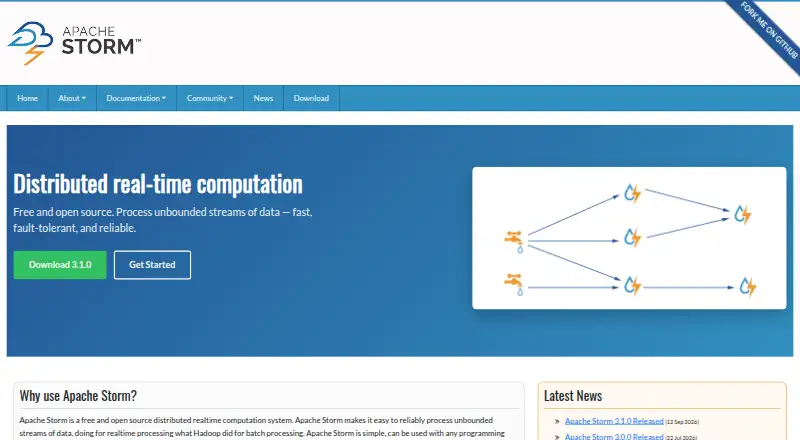
What Apache Storm is
Apache Storm is a free, open-source system for processing unbounded data streams in real time. It supports realtime analytics, online machine learning, continuous computation, distributed RPC, and ETL. Storm builds multi-stage stream computations from spouts, bolts, and topologies, and the project describes it as scalable and fault-tolerant with guaranteed data processing. The project reports a benchmark above one million tuples per second per node. Integrations include Apache Kafka, HDFS, JDBC databases, JMS, and Redis. Developers can use local mode for in-process development or submit topologies to a remote cluster. Storm supports stateful processing and lists JavaScript, Python, Ruby, and C# among supported languages. Security options include pluggable Kerberos/SASL authentication and SimpleACLAuthorizer authorization, both disabled by default. TLS is available for Thrift RPC and worker-to-worker messaging using mutual TLS. The current release is 3.1.0, available in source and binary distributions, through Maven Central, and as an official Docker image. Release files have OpenPGP signatures and SHA-512 checksums.
Good
- Free and open source under Apache License 2.0
- Integrates with Kafka, HDFS, JDBC, JMS, and Redis
- Offers local development and remote cluster modes
- Supports stateful processing
Watch out
- Authentication and authorization are disabled by default
- Security configuration may require enabling authentication and authorization
Who it suits
Storm suits developers building real-time stream-processing workloads such as analytics, ETL, or online machine learning. Its local and remote modes accommodate in-process development and cluster deployments.
Verdict
Storm provides a stream-processing model with integrations, development modes, and security options. Teams should note that its authentication and authorization features are disabled by default.
Plans and prices
From Apache Storm's own pricing page, checked 1 Oct 2026.
| Plan | Price | What it gives you |
|---|---|---|
| Apache Storm | Free | Free and open source · Apache License 2.0 |
The facts
Each one read from Apache Storm's own pages, with the date it was checked.
What it does
- Current release
- The current Apache Storm release is 3.1.0, with source and binary distributions available.checked 1 Oct 2026
- Deployment
- Storm provides local mode for in-process development and remote mode for submitting topologies to a cluster.checked 1 Oct 2026
- Distribution
- Apache Storm is available through Maven Central and as an official Docker image on Docker Hub.checked 1 Oct 2026
- Encryption
- Storm supports TLS for Thrift RPC and Netty worker-to-worker messaging through mutual TLS.checked 1 Oct 2026
- Integrations
- Out-of-the-box integrations include Apache Kafka, HDFS, JDBC databases, JMS, and Redis.checked 1 Oct 2026
- License
- Apache Storm is licensed under the Apache License, Version 2.0.checked 1 Oct 2026
- Performance
- The project says a benchmark processed over one million tuples per second per node.checked 1 Oct 2026
- Programming model
- Storm uses spouts, bolts, and topologies to build arbitrarily complex multi-stage stream computations.checked 1 Oct 2026
- Purpose
- Apache Storm is a distributed realtime computation system for reliably processing unbounded data streams.checked 1 Oct 2026
- Release integrity
- Storm publishes OpenPGP signatures and SHA-512 checksums for every release file.checked 1 Oct 2026
- Reliability
- Storm is designed to be scalable, fault-tolerant, and to guarantee data processing.checked 1 Oct 2026
- Security
- Storm supports pluggable Kerberos/SASL authentication and SimpleACLAuthorizer authorization, both disabled by default.checked 1 Oct 2026
- Support
- Users can get help through the user mailing list at [email protected].checked 1 Oct 2026
- Use cases
- Storm supports realtime analytics, online machine learning, continuous computation, distributed RPC, and ETL.checked 1 Oct 2026
The full review of Apache Storm
Overview
Apache Storm is a distributed system for processing data streams that continue without a defined endpoint. It is built for ongoing computation across a cluster, with an emphasis on scaling, fault tolerance and reliable processing. Supported workloads include real-time analytics, online machine learning, continuous computation, distributed RPC and ETL.
Storm organizes applications as topologies made from spouts and bolts. Spouts supply streams of data; bolts process them. Together, these components can form arbitrarily complex, multi-stage computations. The project reports a benchmark exceeding one million tuples per second per node, though that figure is a project benchmark rather than a general performance guarantee.
The current release is 3.1.0, available in source and binary distributions. Storm is also available through Maven Central and as an official Docker image. It is licensed under Apache License, Version 2.0. For related categories, see Stream Processing Software and Streaming Analytics Software.
Key features
Composable stream processing
Storm's spout-and-bolt model lets developers arrange stream sources and processing steps into multi-stage topologies. This supports complex computations that need to run continuously over incoming data.
Connectors and deployment modes
Out-of-the-box integrations cover Apache Kafka, HDFS, JDBC databases, JMS and Redis. Storm provides a local mode for in-process development and a remote mode for submitting topologies to a cluster.
Reliability and security controls
Storm is designed to scale, tolerate faults and guarantee data processing. Its security options include pluggable Kerberos/SASL authentication and SimpleACLAuthorizer authorization, both disabled by default. TLS is supported for Thrift RPC and for messaging between Netty workers through mutual TLS. Release files include OpenPGP signatures and SHA-512 checksums.
Storm supports stateful processing. The listed supported languages are JavaScript, Python, Ruby and C#. Users seeking assistance can contact the user mailing list at [email protected].
Pricing
Apache Storm is free and open source under the Apache License, Version 2.0. The listed plan is free; the pricing model is free, with a free plan available.
Platforms
Storm is listed for API, Linux, macOS, self-hosted, web and Windows environments. Its deployment model is self-hosted, so teams operate their own installation. Distribution options include source and binary releases, Maven Central and the official Docker image.
Who it's for
Apache Storm is suited to teams building distributed applications that must process unbounded streams continuously. Its use cases span analytics, online machine learning, continuous computation, distributed RPC and ETL. The topology model is relevant when a workload needs multiple connected processing stages, while local and remote modes support in-process development and cluster deployment.
Its self-hosted deployment model and security settings deserve consideration: authentication and authorization are disabled by default, so operators need to account for configuring access controls. The benchmark figure can help frame the project's stated throughput, but actual performance depends on a particular workload and deployment.
Pros and cons
- Pros: Supports a broad range of continuous processing use cases and multi-stage topologies.
- Pros: Includes integrations for Kafka, HDFS, JDBC databases, JMS and Redis, plus local and remote deployment modes.
- Pros: Designed for fault tolerance and reliable processing, with TLS options and signed, checksummed releases.
- Cons: Self-hosted deployment means the operating team is responsible for running the system.
- Cons: Authentication and authorization are disabled by default and need configuration when required.
Alternatives
For other options, compare Feldera, AFL++, Apache Beam, Kafka Streams, RisingWave, Timeplus, Apache Spark and Confluent Cloud.
Verdict
Apache Storm is a free, self-hosted choice for teams that need continuous, distributed stream computation with composable topologies and established integrations. Its core strengths are the breadth of workloads it supports, its reliability goals and its deployment flexibility. The trade-off is operational responsibility: teams must run it themselves and configure security controls that are off by default.
Getting started
- Visit the Apache Storm website
- Choose a source or binary distribution, Maven Central, or the official Docker image
- Use local mode for in-process development or remote mode to submit topologies to a cluster
Questions
How much does Apache Storm cost?
The listed plan is free at no cost, and Storm is open source under Apache License 2.0.
What platforms does Storm support?
Its listed platforms are API, Linux, macOS, self-hosted, web, and Windows.
Which languages are supported?
The listed languages are JavaScript, Python, Ruby, and C#.
What integrations are included?
Out-of-the-box integrations include Apache Kafka, HDFS, JDBC databases, JMS, and Redis.
How can developers deploy Storm?
Storm offers local mode for in-process development and remote mode for submitting topologies to a cluster. It is self-hosted.
What security options does it provide?
It supports pluggable Kerberos/SASL authentication and SimpleACLAuthorizer authorization, both disabled by default, plus TLS for Thrift RPC and mutual TLS for worker-to-worker messaging.
Alternatives to Apache Storm
- 1

Apache Beam
Free planOpen sourceWebAPILinuxmacOS7.7Free plan - 2
Apache Druid
Free planWebAPILinuxmacOS7.2Free plan - 3

Confluent Cloud
Free planWebAPILinux7.1From $385 a month - 4
Timeplus
Free planWebAPILinuxmacOS7.1From $199 a month - 5

Materialize
Free planWebAPILinuxSelf-hosted7.0From $1.50 a year - 6

RisingWave
WebAPILinuxmacOS6.7$0.23 usage-based