
RisingWave
RisingWave is a distributed SQL streaming platform that ingests, transforms, and serves real-time data.
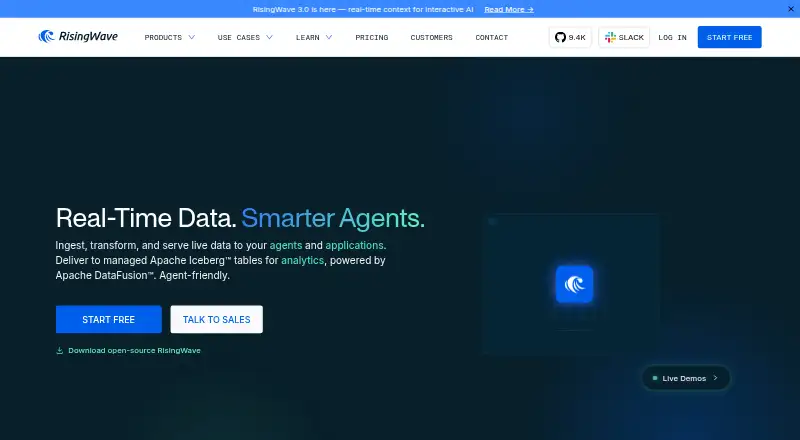
What RisingWave is
RisingWave is a distributed SQL streaming platform that ingests, transforms, and serves real-time data. Its SQL interface is wire-compatible with PostgreSQL, allowing PostgreSQL clients, drivers, and tools to connect. Materialized views update incrementally as events arrive. Barrier-based checkpointing and consistent snapshots support exactly-once processing, while data and connector offsets are persisted in S3-compatible object storage. RisingWave lists 31+ native connectors, including Kafka, PostgreSQL, MySQL, Iceberg, Snowflake, BigQuery, S3, Redis, and Elasticsearch. Self-managed deployments are Apache 2.0 open source with no feature gates, license fees, or usage restrictions, and support Docker, Kubernetes, cloud VMs, and on-premises servers. Hosted Basic is pay-as-you-go at $0.23 a month, limited to 64 cores and available in select regions; a free plan and 7-day trial are also listed. Platforms include API, Linux, macOS, self-hosted, and web. Basic includes standard support; premium 24x7 support is available as an option on Pro.
Good
- PostgreSQL-compatible SQL interface.
- Exactly-once processing with checkpointing and consistent snapshots.
- 31+ native connectors are listed.
- Self-managed edition is Apache 2.0 open source.
Watch out
- Basic is limited to 64 cores.
- Basic availability is limited to select regions.
- Local playground stops after 30 minutes of inactivity.
- Pro 24x7 support is available for purchase.
Who it suits
RisingWave suits teams building real-time data pipelines with SQL and PostgreSQL-compatible tools. It offers hosted and self-managed deployment paths, with self-managed deployments supporting Docker, Kubernetes, cloud VMs, and on-premises servers.
Verdict
RisingWave combines streaming SQL, incremental materialized views, and multiple deployment options. Check the hosted Basic limits and support terms against your deployment needs.
Plans and prices
From RisingWave's own pricing page, checked 1 Oct 2026.
| Plan | Price | What it gives you |
|---|---|---|
| Basic | $0.23 a month | Fully hosted on AWS, GCP or Azure · up to 64 cores · standard support · Pay-as-you-go |
| Pro | Priced on request | Fully hosted or BYOC · no core limits · premium features · premium 24x7 support available for purchase · Pay-as-you-go or annual contract |
| Self-managed | Priced on request | On-premises or Kubernetes · no core limits · premium features · premium support and SLA · Annual contract |
The facts
Each one read from RisingWave's own pages, with the date it was checked.
What it does
- Basic limit
- The Basic plan is fully hosted, limited to 64 cores, and available in select regions.checked 1 Oct 2026
- Connectors
- RisingWave provides 31+ native connectors, including Kafka, PostgreSQL, MySQL, Iceberg, Snowflake, BigQuery, S3, Redis, and Elasticsearch.checked 1 Oct 2026
- Consistency
- RisingWave guarantees exactly-once processing with barrier-based checkpointing and consistent snapshots.checked 1 Oct 2026
- dbt integration
- The dbt-risingwave adapter provides a materialized_view materialization for continuously updated streaming transformations.checked 1 Oct 2026
- Deployment
- Self-managed deployments support Docker, Kubernetes with Helm charts, cloud VMs, and on-premises bare-metal servers.checked 1 Oct 2026
- Local playground
- The single-node playground runs in memory and automatically stops after 30 minutes of inactivity.checked 1 Oct 2026
- Materialized views
- Materialized views are automatically refreshed and incrementally computed whenever new events arrive.checked 1 Oct 2026
- Open source
- Self-managed RisingWave is Apache 2.0 open source with no feature gates, license fees, or usage restrictions.checked 1 Oct 2026
- Persistence
- RisingWave persists data in S3-compatible object storage and checkpoints connector offsets for durability and exactly-once delivery.checked 1 Oct 2026
- Premium capabilities
- Premium capabilities include SQL Server CDC, Snowflake and BigQuery sinks, time travel queries, automatic schema evolution, SSO, LDAP governance, and OTEL integration.checked 1 Oct 2026
- Product
- RisingWave is a distributed SQL streaming platform that ingests, transforms, and serves real-time data.checked 1 Oct 2026
- Security
- RisingWave security guidance covers TLS/SSL in transit, S3 encryption at rest, certificate or password authentication, role-based grants, and SQL-based data masking.checked 1 Oct 2026
- SQL interface
- RisingWave is wire-compatible with PostgreSQL and works with PostgreSQL clients, drivers, and tools.checked 1 Oct 2026
- Support
- RisingWave offers standard support on Basic, premium 24x7 support as an option on Pro, and premium support with SLA and quarterly success reviews for self-managed deployments.checked 1 Oct 2026
The company
- Founded
- 2021checked 28 Sep 2026
- Headquarters
- San Francisco, California, United Stateschecked 28 Sep 2026
The full review of RisingWave
Overview
RisingWave is a SQL-based platform for processing and serving streaming data, best suited to teams that need continuously updated results from live event streams. Its PostgreSQL-compatible interface and choice of hosted or self-managed deployment make it a flexible option, though hosted Basic has a 64-core ceiling and premium capabilities sit on higher-tier plans.
Key features
SQL and incremental views
RisingWave works with PostgreSQL clients, drivers, and tools through its wire-compatible SQL interface, a practical fit for teams already using that ecosystem. Materialized views refresh incrementally as new events arrive, and the dbt-risingwave adapter supports continuously updated transformations through its materialized_view materialization.
Delivery, persistence, and connectors
Barrier-based checkpointing and consistent snapshots underpin its exactly-once processing guarantee. Data is persisted in S3-compatible object storage, with connector offsets checkpointed for durability and exactly-once delivery. The 31+ native connectors include Kafka, PostgreSQL, MySQL, Iceberg, Snowflake, BigQuery, S3, Redis, and Elasticsearch, giving teams several common sources and destinations without limiting the platform to Kafka alone.
Premium capabilities and security
Premium capabilities include SQL Server CDC, Snowflake and BigQuery sinks, time travel queries, automatic schema evolution, SSO, LDAP governance, and OTEL integration. Security guidance covers TLS/SSL in transit, S3 encryption at rest, certificate or password authentication, role-based grants, and SQL-based data masking. These controls and integrations make premium tiers more relevant to organizations with governance or operational requirements than to a small prototype.
Pricing
RisingWave has a free plan and a 7-day trial. Basic costs $0.23 a month on pay-as-you-go billing. It is fully hosted on AWS, GCP, or Azure, includes up to 64 cores and standard support, and is available only in select regions. That makes it the straightforward hosted entry point, but the core cap and regional availability may rule it out for larger or geographically constrained deployments.
Pro has custom pricing and can be billed pay-as-you-go or by annual contract. It supports fully hosted or BYOC deployment, has no core limits, and includes premium features; premium 24x7 support is available for purchase. It suits teams needing greater capacity or premium capabilities, but support uplift is an additional decision rather than an automatic inclusion.
Self-managed pricing is custom pricing under an annual contract. The plan supports on-premises or Kubernetes deployments, has no core limits, and includes premium features plus premium support and an SLA. It is aimed at organizations that need deployment control and service commitments, with the tradeoff of operating their own installation.
Local playground
The single-node playground runs in memory and stops automatically after 30 minutes of inactivity. It is useful for brief evaluation, not a persistent service or production deployment.
Platforms
RisingWave supports API access, Linux, macOS, web access, and self-hosted deployment. Self-managed installations can run with Docker, Kubernetes using Helm charts, cloud VMs, or on-premises bare-metal servers. Hosted Basic runs on AWS, GCP, or Azure; Pro also offers BYOC. Its hybrid deployment model gives infrastructure teams options, while the local in-memory playground remains intentionally temporary.
Who it's for
RisingWave fits data and application teams building streaming pipelines or services that need fresh queryable results from incoming events. PostgreSQL compatibility can ease client integration, while incremental views, dbt support, and connectors suit SQL-oriented transformation workflows. Teams needing unlimited cores, premium integrations, governance features, or an SLA should examine Pro or self-managed deployment. It is less suitable when a small, persistent local instance is the goal, since the playground stops after inactivity.
Pros and cons
- Pros: PostgreSQL wire compatibility lets existing PostgreSQL clients and tooling connect.
- Pros: Incrementally refreshed materialized views and dbt integration support continuously updated SQL transformations.
- Pros: Exactly-once processing, durable object-storage persistence, and checkpointed offsets address consistency and recovery needs.
- Pros: Hosted, BYOC, and self-managed options span cloud and on-premises deployment.
- Cons: Basic is capped at 64 cores and limited to select regions.
- Cons: Pro and self-managed use custom pricing, making cost comparison less immediate than Basic.
- Cons: The playground is in-memory and stops after 30 minutes without activity, so it cannot serve as an always-on local environment.
Alternatives
Aiven for Apache Kafka is worth considering when a freemium Kafka option with a stated free-tier throughput, retention, and topic limits better fits the need.
Apache Pulsar is a free, open-source alternative for readers who prefer a community-backed project and need its broader listed platform support, including Windows.
Confluent Cloud is another freemium choice for teams looking for a managed Kafka service with autoscaling resources and more than 80 fully managed connectors.
Redpanda is an alternative for teams seeking a Kafka API with serverless or bring-your-own-cloud deployment options.
Lightstreamer is a freemium alternative with support across web, desktop, and mobile platforms.
DataStax Astra Streaming offers a freemium option for readers considering usage-based paid plans.
Pravega is a free alternative for Linux deployments.
Solace PubSub+ Event Broker is another freemium option.
Browse more options in Event Streaming Platforms, Stream Processing Software, and Streaming Analytics Software.
Verdict
Choose RisingWave if your team wants SQL-driven streaming transformations and incrementally maintained views, with PostgreSQL-compatible clients and a deployment model that can range from hosted service to self-managed infrastructure. Its strongest case is combining those capabilities with exactly-once processing and broad connectors. Look elsewhere if you need a clearly bounded low-cost tier beyond Basic, a Basic region or capacity it does not offer, or a persistent local playground.
Alternatives to RisingWave
- 1

Apache Beam
Free planOpen sourceWebAPILinuxmacOS7.7Free plan - 2
Apache Druid
Free planWebAPILinuxmacOS7.2Free plan - 3

Confluent Cloud
Free planWebAPILinux7.1From $385 a month - 4
Timeplus
Free planWebAPILinuxmacOS7.1From $199 a month - 5

Materialize
Free planWebAPILinuxSelf-hosted7.0From $1.50 a year - 6

Tinybird Cloud
Free planWebAPI6.7From $49 a month