
Apache Pulsar
Apache Pulsar is an open-source distributed messaging and streaming platform built for cloud use.
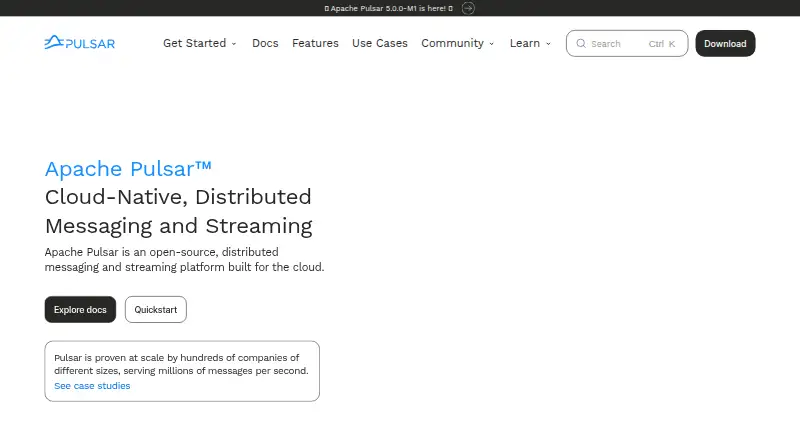
What Apache Pulsar is
Apache Pulsar is an open-source distributed messaging and streaming platform built for cloud use. It supports message consumption with less than 10 ms latency and up to one million unique topics in a cluster. Configurable replication across geographic regions and automatic client failover to healthy clusters support multi-region deployments.
Tenants and policies provide controls over data and actions, and can isolate brokers to protect against noisy-neighbor effects. Maintained client libraries are available for Java, Go, Python, C++, Node.js, and C#. Built-in connectors import and export data for systems including Kafka, RabbitMQ, MySQL, PostgreSQL, MongoDB, Cassandra, and Elasticsearch. Pulsar Functions process messages using user-defined logic in Java, Python, or Go.
Tiered storage can move data from BookKeeper to blob storage such as S3 for unlimited retention. Pulsar can run in Docker or Kubernetes, and a Helm chart is available for Kubernetes deployment. Encryption, pluggable authentication, and authorization are available but are not enabled by default. The 5.0.0-M2 milestone is intended for early testing and feedback, not production use.
Good
- Supports up to one million unique topics per cluster.
- Offers configurable geographic replication and automatic failover.
- Provides maintained clients in six listed languages.
- Tiered storage supports unlimited retention in blob storage.
Watch out
- Security controls are not enabled by default.
- The 5.0.0-M2 milestone is not for production use.
Who it suits
Pulsar suits teams building distributed messaging or streaming systems that need geographic replication, multiple client languages, or connectors to other data systems. Its deployment options include Docker and Kubernetes.
Verdict
Pulsar offers messaging, streaming, processing, and storage features with several deployment choices. Enable and configure its security controls, and do not use the 5.0.0-M2 milestone for production.
Plans and prices
From Apache Pulsar's own pricing page, checked 29 Sep 2026.
| Plan | Price | What it gives you |
|---|---|---|
| Apache Pulsar | Free | Open-source distributed messaging and streaming platform · Apache License 2.0 |
The facts
Each one read from Apache Pulsar's own pages, with the date it was checked.
What it does
- Clients
- Officially maintained client libraries are available for Java, Go, Python, C++, Node.js, and C#.checked 29 Sep 2026
- Deployment
- Pulsar can run in Docker or Kubernetes, and the project offers a Helm chart for Kubernetes deployment.checked 29 Sep 2026
- Geo-replication
- Pulsar supports configurable replication across geographic regions and automatic client failover to healthy clusters.checked 29 Sep 2026
- Integrations
- Built-in connectors import and export data for systems including Kafka, RabbitMQ, MySQL, PostgreSQL, MongoDB, Cassandra, and Elasticsearch.checked 29 Sep 2026
- Latency and scale
- Pulsar supports message consumption with less than 10 ms latency and up to one million unique topics in a single cluster.checked 29 Sep 2026
- Notable release limit
- The 5.0.0-M2 milestone is intended for early testing and feedback and is not meant for production use.checked 29 Sep 2026
- Release integrity
- Pulsar release files have OpenPGP signatures and SHA-512 checksums for integrity verification.checked 29 Sep 2026
- Security controls
- Pulsar provides encryption, pluggable authentication, and authorization controls, but these are not enabled by default.checked 29 Sep 2026
- Serverless processing
- Pulsar Functions process messages using user-defined logic and support Java, Python, and Go.checked 29 Sep 2026
- Storage and retention
- Tiered storage can offload data from BookKeeper to blob storage such as S3 for unlimited retention.checked 29 Sep 2026
- Tenancy and access
- Tenants and policies let organizations control access to data and actions, and isolate brokers for noisy-neighbor protection.checked 29 Sep 2026
- What it does
- Apache Pulsar is an open-source, distributed messaging and streaming platform built for the cloud.checked 29 Sep 2026
The company
- Maker
- The Apache Software Foundation is a nonprofit organization that provides software for the public good.checked 29 Sep 2026
The full review of Apache Pulsar
Overview
Apache Pulsar is an open-source platform for distributed messaging and streaming that you deploy and operate yourself. It suits teams building data-intensive systems across multiple services or regions, especially when they need many distinct topics. Its feature set is broad, but that flexibility comes with infrastructure responsibilities and security controls that must be enabled and configured.
Key features
Pulsar combines messaging and streaming with schema registry support and both delivery guarantees. Official clients cover Java, Go, Python, C++, Node.js and C#/.NET, alongside WebSocket support. That range helps teams connect applications written in different languages, though it does not remove the work of running the platform.
Message consumption can achieve latency below 10 ms, and a single cluster can support up to one million unique topics. Those capabilities make Pulsar worth considering for workloads with many separate streams, but they are not a guarantee for every deployment. Configurable replication between geographic regions and automatic client failover to healthy clusters provide useful tools for cross-region resilience.
Tenants and policies let organizations manage access to data and actions, while broker isolation helps limit noisy-neighbor effects. Pulsar also offers encryption, pluggable authentication and authorization. These protections are not enabled by default, so teams should treat security configuration as part of initial deployment, not a later enhancement.
Built-in connectors move data to and from systems such as Kafka, RabbitMQ, MySQL, PostgreSQL, MongoDB, Cassandra and Elasticsearch. Pulsar Functions add user-defined processing in Java, Python or Go. Tiered storage can offload data from BookKeeper to blob storage such as S3, supporting unlimited retention. Together, these options make Pulsar more than a message broker, but teams should choose it for that breadth only if they can manage the added deployment and operational scope.
Pulsar can run in Docker or Kubernetes, and a Helm chart is available for Kubernetes deployments. Release files include OpenPGP signatures and SHA-512 checksums for integrity verification. The 5.0.0-M2 milestone is for early testing and feedback, not production use.
Pricing
Apache Pulsar is free and open source under the Apache License 2.0. There are no paid tiers to compare; the trade-off is that it is self-hosted, so the team choosing it takes responsibility for deployment and operation.
Platforms
Pulsar supports API access and runs on Linux, macOS and Windows, with self-hosted deployment. Docker and Kubernetes are deployment options, with a Helm chart for Kubernetes.
Who it's for
Pulsar is a strong fit for organizations that need distributed messaging and streaming, cross-region replication, high topic capacity, or long-term retention in blob storage, and have the ability to operate their own platform. It is a weaker fit for teams seeking a managed service or a system that arrives with security controls enabled; those teams should weigh the operational burden before adopting it.
Pros and cons
Pros
- Free, open-source software under Apache License 2.0, with self-hosted deployment.
- Support for up to one million unique topics per cluster and consumption latency below 10 ms.
- Cross-region replication and client failover, plus tenant policies and broker isolation.
- Connectors, Functions and tiered storage extend it beyond basic messaging.
Cons
- Self-hosting puts deployment and operation on the adopting team.
- Encryption, authentication and authorization are not enabled by default and require deliberate setup.
- The 5.0.0-M2 milestone is not suitable for production.
Alternatives
Aiven for Apache Kafka is worth considering if you prefer a freemium Kafka offering: its free plan includes 250 KiB/s throughput, three days of retention, five topics and two partitions per topic.
Confluent Cloud may suit teams looking for a fully managed, serverless option with autoscaling Kafka resources and more than 80 managed connectors.
DataStax Astra Streaming is another freemium streaming alternative.
RisingWave offers a self-managed Apache 2.0 open-source option without feature gates, license fees or usage restrictions.
Redpanda is an alternative for teams considering usage-based serverless deployment or bringing their own cloud.
Keen Product Analytics is a product analytics alternative rather than a direct messaging and streaming substitute.
Lightstreamer is another option in this category.
Amazon Managed Streaming for Apache Kafka is an alternative for teams considering managed Apache Kafka.
For broader comparisons, see Event Streaming Platforms, Schema Registry Software and Message Queue (MQ) Software.
Verdict
Choose Apache Pulsar if you need a free, self-hosted foundation for messaging and streaming with cross-region resilience, a large topic ceiling and flexible processing and retention options. Its main reason to look elsewhere is the operational load: teams must run it themselves and configure security before relying on those controls.
Getting started
- Open https://pulsar.apache.org/
- Choose a Linux, macOS, or Windows environment, or use an API
- Deploy Pulsar with Docker or Kubernetes
- Use the Kubernetes Helm chart when deploying on Kubernetes
- Select an official client library or WebSocket integration
- Configure connectors, tenants, policies, and processing functions as needed
Limits worth knowing
Apache Pulsar is free. Security features require configuration, and the 5.0.0-M2 milestone is limited to early testing and feedback rather than production use.
Questions
Is Apache Pulsar free?
Yes. The Apache Pulsar plan is free, and the project is open source under the Apache License 2.0.
Which platforms can run Pulsar?
It supports APIs on Linux, macOS, and Windows, with self-hosted deployment. Docker and Kubernetes are supported, including a Kubernetes Helm chart.
Which client languages are supported?
Officially maintained libraries cover Java, Go, Python, C++, Node.js, and C#. WebSocket is also listed as supported.
What systems can Pulsar connect to?
Built-in connectors support Kafka, RabbitMQ, MySQL, PostgreSQL, MongoDB, Cassandra, and Elasticsearch.
Does Pulsar support stream processing and schemas?
Yes. Pulsar provides stream processing through Pulsar Functions and is listed as supporting a schema registry.
Are delivery guarantees available?
The listed delivery guarantee is both.
Alternatives to Apache Pulsar
- 1

Redpanda
Free planWebAPILinuxmacOS7.4Free plan - 2

AWS Glue DataBrew
WebAPI7.2 - 3

Confluent Cloud
Free planWebAPILinux7.1From $385 a month - 4
Lenses
Free planWebAPILinuxmacOS7.1From $4 a year - 5
AxonOps Schema Registry
Free planOpen sourceAPILinuxSelf-hosted7.0Free plan - 6

Google Cloud Pub/Sub
Free planWebAPI6.9$40 usage-based