Apache RocketMQ
Apache RocketMQ is distributed middleware for asynchronous communication and publish/subscribe messaging.
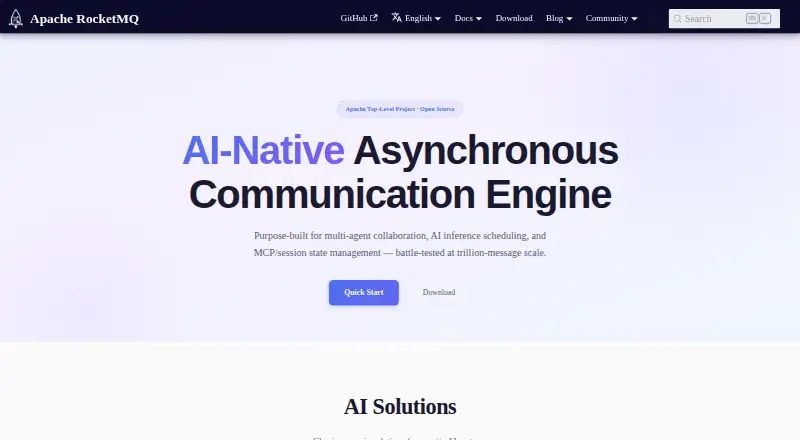
What Apache RocketMQ is
Apache RocketMQ is distributed middleware for asynchronous communication and publish/subscribe messaging. It can help separate systems and shift workloads between upstream and downstream services. Messaging options include request/reply, streaming, transactional messages, FIFO ordering, filtering, and push or pull consumption. The project lists durable persistence, replication, failover, fault tolerance, high-availability options, and cross-region disaster recovery. Its site describes million-level LiteTopics per cluster and says it has demonstrated 10M+ TPS throughput. RocketMQ can run locally, in Docker, or in Kubernetes, and is free under the Apache License 2.0. Its ecosystem includes EventBridge, RocketMQ Connect and Streams, Spring, Flink, Prometheus Exporter, and a Kubernetes Operator, along with listed AI integrations such as native MCP support and A2A compatibility. SDKs are listed for Java, Go, Python, C++, and Rust. The quick-start guide calls for a 64-bit JDK 1.8 or later. ACL is not enabled by default, so operators need to configure access controls or limit access to trusted networks.
Good
- Free under the Apache License 2.0
- Supports transactional messages and FIFO ordering
- Can run locally, in Docker, or Kubernetes
- Offers replication, failover, and cross-region recovery options
Watch out
- ACL is not enabled by default
- Quick-start guide requires a 64-bit JDK 1.8 or later
- Operators must configure ACL or restrict network access
Who it suits
Apache RocketMQ suits developers and operators building asynchronous messaging between services, particularly when they need options such as transactional messages or FIFO ordering. It is for teams prepared to deploy and configure self-hosted middleware.
Verdict
Apache RocketMQ provides a broad set of messaging patterns and deployment options for systems that need asynchronous communication. Plan for operator-managed security configuration, since access controls are not enabled by default.
Plans and prices
From Apache RocketMQ's own pricing page, checked 7 Oct 2026.
| Plan | Price | What it gives you |
|---|---|---|
| Apache RocketMQ | Free | Open-source software · Apache License 2.0 |
| Apache RocketMQ open-source distribution | Free | Self-hosted operation · operator-managed infrastructure · community documentation and support · Free and open source; no paid plan is listed |
The facts
Each one read from Apache RocketMQ's own pages, with the date it was checked.
What it does
- AI integrations
- The site lists native MCP support, A2A compatibility, and integrations with LangChain, CrewAI, AutoGen, AgentScope, Dify, and Coze.checked 7 Oct 2026
- Community adoption
- StackShare records Apache RocketMQ in 48 technology stacks, with 200 followers and one discussion on its listing.checked 14 Oct 2026
- Connect integrations
- RocketMQ Connect is described as a low-code integration layer for more than 50 data sources and sinks.checked 14 Oct 2026
- Dead-letter handling
- Built-in retry and dead-letter-queue behavior is included in the feature comparison.checked 14 Oct 2026
- Delayed delivery
- RocketMQ provides scheduled and delayed messages for workflow timing and retry scenarios.checked 14 Oct 2026
- Deployment
- RocketMQ 5.x separates stateless Proxy from storage and compute so those layers can scale independently.checked 14 Oct 2026
- Documentation
- The documentation includes concepts, quick start, deployment, best practices, SDK references, security guidance, FAQs and release notes.checked 14 Oct 2026
- EventBridge integration
- EventBridge provides a CloudEvents-compatible event bus for cross-platform and serverless routing.checked 14 Oct 2026
- Filtering
- The product supports SQL92 and tag-based message filtering.checked 14 Oct 2026
- Independent build result
- MrKeyoor reported a 72-second dependency installation and a 212-second source build for RocketMQ 5.5.1 in a Debian container.checked 14 Oct 2026
- Independent test limitation
- MrKeyoor's 322-test run produced 137 passes, 182 skips and three setup or collection errors, leaving the complete test gate red.checked 14 Oct 2026
- Integration listed by StackShare
- StackShare identifies Docker as an integration for Apache RocketMQ.checked 14 Oct 2026
- Kubernetes
- The project describes Kubernetes-native deployment with Helm charts, operators and cloud-native observability integration.checked 14 Oct 2026
- Latest release
- Version 5.5.1 was released on August 20, 2026.checked 14 Oct 2026
- Licence
- The source distribution is licensed under the Apache License 2.0, a permissive licence allowing modification and redistribution subject to its notices and conditions.checked 14 Oct 2026
- Limit: CI maintenance
- A RocketMQ maintainer reported that the Bazel workflow had high maintenance cost, frequent configuration failures and long overall wait times.checked 14 Oct 2026
- Limit: setup complexity
- G2's review summary says initial setup can be complex and may require substantial technical expertise.checked 14 Oct 2026
- Message types
- RocketMQ defines NORMAL, FIFO, TRANSACTION and DELAY message types.checked 14 Oct 2026
- Messaging features
- It supports publish/subscribe, request/reply, streaming, transactional messages, FIFO ordering, message filtering, and push or pull consumption.checked 7 Oct 2026
- Messaging patterns
- The platform supports publish/subscribe, request/reply and continuous event-streaming patterns.checked 14 Oct 2026
- MQTT integration
- A native MQTT protocol implementation is provided for IoT device connectivity and edge-cloud messaging.checked 14 Oct 2026
The company
- Maker founded
- The Apache Software Foundation was incorporated in 1999.checked 14 Oct 2026
- Maker headquarters
- The Apache Software Foundation lists 1000 N West Street, Suite 1200, Wilmington, Delaware 19801, USA as its mailing address.checked 14 Oct 2026
- Maker legal entity
- The Apache Software Foundation is a U.S. 501(c)(3) nonprofit organization that stewards Apache projects.checked 14 Oct 2026
The full review of Apache RocketMQ
Apache RocketMQ is open-source, self-hosted middleware for asynchronous messaging between services. It suits teams building distributed systems that need several messaging patterns and control over deployment. Its breadth and scale options are compelling, but operators must take responsibility for securing it.
Overview
RocketMQ decouples upstream and downstream services, letting systems exchange work asynchronously rather than depend on immediate responses. It supports stream processing and schema registry capabilities, alongside multiple delivery guarantees. That range makes it a flexible foundation for messaging workloads, though the self-hosted model means teams must operate the infrastructure themselves.
Key features
- Multiple messaging patterns: Publish/subscribe, request/reply, streaming, transactional messages, FIFO ordering, filtering, and push or pull consumption let teams fit different delivery needs into one middleware system.
- Resilience and scale: Durable persistence, replication, failover, high availability, and cross-region disaster recovery address continuity needs. The project describes million-level LiteTopics per cluster and demonstrated throughput above 10M TPS; these are scale claims, not a substitute for sizing a deployment to its workload.
- Broad integration surface: Connectors and integrations include EventBridge, MQTT, RocketMQ Connect and Streams, Spring, Flink, Prometheus Exporter, and a Kubernetes Operator. Native MCP support, A2A compatibility, and integrations with LangChain, CrewAI, AutoGen, AgentScope, Dify, and Coze extend its reach to AI agent frameworks.
- Clients and protocols: gRPC SDKs are listed for Java, Go, Python, C++, and Rust; supported client languages also include Node.js. Protocol support includes gRPC, MQTT, JMS, and OpenMessaging, giving teams multiple routes to connect existing applications.
- Deployment choice: Run it locally, in Docker, or in Kubernetes, with source and binary packages. The quick-start guide calls for a 64-bit JDK 1.8 or later and recommends 64-bit Linux, Unix, or macOS.
- Security configuration: ACL and TLS are provided, but ACL is not enabled by default. Operators need to configure access controls or restrict the broker to trusted networks; this is a material setup responsibility, not an optional refinement. Vulnerability reports follow the Apache Software Foundation process.
Pricing
Apache RocketMQ costs free as open-source software under the Apache License 2.0. There is no paid RocketMQ plan in this offering; the tradeoff is that teams self-host and manage their deployment, including security configuration. Community email groups, GitHub issues, and contribution guidance provide routes for support and participation.
Platforms
RocketMQ supports API access and runs on Linux, macOS, and Windows, with self-hosted deployment. Local, Docker, and Kubernetes options suit teams that want to choose their own runtime, while the JDK requirement is important when preparing a quick-start environment.
Who it's for
RocketMQ is a strong fit for engineering teams that need asynchronous service decoupling, varied message semantics, and control over a self-managed broker. Its protocol, language, and integration range can serve mixed application stacks, and its reliability features suit systems where persistence and failover matter. It is less suitable for teams that want access controls enabled out of the box or do not want to take on infrastructure operations.
Pros and cons
- Pro: One system covers request/reply, transactions, FIFO ordering, streaming, and filtering, reducing the need to select middleware around a single messaging pattern.
- Pro: Persistence, replication, failover, high availability, and cross-region recovery provide a substantial toolkit for resilient deployments.
- Pro: Open-source licensing and deployment across local, container, and Kubernetes environments give teams control without a software license charge.
- Con: ACL is disabled by default, so teams must deliberately configure access controls or network restrictions before exposing the service.
- Con: Self-hosting and the JDK prerequisite add operational and environment work that a managed service can avoid.
Alternatives
- Lightstreamer is worth considering when a freemium option with a demo license capped at 20 concurrent client connections fits the evaluation or deployment need.
- Aiven for Apache Kafka offers a free managed-service entry point, but its Free plan is capped at 250 KiB/s throughput, three days of retention, five topics, and two partitions per topic.
- Apache Pulsar is another free, self-hosted open-source option for teams comparing broker platforms.
- Confluent Cloud may suit teams seeking a fully managed serverless Kafka option with autoscaling resources and more than 80 managed connectors on its Basic plan.
- Solace PubSub+ Event Broker is an alternative for teams that want to evaluate a cloud event broker through a 30-day trial.
- DataStax Astra Streaming is another freemium streaming option, with usage-based charges for paid plans.
- RisingWave is worth comparing when self-managed Apache 2.0 software with no feature gates, license fees, or usage restrictions is the priority.
- Redpanda is another option to compare for streaming workloads.
Browse our Event Streaming Platforms, Message Queue (MQ) Software, and Message Broker Software rankings to compare more options.
Verdict
Choose Apache RocketMQ if your team wants an open-source messaging foundation with a wide range of patterns, integration paths, and self-hosted deployment choices. Its main advantage is that breadth; its main cost is operational ownership, especially the need to configure security rather than assume safe defaults. Teams seeking a managed broker or minimal administration should look elsewhere.
Alternatives to Apache RocketMQ
- 1

Aiven for Apache Kafka
Free planOpen sourceWebAPILinuxSelf-hosted7.9From $35 a month - 2

Redpanda
Free planWebAPILinuxmacOS7.4Free plan - 3

Confluent Cloud
Free planWebAPILinux7.1From $385 a month - 4
Lightstreamer
Free planAndroidiOSWebAPI7.1Free plan - 5

Solace PubSub+ Event Broker
Free planWebAPILinuxSelf-hosted7.1Free plan - 6
Keen Product Analytics
AndroidiOSWebAPI6.9From $149 a month