
Argo Workflows
Argo Workflows is a free, open-source engine for orchestrating container-based jobs on Kubernetes.
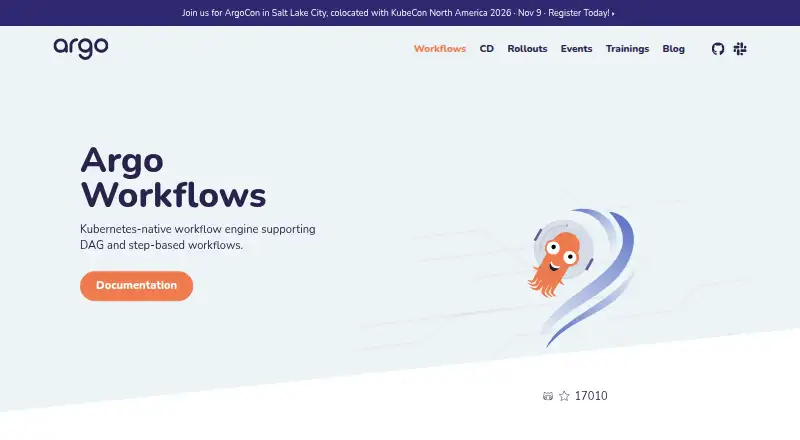
What Argo Workflows is
Argo Workflows is a free, open-source engine for orchestrating container-based jobs on Kubernetes. Workflows can run as ordered steps or as tasks linked in a directed acyclic graph, with each step running in a container. The project lists machine learning pipelines, data and batch processing, infrastructure automation, and CI/CD as use cases. Its controls include loops, conditions, retries, timeouts, suspension, resumption, cancellation, and parallelism limits. Users can schedule workflows with cron and inspect or manage them through a UI with Prometheus metrics. Artifact support covers services including S3, Azure Blob Storage, GCS, Git, HTTP, and plugins. A REST API is available over HTTP and gRPC, with client libraries for Java, Go, Python, and TypeScript. Argo Workflows is self-hosted and can run on any Kubernetes cluster. Administrators should configure server transport security, authentication, roles, and permissions; pods run as root by default unless their security context is configured.
Good
- Free and open source
- Supports DAG and sequential workflows
- Includes retries, timeouts, and scheduled runs
- Offers a workflow UI and Prometheus metrics
- REST API and four client libraries listed
Watch out
- Requires a Kubernetes cluster
- Workflow pods run as root by default
- Administrators must configure server security and permissions
Who it suits
Argo Workflows suits teams running containerized pipeline, batch, infrastructure, or CI/CD jobs on Kubernetes, including teams that want self-hosted control.
Verdict
Argo Workflows offers a broad set of orchestration controls and workflow visibility for Kubernetes-based jobs. Teams should account for self-hosted deployment and configure the recommended security settings, including pod security context.
Plans and prices
From Argo Workflows's own pricing page, checked 5 Oct 2026.
| Plan | Price | What it gives you |
|---|---|---|
| Argo Workflows | Free | Open-source workflow engine for Kubernetes; the official pages opened list no paid plans or usage limits |
The facts
Each one read from Argo Workflows's own pages, with the date it was checked.
What it does
- API and clients
- The server offers a REST API over HTTP and gRPC, and the project lists Java, Go, Python (Hera), and TypeScript (Juno) clients.checked 5 Oct 2026
- Artifacts
- Artifact support includes S3, Artifactory, Alibaba Cloud OSS, Azure Blob Storage, HTTP, Git, GCS, raw artifacts, and plugins.checked 5 Oct 2026
- Deployment
- Argo Workflows is cloud agnostic and can run on any Kubernetes cluster.checked 5 Oct 2026
- Ecosystem
- The project lists Argo Events, Hera, Katib, Kedro, Kubeflow Pipelines, Netflix Metaflow, Piper, Seldon, and SQLFlow among projects that use or rely on Argo Workflows.checked 4 Oct 2026
- Integrations
- The project lists Argo Events, Hera, Katib, Kedro, Kubeflow Pipelines, Netflix Metaflow, Piper, Seldon, and SQLFlow among projects that use or rely on Argo Workflows.checked 5 Oct 2026
- Observability
- The feature list includes Prometheus metrics and a UI for visualizing and managing workflows.checked 4 Oct 2026
- Pod defaults
- The security guide states that workflow pods run as root by default and recommends configuring a workflow pod security context to further secure them.checked 5 Oct 2026
- Project status
- The documentation identifies Argo as a graduated Cloud Native Computing Foundation project.checked 5 Oct 2026
- Purpose
- Argo Workflows is an open-source, container-native engine for orchestrating parallel jobs on Kubernetes.checked 5 Oct 2026
- Scheduling
- Cron-based scheduled workflows are supported.checked 4 Oct 2026
- Security configuration
- The security guidance says administrators should enable transport-layer security, choose an authentication mode, and configure appropriate Argo Server roles and permissions.checked 4 Oct 2026
- Security controls
- The security guidance recommends enabling transport-layer security and an authentication mode for Argo Server, then configuring its role and role binding with appropriate permissions.checked 5 Oct 2026
- Security limitation
- The documentation says Argo Workflows can create arbitrary pods, and—with the workflow-restrictions feature as an exception—does not attempt to restrict or prevent this.checked 5 Oct 2026
- Support
- The project directs users with questions to GitHub Discussions and Slack and describes monthly community meetings.checked 5 Oct 2026
- Use cases
- The project lists machine-learning pipelines, data and batch processing, infrastructure automation, and CI/CD as use cases.checked 5 Oct 2026
- Workflow controls
- Listed capabilities include loops, conditionals, retries, timeouts, suspension and resumption, cancellation, and parallelism limits.checked 4 Oct 2026
- Workflow design
- Workflows can be modeled as task sequences or directed acyclic graphs, with each step defined as a container.checked 5 Oct 2026
- Workflow management
- Features include a UI for visualizing and managing workflows, workflow archiving, cron scheduling, retries, timeouts, suspend and resume, and cancellation.checked 5 Oct 2026
Where it runs
- Windows support
- The feature list includes Windows container support.checked 4 Oct 2026
The full review of Argo Workflows
Argo Workflows is an open-source engine for coordinating containerized jobs on Kubernetes. It is best suited to teams already building data, machine-learning, infrastructure, or CI/CD pipelines there. Its extensive workflow controls come with the responsibility of running and securing the deployment.
Overview
Teams can define a workflow as sequential steps or as tasks linked in a directed acyclic graph, with each step running in a container. That makes Argo a natural fit for parallel jobs and pipelines with dependencies, but a poor match for organizations seeking an orchestrator independent of Kubernetes. It can run on any Kubernetes cluster and is cloud agnostic; the trade-off is a self-hosted deployment for the team to operate.
Key features
Loops, conditionals, retries, timeouts, cancellation, suspension and resumption, and parallelism limits provide practical control over branching and failure-prone work. Cron-based scheduling supports recurring runs, while event triggers and human approvals can help coordinate starts and review points.
Artifact support covers S3, Artifactory, Alibaba Cloud OSS, Azure Blob Storage, HTTP, Git, GCS, raw artifacts, and plugins. The server exposes REST APIs over HTTP and gRPC, and client libraries are available for Java, Go, Python, and TypeScript. Prometheus metrics and a UI for visualizing and managing workflows help operators follow executions; workflow archiving supports retaining workflow records. Windows containers are supported as well.
Argo Workflows also sits within a broader ecosystem that includes Argo Events, Hera, Katib, Kedro, Kubeflow Pipelines, Netflix Metaflow, Piper, Seldon, and SQLFlow. The project directs users with questions to GitHub Discussions and Slack and holds monthly community meetings.
Pricing
Argo Workflows costs nothing. The open-source engine has no paid plan or published usage limits, making it a cost-free option for teams prepared to manage their own Kubernetes deployment. There is no hosted plan described; infrastructure and operational effort remain the team's responsibility.
Platforms
Argo Workflows supports API, Linux, macOS, self-hosted, web, and Windows environments, including Windows containers. It runs on Kubernetes clusters, so platform breadth does not remove the need for Kubernetes operations.
Who it's for
Choose Argo if your organization runs container-based jobs on Kubernetes and needs to coordinate parallel or scheduled work, manage retries and pauses, or track workflow execution. Its listed use cases include machine-learning pipelines, data and batch processing, infrastructure automation, and CI/CD. Teams that do not want to host and secure their own Kubernetes-based orchestrator should look elsewhere.
Security configuration is a meaningful part of adoption: administrators should enable transport-layer security, select an authentication mode, and assign suitable Argo Server roles and permissions. Workflow pods run as root by default, so teams should configure a workflow pod security context rather than accept that default.
Pros and cons
Pros
- Fine-grained workflow control: Branching, retries, timeouts, suspension, cancellation, and parallelism limits suit workflows that need more than a simple sequence.
- Broad artifact and client support: Multiple storage and artifact options, REST APIs, and four listed client libraries make it adaptable to varied pipeline environments.
- Free and cloud agnostic: The open-source engine can run on any Kubernetes cluster without a paid product plan.
Cons
- Kubernetes is a prerequisite: Teams need a Kubernetes cluster and must operate the self-hosted deployment.
- Security requires deliberate setup: Server transport security, authentication and permissions need configuration, and pods run as root by default unless secured with a pod security context.
Alternatives
Kestra is another free, open-source option with a free plan and trial for teams comparing workflow platforms.
Juju is a free, open-source orchestration engine for teams considering a different orchestration tool.
ONAP is a free open-source software platform for teams looking at platform-based alternatives.
Windmill offers a free and open-source plan with a free trial, which may suit readers comparing freemium options.
Orkes Conductor offers a free Developer Edition that includes OSS and enterprise features, pre-built workflow templates, and community support.
AWS Step Functions has a free tier that does not automatically expire after the 12-month AWS Free Tier term, making it an option for readers comparing a cloud service with Argo's self-hosted model.
Google Cloud Workflows offers an Always Free plan with monthly usage limits of 5,000 internal steps and 2,000 external steps, alongside a pay-as-you-go plan.
StackStorm is a free, open-source alternative with no paid products offered by its project.
Verdict
Argo Workflows is a strong choice for Kubernetes teams that need detailed control and visibility across container-based pipelines without paying for an orchestration product. Its main drawback is the operational and security work that self-hosting requires; teams seeking a managed service or automation beyond Kubernetes should consider another tool.
Getting started
- Visit the Argo Workflows website.
- Prepare a Kubernetes cluster for self-hosted deployment.
- Configure Argo Server transport security, authentication, roles, and permissions.
- Set a workflow pod security context rather than relying on the root default.
- Use the UI, REST API, or a listed client library to manage workflows.
Limits worth knowing
The listed plan is free, and the official pages opened list no paid plans or usage limits. The workflow pods run as root by default, so additional security configuration is recommended.
Questions
How much does Argo Workflows cost?
The listed plan is free. It is open source, and the official pages opened list no paid plans or usage limits.
Where can Argo Workflows run?
It is self-hosted and can run on any Kubernetes cluster. Listed platforms include API, Linux, macOS, web, Windows, and self-hosted.
What kinds of workflows can it run?
Workflows can be sequential steps or tasks linked in a directed acyclic graph, with each step running in a container. The project names machine learning pipelines, data and batch processing, infrastructure automation, and CI/CD as use cases.
Which APIs and client libraries are available?
The server provides REST API support over HTTP and gRPC. Client libraries are listed for Java, Go, Python, and TypeScript.
What security configuration should administrators consider?
The security guidance recommends transport-layer security, an authentication mode, and appropriate Argo Server roles and permissions. Workflow pods run as root by default, so it recommends configuring a pod security context.
What support channels does the project offer?
The project directs users to GitHub Discussions and Slack and describes monthly community meetings.
Alternatives to Argo Workflows
- 1

Windmill
Free planOpen sourceWebAPILinuxSelf-hosted8.3From $120 a month - 2

Azure Logic Apps
Free planWebAPILinuxmacOS8.0Free plan - 3
Kestra
Free planOpen sourceWebAPILinuxmacOS7.9Free plan - 4
Google Cloud Workflows
Free planWebAPI7.5From $0.01 a month - 5
Juju
Free planAPILinuxmacOSSelf-hosted6.9Free plan - 6
ONAP
Free planWebAPILinuxSelf-hosted6.8Free plan