ISP Billing
ISP Billing is a cloud platform for internet service providers that links customer records, services, billing, support, and network operations.
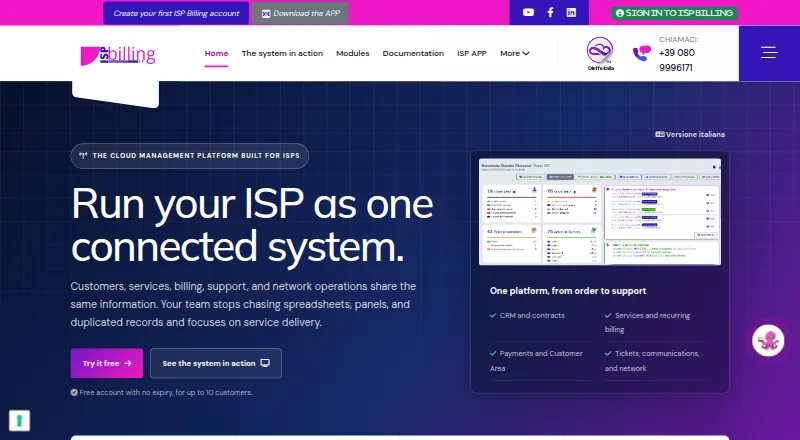
What ISP Billing is
ISP Billing is a cloud platform for internet service providers that links customer records, services, billing, support, and network operations. Its stated workflow runs from customer acquisition and quotes or contracts through recurring billing and collection, then ticket support and customer communications. Communications can use email, SMS, WhatsApp, and ISP APP notifications. Through the Customer Area and ISP APP, customers can view documents and services, pay, open tickets, accept quotes, and manage notifications. The free plan costs nothing with no expiry and supports up to 10 customers, including service management, recurring invoices and XML, tickets, activities, and quotes. Lite costs €€49 a month and supports up to 1,000 customers; Gold costs €€99 a month and supports up to 2,500. Integrations named include Stripe, Aruba FE, MessageNet, FiberCop, UISP, Proxmox, Radius, and VoIP. Optional modules are priced separately from the principal plan. The platform supports Android, iOS, web, and API, and provides API documentation and bilingual documentation.
Good
- Free plan has no expiry.
- Customer self-service supports payments and tickets.
- Communications include email, SMS, and WhatsApp.
- API documentation includes an interactive console.
- Recurring and prepaid billing are supported.
Watch out
- Free plan supports up to 10 customers.
- Optional modules cost extra.
- No free trial is listed.
Who it suits
ISP Billing is intended for internet service providers managing customers, services, billing, support, and network operations. It suits providers that want customer self-service for payments, tickets, documents, and quotes.
Verdict
ISP Billing connects core ISP customer and operational workflows and includes customer self-service options. Check customer limits and the separate pricing for optional modules before selecting a plan.
Plans and prices
From ISP Billing's own pricing page, checked 21 Oct 2026.
| Plan | Price | What it gives you |
|---|---|---|
| ISP Billing Free | Free | Up to 10 customers · Service management · Recurring invoices and XML · Tickets, activities, quotes · 0€/month |
| ISP Billing Lite | €49 a month | Up to 1,000 customers · All Free functions · ISP Dude · Coverage Map and Communications · 49€/month |
| ISP Billing Gold | €99 a month | Up to 2,500 customers · All Free functions · ISP Dude · Coverage Map and Communications · 99€/month |
The facts
Each one read from ISP Billing's own pages, with the date it was checked.
What it does
- API
- The maker provides API documentation covering keys, permissions, pagination, resources, errors, and an interactive console.checked 29 Sep 2026
- API activation
- The API module is free but must be activated on request through support before keys can be configured.checked 21 Oct 2026
- API authentication
- API clients authenticate with HTTPS Bearer credentials formed from an API ID and key, with optional source-IP whitelisting.checked 21 Oct 2026
- API documentation depth
- API documentation provides endpoint permissions, pagination rules, request and response models, errors and an interactive Swagger console.checked 21 Oct 2026
- API scope
- The public API covers customers, groups, custom fields, invoices, payments, services, service instances, ISPRadius 2.0, warehouse and activities.checked 21 Oct 2026
- Cloud requirement
- Access requires an internet connection and username/password credentials because ISP Billing is delivered as cloud software.checked 21 Oct 2026
- Contracts and quotes
- The platform supports quotes, contracts, service pricing, billing cycles and technical prerequisites.checked 21 Oct 2026
- CRM
- The CRM links customer identity, contacts, services, invoices, tickets and activities in one record.checked 21 Oct 2026
- Customer communications
- The platform lists email, SMS, WhatsApp, and ISP APP notifications as customer communication channels.checked 29 Sep 2026
- Customer portal
- Customers can view documents and services, pay, accept quotes, open tickets and manage notification preferences when modules are enabled.checked 21 Oct 2026
- Customer self-service
- The Customer Area and ISP APP let customers view documents and services, pay, open tickets, accept quotes, and manage notifications.checked 29 Sep 2026
- Documentation
- The bilingual operating manual contains procedures, settings, examples and screenshots, with more than 70 operating guides advertised on the home page.checked 21 Oct 2026
- Google Play listing
- The ISPAPP listing shows 500+ downloads, an Everyone content rating and no star-rating count in the opened listing.checked 21 Oct 2026
- Integrations
- The site lists Stripe, Aruba FE, Messagenet, FiberCop, UISP, Proxmox, Radius and VoIP integrations.checked 21 Oct 2026
- Intended users
- The maker describes ISP Billing as a platform built for ISPs and highlights managing ISP customers, services, billing, support, and network operations.checked 29 Sep 2026
- Licence
- ISP Billing is proprietary software licensed non-exclusively, non-transferably and only for the agreement period; Dieffe retains intellectual-property ownership.checked 21 Oct 2026
- Limit: G2 review coverage
- G2 says there are not enough reviews to provide buying insight for Ispbilling.checked 21 Oct 2026
- Limits and add-ons
- The maker says optional modules remain separate from the principal plan and advises checking the catalog for their availability and prices.checked 29 Sep 2026
- Limit: service liability
- The licence excludes liability for many outages, data loss and indirect damages and caps potential compensation at licence fees paid for the usage period.checked 21 Oct 2026
The company
- Company legal name
- ISP Billing is a trademark of Dieffeitalia.it S.r.l., VAT number 02982940732, with €10,000 paid-in share capital.checked 21 Oct 2026
- Company profile
- LinkedIn lists ISP Billing as a telecommunications company headquartered in Martina Franca, Apulia, with 2–10 employees and founded in 2023.checked 21 Oct 2026
- Company type
- LinkedIn identifies the business type as an individual proprietorship (Ditta individuale).checked 21 Oct 2026
- Headquarters
- Martina Franca, Taranto, Italychecked 28 Sep 2026
Where it runs
- ISP APP
- The ISP APP is a mobile Customer Area interface with invoices, payments, tickets, consumption and notifications.checked 21 Oct 2026
The full review of ISP Billing
Overview
ISP Billing is a cloud platform for internet service providers that brings customer accounts, services, billing, support, and network operations together. It is best suited to ISPs that want one system spanning commercial workflows and customer self-service, rather than a general-purpose billing tool. Its free entry point is unusually practical for a small customer base, but growth brings firm customer caps and optional modules can add to the bill.
Key features
The workflow covers customer acquisition, quotes and contracts, recurring billing and collection, then tickets and customer communications. That breadth can reduce the need to manage these ISP-specific tasks across separate systems; the trade-off is that the platform is tailored to providers rather than businesses seeking a generic invoicing package.
Customers can use the Customer Area and ISP APP to view documents and services, pay, open tickets, accept quotes, and manage notifications. Email, SMS, WhatsApp, and ISP APP notifications give providers several routes for customer contact. These self-service functions are valuable for reducing routine back-and-forth, though ISP App is a separate paid module.
Billing capabilities include usage rating, prepaid and postpaid billing, plan management, invoice generation, payment collection, and customer accounts. Named integrations include Stripe, Aruba FE, MessageNet, FiberCop, UISP, Proxmox, Radius, and VoIP, covering payment, communications, and network-related connections. The API documentation addresses keys, permissions, pagination, resources, errors, and an interactive console, a useful foundation for teams connecting their own systems.
The maker says its GDPR and NIS 2 compliance programs are active, with ongoing review of procedures, organizational safeguards, and technical controls. Bilingual documentation and support by email or phone are also provided.
Pricing
ISP Billing is freemium, with no free trial. The free plan has no expiry and costs nothing. It supports up to 10 customers and includes service management, recurring invoices and XML, tickets, activities, and quotes. That is a meaningful way for a very small ISP to start, but the 10-customer ceiling makes it a poor fit once the operation grows beyond a pilot or tiny customer base.
ISP Billing Lite costs €49 a month and supports up to 1,000 customers. It includes all Free functions, plus ISP Dude, Coverage Map, and Communications. It is the clearest fit for a small provider that needs more capacity and those additions without moving to the higher tier.
ISP Billing Gold costs €99 a month and raises the customer limit to 2,500 while including all Free functions, ISP Dude, Coverage Map, and Communications. It suits providers that need the higher cap; compared with Lite, the stated plan difference is capacity, so a provider below 1,000 customers has no stated reason to pay more.
Optional modules are charged separately from the principal plan: ISP App is €10/mese, Aruba electronic invoicing is €15/mese, and ISP Billing Radius 2.0 is €40/mese. These extras can materially change the cost, especially for customers who want the app or Radius functionality, so budget for them separately rather than treating the plan price as the full package.
Platforms
ISP Billing supports Android, iOS, web, and API access, giving providers mobile, browser, and integration options.
Who it's for
Choose ISP Billing if you run an ISP and want customer management, service and plan administration, billing, collections, support, and customer communications tied into one workflow. Its free tier is most useful for a provider with no more than 10 customers, while Lite and Gold make the product relevant at larger but still capped customer counts. Look elsewhere if your customer base exceeds 2,500 or if a general-purpose billing product would better match your operation.
Pros and cons
- Pros: The no-expiry free plan includes recurring invoices, XML, tickets, activities, and quotes, so a tiny ISP can use core operational functions without a monthly subscription.
- Pros: Customer self-service covers payments, tickets, quote acceptance, and documents, while multiple notification channels support customer communications.
- Pros: Prepaid and postpaid billing, usage rating, and named integrations address needs specific to ISP operations.
- Cons: The free plan is capped at 10 customers, and paid tiers top out at 2,500, limiting its fit for larger providers.
- Cons: Optional modules are separate charges, so features such as the ISP App or Radius 2.0 raise the cost beyond the main plan.
Alternatives
Telecom Billing Software is a category directory for comparing options across telecom billing.
Consider ISPbills if its free plan for up to 100 active subscribers is a better match; it has no monthly subscription charge but a one-time setup fee of ৳1,000. Alepo BSS Now is another paid option, with subscription pricing described as scaling with business success and customer management, billing, self-care, and AI support. AEX Software may suit buyers looking for subscriber-based pricing and a choice of hosted, self-hosted, or hybrid deployment. Aradial is an alternative paid billing product. ASTPP is another freemium option. BillRun offers a free trial and a tiered monthly per-subscriber plan. OneBill is a paid option with a free trial. PortaSwitch is a paid alternative with self-hosted and SaaS deployment options.
Verdict
ISP Billing is a strong fit for small and midsize ISPs that want billing, customer operations, support, and self-service in one provider-focused platform. The no-expiry free tier is a practical starting point, and the paid tiers offer clear capacity steps. Choose another product if you need more than 2,500 customers or want the customer app and other optional modules without separate charges.
Getting started
- Open the ISP Billing website.
- Choose the free plan or a paid plan based on its customer cap.
- Use the platform through its listed web, Android, or iOS access.
- Consult the API documentation if you are connecting through the API.
- Check the module catalog for optional extras and their prices.
Limits worth knowing
The free plan supports up to 10 customers. Lite is capped at 1,000 customers and Gold at 2,500; optional modules remain separate from the principal plan and have separate prices.
Questions
Is there a free plan?
Yes. ISP Billing Free costs nothing, has no expiry, and supports up to 10 customers.
How much do the paid plans cost?
ISP Billing Lite costs €49 a month and supports up to 1,000 customers. ISP Billing Gold costs €99 a month and supports up to 2,500.
Which platforms are listed?
The listed platforms are Android, iOS, web, and API.
Which integrations are named?
Named integrations include Stripe, Aruba FE, MessageNet, FiberCop, UISP, Proxmox, Radius, and VoIP.
Are optional modules included in the main plan?
Optional modules are separate from the principal plan. Listed examples include ISP App (€10/mese), Aruba electronic invoicing (€15/mese), and ISP Billing Radius 2.0 (€40/mese).
Who makes ISP Billing?
The listed headquarters are in Martina Franca, Taranto, Italy.