
Hyperstone
Hyperstone is a game optimization platform for tuning prices, difficulty, ad frequency, and LiveOps.
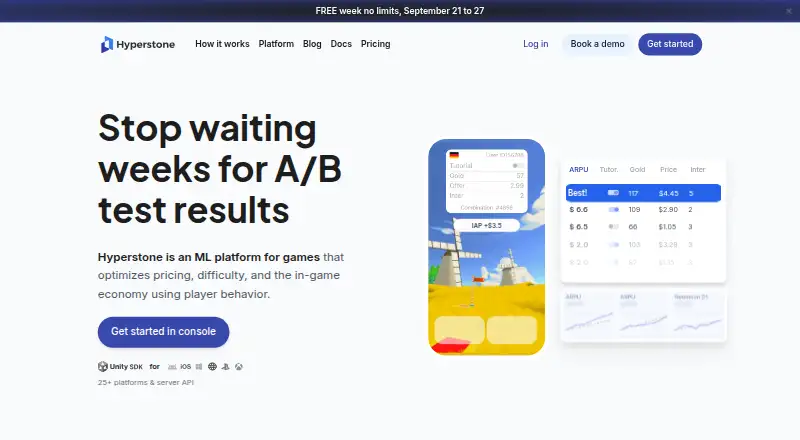
What Hyperstone is
Hyperstone is a game optimization platform for tuning prices, difficulty, ad frequency, and LiveOps. It can test up to 1,000 combinations at a time and adjust configuration values for individual players against a selected metric, such as LTV, ARPU, or retention. Its dashboards update as player events arrive and provide Engagement, Monetization, Business, and AI reports. Teams can deliver winning configuration values through the SDK without a store update. Hyperstone lists a Unity SDK and Server-to-Server integration, with custom integration available, and supports destinations including Google Play, App Store, Steam, Huawei, itch.io, PlayStation, Xbox, iOS, Android, and web browser. It offers a free plan with up to 2,000 installs per app each month; additional installs automatically switch to pay-as-you-go at $0.001 per install. The Unity SDK is in Beta, and its APIs, method names, and classes may change.
Good
- Tests up to 1,000 configuration combinations at once.
- Optimizes settings for LTV, ARPU, or retention.
- Dashboards include Engagement, Monetization, Business, and AI reports.
- Winning settings can be delivered without a store update.
- Free plan includes up to 2,000 monthly installs per app.
Watch out
- Excess installs switch the app to $0.001-per-install billing.
- Free-to-pay-as-you-go switching cannot be reversed.
- Unity SDK is in Beta and may change.
Who it suits
Hyperstone is intended for indie teams, mid-size studios, publishers, and enterprise game teams that want to adjust game settings using player-level metrics. Its free plan may suit teams within the 2,000-install monthly allowance per app.
Verdict
Hyperstone combines multivariate testing, per-player configuration, and analytics for game optimization. Review the install threshold and irreversible billing switch, as well as the Beta SDK status, before adopting it.
Plans and prices
From Hyperstone's own pricing page, checked 15 Oct 2026.
| Plan | Price | What it gives you |
|---|---|---|
| Free | Free | Unlimited seats · all platform features · up to 2,000 installs/month per app · auto-switch to pay-as-you-go when exceeded · forever |
| Growth | Free | All platform features · usage-based scaling · 2,000 installs free, then $0.001 per install; no monthly commitment |
| Enterprise | Priced on request | SSO OAuth2/OIDC · custom installation · invoicing and volume discounts · priority support · unlimited apps · custom SLA · US/EU data residency · custom pricing |
The facts
Each one read from Hyperstone's own pages, with the date it was checked.
What it does
- Analytics
- Its analysis dashboards update as player events arrive and include Engagement, Monetization, and Business reports plus an AI Report.checked 3 Oct 2026
- API limits
- The S2S documentation warns that requests have strict rate limits and recommends batching metrics.checked 15 Oct 2026
- Audience
- Hyperstone describes its audience as indie teams, mid-size studios, publishers, and enterprise game teams.checked 3 Oct 2026
- Configuration rollout
- Winning configuration values can be delivered through the SDK without a store update.checked 3 Oct 2026
- Data collection
- The Unity SDK privacy page says it does not collect personally identifiable information, advertising identifiers, or device identifiers.checked 3 Oct 2026
- Data export
- Optimization results and raw event data can be exported in CSV and JSON formats.checked 15 Oct 2026
- Data retention
- The maker says server-side SDK data is purged after 30 days of user inactivity and that it does not share collected data with third parties.checked 3 Oct 2026
- Deep analysis
- Deep Analysis shows parameter correlations, per-parameter impact, trade-offs, statistical significance, and cross-correlation results.checked 15 Oct 2026
- Downgrade limit
- The pricing FAQ says switching an app from Free to Pay-as-you-Go is irreversible and it cannot be downgraded back to Free.checked 3 Oct 2026
- Independent product claim
- A Hyperstone LinkedIn post claims the system tests more than 1,000 configurations across more than 100 parameters simultaneously.checked 15 Oct 2026
- Independent product update
- A later LinkedIn update describes an Optimization Editor that can test different gameplay modes, feature combinations, and parameter values in one optimization.checked 15 Oct 2026
- Independent store check
- The opened Google Play developer page is for Hyperstone Studios games such as Mighty Tornado!, not the Hyperstone.ai optimization product.checked 15 Oct 2026
- Integrations
- The maker advertises Unity SDK and server-to-server integration and says its SDK/API can complement analytics, ad mediation, and payment tools.checked 15 Oct 2026
- Limit: SDK maturity
- The Unity SDK's Beta status means integrations may need updates when APIs and classes change.checked 15 Oct 2026
- Metrics
- The service provides more than 30 ready-made metrics covering revenue, advertising, retention, sessions, engagement, and in-app purchases.checked 15 Oct 2026
- News
- Hyperstone announced a Product Hunt launch on 8 August 2026 and invited community upvotes, comments, and reviews.checked 15 Oct 2026
- Optimization
- Its algorithms continuously explore parameter combinations and converge on configurations that improve a target metric.checked 15 Oct 2026
- Optimization method
- The documentation describes a stochastic multi-armed-bandit approach that serves configurations, collects measurements, and updates subsequent assignments.checked 15 Oct 2026
- Partnership news
- Hyperstone announced a partnership with Vaiz on 25 July 2026 to combine game optimization with studio task collaboration.checked 15 Oct 2026
The company
- Company
- Hyperstone says it is built by Theoretical Studio, with Gleb Shishov, Mike Shimko, and Boris Shishov listed as co-founders.checked 15 Oct 2026
- Company location signal
- Gleb Shishov's LinkedIn profile lists Kazakhstan as his location.checked 15 Oct 2026
- Company size
- Gleb Shishov's LinkedIn profile shows Theoretical Studio affiliation and 120 followers on the profile page.checked 15 Oct 2026
Where it runs
- Game platforms
- The site lists Google Play, App Store, Steam, Huawei, itch.io, PlayStation, Xbox, iOS, Android, and web browser among supported destinations.checked 3 Oct 2026
Money
- Limit: billing switch
- When an app exceeds the Free allowance, it automatically moves to pay-as-you-go and the pricing FAQ says it cannot be returned to Free.checked 15 Oct 2026
The full review of Hyperstone
Hyperstone is a game-optimization platform for studios that want to tune live settings against measurable player outcomes. It suits teams running experiments across pricing, difficulty, advertising, or LiveOps, from independent developers to enterprise publishers. Its unusually broad testing and per-player controls are persuasive, provided you plan carefully around usage billing and the Beta Unity SDK.
Overview
Hyperstone can test as many as 1,000 combinations of prices, difficulty, ad frequency, and LiveOps settings simultaneously. It then adjusts configuration values for individual players toward a selected objective such as lifetime value, average revenue per user, or retention. This is a focused optimization layer rather than a general-purpose game backend. Winning values can be sent through the SDK without a store update, so teams can change live parameters without waiting for a new release.
Key features
Experimentation and optimization
Multivariate testing lets a team evaluate interacting settings instead of changing one variable at a time. Per-player configuration can pursue different outcomes for different users, but the team must define the metric that determines success; the platform does not remove that product judgment.
Analytics
Engagement, Monetization, and Business dashboards update as player events arrive. An AI Report adds another view of the incoming data, giving teams current operational and commercial reporting alongside experiments.
Delivery and integrations
Remote configuration and LiveOps controls are delivered through the SDK, avoiding a store submission for each winning change. The maker provides a Unity SDK and Server-to-Server integration, with custom integration also available. Unity teams should account for the SDK being in Beta: APIs, method names, and classes may change.
Privacy and security
The Unity SDK privacy policy says it collects no personally identifiable information, advertising identifiers, or device identifiers. Communication with Hyperstone servers uses HTTPS in transit, server-side SDK data is purged after 30 days of user inactivity, and collected data is not shared with third parties.
Pricing
Hyperstone is freemium. The Free plan costs $0 per month forever, has unlimited seats, includes every platform feature, and allows up to 2,000 installs per app each month. Crossing that threshold automatically moves the app to pay-as-you-go at $0.001 per additional install. The move is irreversible: an app switched from Free cannot return to Free. That makes the free tier suitable for prototypes and controlled launches, but teams should monitor installs before broad distribution.
Growth is described as $0 once, billed as 2,000 free installs followed by $0.001 per install. It includes all platform features, has no monthly commitment, and scales with usage. In practice it is the same usage-based path for a growing game, not a lower-risk way to avoid the install threshold.
Enterprise uses custom pricing and supports unlimited apps. It adds SSO through OAuth2 and OIDC, custom installation, invoicing and volume discounts, priority support, and 24/7 support. It is the sensible route for organizations that need identity controls, procurement terms, or guaranteed service coverage.
There is no free trial. Paid usage starts from $0.01 per user, while the install-based plans above define the app threshold and overage charge.
Platforms
Hyperstone supports Android, iOS, Linux, macOS, Windows, web, API, and self-hosted deployments. Listed game destinations include Google Play, App Store, Steam, Huawei, itch.io, PlayStation, Xbox, iOS, Android, and web browser. Unity is the named game-engine integration.
Who it's for
Indie teams can use the permanent free allowance to run small experiments, provided 2,000 monthly installs is realistic. Mid-size studios and publishers gain more from simultaneous multivariate tests, per-player targeting, and remote delivery across live games. Enterprise teams have a clearer fit when SSO, custom installation, unlimited apps, invoicing, and 24/7 support justify custom pricing. Teams that need a stable, non-Beta SDK or a general backend should look elsewhere.
Pros and cons
- Pro: Up to 1,000 combinations can be tested at once, useful for games with several interacting monetization or difficulty decisions.
- Pro: Per-player optimization can target LTV, ARPU, or retention rather than applying one setting to everyone.
- Pro: Event-updated reports cover engagement, monetization, business performance, and an AI view.
- Pro: Remote delivery avoids a store update for winning configuration values.
- Con: Free usage is capped at 2,000 installs per app per month, and exceeding it triggers paid usage automatically.
- Con: The Free-to-Pay-as-you-Go change cannot be reversed.
- Con: The Unity SDK is in Beta, with APIs and class names subject to change.
Alternatives
GameAnalytics is the better pick when broad dashboards, funnels, cohorts, retention, and real-time reporting matter more than automated per-player optimization.
Metaplay suits teams wanting a full SDK and local server for unrestricted local development.
PlayFab is a stronger option for a backend-oriented service with a free-to-start allowance tied to title and player limits.
brainCloud provides backend services with a free plan and free trial.
BACKND is another freemium backend option, including core chat and translation in its free tier.
Crux fits teams prioritizing quantified MAU, API-call, server, and environment quotas.
Ondara Game Services is an alternative game-services platform from an indie studio.
AccelByte Gaming Services offers cloud foundations with usage fees as players arrive and a paid private-cloud tier.
Verdict
Choose Hyperstone if your live game needs systematic, multivariate tuning and per-player optimization, especially when remote configuration can replace frequent releases. Its analytics and broad platform coverage strengthen that case. Look elsewhere if the irreversible install-based billing switch, custom-priced enterprise tier, or Beta Unity SDK conflicts with your rollout and maintenance requirements.
Alternatives to Hyperstone
- 1

Unity
Free planAndroidiOSWebAPI8.4Free plan - 2
PlayFab
Free planAndroidiOSWebAPI8.3$99 usage-based - 3

AccelByte Gaming Services
Free planAndroidiOSWebAPI8.2From $1,000 a month - 4

brainCloud
Free planAndroidiOSWebAPI8.2From $5 a month - 5

GameAnalytics
Free planAndroidiOSWebAPI8.2From $49 a month - 6

Metaplay
Free planAndroidiOSWebAPI8.2From €195 a month