
Metaplay
Metaplay is a backend platform for building and operating live-service games.
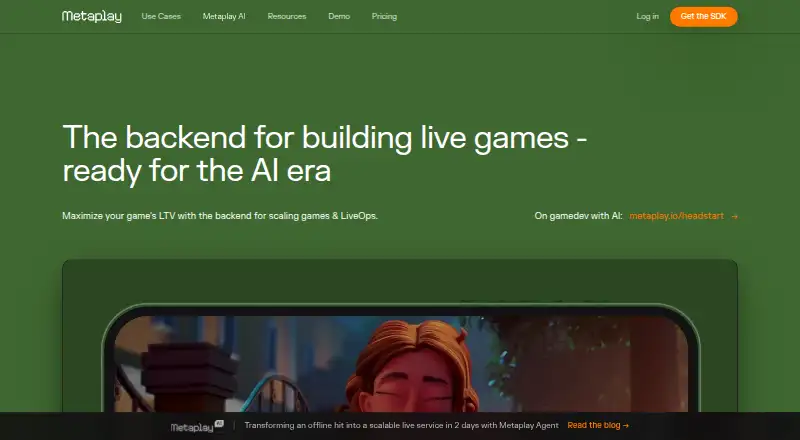
What Metaplay is
Metaplay is a backend platform for building and operating live-service games. Its server-authoritative C# game server works with a Unity client library and shared client-server logic. A LiveOps dashboard provides player segmentation, A/B testing, over-the-air configuration updates, events, economy management and player support tools. The SDK includes guilds, social features, leaderboards, leagues and asynchronous matchmaking; synchronous matchmaking is in active development. Studios can host on managed Metaplay Cloud, their own AWS infrastructure, another Kubernetes cluster or on-premises. The platform supports Unity games on iOS, Android, Windows, Mac, Linux and WebGL. The free plan offers the full SDK and a local server for local development. Metaplay describes its audience as game studios building server-authoritative games, from prototype through global launch, including teams operating multiple titles. One hosting distinction matters: managed Metaplay Cloud supports single-region deployments, while multi-region deployments are supported on self-hosted infrastructure.
Good
- Full SDK and local server on the free plan
- LiveOps dashboard includes segmentation and A/B testing
- Supports multiple hosting models
- Includes social features and asynchronous matchmaking
Watch out
- Managed cloud deployments are single-region
- Synchronous matchmaking is in active development
Who it suits
Metaplay suits game studios building server-authoritative Unity games, from prototypes to global launches. Teams needing multi-region deployments can use self-hosted infrastructure rather than managed Metaplay Cloud.
Verdict
Metaplay combines game backend services with LiveOps tools and flexible hosting options. Studios should account for the single-region limit on managed cloud deployments when planning infrastructure.
Plans and prices
From Metaplay's own pricing page, checked 14 Oct 2026.
| Plan | Price | What it gives you |
|---|---|---|
| Free | Free | SDK and Portal access · non-publishing licence · local environment only · 0 DAU · €0 monthly |
| Community Support | Free | Discord community support · no direct support · no consulting hours · €0 monthly |
| Starter | €195 a month | Publishing licence (limited) · 1 development environment · 5 included DAU/month · maximum 5 DAU · €195 monthly |
| Pre-Launch | €995 a month | Publishing licence (limited) · 2 development and 1 staging environment · 100 included DAU/month · maximum 100 DAU · €995 monthly |
| Standard Support | €1,500 a month | Discord · email and portal support · Mon-Fri 09:00-17:00 EET · 1-hour onboarding · €1,500 monthly |
| Production | €1,985 a month | Publishing licence · 2 development, 1 staging and 1 production environment · 5,000 included DAU/month · unlimited maximum DAU · production backups and SLA · €1,985 monthly plus €2.95 per 1,000 DAU above 5,000 |
| Dedicated Support | €5,000 a month | Discord · email, portal and Slack support · Mon-Fri 09:00-17:00 EET · 2-hour onboarding plus 14 hours/month consulting · €5,000 monthly |
| Critical Incident Response | €5,000 a month | Add-on to paid support · 24/7 availability · 1h response SLA · + €5000/month |
| Tailored support | Priced on request | Custom availability and engineer hours · onboarding · hands-on codebase help · Custom |
| Private Cloud | Priced on request | Publishing licence · customer-hosted infrastructure · environments as agreed · 5,000 included DAU/month · unlimited maximum DAU · Custom monthly base fee; additional DAU from €2.00 per 1,000 |
The facts
Each one read from Metaplay's own pages, with the date it was checked.
What it does
- AI extensibility
- Metaplay exposes documentation and portal MCP servers plus agent skills for coding, deployment, logs and incident triage.checked 14 Oct 2026
- AI tooling
- Metaplay provides Docs and Portal MCP servers for AI tools, and says both are read-only by default and respect existing permissions.checked 2 Oct 2026
- API availability
- Slashdot lists Metaplay as having an API.checked 14 Oct 2026
- Client and server SDK
- Metaplay uses a Unity client library and a .NET game server with shared C# code.checked 14 Oct 2026
- Compliance
- Metaplay says it provides GDPR data export and deletion tools and works with enterprise customers on SOC 2 and other certifications.checked 2 Oct 2026
- Core technology
- The platform uses a server-authoritative C# game server with a Unity client library and shared client-server logic.checked 2 Oct 2026
- Database technology
- Cloud deployments use Amazon Aurora MySQL 8.0, while local development uses SQLite by default.checked 14 Oct 2026
- Deployment options
- Slashdot lists web, on-premises, iPhone, iPad, Android, Windows, Mac, Linux and Chromebook deployment.checked 14 Oct 2026
- Documentation depth
- Documentation includes getting-started paths, tutorials, release notes, sample games, architecture guides and operational security material.checked 14 Oct 2026
- External integrations
- Public web endpoints, custom HTTP endpoints, webhooks and API integrations are supported with authentication and rate limiting.checked 14 Oct 2026
- Game-server architecture
- The server uses a stateful actor model based on Akka.NET and supports horizontal clustering.checked 14 Oct 2026
- GDPR tooling
- The LiveOps Dashboard provides a GDPR export workflow that filters player data before download.checked 14 Oct 2026
- Hosting
- Metaplay can run on managed Metaplay Cloud, customer AWS infrastructure, another Kubernetes cluster or on-premises, according to its FAQ.checked 2 Oct 2026
- Independent funding record
- Dealroom reports no known external funding for Metaplay.checked 14 Oct 2026
- Industry recognition
- Deloitte's Finland Technology Fast 50 material describes Metaplay as a Helsinki game-backend company founded in 2019 with more than 20 employees.checked 14 Oct 2026
- Integrations
- Metaplay lists analytics export to BigQuery and S3, purchase validation for Google Play, App Store and Steam, and sign-in options including Google, Apple, Facebook, Steam and custom web login.checked 2 Oct 2026
The company
- Company
- Metaplay says it is based in Finland and was founded in 2019; its contact page lists its office in Helsinki.checked 2 Oct 2026
- Company headquarters
- Metaplay Oy lists Urho Kekkosen katu 7B, Helsinki, Finland as its address.checked 14 Oct 2026
- Company legal name
- The maker identifies itself as Metaplay Oy.checked 14 Oct 2026
- Company size
- LinkedIn lists 11-50 employees.checked 14 Oct 2026
- Founded
- LinkedIn lists Metaplay as founded in 2019.checked 14 Oct 2026
- Headquarters
- Helsinki, Finlandchecked 23 Sep 2026
- Independent company record
- Asiakastieto lists 21 employees and €1.8 million revenue for 2025.checked 14 Oct 2026
Where it runs
- In-app purchase validation
- The backend validates purchases for Google Play, Apple App Store and Steam.checked 14 Oct 2026
The full review of Metaplay
Metaplay is a backend platform for building and running live-service games, with server-authoritative C# servers and a Unity client library. It is aimed at studios that want game services and LiveOps tools under one roof. Its local free tier lowers the cost of prototyping, while hosted plans impose tight early-stage player limits.
Overview
Metaplay combines shared client-server logic with a server-authoritative C# game server, giving Unity teams a foundation for accounts, cloud data, multiplayer and matchmaking. Its LiveOps dashboard adds tools for managing players and a game's evolving content. The platform can run on Metaplay Cloud, customer AWS, another Kubernetes cluster or on-premises, so studios can choose managed hosting or keep infrastructure in their own environment.
The Unity SDK supports Unity 2020.3 LTS and later, with games for iOS, Android, Windows, Mac, Linux and WebGL. Managed Metaplay Cloud is limited to single-region deployments; teams that need multiple regions must self-host. That distinction matters for games with global infrastructure requirements.
Key features
LiveOps and social systems
The dashboard includes player segmentation, A/B testing, over-the-air configuration updates, events, economy management and player support tools. These are useful for teams operating a live game that needs regular tuning without treating every change as a new client release. The SDK also includes guilds, social features, leaderboards, leagues and asynchronous matchmaking. Synchronous matchmaking is in active development, so teams should not treat it as a finished capability.
Integrations, security and AI tooling
Metaplay supports analytics export to BigQuery and S3, purchase validation for Google Play, the App Store and Steam, and sign-in through Google, Apple, Facebook, Steam or custom web login. Its Docs and Portal MCP servers let AI tools access those resources read-only by default and respect existing permissions.
The maker describes TLS-encrypted client-server communication, cloud-provider encryption for database data at rest, role-based access controls and audit logs. GDPR export and deletion tools are provided, and Metaplay works with enterprise customers on SOC 2 and other certifications.
Pricing
Metaplay has free local development and hosted plans priced in euros. The free tiers serve different purposes: the Free plan is for building and running locally with the full SDK and local server, without hard limits on local development; Community support costs €free and adds Discord access. Neither is a substitute for a hosted production allowance.
- Starter — €195/month: 5 DAU and one mini environment, aimed at a solo developer or two-person team. The very small audience cap makes it a narrow fit for early deployment rather than meaningful scale.
- Pre-launch — €995/month: 100 DAU and two small environments for small teams. It provides more room for pre-launch work, but still caps the audience at 100 DAU.
- Production — €1985/month plus €2.95 per 1,000 monthly DAU above 5,000 DAU/day: includes the first 5,000 DAU/day, unlimited DAU subject to the Fair Use Policy, two small environments, staging and scalable production environments. This is the hosted option for launched games, with usage charges applying above the included threshold.
- Private Cloud — custom pricing: unlimited DAU and environments suited to the customer's needs, intended for very large scale above 1 million DAU.
Support is priced separately. Standard support costs €1500/month and provides weekday 09–17h coverage, next-business-day response, onboarding, portal tickets and 1:1 email support. Dedicated support costs €5000/month for weekday 09–17h coverage, same-business-day response, two engineer days per month, a private Slack channel and onboarding. Critical Incident Response is an add-on to paid support at + €5000/month, with 24/7 availability and a one-hour response SLA.
Platforms
Metaplay is listed for Android, iOS, web, Windows, Mac and Linux, as well as API and self-hosted deployments. Its game SDK is specifically for Unity and supports the platforms noted above. Hosting flexibility is a strength for teams that need control over deployment; managed cloud's single-region constraint is the important trade-off.
Who it's for
Metaplay best suits ambitious studios building server-authoritative Unity games, from prototype through global launch, including teams running multiple titles. Local development is available at no cost, while the low DAU caps on Starter and Pre-launch make those plans better suited to small projects or pre-launch stages than growing live games. Studios that need multi-region hosting should plan to self-host.
Pros and cons
- Pros: A broad LiveOps dashboard and built-in social, leaderboard and matchmaking systems give teams a substantial set of live-game tools in one platform.
- Pros: Local development has the full SDK and no hard local-development limits, letting teams prototype before paying for hosted capacity.
- Pros: Hosting across managed cloud, AWS, Kubernetes and on-premises gives studios a choice between operational convenience and infrastructure control.
- Cons: Starter includes only 5 DAU and Pre-launch only 100 DAU, limiting their usefulness once a game attracts a larger audience.
- Cons: Managed Metaplay Cloud supports only single-region deployment, so multi-region games need self-hosted infrastructure.
- Cons: Synchronous matchmaking remains in active development, which matters to games that require it at launch.
Alternatives
For a broader comparison, browse Game Backend Services, Game Matchmaking Software, Game Leaderboard Software and Game LiveOps Software.
- brainCloud is another freemium option with a free plan and free trial.
- Photon Engine offers a free development plan capped at 20 connected users and 60.0 GB of monthly traffic, with no CCU burst.
- Colyseus offers an open-source free plan for self-hosting, with community support and no restrictions.
- Normcore has a free Public plan with unlimited applications, concurrent users and rooms, alongside a 100 room-hour allowance.
- SmartFoxServer offers a free Community Edition with no time limit and 100 concurrent users.
- AccelByte Gaming Services offers a public-cloud foundations tier that is free while building, with usage fees as players arrive.
- PlayFab offers a free-to-start plan before a title passes 100K players, including 10 titles in Development Mode and 1,000 lifetime players per title.
- Epic Online Services is free to use with no royalty or hosting fees, though service usage restrictions may apply.
Verdict
Choose Metaplay if you are building a Unity live-service game and want backend, social and LiveOps capabilities together, with the option to self-host as you scale. Its local free tier is a useful starting point, but hosted entry plans have small player caps, and managed cloud is not suited to multi-region deployment. Look elsewhere if either limit conflicts with your launch plan.
Getting started
- Visit https://www.metaplay.io/.
- Use the free plan to build and run locally with the full SDK and local server.
- Choose a hosting route: Metaplay Cloud, AWS, another Kubernetes cluster or on-premises.
- Select a paid plan if you need its stated DAU and environment allowance.
- Build for a supported Unity platform using Unity 2020.3 LTS or later.
Limits worth knowing
The free plan is for local development with a local server. Starter costs €195/month and includes 5 DAU and one mini environment. Managed Metaplay Cloud is limited to single-region deployments; multi-region deployments are supported on self-hosted infrastructure.
Questions
Is Metaplay free?
Yes. Its free plan includes the full SDK and a local server for local development.
Which platforms does Metaplay support?
Unity games are supported on iOS, Android, Windows, Mac, Linux and WebGL. The SDK works with Unity 2020.3 LTS and later.
Can studios self-host Metaplay?
Yes. Hosting options include customer AWS infrastructure, another Kubernetes cluster and on-premises, as well as managed Metaplay Cloud.
What integrations does it offer?
Metaplay lists analytics export to BigQuery and S3, purchase validation for Google Play, App Store and Steam, and sign-in options for Google, Apple, Facebook, Steam and custom web login.
Does Metaplay include matchmaking?
Yes. The SDK includes asynchronous and synchronous matchmaking; synchronous matchmaking is in active development.
What does the Starter plan cost?
Starter is €195/month and includes 5 DAU and one mini environment.
Alternatives to Metaplay
- 1

Colyseus
Free planOpen sourceAndroidiOSWebAPI8.5From $15 a month - 2

Unity
Free planAndroidiOSWebAPI8.4Free plan - 3
PlayFab
Free planAndroidiOSWebAPI8.3$99 usage-based - 4

AccelByte Gaming Services
Free planAndroidiOSWebAPI8.2From $1,000 a month - 5

brainCloud
Free planAndroidiOSWebAPI8.2From $5 a month - 6

Unity Version Control
Free planWebAPILinuxmacOS8.1Free plan