
Colyseus
Colyseus is an open-source Node.js framework for building real-time multiplayer games, with matchmaking and state synchronization.
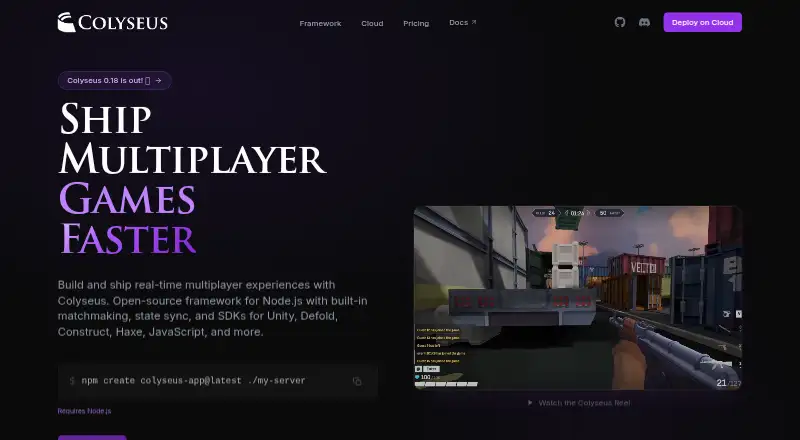
What Colyseus is
Colyseus is an open-source Node.js framework for building real-time multiplayer games, with matchmaking and state synchronization. Its authoritative server model has clients send inputs while the server decides game outcomes. Developers define game state on the server, which Colyseus synchronizes to clients without manual serialization. The framework creates rooms and matches players automatically; rooms can be distributed across processes or machines. The site says this approach can scale from 10 to 10,000+ concurrent users. SDKs or integrations are listed for JavaScript, Unity, Godot, GameMaker, Defold, Haxe, C, and Construct 3. The MIT-licensed framework is free for commercial games and can be self-hosted as a standard Node.js application on cloud platforms or bare metal. Colyseus Cloud provides deployment, scaling, and monitoring across 32 global locations. Cloud currently has no free tier or automatic scaling; heavier workloads require increasing deployment resources through the dashboard.
Good
- MIT-licensed framework is free for commercial games
- Built-in room creation and player matching
- Listed SDKs span game engines and languages
- Self-hosting and cloud hosting options
Watch out
- Colyseus Cloud has no free tier
- Cloud does not currently offer auto-scaling
Who it suits
It suits developers building real-time multiplayer games who want server-authoritative state synchronization and matchmaking. Teams can choose self-hosting or Colyseus Cloud, depending on their deployment needs.
Verdict
Colyseus provides core multiplayer framework capabilities with either self-hosted deployment or a managed cloud option. The Cloud plan’s lack of a free tier and automatic scaling matters for teams weighing managed hosting.
Plans and prices
From Colyseus's own pricing page, checked 14 Oct 2026.
| Plan | Price | What it gives you |
|---|---|---|
| Open Source | Free | Self-hosted · community support · no restrictions |
| Colyseus Cloud | $15 a month | Managed servers · SSL certificates · no CCU/DAU/MAU limits · unlimited bandwidth · email support · starting at $15/mo |
The facts
Each one read from Colyseus's own pages, with the date it was checked.
What it does
- Authentication and admin
- The official documentation describes authentication, database services and an admin panel as included parts of the stack.checked 14 Oct 2026
- Authentication integration
- The official authentication module supports email and password, anonymous authentication, password reset, and OAuth 2.0 providers.checked 29 Sep 2026
- Authoritative servers
- Colyseus uses an authoritative server architecture in which clients send inputs and the server decides what happens.checked 29 Sep 2026
- Cloud availability limit
- The Cloud hosting page says there is no free tier at this moment.checked 29 Sep 2026
- Cloud hosting
- Colyseus Cloud provides managed deployment, scaling and monitoring without requiring operators to manage servers.checked 14 Oct 2026
- Cloud locations
- Colyseus Cloud provides deployment, scaling, and monitoring across 32 global locations.checked 29 Sep 2026
- Cloud reliability
- The Cloud hosting page advertises a 99.9% uptime SLA, monitoring and alerts, and zero-downtime rolling deployments.checked 29 Sep 2026
- Cloud scaling limit
- The Cloud hosting page says auto-scaling is not currently offered, and heavier workloads require upgrading deployment resources through the dashboard.checked 29 Sep 2026
- Documentation depth
- Documentation includes getting-started guides for many engines, API references, deployment and scalability sections, recipes, FAQs and migration guides.checked 14 Oct 2026
- Engine integrations
- Official clients are listed for TypeScript, React, Unity, MonoGame, Godot, Defold, Construct 3, GameMaker, Cocos Creator, Haxe, Flutter, Swift, C, Discord Activity and WeChat.checked 14 Oct 2026
- Hosting options
- Colyseus is a standard Node.js application that can be deployed on AWS, Google Cloud, DigitalOcean, Fly.io, Railway, or bare metal.checked 29 Sep 2026
- Independent repository activity
- Hysen Labs records the project as mainly TypeScript, MIT licensed and actively maintained from recent GitHub commits.checked 14 Oct 2026
- Independent score
- FAUN.dev gives Colyseus an editorial score of 73 out of 100, with portability and pricing scoring highest and netcode quality lowest.checked 14 Oct 2026
- Installation
- The recommended server scaffold is npm create colyseus-app@latest followed by npm start.checked 14 Oct 2026
- License
- The repository is released under the MIT license, permitting commercial use, modification and redistribution with notices retained.checked 14 Oct 2026
- Limit: missing built-ins
- An independent architecture review reports that persistence, leaderboards, friends and other live-ops features historically required separate systems.checked 14 Oct 2026
- Limit: Node.js dependency
- The Hysen Labs review says Colyseus is unsuitable when the server backend cannot run Node.js.checked 14 Oct 2026
- Limit: operations burden
- The Hysen Labs review notes that self-hosters must provision and monitor infrastructure such as Redis and load balancers.checked 14 Oct 2026
- Limit: pre-1.0 changes
- The Hysen Labs review warns that pre-1.0 minor releases can include breaking changes and require coordinated SDK upgrades.checked 14 Oct 2026
- Matchmaking and scale
- The framework provides automatic room creation and player matching, and its site says it can scale from 10 to 10,000+ concurrent users by distributing rooms across processes or machines.checked 29 Sep 2026
The company
- Company headquarters
- LinkedIn lists the headquarters as Sapiranga, Brazil.checked 14 Oct 2026
- Company size
- LinkedIn lists Colyseus Multiplayer Framework as a self-owned company with one employee.checked 14 Oct 2026
- Founded
- LinkedIn lists 2016 as the founding year.checked 14 Oct 2026
- Maker identity
- The repository copyright and LinkedIn employee listing identify Endel Dreyer as the maker associated with Colyseus.checked 14 Oct 2026
The full review of Colyseus
Overview
Colyseus is a Node.js framework for real-time multiplayer game development, best suited to teams that want server-authoritative gameplay and control over hosting. Its open-source core and multiple deployment paths make it flexible, though the managed Cloud option lacks both a free tier and automatic scaling.
Developers define game state on the server, where outcomes are decided from player inputs; Colyseus synchronizes that state to clients without manual serialization. Automatic room creation and matchmaking cover common multiplayer infrastructure needs. The framework is MIT licensed and free for commercial games, so teams can use the core without buying a hosting plan.
Colyseus spans Game Networking Middleware, Game Backend Services, and Game Matchmaking Software. Founded in 2016, it supports a hybrid deployment model: self-host the standard Node.js application or use Colyseus Cloud.
Key features
Authoritative play and state sync
Keeping decisions on the server gives developers a central authority for game outcomes, while automatic state synchronization removes a repetitive networking task. This approach suits games that need server-controlled rules; teams still define the game state and logic themselves.
Rooms, matchmaking and scaling
Automatic room creation and player matching reduce the need to build those multiplayer foundations separately. Colyseus says it can scale from 10 to 10,000+ concurrent users by distributing rooms across processes or machines. That offers a stated scaling path, but the actual workload still depends on deployment resources and game demands.
SDKs, authentication and operations
SDKs or integrations are listed for JavaScript, Unity, Godot, GameMaker, Defold, Haxe, C, and Construct 3, giving teams a range of engine choices. The official authentication module supports email and password, anonymous sign-in, password reset, and OAuth 2.0 providers.
Colyseus Cloud provides deployment, scaling, and monitoring across 32 global locations, along with monitoring and alerts, zero-downtime rolling deployments, and a 99.9% uptime SLA. It does not currently auto-scale, however: heavier workloads require upgrading deployment resources through the dashboard. Teams can instead deploy the Node.js app on AWS, Google Cloud, DigitalOcean, Fly.io, Railway, or bare metal.
Pricing
The pricing model is freemium, with an open-source option and a paid managed-hosting plan. The free core is the strongest fit for teams prepared to operate their own servers; Cloud is for teams that want Colyseus-managed deployment and email support.
| Plan | Price | Includes | Best for |
|---|---|---|---|
| Open Source | free | Self-host on your own servers, community support, no restrictions | Teams comfortable managing infrastructure themselves |
| Colyseus Cloud | $15 a month | Starting at $15/mo; no CCU/DAU/MAU limits, unlimited bandwidth, managed SSL certificates, support by email | Teams seeking managed hosting without player-count or bandwidth quotas |
The open-source plan removes software restrictions but does not provide managed hosting. Cloud starts at $15/mo and advertises generous usage allowances, but its lack of a free tier means there is no no-cost way to run a managed deployment. Its lack of automatic scaling also means growing workloads may require manual resource upgrades.
Platforms
Colyseus supports Android, iOS, Linux, macOS, web, and Windows, as well as API and self-hosted deployments. This breadth suits cross-platform games, while the Node.js framework and listed SDKs give developers several routes to connect engines and clients.
Who it's for
Colyseus is a strong fit for multiplayer game teams that want an open-source, server-authoritative foundation with built-in matchmaking and state synchronization. It especially suits developers who value self-hosting flexibility or can justify managed Cloud hosting. Teams that require free managed hosting or automatic Cloud scaling should look elsewhere or plan to manage infrastructure independently.
Pros and cons
Pros
- Commercial-friendly open source: The MIT-licensed framework is free for commercial games, and the self-hosted plan has no restrictions.
- Core multiplayer services included: Automatic rooms, matchmaking, and state synchronization reduce the amount of networking infrastructure developers must build themselves.
- Broad engine reach: SDKs and integrations cover JavaScript, Unity, Godot, GameMaker, Defold, Haxe, C, and Construct 3.
- Flexible hosting: Teams can self-host across several cloud providers or bare metal, or choose Cloud across 32 global locations.
Cons
- Cloud has no free tier: Managed hosting starts at $15/mo, so experimentation on Cloud is not free.
- No Cloud auto-scaling: Teams with heavier workloads must upgrade deployment resources through the dashboard rather than rely on automatic scaling.
- Self-hosting carries infrastructure responsibility: The free plan includes community support, while Cloud adds email support; teams choosing the former must operate their own servers.
Alternatives
Choose Photon Quantum if its free plans, including a development-only 20 CCU option and a separate Free 100 CCU plan, better suit a capped or development-focused workload.
SmartFoxServer is another freemium option with a Community Edition that allows 100 concurrent users and has no time limit.
Choose Photon Fusion if a free 100 CCU plan for one games-only app, with approximate 40k MAU and 0.3 TB monthly traffic, better fits your limits.
Photon Realtime offers a development-only free plan capped at 20 concurrent users and 60.0 GB traffic per month.
Consider FishNet for a Unity networking solution with no CCU caps or paywalls on its free plan.
Netick is a free option for server-authoritative, state-sync networking for Unity, with interest management and lag compensation reserved for Pro.
Choose Normcore if its free Public plan, with unlimited applications, concurrent users, and rooms, is a better match for your needs.
Mirror Networking is a free, open-source MIT option with no paywalls or CCU costs.
Browse Game Matchmaking Software or Game Leaderboard Software for more category options.
Verdict
Choose Colyseus if you want a commercial-friendly multiplayer framework with server authority, built-in matchmaking, synchronized state, and the freedom to self-host or move to managed Cloud. The principal reason to look elsewhere is Cloud's paid entry point and lack of automatic scaling; teams unwilling to manage servers should weigh those constraints before committing.
Alternatives to Colyseus
- 1
BrowserGap
Free planWebAPILinuxmacOS7.5$3.81 one-time - 2
Faye
Free planOpen sourceWebAPILinuxmacOS7.5Free plan - 3

PubNub Chat
Free planAndroidiOSWebAPI7.5From $98 a month - 4
Scaledrone
Free planAndroidiOSWebAPI7.4From $19 a month - 5
Lightstreamer
Free planAndroidiOSWebAPI7.1Free plan - 6
Wren
Free planOpen sourceAPIExtensionmacOS7.1Free plan