
Crux
Crux provides multiplayer game backend services for authentication, persistent data, leaderboards, economies, server registration, live configuration and mat…
What Crux is
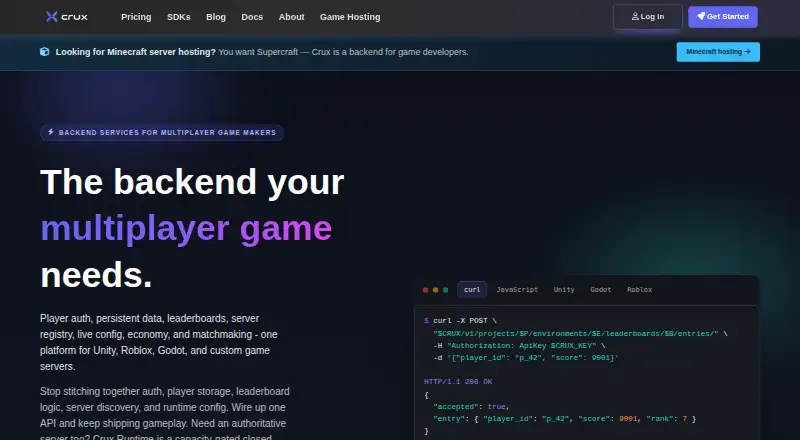
Crux provides multiplayer game backend services for authentication, persistent data, leaderboards, economies, server registration, live configuration and matchmaking. Authentication includes email and password, guest sessions, Google, GitHub and Discord OAuth, plus Roblox verification. Developers can store player- or project-scoped JSON documents and create ranked or seasonal leaderboards with configurable rules and recurring resets. Economy tools manage currencies, virtual items and inventories through atomic, server-authoritative updates. Matchmaking groups players by game mode and region and assigns them to live servers. Listed integrations include Unity, Roblox, Godot and custom game servers, with client SDKs for JavaScript, Godot, Unity and Roblox. The hosted API is documented with OpenAPI; the SDKs are MIT-licensed, while the managed backend is proprietary. Crux Runtime is a capacity-gated closed alpha for Godot 4 Linux dedicated-server exports. Runtime evaluation for admitted Dev projects is limited to three lifetime hours, one concurrent session and a one-hour session cap; self-hosting is not a shipping feature.
Good
- Supports several authentication methods, including Roblox verification.
- Offers ranked and seasonal leaderboards.
- Economy tools handle currencies, items and inventories.
- Provides SDKs for JavaScript, Godot, Unity and Roblox.
- Dev plan includes all BaaS features.
Watch out
- Runtime is a capacity-gated closed alpha.
- Admitted Dev projects get three lifetime Runtime evaluation hours.
- Self-hosting is not a shipping feature.
- Managed backend is proprietary.
Who it suits
Crux is aimed at indie and mid-size teams building dedicated-server multiplayer survival or co-op games. It is less suited to offline single-player games.
Verdict
Crux covers core backend needs for multiplayer projects, with a free Dev plan and paid plans from $10 a month. Its intended fit and Runtime limitations are worth checking before choosing it.
Plans and prices
From Crux's own pricing page, checked 4 Oct 2026.
| Plan | Price | What it gives you |
|---|---|---|
| Dev | Free | 10,000 MAU/month · 2M API calls · 10 req/s peak · 3 active servers · unlimited projects · 2 environments each · all BaaS features · Runtime evaluation: 3 lifetime hours when admitted · community support · no credit card · $0 forever |
| Launch | $10 a month | 25,000 MAU/month · 25M API calls · 100 req/s peak · 100 active servers · 4 environments · one project · 50 GB player documents · email support · $10 / month |
| Scale | $79 a month | 500,000 MAU/month · 500M API calls · 1,000 req/s peak · 2,000 active servers · 8 environments · one project · 1 TB player documents · priority email support · $79 / month |
| Custom | Priced on request | Custom MAU and API limits · custom project and environment limits · custom storage and resource limits · support terms agreed with your team · Commercial terms by agreement |
The facts
Each one read from Crux's own pages, with the date it was checked.
What it does
- API and SDK licensing
- The hosted API is documented as OpenAPI, client SDKs are MIT-licensed, and the managed backend is proprietary.checked 4 Oct 2026
- Authentication
- Player authentication supports email and password, guest sessions, Google, GitHub and Discord OAuth, and Roblox verification.checked 4 Oct 2026
- Data and leaderboards
- Crux stores player-scoped and project-scoped JSON documents and offers ranked and seasonal leaderboards with configurable rules and recurring resets.checked 4 Oct 2026
- Data portability
- The maker states that stored players, documents, leaderboard entries, economy balances, and config bundles are readable through the API and promises advance notice and an export window if Crux winds down.checked 4 Oct 2026
- Game economy
- The economy feature supports currencies, virtual items, and inventories with atomic server-authoritative updates.checked 4 Oct 2026
- Integrations
- The maker lists Unity, Roblox, Godot, and custom game servers as supported integrations, and publishes JavaScript, Godot, Unity, and Roblox client SDKs.checked 4 Oct 2026
- Intended users
- Crux says it is best suited to dedicated-server and multiplayer survival or co-op games, including indie and mid-size studios, and less suited to offline single-player games.checked 4 Oct 2026
- Limits
- Runtime evaluation for admitted Dev projects is limited to three lifetime hours, one concurrent session, and a one-hour session cap; self-hosting is not a shipping feature.checked 4 Oct 2026
- Matchmaking and registry
- Matchmaking queues by game mode and region and assigns players to live servers from the dedicated server registry.checked 4 Oct 2026
- Privacy
- The maker says player data is processed on the game developer's behalf, and states that it does not sell personally identifying profile data to third parties.checked 4 Oct 2026
- Product
- Crux provides multiplayer game backend services including player authentication, persistent data, leaderboards, server registry, live config, economy, and matchmaking.checked 4 Oct 2026
- Runtime
- Crux Runtime is a capacity-gated closed alpha that runs Godot 4 Linux dedicated-server exports as isolated EU processes.checked 4 Oct 2026
- Security
- Crux describes PostgreSQL row-level security, environment isolation, and separate API key, server token, and player JWT access modes.checked 4 Oct 2026
- Support
- Dev includes community support, Launch includes email support, and Scale includes priority email support.checked 4 Oct 2026
The full review of Crux
Crux is a hosted backend for games with multiplayer progression and live servers. It best suits indie and mid-size teams making dedicated-server survival or co-op games; offline single-player projects are a poor fit. Its broad backend toolkit and free entry plan are appealing, but Runtime remains a tightly limited alpha.
Overview
Crux brings authentication, persistent data, leaderboards, economy, server registration and matchmaking into one managed service. For a small team, that can mean fewer separate backend components to integrate. The tradeoff is that the managed backend is proprietary: the hosted API is documented with OpenAPI and client SDKs are MIT-licensed, but those terms do not make the backend itself open source.
Authentication covers email and password, guest sessions, Google, GitHub and Discord OAuth, plus Roblox verification. Player- and project-scoped JSON documents support persistent state. Ranked and seasonal leaderboards have configurable rules and recurring resets, while server-authoritative atomic economy updates help protect currencies, items and inventories. Matchmaking queues by game mode and region, then assigns players to live servers in the registry.
Key features
Progression and live operations
Remote configuration, live event tools, data, rankings and economy features provide a useful base for games that evolve after launch. Crux does not offer player segmentation or experimentation, so teams that need those capabilities will need another approach.
Runtime and deployment
Crux Runtime runs Godot 4 Linux dedicated-server exports as isolated processes in the EU, but it is a capacity-gated closed alpha, not a general production hosting promise. Admitted Dev projects get just three lifetime evaluation hours, one concurrent session and a one-hour session cap. Self-hosting is not a shipping feature, which makes Crux a weaker choice for teams that require control over server deployment.
Security and portability
PostgreSQL row-level security, environment isolation and separate API key, server token and player JWT access modes provide distinct controls for different parts of a game backend. Crux says it processes player data on the developer's behalf and does not sell personally identifying profile data to third parties. Stored players, documents, leaderboard entries, economy balances and config bundles can be read through the API; Crux also promises advance notice and an export window if it winds down.
Pricing
Dev costs nothing, billed $0 forever, with no credit card required. It includes 10,000 MAU/month, 2M API calls, a 10 req/s peak, three active servers, unlimited projects, two environments each and all BaaS features, plus community support. This is a generous way to build and evaluate the backend, but the Runtime allowance is only three lifetime hours when admitted.
Launch costs $10 a month, billed $10 / month. It raises the caps to 25,000 MAU/month, 25M API calls, 100 req/s peak and 100 active servers, and adds four environments, one project, 50 GB of player documents and email support. It is the practical step up for one project that has outgrown Dev's quotas, but gives up Dev's unlimited project count.
Scale costs $79 a month, billed $79 / month. It includes 500,000 MAU/month, 500M API calls, 1,000 req/s peak, 2,000 active servers, eight environments, one project, 1 TB of player documents and priority email support. This is aimed at a substantially larger service; it retains the one-project limit despite the higher capacity.
Custom has custom pricing, with commercial terms by agreement and limits for MAU, API calls, projects, environments, storage and resources set to fit the agreement; support terms are agreed with your team. It is the route for requirements beyond the fixed plans, but the cost and terms depend on negotiation.
Platforms
Crux lists Android, iOS, Linux, macOS, web, Windows and API support. Its integrations include Unity, Roblox, Godot and custom game servers, with JavaScript, Godot, Unity and Roblox client SDKs. Godot 4 is the stated engine for Runtime, so teams using another engine should distinguish integration support from Runtime hosting.
Who it's for
Crux is most compelling for indie and mid-size studios building multiplayer survival or co-op games around persistent player data, economies and dedicated servers. It is less suited to offline single-player games, or to teams that need production Runtime hosting today, self-hosting, player segmentation or experimentation.
Pros and cons
- Pros: A single service covers accounts, persistence, rankings, economy and matchmaking, reducing the need to assemble those backend basics separately.
- Pros: Dev has no charge, no credit-card requirement, unlimited projects and all BaaS features, giving teams room to build before committing to a paid plan.
- Pros: API-readable data and the promised wind-down export window give developers a clearer path to retrieve core game records.
- Cons: Runtime is a closed alpha with strict evaluation caps, and self-hosting is not a shipping option.
- Cons: Launch and Scale each allow one project, while Dev's quotas are much lower than the paid tiers.
- Cons: No player segmentation or experimentation limits Crux for teams whose live-ops workflow depends on either capability.
Alternatives
For a broad selection of services in the category, browse Game LiveOps Software; for ranking-focused options, see Game Leaderboard Software.
- BACKND is another freemium option with a free plan and chat-focused features, including translation.
- brainCloud is a freemium alternative with self-hosted support among its platforms.
- Metaplay offers local development with its full SDK and local server, with no hard limits on local development.
- GameAnalytics is worth considering when analytics is the priority: its free plan has no MAU limits and includes dashboards, events, funnels, cohorts, retention and real-time reporting.
- Hyperstone is another freemium option with a free plan and self-hosted support.
- Ondara Game Services is another freemium game services option.
- PlayFab is another freemium option with a free-to-start plan for development.
- AccelByte Gaming Services offers free cloud foundations while building, with usage fees as players arrive; consider it when that pricing structure better suits your rollout.
Verdict
Choose Crux if you are building a persistent multiplayer survival or co-op game and want authentication, progression, economy and matchmaking under one managed backend, with a substantial free plan for early development. Look elsewhere if you need mature server hosting, self-hosting, segmentation or experimentation: Runtime's alpha limits make it an evaluation feature, not the reason to commit to Crux for production.
Getting started
- Open the Crux website
- Choose the free Dev plan or a paid plan
- Create a project and environments within the selected plan
- Integrate the JavaScript, Godot, Unity or Roblox SDK
- Connect your game server through the documented hosted API
- Use the dedicated-server registry and matchmaking services
Limits worth knowing
The free Dev plan allows 10,000 MAU per month, 2 million API calls, 10 requests per second, three active servers and two environments per project. Admitted Dev projects receive three lifetime Runtime hours, one concurrent session and a one-hour session cap; Launch and Scale add higher quotas but restrict accounts to one project.
Questions
Is there a free plan?
Yes. Dev is billed at $0 forever and does not require a credit card.
What does the first paid plan cost?
Launch costs $10 a month.
Which game engines are supported?
Crux lists Unity, Roblox and Godot 4, plus custom game servers, and publishes JavaScript, Godot, Unity and Roblox client SDKs.
Is Crux open source?
The client SDKs are MIT-licensed. The managed backend is proprietary, and its hosted API is documented with OpenAPI.
Does Crux provide live configuration?
Yes. Live configuration and live event tools are listed, while player segmentation and experimentation are not.
Alternatives to Crux
- 1

Colyseus
Free planOpen sourceAndroidiOSWebAPI8.5From $15 a month - 2

Unity
Free planAndroidiOSWebAPI8.4Free plan - 3
PlayFab
Free planAndroidiOSWebAPI8.3$99 usage-based - 4

AccelByte Gaming Services
Free planAndroidiOSWebAPI8.2From $1,000 a month - 5

brainCloud
Free planAndroidiOSWebAPI8.2From $5 a month - 6

Metaplay
Free planAndroidiOSWebAPI8.2From €195 a month