
GO Feature Flag
GO Feature Flag is an open-source feature flag management system built on OpenFeature for deployment on infrastructure you control.
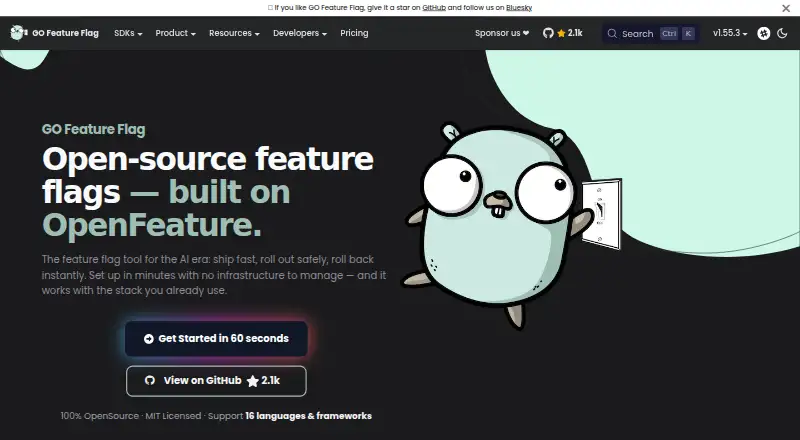
What GO Feature Flag is
GO Feature Flag is an open-source feature flag management system built on OpenFeature for deployment on infrastructure you control. Its relay proxy runs locally with Docker and a flag configuration file, supporting self-hosted operation across Android, iOS, Linux, macOS, Windows, web, and APIs. You can target users and segments, release changes through percentage or progressive rollouts, schedule flag updates, and run A/B tests. Client and server SDKs cover JavaScript, TypeScript, React, Angular, Swift, Kotlin/Android, Go, Java, .NET, Python, Node.js, PHP, Ruby, Rust, and NestJS. Configuration retrievers load data from HTTP(S), local files, Kubernetes ConfigMaps, cloud storage, Git providers, MongoDB, Redis, and PostgreSQL. Exporters send evaluation data to Kafka, AWS S3, Google Cloud BigQuery, OpenTelemetry, webhooks, or application logs. Change notifications can reach Slack, Discord, Microsoft Teams, webhooks, or logs. Go interfaces support custom retrievers, exporters, and notifiers. The maker states that flag evaluation and usage data remain in your environment. The MIT-licensed Opensource plan costs nothing, billed forever, with all features, unlimited flags, and community support.
Good
- MIT-licensed open-source project permits commercial use
- Free forever plan includes all features and unlimited flags
- Supports targeting, segments, progressive rollouts, scheduling, and A/B tests
- SDKs cover 16 listed languages and frameworks
- Configuration and data integrations cover many infrastructure services
- Evaluation and usage data stay in your environment
Watch out
- Free plan includes community support only
- Enterprise support and SLA features require the Enterprise plan
- Self-hosted deployment requires infrastructure you already control
Who it suits
GO Feature Flag suits teams that want self-hosted feature management, OpenFeature compatibility, and releases separated from deployments. It is also suited to organizations needing broad SDK coverage, configurable integrations, and control over evaluation data.
Verdict
Pick GO Feature Flag if your team needs an open-source, self-hosted system with OpenFeature support and extensive rollout controls. Look elsewhere if you require included premium support or an SLA on CVE fixes.
Plans and prices
From GO Feature Flag's own pricing page, checked 7 Oct 2026.
| Plan | Price | What it gives you |
|---|---|---|
| Opensource | Free | All features · own infrastructure · unlimited feature flags · community support only · forever |
| Enterprise | Priced on request | Premium support · SLA on CVE fixes · direct maintainer communication · integration help · roadmap preview · team training |
The facts
Each one read from GO Feature Flag's own pages, with the date it was checked.
What it does
- Audience
- The maker describes the product as a feature management solution for teams seeking self-hosting, OpenFeature compatibility, and feature releases decoupled from deployments.checked 7 Oct 2026
- Configuration integrations
- Built-in retrievers load flag configuration from HTTP(S), local files, Kubernetes ConfigMaps, cloud storage, Git providers, MongoDB, Redis, and PostgreSQL.checked 7 Oct 2026
- Data control
- The maker says the product is self-hosted and that flag evaluation and usage data stay in the customer's environment.checked 7 Oct 2026
- Data integrations
- Exporters can send evaluation data to destinations including Kafka, AWS S3, Google Cloud BigQuery, OpenTelemetry, webhooks, and application logs.checked 7 Oct 2026
- Deployment
- The relay proxy can be started locally with a Docker command and uses a flag configuration file.checked 7 Oct 2026
- Extensibility
- Custom retrievers, exporters, and notifiers can be implemented through Go interfaces.checked 7 Oct 2026
- Flag management
- The product supports targeting users and segments, percentage and progressive rollouts, scheduled changes, and A/B testing.checked 7 Oct 2026
- License
- The project is 100% open source under the MIT license, and the site says the license permits commercial use.checked 7 Oct 2026
- Notifications
- The product can notify teams about flag configuration changes through Slack, Discord, Microsoft Teams, webhooks, or application logs.checked 7 Oct 2026
- Product
- GO Feature Flag is an open-source feature flag management system built on OpenFeature and designed to run on infrastructure you already have.checked 7 Oct 2026
- SDKs
- The site lists client and server SDKs for 16 languages and frameworks, including JavaScript, React, Swift, Kotlin, Go, Java, Python, .NET, Ruby, and Rust.checked 7 Oct 2026
- Support
- Community support is included with the free plan; paid enterprise support includes premium support and an SLA on CVE fixes.checked 7 Oct 2026
The full review of GO Feature Flag
GO Feature Flag is an open-source flag management system built on OpenFeature. It is best suited to teams that want to run release controls on infrastructure they own and connect flagging to a broad range of application stacks. The free, unlimited-flag offering is unusually capable, while premium support and vulnerability-fix commitments are reserved for enterprise customers.
Overview
The project is released under the MIT license, including permission for commercial use. Its relay proxy can be launched locally with Docker and reads a flag configuration file, so teams can fit it into infrastructure they already operate rather than adopt a separate hosted control plane. That is a strong match for organisations that need evaluation and usage data to remain in their environment, but it also makes operational responsibility their own.
OpenFeature compatibility gives the system a standards-based foundation, and its purpose is to separate feature releases from application deployments. The free service comes with community support; teams that need a formal support relationship must move to enterprise.
Key features
Targeting rules cover individual users and segments, while percentage and progressive rollouts support gradual exposure. Scheduled changes are useful for timed launches, and A/B testing adds an experimentation path alongside ordinary release management. Together, these controls suit teams that need staged delivery rather than simple on-or-off switches.
Client and server SDKs span 16 languages and frameworks, including JavaScript, TypeScript, React, Angular, Swift, Kotlin/Android, Go, Java, .NET, Python, Node.js, PHP, Ruby, Rust, and NestJS. That breadth reduces the need to build separate flag plumbing for mixed technology estates, although the self-hosted service still needs to be maintained by the customer.
Built-in retrievers can read configuration from HTTP(S), local files, Kubernetes ConfigMaps, cloud storage, Git providers, MongoDB, Redis, and PostgreSQL. Exporters send evaluation data to Kafka, AWS S3, Google Cloud BigQuery, OpenTelemetry, webhooks, or application logs, allowing teams to connect flag activity to existing data and observability systems. Notifications can reach Slack, Discord, Microsoft Teams, webhooks, or logs when configuration changes. Go interfaces allow custom retrievers, exporters, and notifiers, which is valuable when standard connectors do not match an internal platform.
Pricing
Opensource
The Opensource plan costs nothing, billed forever. It includes all features, runs on your own infrastructure, allows unlimited feature flags, and provides community support only. There are no per-seat or flag-count charges stated, making it a practical default for teams comfortable operating the relay and handling their own support.
Enterprise
Enterprise uses custom pricing. It adds premium support, an SLA on CVE fixes, direct maintainer communication, integration help, roadmap previews, and team training. Choose it when response commitments, guided integration, or a formal security-fix obligation matter more than keeping the service entirely self-supported.
Platforms
GO Feature Flag supports Android, iOS, Linux, macOS, Windows, web, API, and self-hosted deployments. The SDK coverage makes it suitable for organisations delivering across mobile, desktop, web, and server environments.
Who it's for
This is a strong fit for engineering teams that require self-hosting, OpenFeature compatibility, extensive rollout controls, and strict control over evaluation data. It is less suitable for organisations that want a fully managed service or included vendor-backed support without purchasing enterprise coverage.
Pros and cons
- Pros: The MIT license permits commercial use; unlimited flags and all features are included in the free plan; rollout, scheduling, segmentation, and A/B testing cover sophisticated release workflows; SDKs and integrations span diverse stacks and infrastructure; self-hosting keeps evaluation and usage data in the customer environment.
- Cons: The free plan offers community support only; operating the relay, configuration sources, and integrations remains the customer's responsibility; premium support and an SLA on CVE fixes require custom-priced enterprise service.
Alternatives
Feature Flag Software is the broader category starting point for comparing other tools.
Flagsmith is worth choosing if you prefer a freemium product with a free trial and open-source core functionality under a BSD-3 licence.
Featurevisor is a straightforward alternative for MIT-licensed self-hosting with no per-seat pricing.
Unleash suits teams wanting an open-source plan with one project, two environments, and up to 5,000 feature flags per instance.
ConfigCat is a better fit for a managed free tier capped at 10 flags, two environments, two products, and 5 million config JSON downloads per month.
Featureflip is an option for teams comfortable with a small, explicitly capped free workspace.
Flipt is an alternative for Git-native workflows with UI synchronisation and unlimited flags on its open-source plan.
feat fits teams seeking hosted limits such as 7,500 monthly active users, 100 server connections, and two projects on its free tier.
Featureflow is suited to small teams wanting a free hosted plan with up to five seats, one project, two environments, and 1 million SDK requests per month.
Verdict
Choose GO Feature Flag if you need an MIT-licensed, self-hosted OpenFeature system with unlimited flags, deep rollout controls, and extensive integration options. Look elsewhere if your priority is a managed service or guaranteed vendor support and CVE response without moving to custom-priced enterprise.
Getting started
- Visit https://gofeatureflag.org/
- Choose the free Opensource plan or review Enterprise support options
- Prepare a flag configuration file
- Start the relay proxy locally with Docker
- Connect an SDK for your application language or framework
- Configure retrievers, exporters, and notifications as needed
Limits worth knowing
The Opensource plan is free forever and includes all features and unlimited feature flags, but support is community-only. Premium support, an SLA on CVE fixes, direct maintainer communication, integration help, roadmap previews, and team training are part of Enterprise.
Questions
Is GO Feature Flag open source?
Yes. The project is 100% open source under the MIT license, which the site says permits commercial use.
Where can it run?
Listed platforms include Android, API, iOS, Linux, macOS, self-hosted environments, web, and Windows.
Which integrations are available?
Retrievers support HTTP(S), local files, Kubernetes ConfigMaps, cloud storage, Git providers, MongoDB, Redis, and PostgreSQL. Exporters and notifications support destinations including Kafka, AWS S3, BigQuery, OpenTelemetry, Slack, Discord, Microsoft Teams, webhooks, and logs.
Does it offer SDKs?
Yes. Client and server SDKs are listed for JavaScript, TypeScript, React, Angular, Swift, Kotlin/Android, Go, Java, .NET, Python, Node.js, PHP, Ruby, Rust, and NestJS.
Alternatives to GO Feature Flag
- 1
Flagsmith
Free planOpen sourceAndroidiOSWebAPI8.5From $40 a month - 2

GrowthBook
Free planOpen sourceAndroidiOSWebAPI8.5From $40 a month - 3
Unleash
Free planOpen sourceAndroidiOSWebAPI8.5Free plan - 4

Statsig
Free planAndroidiOSWebAPI8.1From $150 a month - 5

DevCycle
Free planAndroidiOSWebAPI8.0From $625 a month - 6

Bucketeer
Free planOpen sourceAndroidiOSWebAPI7.9Free plan