Featurevisor
Featurevisor is a free, Git-based tool for managing feature flags, experiments, and remote configuration.
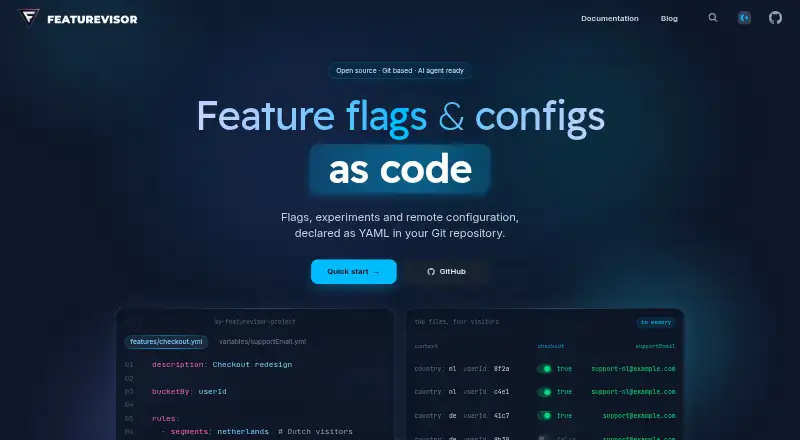
What Featurevisor is
Featurevisor is a free, Git-based tool for managing feature flags, experiments, and remote configuration. Teams define settings in YAML in a Git repository, build datafiles for each environment, deploy them, and use an SDK to evaluate features. Rules can target users in order, roll out a percentage of traffic, or assign weighted experiment variations. Typed global and feature variables support defaults and targeted overrides, with schemas checked during datafile builds.
Applications retrieve static JSON datafiles and evaluate flags locally in memory, so each decision does not require a network request. Datafiles are served from the customer’s own CDN. Teams can write YAML tests for local or CI checks; failed assertions produce a non-zero exit. Git pull requests and CI linting, tests, and builds provide change control. Featurevisor is self-hosted, MIT-licensed, and listed as free, with no per-seat charge. SDKs and integrations cover multiple languages and frameworks, while CI/CD guides include GitHub Actions, GitHub Pages, Cloudflare Pages, and PartyKit.
Good
- Supports ordered targeting rules and percentage rollouts.
- Evaluates flags locally from static JSON datafiles.
- YAML tests can run locally or in CI.
- Self-hosted, MIT-licensed, and free with no per-seat pricing.
Watch out
- Requires teams to build and deploy datafiles.
- Datafiles must be served from the customer's own CDN.
Who it suits
Featurevisor suits development teams that want Git-based control over feature delivery, experiments, and configuration. It is also relevant to teams seeking local flag evaluation and self-hosted deployment.
Verdict
Featurevisor brings feature management into a Git and CI workflow, with local evaluation and configurable targeting. Its self-hosted approach avoids per-seat pricing, but teams are responsible for building and serving the datafiles.
Plans and prices
From Featurevisor's own pricing page, checked 14 Oct 2026.
| Plan | Price | What it gives you |
|---|---|---|
| Featurevisor | Free | Open-source project · self-hosted Git workflow · no paid tier stated · Free to use |
The facts
Each one read from Featurevisor's own pages, with the date it was checked.
What it does
- Analytics
- Weighted experiments can connect to whichever analytics tool the customer already uses, and the docs include a Google Analytics tracking guide.checked 4 Oct 2026
- Catalog tool
- The CLI can generate a searchable read-only Catalog showing definitions, relationships, tests and Git history.checked 14 Oct 2026
- CI/CD integrations
- The docs include CI/CD guides for GitHub Actions, GitHub Pages, Cloudflare Pages and PartyKit.checked 4 Oct 2026
- Cloudflare integration
- The documentation provides GitHub Actions workflows that lint, test, build and upload datafiles to Cloudflare Pages.checked 14 Oct 2026
- Configuration
- Typed global and feature variables support defaults and targeted overrides, with schemas validated when datafiles are built.checked 4 Oct 2026
- Deployment
- Datafiles are served from the customer’s own CDN, with no vendor in the request path.checked 4 Oct 2026
- Deployment model
- The generated datafiles can be hosted on any CDN or static file service chosen by the customer.checked 14 Oct 2026
- Documentation depth
- The documentation covers concepts, quick start, attributes, segments, features, variables, targets, projects, configuration, linting, building, testing, deployment and SDKs.checked 14 Oct 2026
- Environment handling
- Definitions can contain separate environment rules, while Sets provide independent project trees that can be promoted between stages.checked 14 Oct 2026
- Evaluation
- Applications fetch static JSON datafiles and evaluate flags locally in memory without a network request for each decision.checked 4 Oct 2026
- Experiments
- Features can define weighted string variations for A/B and multivariate experiments.checked 14 Oct 2026
- Extensibility
- Featurevisor has a Plugins API for extending CLI functionality.checked 14 Oct 2026
- Feature controls
- Features support ordered targeting rules, percentage rollouts and weighted variations for experiments.checked 4 Oct 2026
- Feature flags
- Boolean flags use ordered targeting rules whose first matching rule determines the result.checked 14 Oct 2026
- GitOps workflow
- Changes are made through pull requests, CI linting and tests, datafile builds, and deployment to a customer-controlled CDN.checked 14 Oct 2026
- Licence
- The GitHub repository is publicly marked as MIT licensed.checked 14 Oct 2026
- Limit: migration tooling
- The FAQ states that Featurevisor does not yet provide an import migration tool for features and experiments from another service.checked 14 Oct 2026
- Limit: no editing dashboard
- The FAQ says feature changes are made in YAML or JSON files in Git and that there is no UI for managing them.checked 14 Oct 2026
- Limit: no public OpenAPI
- The Headless Index reports that it found no published OpenAPI specification and therefore could not compute its JAIRF rating.checked 14 Oct 2026
- Limit: operational responsibility
- Independent analysis notes that teams must build and deploy static datafiles themselves and operate the self-hosted workflow.checked 14 Oct 2026
- Limit: public transparency
- SaaS Ranking reports a 0/100 transparency score and says it found no public pricing, DPA, subprocessor list, named certifications or uptime SLA at checked addresses.checked 14 Oct 2026
The company
- Company affiliation
- GitNation identifies Fahad Heylaal as Featurevisor’s creator and lists DAZN in the Netherlands as his company affiliation.checked 14 Oct 2026
- Founded
- The project’s first public v0.1 announcement is dated March 5, 2023.checked 14 Oct 2026
- License and maker
- The site identifies the project as MIT-licensed and says it is built by Fahad Heylaal.checked 4 Oct 2026
The full review of Featurevisor
Featurevisor is a Git-based feature management tool for teams that define flags, experiments and remote configuration in YAML. It is best suited to engineering teams already comfortable with Git, CI and operating their own delivery infrastructure. Its local evaluation model keeps the vendor out of application requests, in exchange for owning the datafile build-and-serve workflow.
Overview
Featurevisor makes feature changes part of the software delivery process: teams define them in a repository, build environment-specific datafiles, and deploy those files for SDKs to evaluate. Ordered targeting rules, percentage rollouts and weighted experiment variations cover common release and testing needs, while typed variables allow defaults and targeted overrides. Schema validation at build time helps catch configuration errors before deployment.
Applications fetch static JSON datafiles and evaluate features locally in memory, rather than making a network request for every decision. That keeps the decision path independent of a live evaluation service, but teams must build and serve the datafiles from their own CDN. This is a strong fit for teams that value control over infrastructure and change history; it is less suitable for those seeking a managed service to handle delivery.
Key features
- Targeting and experimentation: Ordered rules and percentage rollouts support gradual releases, while weighted variations enable A/B and multivariate experiments. Experiments can use the customer’s existing analytics tool; a Google Analytics tracking guide is provided.
- Typed configuration: Global and feature variables accept defaults and targeted overrides. Build-time schema validation makes configuration mistakes easier to catch in the same workflow as code changes.
- Local evaluation: SDKs evaluate fetched JSON datafiles in memory without a per-decision network request. This avoids putting a vendor service in the request path, but makes reliable datafile deployment the team’s responsibility.
- Git and CI controls: Pull requests, CI linting, tests and builds govern changes. Production values can be traced to commits, reviewers and builds, which suits teams that want feature changes to follow established review controls.
- Testable behavior: YAML test specifications assert expected feature behavior locally or in CI; a failed assertion returns a non-zero exit, so it can fail a pipeline.
- SDKs and integrations: SDK documentation covers JavaScript, Node.js, browsers, Go, Python, PHP, Ruby, Java, Kotlin, Swift, Rust and Elixir, alongside framework guides and optional OpenFeature providers. CI/CD guides cover GitHub Actions, GitHub Pages, Cloudflare Pages and PartyKit.
Pricing
Featurevisor costs nothing. The free offering is self-hosted, has no per-seat pricing and is MIT-licensed. There is no evaluation service to keep running, but teams do need to build and serve their own datafiles. That trade-off favors organizations able to operate their own delivery path over those that want a hosted control plane.
Platforms
Featurevisor is listed for Android, API, iOS, Linux, macOS, self-hosted, web and Windows. Its SDK language coverage includes JavaScript, Node.js, browser, React, React Native, Go, Python, PHP, Ruby, Java, Swift and Next.js.
Who it's for
Featurevisor fits teams using Git-based development who want flags, experiments and remote configuration reviewed and tested alongside application changes. It is particularly relevant for progressive delivery, trunk-based development, testing in production and microfrontends. Teams without capacity to build datafiles and serve them from their own CDN should favor a managed option instead.
Pros and cons
- Pro: Local in-memory evaluation avoids a network request for each flag decision and keeps a vendor service out of the application request path.
- Pro: Git pull requests, CI checks and build-time schema validation put feature changes under familiar review and testing controls.
- Pro: The self-hosted MIT-licensed offering has no per-seat charge or evaluation service that must stay alive.
- Con: Teams must build environment-specific datafiles and serve them from their own CDN, adding operational responsibility that a hosted product can absorb.
- Con: The workflow centers on YAML, Git and CI, so teams that need feature management without that engineering process are a poorer fit.
Alternatives
For a broader comparison, see Feature Flag Software. Consider Flagsmith if a freemium product with a free plan and free trial better suits your evaluation, or if you want its open-source core feature flag functionality. GO Feature Flag is another free, self-hosted choice, with an opensource plan that includes all features, unlimited flags and community support only.
ConfigCat may suit teams looking for a freemium plan with stated monthly download and traffic quotas: its Forever Free plan includes 10 flags, 2 environments, 2 products, 5 million config JSON downloads/month and 20 GB network traffic/month. Choose Flipt if a Git-native open-source workflow with a UI and Git sync is a closer match.
feat offers a free plan capped at 7,500 MAU, 100 server connections and 2 projects, with unlimited environments and flags; that may suit teams comfortable with those usage limits. Featureflow is worth considering for its free-forever plan, which includes up to 5 seats, 1 project, 2 environments and 1M SDK requests/month.
DevCycle has a free plan with caps on client-side MAUs and monthly cloud and server configuration requests, making it an option for teams that can work within those quotas. GrowthBook is another self-hosted alternative, with an open-source plan listing one project, unlimited flags, unlimited experiments and unlimited traffic.
Verdict
Choose Featurevisor if your team wants feature management governed through Git and CI, values local evaluation, and is prepared to build and serve its own datafiles. Its strongest advantage is keeping decisions local without per-seat costs or a live vendor evaluation service. Look elsewhere if you need a hosted delivery workflow or do not want to own the infrastructure that makes the configuration available to applications.
Getting started
- Visit https://featurevisor.com/.
- Define feature flags, experiments, or remote configuration in YAML in a Git repository.
- Build environment-specific datafiles and deploy them.
- Serve the datafiles from your own CDN.
- Use an SDK to evaluate features in your application.
Questions
How much does Featurevisor cost?
Featurevisor is free, with a listed price of no cost.
Is Featurevisor open source?
Yes. The project is MIT-licensed.
How is Featurevisor hosted?
It is self-hosted, and datafiles are served from the customer's own CDN.
Which SDKs and languages are listed?
The documentation lists SDKs for JavaScript, Node.js, browsers, Go, Python, PHP, Ruby, Java, Kotlin, Swift, Rust, and Elixir, plus framework guides and optional OpenFeature providers.
Does Featurevisor have integrations?
CI/CD guides cover GitHub Actions, GitHub Pages, Cloudflare Pages, and PartyKit. Weighted experiments can connect to an existing analytics tool, and the documentation includes a Google Analytics tracking guide.
Who built Featurevisor?
The site says it is built by Fahad Heylaal.
Alternatives to Featurevisor
- 1

Flagsmith
Free planOpen sourceAndroidiOSWebAPI8.5From $40 a month - 2

GrowthBook
Free planOpen sourceAndroidiOSWebAPI8.5From $40 a month - 3
Unleash
Free planOpen sourceAndroidiOSWebAPI8.5Free plan - 4

Statsig
Free planAndroidiOSWebAPI8.1From $150 a month - 5

DevCycle
Free planAndroidiOSWebAPI8.0From $625 a month - 6

Bucketeer
Free planOpen sourceAndroidiOSWebAPI7.9Free plan