Bucketeer
Bucketeer is an open-source feature flag platform for self-hosted deployment.
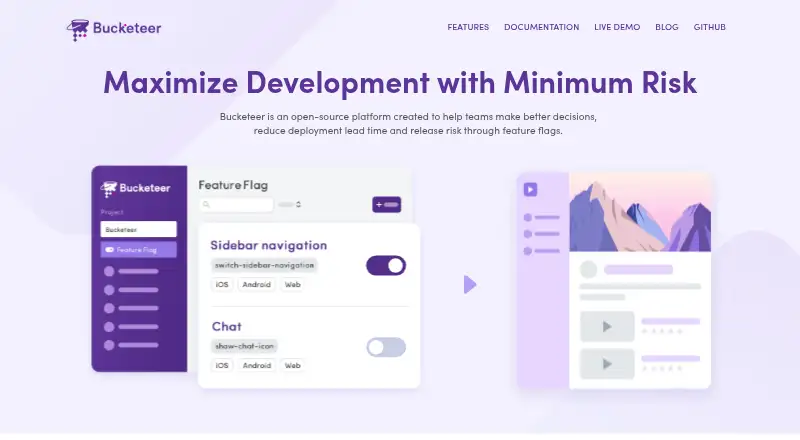
What Bucketeer is
Bucketeer is an open-source feature flag platform for self-hosted deployment. Teams can switch features on or off without deploying code and use dark launches and staged rollouts based on user attributes, devices, and segments. Other controls include progressive rollouts, reusable segments, date-based targeting, flag-based rules, and prerequisites between flags. For A/B testing, Bucketeer uses Bayesian probabilities and says this can yield results with smaller sample sizes. Automation can schedule flag changes, react to event rates, or use webhooks connected to CI/CD or APM tools such as Datadog, New Relic, and Dynatrace. Integrations include Slack notifications, Firebase Cloud Messaging updates, a RESTful HTTP API, webhooks, and OpenFeature compatibility. Governance features include environment-level Viewer, Editor, and Owner roles, audit logging, separate API keys, and environment isolation. Client SDKs cover Android, iOS, Flutter, JavaScript, React, and React Native; server SDKs cover Go and Node.js. Docker Compose and Kubernetes with Helm are deployment choices. The HTTP API is labeled Alpha.
Good
- Supports staged and progressive rollouts.
- Offers reusable segments and targeting rules.
- Includes audit logging and environment-level roles.
- Free, open-source, and self-hosted.
Watch out
- The HTTP API is labeled Alpha.
- Client SDKs evaluate remotely only.
- Self-hosting requires a deployment setup.
- No commercial support offering is listed.
Who it suits
Bucketeer suits teams seeking self-hosted feature flags, staged releases, targeting, and experiment controls. It may appeal to teams that can work with an HTTP API labeled Alpha.
Verdict
Bucketeer combines feature controls, targeting, and integrations in a free self-hosted platform. Teams should note the API's Alpha label and the different evaluation modes for client and server SDKs.
Plans and prices
From Bucketeer's own pricing page, checked 2 Oct 2026.
| Plan | Price | What it gives you |
|---|---|---|
| Bucketeer (open-source self-hosted) | Free | Open source · self-hosted · free forever · free of per-seat pricing |
| Open-source self-hosted | Free | self-host your infrastructure · Docker Compose or Kubernetes/Helm deployment · infrastructure costs remain · free forever; no licensing or per-seat charges stated |
The facts
Each one read from Bucketeer's own pages, with the date it was checked.
What it does
- Access control
- Role-based permissions include Viewer, Editor, and Owner roles scoped by environment.checked 15 Oct 2026
- API keys
- Separate key roles exist for client SDKs, server SDKs, and read-only public API access.checked 15 Oct 2026
- API limit
- The documentation labels the HTTP API as Alpha.checked 2 Oct 2026
- API maturity
- The HTTP API documentation labels the API as alpha.checked 15 Oct 2026
- Audience splitting
- Nested audience splits can run tests such as a 50/50 experiment within 5% of traffic.checked 15 Oct 2026
- Audit logging
- Audit logs record changes and expose who changed what and when.checked 15 Oct 2026
- Automated operations
- Automations include scheduled flag changes, progressive rollouts, and event-rate kill switches.checked 15 Oct 2026
- Automation
- Auto operations can schedule flag changes, respond to event rates, and use webhook triggers for CI/CD or APM integrations including Datadog, New Relic, and Dynatrace.checked 2 Oct 2026
- Bayesian experimentation
- Bucketeer uses Bayesian analysis intended to reach useful experiment conclusions with smaller samples.checked 15 Oct 2026
- Code references
- The Code References CLI scans repositories for flag usage and helps identify stale flags.checked 15 Oct 2026
- Dark launch
- The platform supports dark launches that expose features only to selected audiences.checked 15 Oct 2026
- Deployment
- Docker Compose is positioned for development and lightweight deployments, while Helm on Kubernetes is the production option.checked 15 Oct 2026
- Documentation
- The documentation covers getting started, flags, experimentation, SDKs, API reference, best practices, and contribution guidance.checked 15 Oct 2026
- Evaluation modes
- Client SDKs use remote evaluation, while server SDKs support remote and local evaluation.checked 15 Oct 2026
- Experimentation
- Bucketeer uses Bayesian probabilities for A/B testing and says this can produce results with smaller sample sizes.checked 2 Oct 2026
- Experiment method
- Its experiment analysis uses HMC-NUTS sampling and reports probability of being best and expected loss.checked 15 Oct 2026
- Feature flags
- Flags can enable or disable functionality in real time without deploying new code.checked 15 Oct 2026
- Integrations
- Documented integrations include Slack notifications and Firebase Cloud Messaging push updates.checked 15 Oct 2026
- License
- The repository is distributed under the Apache License 2.0.checked 15 Oct 2026
- Limit: API maturity
- The public HTTP API is explicitly marked alpha, so API behavior may still change.checked 15 Oct 2026
- Limit: deployment complexity
- CyberAgent says the earlier Minikube development environment required Kubernetes knowledge and consumed substantial resources; Docker Compose was added for lighter local work.checked 15 Oct 2026
- Limit: flag debt
- CyberAgent notes that feature flags increase code volume and create management costs as flags accumulate or become interdependent.checked 15 Oct 2026
- Limit: production Compose
- The Docker Compose design article says production use requires additional review because Redis Streams throughput and Nginx configuration may be limiting factors.checked 15 Oct 2026
Where it runs
- Android package
- Maven Central lists io.bucketeer:android-client-sdk version 2.3.1 under Apache 2.0.checked 15 Oct 2026
The full review of Bucketeer
Bucketeer is a self-hosted feature-flag and experimentation platform for teams that want control over how changes reach users. It suits engineering groups willing to operate their own release tooling and offers a broad set of rollout controls at no per-seat cost.
Overview
Teams can switch features on or off without deploying code, then use dark launches and staged rollouts to manage exposure. Targeting by user attributes, devices, and segments helps teams vary releases by audience rather than relying on a single global switch. The trade-off is operational responsibility: Docker Compose supports lightweight setups, while Kubernetes with Helm is the production deployment option. Bucketeer says the platform can scale to 100M+ users.
For A/B testing, Bucketeer uses Bayesian probabilities and says this approach can produce results with smaller sample sizes. That can be useful when traffic is limited, but teams still need to make their own experiment-design and interpretation decisions.
Key features
Rollouts, rules, and experiments
Progressive and percentage rollouts, reusable segments, date-based targeting, flag-based rules, and prerequisites provide a flexible release toolkit. Prerequisites can tie one flag to another, while staged exposure supports gradual releases. This range is useful for teams with audience-specific launches or dependent features; it may be more machinery than a team needs for occasional, simple toggles.
Automation and integrations
Auto operations can schedule flag changes, respond to event rates, and trigger webhooks for CI/CD or APM integrations such as Datadog, New Relic, and Dynatrace. Slack notifications, Firebase Cloud Messaging push updates, webhooks, a RESTful HTTP API, and OpenFeature compatibility extend the platform's connections to release workflows. The important caveat is that the HTTP API is labeled Alpha, so teams that depend on it should account for that status.
Access and evaluation
Environment-level Viewer, Editor, and Owner roles, audit logging, separate client, server, and public API keys, and environment isolation give teams useful governance controls. Server SDKs support local and remote evaluation, but client SDKs evaluate remotely. That distinction matters for architecture: teams that require local evaluation on client devices should look elsewhere.
SDKs cover Android, iOS, Flutter, JavaScript, React, React Native, Go, Node.js, and OpenFeature. Bucketeer directs questions and community discussion to its Cloud Native Slack channel.
Pricing
Bucketeer (open-source self-hosted) costs nothing, is free forever, and has no per-seat pricing. The plan includes open-source self-hosting, targeting rules, percentage rollouts, user segments, and an audit log. Its no-per-seat model suits teams that want to add collaborators without a seat charge, while self-hosting means they must run the platform themselves. No trial or renewal term applies to the free-forever plan.
Platforms
Bucketeer supports Android, iOS, web, API, and self-hosted deployments. Its client SDKs are for Android, iOS, Flutter, JavaScript, React, and React Native; server SDKs are for Go and Node.js. Client-side remote evaluation and server-side local or remote evaluation are the key practical differences between those SDK groups.
Who it's for
Bucketeer is a strong fit for engineering teams that can operate Docker Compose or Kubernetes deployments and want release controls, audience targeting, experimentation, and governance without per-seat fees. It is a weaker choice for teams that need client SDKs to evaluate locally or need to rely on an HTTP API with a more established status.
Pros and cons
- Pro: Progressive rollouts, segments, targeting rules, and prerequisites let teams control exposure in several ways.
- Pro: The free-forever, self-hosted plan has no per-seat pricing, which avoids a seat-based charge as the team grows.
- Pro: Role controls, audit logging, separate key types, and environment isolation support governed release workflows.
- Con: Teams must deploy and operate the service themselves, using Docker Compose or Kubernetes with Helm.
- Con: Client SDKs evaluate remotely, which rules out workflows that require client-side local evaluation.
- Con: The HTTP API is labeled Alpha, a meaningful caveat for API-dependent integrations.
Alternatives
Feature Flag Software and Experimentation Platforms are useful category lists for comparing options. Among the named alternatives, GrowthBook is worth considering for teams that want a self-hosted open-source plan with unlimited experiments and traffic in one project; its listed Starter cloud plan is also 0.00 USD per.
Confidence by Spotify may suit teams seeking a free hosted option with 75,000 credits per month, unlimited flags and seats, up to five surfaces, Google SSO, and a one-month audit log. Statsig is an alternative for teams that want a free developer plan with 2M events per month, unlimited flag and config checks, 50,000 session replays per month, one-year analytics retention, and unlimited seats.
Amplitude may fit teams looking for a free plan billed at 2M events per month, with 10,000 monthly session replays and 2,000 AI feedback records. Compose offers an Early Adopter Plan billed at $0.0012 per Monthly Tested User each month, charged after the month for prior usage, for teams considering usage-based experimentation pricing.
ABsmartly is a paid option with pricing by request and a yearly subscription. AB Tasty is another paid option with Pro and Growth plans at custom pricing. Marpipe is an alternative with free catalog creative and feed-management plans.
Verdict
Choose Bucketeer if your engineering team wants a free, self-hosted platform with flexible rollout controls, targeting, experimentation, and no per-seat charge. Look elsewhere if client-side local evaluation is essential or your workflow depends on an HTTP API beyond its Alpha stage.
Getting started
- Open the Bucketeer website
- Choose a self-hosted deployment approach with Docker Compose or Kubernetes and Helm
- Deploy Bucketeer in an isolated environment
- Install the SDK matching your Android, iOS, Flutter, JavaScript, React, React Native, Go, or Node.js application
- Create flags, targeting rules, segments, and rollout schedules
- Connect webhooks or listed integrations such as Slack, Datadog, New Relic, or Dynatrace
Limits worth knowing
The free Bucketeer plan is self-hosted and free forever, with no per-seat pricing. The HTTP API is labeled Alpha, and client SDKs evaluate remotely.
Questions
Is Bucketeer free?
The Bucketeer open-source self-hosted plan costs nothing and is free forever without per-seat pricing.
Can Bucketeer run without self-hosting?
The listed platforms include web, Android, iOS, API, and self-hosted deployment.
Which SDK languages are available?
Client SDKs are listed for Android, iOS, Flutter, JavaScript, React, and React Native. Server SDKs are listed for Go and Node.js, with OpenFeature compatibility.
Does Bucketeer support targeting and rollouts?
Yes. It lists targeting rules, percentage rollouts, user segments, progressive rollouts, date targeting, prerequisites, and flag-based rules.
What governance controls are included?
Bucketeer lists Viewer, Editor, and Owner environment roles, audit logging, separate client/server/public API keys, and environment isolation.