GameFlow
GameFlow is free gamepad tooling that converts input from gamepads, keyboards, mice, and phones into virtual-controller output using saved profiles.
What GameFlow is
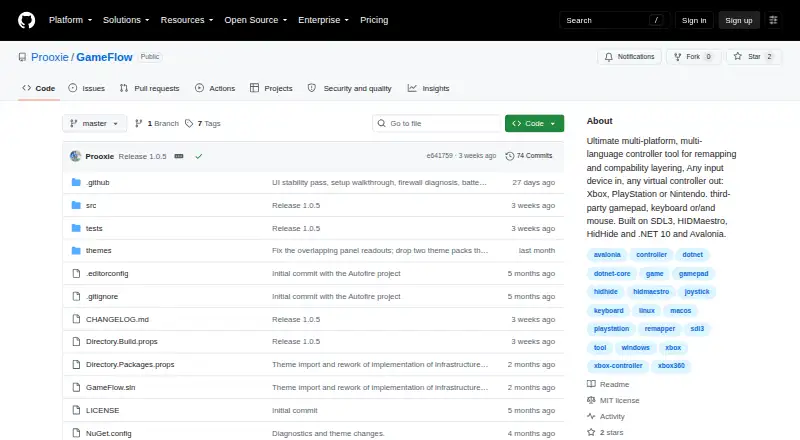
GameFlow is free gamepad tooling that converts input from gamepads, keyboards, mice, and phones into virtual-controller output using saved profiles. Its mapping options include autofire, remapping, shift layers, SOCD cleaning, stick trim, gyro aiming, touchpad mapping, button combinations, and freeze macros. Custom control logic can be written in sandboxed Lua through MoonSharp. Profiles are editable JSON documents that users can create, duplicate, rename, import, and export. A phone browser on the same local network can work as a controller without an installed app, with support for up to 16 phones. The motion server exposes DSU/Cemuhook over UDP for Cemu, Dolphin, Yuzu, and Ryujinx, and the protocol supports four pads. GameFlow can also generate a transparent controller overlay URL for an OBS Browser source. Windows virtual output uses HIDMaestro in user mode. The application requires .NET SDK 10.0 or later and uses SDL3 for gamepad and joystick input on Windows, Linux, and macOS. Linux and macOS virtual gamepad output is not built yet.
Good
- Free and MIT licensed.
- Profiles can be imported and exported as JSON.
- Phone browser controller supports up to 16 phones.
- Includes gyro, touchpad, and macro mapping.
- Windows virtual output works without a kernel driver or reboot.
Watch out
- Requires .NET SDK 10.0 or later.
- Linux and macOS virtual gamepad output is not built yet.
- Does not hide physical controllers from games.
- No HidHide-equivalent integration.
Who it suits
GameFlow may suit players who want to remap game inputs, build custom control profiles, or use a phone browser as a controller. It is also relevant to users of the named motion-emulation software or OBS overlays.
Verdict
GameFlow offers extensive profile-based mapping and several ways to use phone or motion input. Its virtual gamepad output is limited to Windows for now, and it does not hide physical controllers from games.
Plans and prices
From GameFlow's own pricing page, checked 15 Oct 2026.
| Plan | Price | What it gives you |
|---|---|---|
| Free | Free | free · open source · beta · Windows, Linux and macOS archives |
The facts
Each one read from GameFlow's own pages, with the date it was checked.
What it does
- API and SDK
- No public GameFlow API or SDK is documented; the project documents an internal HTTP/WebSocket phone protocol and DSU server instead.checked 15 Oct 2026
- Audience
- The project describes itself as cross-platform gamepad tooling for anyone.checked 30 Sep 2026
- Autofire
- Button and stick autofire uses hysteresis to reduce threshold jitter.checked 15 Oct 2026
- Calibration
- Calibration detects button, D-pad, stick and trigger mappings for devices whose reported layout is wrong.checked 15 Oct 2026
- Documentation depth
- The repository includes a 365-line wiki covering concepts, mappings, platform interop, phone protocol, overlays, themes, troubleshooting and contribution guidance.checked 15 Oct 2026
- Gyro aiming
- Gyro aiming supports local, player and world frames, smoothing, drift calibration and stick or mouse output.checked 15 Oct 2026
- HIDMaestro capabilities
- HIDMaestro claims 336 device profiles, support across DirectInput, XInput, SDL3, browser, WGI and RawInput, and approximately 35 microseconds measured latency.checked 15 Oct 2026
- HIDMaestro licensing
- HIDMaestro states that its SDK and driver are MIT licensed and allow commercial use.checked 15 Oct 2026
- HIDMaestro prerequisites
- HIDMaestro documents Windows 10/11 x64 or Windows 11 ARM64, .NET 10 and administrator privileges for virtual-device creation.checked 15 Oct 2026
- HIDMaestro SDK
- HIDMaestro describes itself as a C# SDK paired with a user-mode driver for virtual controllers.checked 15 Oct 2026
- Installation
- The documented install path is cloning the repository, running dotnet build and launching the GameFlow.App project.checked 15 Oct 2026
- Known theme issue
- Several bundled controller themes have imperfect button and stick placement because authoritative layout coordinates were unavailable.checked 15 Oct 2026
- Known USB Sony limitation
- Battery, motion and touch data cannot pass through USB Sony output profiles; the release notes recommend a Bluetooth Sony profile when those data are needed.checked 15 Oct 2026
- License
- The repository is marked MIT licensed.checked 15 Oct 2026
- Lua scripting
- Controls can run sandboxed Lua scripts through MoonSharp.checked 15 Oct 2026
- Motion integration
- The DSU/Cemuhook UDP server defaults to port 26760 and supports Cemu, Dolphin, Yuzu and Ryujinx.checked 15 Oct 2026
- Multiple controllers
- Each slot is an independent input, profile and output pipeline, allowing several virtual controllers at once.checked 15 Oct 2026
Where it runs
- Device tuning
- Per-slot and per-device settings include deadzone, anti-deadzone, sensitivity, curves, inversion, rumble, lighting and adaptive triggers.checked 15 Oct 2026
- Known macOS validation issue
- The macOS input path was written against documented APIs but had not been exercised on real Mac hardware during development.checked 15 Oct 2026
- Linux output limit
- Linux has real mouse output but virtual gamepad output is not implemented and falls back to preview.checked 15 Oct 2026
- macOS output limit
- macOS has real mouse output but virtual gamepad output is not implemented and falls back to preview.checked 15 Oct 2026
- Macros
- Button combos create timed virtual presses and freeze macros capture a stick vector when a button rises.checked 15 Oct 2026
- Mapping
- Features include autofire, button remapping, shift layers, SOCD cleaning, stick trim, multi-source rows, gyro aiming, touchpad mapping, button combos and freeze macros.checked 30 Sep 2026
The company
- Maker GitHub identity
- The repository owner profile identifies the maker as Proxy Darkness using the handle Prooxie and shows three public repositories.checked 15 Oct 2026
The full review of GameFlow
GameFlow is a profile-based tool for remapping gamepad, keyboard, mouse, joystick, and phone-browser input into controller output. It suits players who want control schemes beyond basic button reassignment, especially on Windows. Its broad mapping toolkit is offset by a significant caveat: virtual gamepad output is not yet built for Linux or macOS.
Overview
GameFlow combines input mapping, saved profiles, and virtual-controller output in one cross-platform project. Its range of control options gives it appeal for players shaping a setup around a particular game or device, while human-editable profiles make those setups portable and adjustable. But platform support is uneven: Windows has virtual output, whereas Linux and macOS do not.
Key features
Mapping and profiles
The mapping toolkit includes button remapping, autofire, shift layers, SOCD cleaning, stick trim, multi-source rows, gyro aiming, touchpad mapping, button combos, and freeze macros. That breadth is useful when a simple button swap is not enough, though it also makes GameFlow more ambitious than a basic mapper. Custom control logic can be written in sandboxed Lua through MoonSharp. Profiles are human-editable JSON documents that can be created, duplicated, renamed, imported, and exported.
Phone and motion input
A phone browser on the same local network can act as a controller without an app installation, with up to 16 phones supported. This makes phone input a flexible option for shared setups, provided the devices are on the same LAN. The motion server exposes DSU/Cemuhook over UDP for Cemu, Dolphin, Yuzu, and Ryujinx, with protocol support for four pads.
Streaming overlay
GameFlow can generate a transparent controller-overlay URL for an OBS Browser source. That is a practical addition for streamers who want an on-screen controller view without a separate overlay tool.
Compatibility and limitations
The application requires .NET SDK 10.0 or later and uses SDL3 for gamepad and joystick input on Windows, Linux, and macOS. Windows virtual-controller output uses HIDMaestro in user mode, without requiring a kernel driver or reboot. Linux and macOS virtual gamepad output is not built yet, so those platforms cannot currently use GameFlow for that central function. It also does not hide physical controllers from games and has no HidHide or equivalent integration; players whose games see both a physical device and its virtual counterpart should look elsewhere.
Pricing
GameFlow is free: the Free plan is free and open source, and is marked beta. It includes the Windows, Linux, and macOS archives. There are no paid tiers to weigh against the free option, but the platform gaps and beta status matter more than the price for anyone relying on virtual output outside Windows. The project is MIT licensed; its license disclaims warranties and provides the software as-is.
Platforms
GameFlow is described as multiplatform, with archives for Windows, Linux, and macOS, plus web-based phone control through a browser. SDL3 handles gamepad and joystick input on the desktop platforms, but only Windows has virtual-controller output at present. Phone control requires a browser on the same LAN, and the application requires .NET SDK 10.0 or later.
Who it's for
GameFlow is best suited to Windows players who want extensive profile-based mapping, custom Lua logic, phone-browser input, motion-server support, or an OBS controller overlay without paying for the software. It is a weaker fit for Linux and macOS players who need virtual gamepad output, or for anyone who must prevent games from detecting physical controllers. The project also invites contributions through forks, focused commits, and pull requests, making it a natural choice for technically inclined users who want to participate in development.
Pros and cons
- Pros: Broad mapping options, including layers, macros, gyro aiming, and Lua control logic, support setups well beyond basic remapping.
- Pros: Human-editable, importable and exportable JSON profiles make it easier to organize and transfer control schemes.
- Pros: Phone-browser input, DSU/Cemuhook motion support, and an OBS overlay URL serve several distinct use cases in one free tool.
- Cons: Virtual gamepad output is Windows-only for now, limiting a major function on Linux and macOS.
- Cons: Physical controllers cannot be hidden from games, which can be a problem when a game detects both physical and virtual devices.
- Cons: The project is beta, and the .NET SDK 10.0-or-later requirement adds a setup dependency.
Alternatives
For a broader category comparison, see Game Controller Mapper Software.
- Steam Input is a free alternative for users looking for controller tools across API, Linux, macOS, and Windows platforms.
- AntiMicroX is another free option for Linux and Windows users.
- LEA Extended Input may suit users seeking Android or iOS clients alongside Windows; its clients and server are free.
- Monect PC Remote Play is worth considering for broader PC remote-control use across Android, iOS, macOS, web, and Windows; its free plan covers core features, while Premium adds an ad-free experience and higher feature limits.
- ControllerBuddy is a free, open-source Linux and Windows alternative.
- JoyShockMapper is a free option for Linux and Windows, with a Windows release and Linux builds available from source.
- OmniControl is a Windows-only choice: its free plan covers controller reading, mapping, and tuning without a time limit or account requirement, while Insider costs $9.99 a month.
- PadForge is a free Windows-only alternative with no paywall, subscriptions, or paid feature packs.
Verdict
Choose GameFlow if you use Windows and want unusually broad input mapping, reusable profiles, phone or motion input, and OBS overlay support at no cost. Its main reason to look elsewhere is clear: Linux and macOS lack virtual gamepad output, and no platform can use it to hide physical controllers from games.
Getting started
- Visit the GameFlow GitHub website.
- Choose the archive for Windows, Linux or macOS.
- Install or use .NET SDK 10.0 or later.
- Create or import a profile, then configure input mappings.
- On Windows, use its HIDMaestro virtual-controller output if needed.
Limits worth knowing
GameFlow is free and open source. Virtual gamepad output is not built for Linux or macOS, and the software does not hide physical controllers from games or integrate with HidHide or an equivalent tool.
Questions
Is GameFlow free?
Yes. It is free, and the project is MIT licensed.
Which platforms does it support?
Archives are available for Windows, Linux and macOS. The application requires .NET SDK 10.0 or later.
Can a phone act as a controller?
Yes. A phone browser on the same LAN can act as a controller without an app installation, with support for up to 16 phones.
Does it provide virtual-controller output on every platform?
Windows virtual-controller output uses HIDMaestro in user mode. Linux and macOS virtual gamepad output are not built yet.
Can it hide a physical controller from a game?
No. GameFlow does not hide physical controllers from games and has no HidHide-equivalent integration.
Alternatives to GameFlow
- 1
Monect PC Remote Play
Free planAndroidiOSWebmacOS7.6Free plan - 2

OmniControl
Free planWindows7.3From $59.99 a year - 3
ControllerBuddy
Free planOpen sourceLinuxmacOSWindows7.2Free plan - 4
JoyShockMapper
Free planOpen sourceLinuxSelf-hostedWindows7.2Free plan - 5
reWASD
AndroidiOSWindows7.1$14.99 one-time - 6
JoyToKey
Windows6.9$7.50 one-time