Fabric
Fabric is a workspace for files, clients, notes, meetings, research, and AI, bringing connected information and AI agents into one place.
What Fabric is
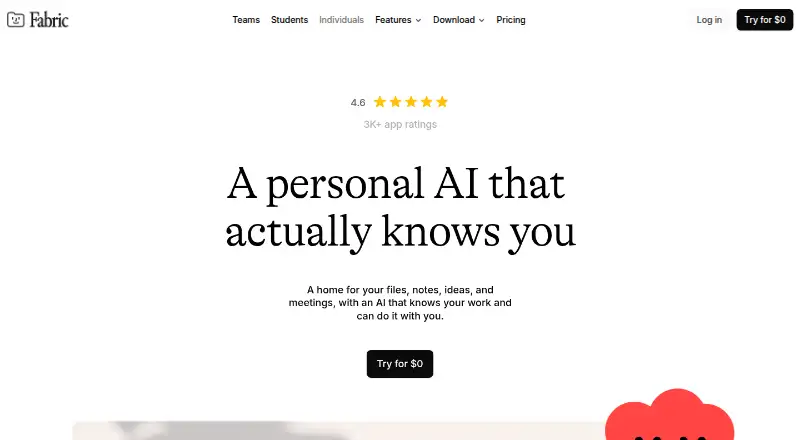
Fabric is a workspace for files, clients, notes, meetings, research, and AI, bringing connected information and AI agents into one place. Its tools include a visual canvas, writing features, meeting recording and transcription, tasks, and project management. Agents can summarize calls, draft status updates, monitor competitors, and prepare for meetings. Fabric also says its AI can take actions across connected apps, including sending emails, creating tasks, updating CRMs, and retrieving invoices. It advertises more than 50 integrations, such as Gmail, Google Drive, Slack, Notion, Linear, GitHub, Figma, and Salesforce. Spaces can be published as client or stakeholder portals without requiring viewers to log in, and shared content can be password protected. Files are encrypted at rest with 256-bit AES, and data in transit is protected by SSL/TLS. Fabric says subscriptions can be cancelled at any time, but refunds are not offered.
Good
- Includes meeting recording and transcription
- AI agents can prepare for meetings and summarize calls
- Advertises 50+ integrations
- Shared spaces can be password protected
Watch out
- Fabric says it does not offer refunds
- Plus includes 50GB storage and 50MB file uploads
- Paid plans have differing AI usage limits
Who it suits
Fabric suits founders, solopreneurs, agencies, creatives, students, researchers, and teams who want files, project work, meetings, and AI tools in one workspace. Its shared portals may also suit people presenting material to clients or stakeholders.
Verdict
Fabric brings organization, collaboration, and AI actions together, with options for sharing spaces externally. Check the storage, upload, and AI allowances of each plan, and note the no-refund policy before subscribing.
Plans and prices
From Fabric's own pricing page, checked 15 Oct 2026.
| Plan | Price | What it gives you |
|---|---|---|
| Plus | $8 a month | Unlimited items · 50GB storage · 50MB file upload limit · 5x more AI usage · Billed yearly at $96/yr |
| Pro | $18 a month | 250GB storage · 15x more AI usage · Premium data connections · Up to 10 scheduled AI jobs · Billed yearly at $216/yr |
| Max | $54 a month | 1TB storage · 45x more AI usage · Up to 50 scheduled jobs · Billed yearly at $648/yr |
| Teams | $16 a month | 14-day free trial · Shared workspaces · Admin usage dashboard · AI teammates and automations · Centralized billing and access control · Per user; billed yearly or monthly |
| Enterprise | Priced on request | Custom usage · Priority support and account management · Deep organizational access controls · Enterprise analytics · Billed yearly |
The facts
Each one read from Fabric's own pages, with the date it was checked.
What it does
- AI agents
- Fabric says its agents can summarize calls, write status updates, monitor competitors, and prepare for meetings.checked 29 Sep 2026
- AI assistant
- The assistant answers questions and brainstorms across the user's content library.checked 15 Oct 2026
- AI data use
- Fabric states that customer data is not used to train AI models and is used only for the customer's workspace features.checked 15 Oct 2026
- AI meeting notes
- Meetings can be recorded, transcribed and converted into insights and searchable notes.checked 15 Oct 2026
- AI summaries
- Yeschecked 20 Sep 2026
- API
- Fabric exposes a REST API at api.fabric.so with documented v2 endpoints.checked 15 Oct 2026
- API authentication
- Personal and developer API keys use the X-Api-Key header; OAuth 2.0 client creation is described as coming soon.checked 15 Oct 2026
- API limits
- The public API currently accepts only Markdown for created notes and limits files to 5GB or the subscription limit.checked 15 Oct 2026
- API resources
- Public API endpoints create bookmarks, notes, folders and files, with each resource requiring a parent ID.checked 15 Oct 2026
- Audience
- Fabric describes the product as built for founders, solopreneurs, agencies, creatives, students, researchers, and teams.checked 29 Sep 2026
- Canvas
- Fabric provides an infinite canvas for arranging notes, references, images and ideas.checked 15 Oct 2026
- Connections
- The marketplace lists Google Drive, Dropbox, Notion, Slack, Gmail, Google Calendar, Outlook, Teams, Linear, Asana, Airtable, ClickUp, Todoist, Figma, Evernote and other connections.checked 15 Oct 2026
- Data portability
- The Android listing says data is encrypted in transit and users can export everything at any time.checked 15 Oct 2026
- Features
- The product includes a visual canvas, writing tools, meeting recording and transcription, tasks, and project management.checked 29 Sep 2026
- Integrations
- Fabric advertises 50+ integrations, including Gmail, Google Drive, Slack, Notion, Linear, GitHub, Figma, and Salesforce.checked 29 Sep 2026
- Limit: AI usage and support
- Appshunter reviewers complain that AI credits can run out quickly and that support is difficult to reach outside Discord.checked 15 Oct 2026
- Limit: complex navigation
- Reviewers describe the interface as feature-rich but difficult to navigate, with too many controls and unintuitive note creation.checked 15 Oct 2026
- Limit: mobile reliability
- Independent Appshunter reviews report poor offline support, dropped drafts, choppy animations, touch problems and unexpected logouts.checked 15 Oct 2026
Where it runs
- App data disclosure
- Google Play says the app shares no data with third parties, may collect personal information, files and app activity, and supports deletion requests.checked 15 Oct 2026
- Cross-app actions
- Fabric says its AI can act across connected apps to send emails, create tasks, update CRMs, and retrieve invoices.checked 29 Sep 2026
- iOS requirements
- The App Store listing requires iOS 15.6 or later and iPadOS 15.6 or later.checked 15 Oct 2026
The company
- Company size
- LinkedIn lists Fabric as a privately held technology and internet company with 2–10 employees.checked 15 Oct 2026
- Headquarters and funding
- Crunchbase lists Fabric in London, United Kingdom, as a private pre-seed company with one recorded funding round and nine investors.checked 15 Oct 2026
Money
- Free plan
- Yeschecked 20 Sep 2026
The full review of Fabric
Overview
Fabric is a connected workspace for people who want files, notes, meetings, research and project work alongside AI tools. It is best suited to individuals and teams that need to organize varied work and share selected spaces with clients or stakeholders. Its breadth is appealing, but the right plan depends on how much storage, upload capacity and AI use you need.
Key features
Fabric combines a visual canvas and writing tools with tasks, project management, meeting recording and transcription. AI note search and call summaries can help users work across their information, while agents can draft status updates, monitor competitors and prepare for meetings. These functions make Fabric more than a place to store notes, though the paid plans differ substantially in storage and AI allowances.
Fabric advertises more than 50 integrations, including Gmail, Google Drive, Slack, Notion, Linear, GitHub, Figma and Salesforce. Its AI can take actions across connected apps, such as sending emails, creating tasks, updating CRMs and retrieving invoices. That reach will matter most to users who want their workspace to connect with existing tools; readers seeking only a focused note-taking app may not need it.
Spaces can be published as client or stakeholder portals without requiring viewers to log in, and shared content can be password-protected. This is a practical option for external sharing without asking recipients to join the workspace. Fabric says files are encrypted at rest with 256-bit AES and data in transit is protected by SSL/TLS. Users can delete their data, opt out of anonymized aggregated service-improvement data and grant or deny phone permissions.
Pricing
Fabric has a free plan and paid plans billed yearly. Plus costs $8 a month, billed yearly at $96/yr. Its 50GB storage, 50MB file-upload limit, 100 spaces and light AI usage make it a reasonable entry point for personal use, but the upload cap may constrain larger files.
Pro costs $18 a month, billed yearly at $216/yr. It raises storage to 250GB, allows 5GB file uploads and unlimited spaces, with moderate AI usage and up to 10 scheduled AI jobs. It is a better fit for regular project work and larger files, while the scheduled-job cap may be limiting for users who automate frequently.
Max costs $54 a month, billed yearly at $648/yr. It includes 1TB storage, 5GB uploads, unlimited spaces, heavy AI usage and up to 50 scheduled jobs. This is the individual plan for heavier storage and automation needs, at a considerable premium over Pro.
Teams costs $16 a month per user, billed yearly, and includes 2TB+ storage, 5GB uploads, unlimited spaces and a 14-day free trial. The per-user pricing suits groups that need shared team capacity, but costs rise with each seat. Enterprise has custom pricing, more usage included, priority support and account management, deep organizational access control and enterprise analytics; it is aimed at organizations needing those controls and support rather than a set individual price.
Fabric says subscriptions can be cancelled at any time but does not offer refunds, so subscribers should be comfortable with the annual billing commitment before purchasing. The free plan is an option for starting without a paid subscription, but its caps should be weighed against the paid tiers' storage, upload and AI allowances.
Platforms
Fabric supports web, iOS and Android, plus a browser extension. The broader platform listing also includes macOS, Windows and an API, giving it reach across mobile and desktop environments.
Who it's for
Fabric is a strong fit for founders, solopreneurs, agencies, creatives, students, researchers and teams who want notes, meetings, files and project activity in a connected workspace. Agencies and other client-facing users may particularly value password-protected portals that recipients can view without logging in. It is less compelling for someone who wants only a lightweight note app or needs generous large-file uploads on the entry plan.
Pros and cons
- Pros: A broad mix of notes, meetings, tasks and project tools can keep varied work in one workspace.
- Pros: More than 50 integrations and cross-app AI actions can connect workspace activity with tools such as Gmail, Slack and Salesforce.
- Pros: Shareable, password-protected portals do not require client or stakeholder logins.
- Cons: Plus limits uploads to 50MB, despite offering 50GB of storage.
- Cons: AI usage is tiered, and scheduled jobs are capped at 10 on Pro and 50 on Max.
- Cons: Annual billing and the no-refund policy make plan selection important before subscribing.
Alternatives
If your main need is storing and reusing code snippets rather than coordinating broader work, compare Cacher, SnipIT, Bitbucket, Gisto, massCode, Snippets, Lepton and Snibox. SnipIT's free plan includes code, AI, links and tools vaults plus web clipping and local browser storage; massCode is free and open source with no account required; and Snibox is MIT-licensed and self-hosted, with one registered user out of the box. Cacher offers a free tier with limits on private snippets, labels, attachments and monthly uploads, while Snippets offers unlimited workspaces and notes on its free plan. Bitbucket's free plan supports up to five users and unlimited public and private repositories; Gisto's local mode does not sync across devices or cloud providers. Lepton offers unlimited public or secret snippets and tags free, while the listed Snippets Pro and Cloud plans are also options for readers considering paid tiers.
For a more focused category comparison, browse Code Snippet Managers, AI Script Writing Software, AI Research Assistants, Meeting Recording Software, AI Note-Taking Apps and Voice Note Apps.
Verdict
Choose Fabric if you want one workspace to connect notes, meetings, projects and external apps, especially when client portals or AI actions are part of the workflow. Its main drawback is the combination of tiered storage and AI limits with annual billing and no refunds; look elsewhere if you need a narrowly focused tool or want to avoid those commitments.
Alternatives to Fabric
- 1

ScreenWeaver
Free planAndroidiOSWebAPI8.2Free plan - 2
ngram
Free planWebAPIExtension7.6From $29 a month - 3

FiveDraft
Free planAndroidiOSWeb7.4From €5 a month - 4
Lastslate
Free planmacOSWindows7.4From $10 a month - 5
Screenplay Assistant
Free planAndroidiOSWebmacOS7.3From $7 a month - 6
Scriptuber
Free planAndroidiOSWeb7.1From $19 a month