
Conjointly
Conjointly is a survey research platform combining research methods, survey tools, respondent options, and research support.
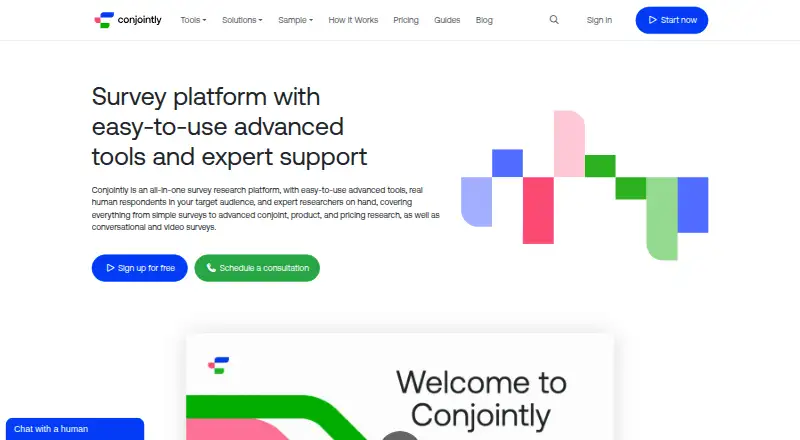
What Conjointly is
Conjointly is a survey research platform combining research methods, survey tools, respondent options, and research support. Its methods include conjoint analysis, Van Westendorp, Gabor-Granger, monadic testing, MaxDiff, and Kano. The Survey Tool provides unlimited surveys and questions, survey logic, randomisation, multilingual support, reporting dashboards, and Excel and PowerPoint exports. Researchers can bring their own respondents, use self-serve samples, or request predefined panels managed by Conjointly’s fieldwork team. Documented integrations include Fuel Cycle, SurveyMonkey, Qualtrics, and Alchemer. Its API uses JSON requests and responses to launch experiments, invite respondents, and view or export results. The Basic tier includes unlimited surveys and questions, but advanced-method analytics cover up to 20 responses unless a licence enables full analysis for more. Academics and students can apply for a no-cost option.
Good
- Includes several named research methods.
- Unlimited surveys and questions in the Survey Tool.
- Supports multilingual surveys and randomisation.
- Respondent options include self-serve samples and panels.
- API can launch experiments and export results.
Watch out
- Basic advanced-method analytics cover up to 20 responses.
- Full analysis beyond that requires a licence.
- Professional costs $2,895 per year per team.
Who it suits
Conjointly suits researchers at organizations ranging from early-stage start-ups to large enterprises, for B2C or B2B research. It also offers an application-based no-cost option for academics and students.
Verdict
Conjointly brings survey creation, established research methods, respondent sourcing, and support together. Check the Basic-tier response cap and plan pricing against your study needs.
Plans and prices
From Conjointly's own pricing page, checked 28 Sep 2026.
| Plan | Price | What it gives you |
|---|---|---|
| Professional | $2,895 a year | All Basic features · advanced methods · up to 2 hours of consultations per year · Per team per year; annual recurring payment by credit card |
| Ultimate | $10,000 a year | All Professional features · additional research support · procurement onboarding · tailored team trainings · Starts at $10,000 per year |
| Basic | Free | Unlimited surveys, questions, and team members · advanced methods limited to 20 responses · No cost; no wait |
The facts
Each one read from Conjointly's own pages, with the date it was checked.
What it does
- Academic access
- Conjointly offers a no-cost option for academics and students through an application form.checked 28 Sep 2026
- Advanced-method limit
- The Basic tier permits up to 20 responses for advanced-method analytics; a licence enables full analysis for additional responses.checked 28 Sep 2026
- AI data use
- Conjointly states that it does not train generative AI models using customer or respondent data.checked 28 Sep 2026
- API
- The API supports launching experiments, inviting respondents, and viewing or exporting results, using JSON requests and responses.checked 28 Sep 2026
- Integrations
- Conjointly documents survey redirects and integrations with Fuel Cycle, SurveyMonkey, Qualtrics, and Alchemer.checked 28 Sep 2026
- Intended users
- Conjointly describes its customers as ranging from early-stage start-ups to large enterprises and says the platform supports B2C and B2B research.checked 28 Sep 2026
- Product
- Conjointly is an all-in-one survey research platform with advanced research tools, respondent sourcing, and expert research support.checked 28 Sep 2026
- Research methods
- Its tools include conjoint analysis, Van Westendorp, Gabor-Granger, monadic testing, MaxDiff, and Kano.checked 28 Sep 2026
- Respondents
- Users can bring their own respondents, use self-serve samples, or request predefined panels managed by Conjointly’s fieldwork team.checked 28 Sep 2026
- Security certifications
- Conjointly says it is certified for SOC 2 Type 1 and 2, ISO 20252:2019 (Annex A), ISO 27001:2022, and ISO 27701:2019.checked 28 Sep 2026
- Support
- Basic includes limited online live support chat, while Professional includes up to two hours of consultations per year and Ultimate includes additional research support.checked 28 Sep 2026
- Survey features
- The Survey Tool includes unlimited surveys and questions, survey logic, randomisation, multilingual support, reporting dashboards, and Excel and PowerPoint exports.checked 28 Sep 2026
The company
- Company history
- Conjointly says its online conjoint analysis tool started in 2016 and later evolved into a market research platform.checked 28 Sep 2026
- Founded
- 2016checked 28 Sep 2026
- Headquarters
- Pyrmont, New South Wales, Australiachecked 28 Sep 2026
Money
- Free plan
- Yeschecked 21 Sep 2026
The full review of Conjointly
Conjointly is a survey research platform for teams that need specialist methods as well as survey creation and respondent sourcing. It is best suited to researchers running product, pricing or preference studies, from start-ups to larger organisations. Teams seeking only a basic questionnaire builder may find its advanced toolkit and annual plans more than they need.
Overview
Conjointly combines survey design, established research methods, sample options and research support. Its toolkit includes conjoint analysis, Van Westendorp, Gabor-Granger, monadic testing, MaxDiff and Kano, making it particularly relevant to structured product and pricing questions rather than general-purpose polling alone.
The Survey Tool allows unlimited surveys and questions, with logic, randomisation, multilingual support, reporting dashboards, and Excel and PowerPoint exports. Users can supply their own respondents, use self-serve samples or request predefined panels managed by Conjointly’s fieldwork team. This flexibility helps teams match sourcing to a study, though it does not remove the need to plan for sample and analysis costs.
Key features
Methods, analysis and automation
Conjoint analysis and methods such as MaxDiff and Kano are the platform’s clearest advantage for teams measuring preferences or trade-offs. Advanced segmentation and reporting support deeper analysis, while the API can launch experiments, invite respondents, and view or export results through JSON requests and responses. That makes it a plausible fit for teams incorporating research workflows into other systems, but API access is most useful where someone can build or maintain that integration.
Survey design and sourcing
Unlimited surveys and questions give teams room to run multiple studies without a survey-count ceiling. Logic, randomisation and multilingual support cover important design needs; dashboard reporting and Excel or PowerPoint exports help take findings into analysis and presentations. Respondents can come from a team's own pool, self-serve samples or Conjointly-managed predefined panels, giving different routes to fieldwork.
Integrations, security and data use
Conjointly documents redirects and integrations with Fuel Cycle, SurveyMonkey, Qualtrics and Alchemer. It says it holds SOC 2 Type 1 and 2, ISO 20252:2019 (Annex A), ISO 27001:2022 and ISO 27701:2019 certifications, and does not train generative AI models on customer or respondent data. These commitments matter to teams assessing data handling and procurement requirements.
Pricing
Conjointly uses a freemium model, with a free Basic plan and paid plans from $2,895/yr. The Basic plan includes unlimited surveys and questions, but caps advanced-method analytics at 20 responses; a licence is required for full analysis on additional responses. Basic also includes limited online live support chat. That makes it useful for trying the survey workflow or conducting a small advanced-method exercise, but not a substitute for a full analysis licence on larger studies.
Professional costs $2,895 a year, billed per team per year as an annual recurring credit-card payment. It includes all Basic features, advanced methods and up to two hours of consultations per year. This is the clearest fit for teams that need full advanced-method analysis and some expert guidance. Ultimate starts at $10,000 per year and adds research support, procurement onboarding and tailored team trainings to Professional; it suits organisations that need more support and procurement preparation, but its starting price makes it a substantial commitment.
Academics and students can apply for a no-cost option. Teams should weigh the Basic response cap and their need for consultation or additional support against the recurring annual cost of paid tiers.
Platforms
Conjointly is available on the web and through an API. The API supports experiment launches, respondent invitations, and results viewing or export, so it is relevant to teams that want to connect research operations to their own systems.
Who it's for
Conjointly suits B2C and B2B teams conducting structured market research, especially those needing conjoint, pricing or preference methods alongside survey design and respondent sourcing. Its range of methods and support options can serve small start-ups as well as enterprise teams. It is less compelling for users who only need a low-cost basic survey tool or who do not expect to use specialist analysis.
Pros and cons
- Specialist methods in one platform: conjoint analysis, Van Westendorp, Gabor-Granger, monadic testing, MaxDiff and Kano cover varied product and pricing research needs.
- Flexible respondent sourcing: teams can bring their own respondents, use self-serve samples or request managed predefined panels.
- Useful survey and export capabilities: unlimited surveys and questions, logic, randomisation, multilingual support, dashboards, and Excel and PowerPoint exports support the full survey workflow.
- Basic limits advanced analysis: only 20 responses qualify for advanced-method analytics without a licence, limiting its use for larger studies.
- Paid plans are annual commitments: Professional is billed per team per year, and Ultimate starts at $10,000 per year, which may not suit occasional or budget-constrained users.
- Support varies by tier: Basic has limited live chat, Professional includes up to two consultation hours yearly, and additional research support is reserved for Ultimate.
Alternatives
For a broader comparison, see Market Research Software and Survey Software.
SurveyToGo is another freemium option, with a free plan and support for Android, iOS, web, Windows, API and self-hosted deployment. DataLion offers a free forever plan at no cost for one user, one project and 100 cases, with survey tools and imports. LimeSurvey has a free plan capped at 25 responses per month and one admin user, while Basic costs $39 a month. Qualtrics offers an individual free plan with one user, three active surveys, 30 questions per survey and 500 total responses.
SoSci Survey offers a free research plan for up to 5,000 respondents, making it worth considering where that free respondent allowance fits the study. Conjoint Survey has a free pilot for one researcher, one conjoint survey and up to 20 completed responses, but excludes full exports and coauthor viewing. Qualitati offers 30 monthly credits on its free plan, with paid plans starting at €9 a month. SurveyLab has a free plan with 50 responses total and a Starter plan at $49 a month for 1,000 responses monthly.
Verdict
Choose Conjointly if your team needs specialist research methods, respondent sourcing and a route to expert support within one platform. Its strongest case is the breadth of structured analysis paired with flexible fieldwork. Look elsewhere if you only need straightforward surveys, cannot justify annual paid pricing, or need to analyse more than 20 advanced-method responses without taking a licence.
Alternatives to Conjointly
- 1

Qualtrics
Free planAPI7.3From $420 a month - 2

SurveyMonkey
AndroidiOSAPI7.2 - 3

Pollfish
WebAPI6.4From $10,000 a year - 4
 6.2
- 56.2
- 6

Zappi
Web5.9