
CBT without a Therapist: Helpy
CBT without a Therapist: Helpy is a self-help platform built around cognitive behavioral therapy (CBT), with materials also drawing on DBT and ACT.
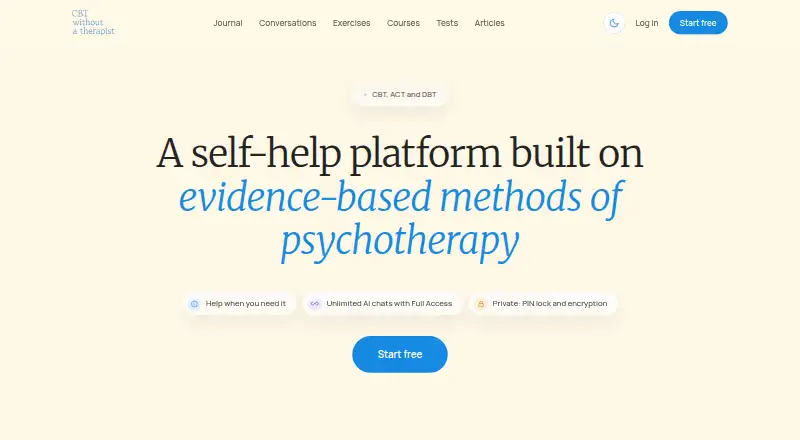
What CBT without a Therapist: Helpy is
CBT without a Therapist: Helpy is a self-help platform built around cognitive behavioral therapy (CBT), with materials also drawing on DBT and ACT. Its thought journal guides users in separating facts from assumptions, spotting cognitive distortions, and evaluating whether thoughts fit reality. An AI assistant asks clarifying questions and can suggest a thought record, grounding, or breathing practice. The service also has audio and written exercises and screening questionnaires for anxiety, mood, sleep, and burnout; results are not diagnoses. An anxiety program is available, with its first module free. Helpy runs on Android, iOS, and the web. The free plan includes unlimited journaling, limited AI chat replies, and the exercise library; Full Access costs $29 as a one-time payment. Optional end-to-end encryption is off by default, and journal text is decrypted and sent to the AI when a user requests an entry review. Helpy is self-help, not medical care or therapy, and it is not a substitute for professional care.
Good
- Thought journal helps examine assumptions and distortions.
- AI can suggest grounding or breathing practices.
- Exercises include audio and written formats.
- Free plan includes the full exercise library.
- Available on web, iOS, and Android.
Watch out
- AI chat replies are limited on the free plan.
- Journal encryption is off by default.
- The service is not therapy or medical care.
- Crisis handling is not monitored and may miss danger.
Who it suits
Helpy may suit people dealing with anxiety, stress, panic, burnout, or emotional overwhelm who want guided self-help practice. It is also presented for people seeking self-guided work alongside CBT, DBT, or ACT, rather than clinical care.
Verdict
Helpy offers structured self-help exercises, journaling, and AI-guided suggestions, with a free plan and a $29 one-time Full Access option. It is not clinical care, and its crisis messaging is not monitored.
Plans and prices
From CBT without a Therapist: Helpy's own pricing page, checked 21 Oct 2026.
| Plan | Price | What it gives you |
|---|---|---|
| Free | Free | unlimited thought journal · limited AI chat replies · full exercise library with audio · first module of every course · free forever |
| Full Access | $29, paid once | unlimited conversations · better-understanding AI model · unlimited journal-entry analysis · lifetime access · one-time payment; no subscription or auto-renewal |
The facts
Each one read from CBT without a Therapist: Helpy's own pages, with the date it was checked.
What it does
- AI assistant
- The AI assistant asks clarifying questions and suggests techniques such as thought records, grounding or breathing.checked 21 Oct 2026
- Changelog: recent features
- Recent releases added Apple Watch support, psychological profiles, widgets, voice input, new journal types, dark mode and PDF exports.checked 21 Oct 2026
- Courses
- The anxiety course has five modules with the first module free; additional programs are listed as forthcoming.checked 21 Oct 2026
- Crisis handling
- The maker says crisis messages can trigger helpline details without an account, but the service is not monitored and its wording checks can miss danger.checked 3 Oct 2026
- Data and providers
- The privacy policy says account details, journal entries, chats, and quiz results are stored using Google Firebase, and AI providers process chat messages to generate responses.checked 3 Oct 2026
- Data control
- The maker says users can delete individual entries or the whole journal and that data is not sold or used for advertising.checked 21 Oct 2026
- Developer
- Google Play identifies Mikhail Sibgatulin as developer and gives an Acassuso, Buenos Aires, Argentina address.checked 21 Oct 2026
- Encryption limitation
- When a user asks Helpy to review a journal entry, the entry is decrypted on the user's side and sent to the AI for that reply.checked 3 Oct 2026
- Exercises
- The service advertises more than 50 written and audio exercises for anxiety, stress, attention, sleep and acceptance.checked 21 Oct 2026
- Exercises and tests
- The service offers audio and written exercises and screening questionnaires for anxiety, mood, sleep, and burnout; test results are not diagnoses.checked 3 Oct 2026
- Google Play availability
- Google Play lists the Android app as free to download with in-app purchases and 5K-plus downloads.checked 21 Oct 2026
- Google Play data safety
- Google Play says the app may share personal and activity data, may collect location and other personal data, encrypts data in transit and supports deletion requests.checked 21 Oct 2026
- Intended users
- The product is presented for people experiencing anxiety, stress, panic, burnout, or emotional overwhelm, and for people seeking self-guided practice alongside CBT, DBT, or ACT.checked 3 Oct 2026
- Journal
- The thought journal helps users separate facts from assumptions, identify cognitive distortions, and check how well thoughts match reality.checked 3 Oct 2026
- Journal encryption
- End-to-end encryption is optional and off by default; when enabled, journal text is encrypted on the device, while dates and entry counts remain visible.checked 3 Oct 2026
- Limit: chat history
- An AppBrain commenter reported that past chats were not visible after signing in on another device.checked 21 Oct 2026
- Limit: exercise defect
- The same AppBrain commenter reported that the back side of a compassion-break card displayed no content.checked 21 Oct 2026
- Medical limitation
- Terms state that Helpy is not therapy, medical care, diagnosis or emergency support and may produce inaccurate or incomplete AI responses.checked 21 Oct 2026
- Mood tracking
- A mood tracker provides calendar views and statistics so users can review changes over time.checked 21 Oct 2026
- Not a clinical service
- The maker says the service is self-help, not medical care or therapy, and Helpy is not a licensed therapist or a substitute for professional care.checked 3 Oct 2026
Where it runs
- Android adoption
- AppBrain recorded about 4.8 thousand installs and said the app had no ratings yet.checked 21 Oct 2026
- Apple Watch
- The Apple Watch app supports voice conversations, mood logging and starting panic breathing with haptic feedback.checked 21 Oct 2026
- Cross-device account
- The listing says the phone, watch, Mac and web versions share the same account, journal, mood data, tests and conversations.checked 21 Oct 2026
- iOS requirements
- The App Store listing requires iOS 15 or later and lists a 131.2 MB app size.checked 21 Oct 2026
The full review of CBT without a Therapist: Helpy
Overview
CBT without a Therapist: Helpy is a self-help platform that pairs a thought journal with AI suggestions and guided exercises based on CBT, DBT, and ACT. It suits people seeking structured practice for anxiety, stress, or emotional overwhelm; its practical tools do not replace a therapist or clinical care.
The service brings reflection, exercises, screening questionnaires, and a course into one place. Its journal helps users distinguish facts from assumptions, recognize cognitive distortions, and check thoughts against reality. Helpy can ask follow-up questions and suggest a thought record, grounding, or breathing practice. That makes it useful for turning a difficult moment into a concrete exercise, though the suggestions are not clinical judgment.
Key features
Journal and AI guidance
The thought journal provides a repeatable way to examine thinking rather than simply record events. AI-guided suggestions can point users toward a relevant technique, but there is no human escalation and Helpy is not a licensed therapist. It is a poor fit for someone who needs a professional to assess their situation or respond personally.
Exercises, screening, and courses
Audio and written exercises broaden the service beyond chat. Screening questionnaires cover anxiety, mood, sleep, and burnout, but their results are not diagnoses; they are prompts for self-reflection, not a basis for medical decisions. The anxiety program is available, with its first module free. The site says other programs are on the way, so the current course offering is limited.
Privacy and crisis limits
End-to-end encryption for journal text is optional and off by default. When enabled, text is encrypted on the device, but dates and entry counts remain visible. Asking Helpy to analyze an entry means that entry is decrypted on the user's side and sent to the AI for the response. Account details, journal entries, chats, and quiz results are stored using Google Firebase, and AI providers process chat messages.
Crisis messages may prompt helpline details even without an account, but the service is not monitored and its wording checks can miss danger. That makes Helpy unsuitable as an emergency contact or crisis service. The maker says support usually replies to email within one business day.
Pricing
The Free plan costs nothing and is billed Free forever. It includes an unlimited thought journal, limited AI chat replies, the full exercise library with audio, and the first module of every course. This is enough for readers who mainly want journaling and exercises, but the capped chat can constrain frequent AI-guided practice.
Full Access costs $29, paid once, billed as a one-time payment with no subscription. It adds unlimited conversations, a model with better understanding, unlimited journal entry analysis, and lifetime access. It fits people who expect to use the assistant and entry analysis regularly and prefer not to renew a subscription. The maker names Freemius as Merchant of Record and says customers may request a full refund within 14 days of purchase. There is no free trial.
Platforms
Helpy is available on web, iOS, and Android, giving users a choice of browser or mobile access.
Who it's for
Choose Helpy if you want a structured self-help routine for anxiety, stress, panic, burnout, or emotional overwhelm, and are comfortable working without a therapist in the app. Its journal and exercise library are the strongest reasons to start with the free plan. Look elsewhere if you need diagnosis, therapy, human escalation, or monitored crisis support.
Pros and cons
- Pros: The journal breaks thought review into practical steps, and the full audio and written exercise library is included on the free plan.
- Pros: Full Access is a one-time 29.00 USD payment rather than a recurring subscription, with unlimited conversations and journal analysis.
- Cons: Free users have limited AI chat replies, so regular conversational use may require payment.
- Cons: Encryption is optional, and journal analysis sends the entry to the AI; privacy-conscious users should account for that before sharing sensitive writing.
- Cons: It offers no human escalation, and crisis messaging is unmonitored and may miss danger.
Alternatives
For a broader directory of options, browse AI Mental Health Chatbots.
- Mithra by MannSetu is worth comparing if you want a free tier with both text chat and voice input, though its daily chat allowance is limited.
- Clare may suit readers who prefer calls and messages during stated daily hours, with a 7-day free trial for its monthly plan.
- Dr. Riya by Mindtalk is a free option for readers who want an app that explicitly rules out diagnosis, prescribing, and therapy.
- Noa by Anshap may appeal if you want core features without paywalls or hidden fees.
- Psychia offers a free tier with unlimited text conversations, but its instant model is subject to a queue and keeps up to five conversations in history.
- Thrive AI is a choice for readers interested in free blogs and self-assessments, though its free plan does not include AI-guided exercises.
- Blue Fever is another free option for iOS and macOS users.
- Mentis combines tracking, articles, basic journaling, and core CBT activities; its free plan limits the AI plan, chatbot, and daily activities.
Verdict
Helpy is a sensible starting point for people who want a repeatable CBT-style journal and a substantial free exercise library, with a one-time upgrade for unlimited AI use. Its main limitation is equally clear: it is self-help without human clinical support. Choose it for guided practice, not for therapy, diagnosis, or crisis care.
Getting started
- Open Helpy on the web or install its Android or iOS app
- Start with the Free plan
- Use the thought journal, exercises, screening questionnaires, or free course modules
- Enable end-to-end journal encryption if desired
- Upgrade to Full Access with the one-time 29.00 USD payment for expanded AI use
Limits worth knowing
The Free plan provides limited AI chat replies, while Full Access adds unlimited conversations and journal analysis. Free access includes the first module of every course; the anxiety program's first module is free.
Questions
Is Helpy free?
Yes. The Free plan costs nothing and is billed free forever. Full Access costs 29.00 USD once.
What does Full Access include?
It provides unlimited conversations, a model with better understanding, unlimited journal-entry analysis, and lifetime access.
Which devices support Helpy?
Helpy is available on the web, Android, and iOS.
Is Helpy a therapist or medical service?
No. It is self-help, not medical care or therapy, and it is not a substitute for professional care.
Are the screening tests diagnoses?
No. The questionnaires cover anxiety, mood, sleep, and burnout, but their results are not diagnoses.
How does journal encryption work?
End-to-end encryption is optional and off by default. When you ask Helpy to review an entry, it is decrypted on your side and sent to the AI for that reply.