
BlueConic
BlueConic combines real-time customer profiles with AI agents that run growth programs across a company’s existing channels.
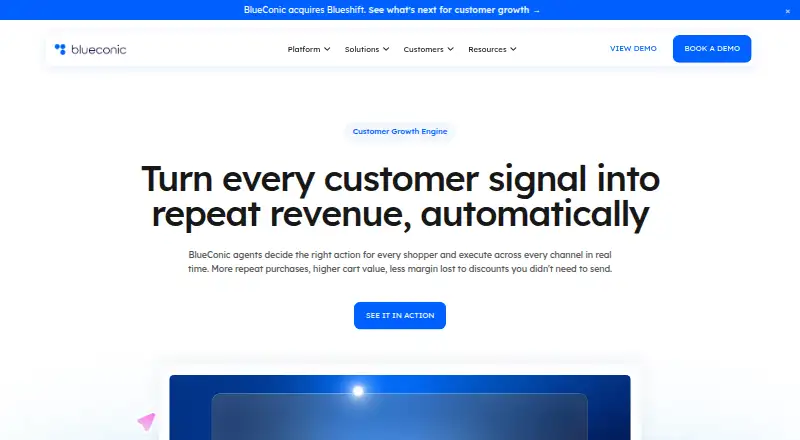
What BlueConic is
BlueConic combines real-time customer profiles with AI agents that run growth programs across a company’s existing channels. Its Growth Plays focus on identity and audience building, commerce growth, and customer retention and loyalty. Customer signals, including intent gathered through quizzes and product finders, can update profiles in real time. Teams can set eligibility rules, offers, frequency caps, and spending limits for Agent Studio. BlueConic says it works directly from an existing data warehouse without copies or new pipelines, and lists more than 150 integrations, including Klaviyo, Meta, Shopify, and Braze. It is aimed at B2C brands, with e-commerce teams specifically mentioned. BlueConic lists Android, iOS, web, and extension platforms, and offers real-time profiles, identity resolution, audience activation, and data ingestion. A free access subscription costs nothing, with profile, volume, and usage limits and no support obligations. Paid pricing is available on request.
Good
- Customer profiles update in real time from customer signals.
- Growth Plays cover acquisition, commerce, retention, and loyalty.
- Teams can set agent eligibility, offers, caps, and limits.
- Lists 150+ integrations, including Klaviyo and Shopify.
- Works directly from an existing data warehouse.
Watch out
- Paid pricing is available only on request.
- Free access has profile, volume, and usage limits.
- Free access carries no support obligations.
- BlueConic may suspend or terminate free access.
Who it suits
BlueConic suits B2C brands, particularly e-commerce teams seeking to coordinate growth programs across existing channels. It may also suit teams that want profile updates and agent controls tied to their customer data.
Verdict
BlueConic brings profile management and AI-led growth programs together, with controls for teams and a broad integration list. The free tier has usage limits and no support obligations; paid pricing requires contacting the company.
Plans and prices
From BlueConic's own pricing page, checked 3 Oct 2026.
| Plan | Price | What it gives you |
|---|---|---|
| Free Access Subscription | Free | Profile, volume, and usage limits apply; no support obligations |
| BlueConic | Priced on request | Pricing supplied through sales contact form; no public tiers or quotas shown |
The facts
Each one read from BlueConic's own pages, with the date it was checked.
What it does
- Agent controls
- Teams can set eligibility, offers, frequency caps, and spending limits that Agent Studio follows.checked 3 Oct 2026
- AI Canvas
- AI Canvas lets users describe a growth goal in natural language while AI agents configure connections and campaign setup.checked 21 Oct 2026
- API lifecycle
- API v1 and OAuth 1.0 are being deprecated in favor of REST API v2 and OAuth 2.0.checked 21 Oct 2026
- Authentication controls
- The platform supports multifactor authentication, password standards, SAML single sign-on and encrypted connection credentials.checked 21 Oct 2026
- Core workflows
- Its Growth Plays cover identity and audience building, commerce growth, and customer retention and loyalty.checked 3 Oct 2026
- Customer identity
- Its identity-resolution capability matches signals from multiple sources into one persistent customer profile.checked 21 Oct 2026
- Data warehouse
- BlueConic says it works directly from an existing data warehouse without copies or new pipelines.checked 3 Oct 2026
- Documentation
- The public help center includes REST API, connection, SDK, AI Workbench, release-note and troubleshooting collections.checked 21 Oct 2026
- Encryption and network security
- The service requires HTTPS and states that it uses TLS 1.2/1.3, segmented private-network architecture, firewalls and SFTP or HTTPS connections.checked 21 Oct 2026
- Integrations
- Named and universal connections cover email, campaign tools, ad and DMP systems, web platforms, identity providers, files, webhooks and mobile sources.checked 21 Oct 2026
- Intended users
- The company describes the Customer Growth Engine as being for B2C brands and markets it to e-commerce teams.checked 3 Oct 2026
- Interactive Experiences
- Experiences captures zero- and first-party data through quizzes, product finders, preference flows and similar interactions.checked 21 Oct 2026
- Investor
- BlueConic says Vista Equity Partners invested in 2022, alongside earlier investors Spring Lake Equity Partners, Sigma Prime Ventures and Converge Venture Partners.checked 21 Oct 2026
- License model
- The terms grant customers a limited, non-exclusive, non-transferable license to access the hosted SaaS service during the subscription term.checked 21 Oct 2026
- Limit: data-model fit
- A reviewer reports weak relational-database support, difficulty with B2B use cases and profile-property limits for customers with many subscriptions.checked 21 Oct 2026
- Limit: learning curve and interface
- Reviewers report that advanced features take time to learn and that the interface or dialogue builder can feel clunky, glitchy or intimidating.checked 21 Oct 2026
- Measurement
- BlueConic ties customer behavior to revenue outcomes and reports metrics such as conversion, ROAS and cost per conversion.checked 21 Oct 2026
- Mobile SDK
- React Native SDK release notes document Android and iOS support, including geofencing, recommendations, CTV devices and profile operations.checked 21 Oct 2026
- Notable news: AI launch
- BlueConic announced Growth Plays and AI Canvas on April 20, 2026 as agentic tools for real-time campaign decisioning and execution.checked 21 Oct 2026
The company
- Company facts
- LinkedIn lists BlueConic as privately held, founded in 2010, headquartered in Boston and sized at 201–500 employees.checked 21 Oct 2026
- Headquarters
- The company lists Boston, Massachusetts, and Nijmegen, Netherlands, as locations; its careers page says it is headquartered in Boston.checked 3 Oct 2026
Money
- Free subscription limits
- Free Access Subscriptions have profile, volume, and usage limits, and BlueConic may suspend or terminate access at any time.checked 3 Oct 2026
- Limit: price and overages
- Reviewers call the product expensive for small organizations, and one reports automatic extra charges when subscription limits are exceeded.checked 21 Oct 2026
Where it runs
- Limit: browser extension
- The Chrome extension requires broad browser permissions and a reviewer reported that it works unreliably despite being necessary for dialogue testing.checked 21 Oct 2026
The full review of BlueConic
BlueConic is a customer data and growth platform for B2C brands, especially e-commerce teams looking to turn customer profiles into coordinated programs. Its appeal is real-time profile updates paired with AI agents that follow team-defined limits; custom pricing and a capped free tier make it a poor fit for casual or low-cost use.
Overview
BlueConic brings profile management and growth activity together rather than treating customer data as a static record. Its Growth Plays span identity and audience building, commerce growth, and retention and loyalty. That scope suits organizations that want one platform to connect customer signals to activity across existing channels, but may be more than a team seeking only a basic CRM or profile store needs.
Key features
Customer signals can update profiles in real time, including intent gathered through quizzes and product finders. With identity resolution, audience activation, and data ingestion, the platform is built to move from recognizing customers to reaching audiences. The practical value depends on a team having growth programs ready to use those profiles.
Agent Studio lets teams set eligibility rules, offers, frequency caps, and spending limits for agents to follow. These controls help keep automated programs within business boundaries, a meaningful safeguard for teams scaling offers. They do not make BlueConic a simple plug-in for organizations that have no need for agent-run growth programs.
BlueConic says it has more than 150 integrations and names Klaviyo, Meta, Shopify, and Braze as tools Growth Plays can use. It also says it can work directly from an existing data warehouse without copies or new pipelines, which can reduce the need to build another data flow. The integration breadth is useful for teams already working across those channels; it is less decisive for buyers whose key systems are not represented.
BlueConic says it has completed a SOC 2 Type 2 audit for the Security, Availability, and Confidentiality Trust Services Criteria. Its privacy controls help sites manage compliance and consent. Customers can contact support through an in-tenant AI Help Bot, support tickets, or email; support hours are Monday through Friday, 2:30am to 5:30pm ET, excluding public holidays.
Pricing
BlueConic offers a Free Access Subscription at no cost. Profile, volume, and usage limits apply, and the company has no support obligations on this tier. BlueConic may suspend or terminate free access at any time, so it is a constrained way to assess the product rather than a dependable long-term service tier.
Paid pricing is custom pricing. Visitors must submit a form to request pricing, so teams cannot compare a published paid rate before engaging with the company. The free tier fits limited evaluation; organizations planning sustained use should account for the unknown paid cost and the free plan's caps.
Platforms
BlueConic is available on Android, iOS, web, and as an extension. Its data capabilities include real-time profiles, identity resolution, audience activation, and both inbound and outbound data ingestion.
Who it's for
BlueConic is aimed at B2C brands, with a particular emphasis on e-commerce teams. It is strongest for organizations that want to combine current customer signals, audience activation, and controlled growth programs across existing channels. Teams that need straightforward customer management, predictable self-service pricing, or support commitments on a free plan should look elsewhere.
Pros and cons
- Pros: Real-time profile updates can use intent signals from quizzes and product finders, keeping audience information responsive to customer interest.
- Pros: Agent controls for eligibility, frequency, offers, and spending give teams concrete boundaries for automated programs.
- Pros: More than 150 integrations and direct work from an existing warehouse can help connect growth programs without adding copies or pipelines.
- Cons: Paid pricing requires a contact form, making budget comparison difficult before a sales conversation.
- Cons: The free tier has profile, volume, and usage limits, no support obligations, and access can be suspended or terminated at any time.
Alternatives
For broader retail-focused CRM options, browse Retail CRM Software; for products centered on customer data platforms, see Customer Data Platforms.
Zoho CRM is a better fit for a small team wanting a freemium CRM, with a free plan for three users and a Standard plan listed at $23 a month, billed annually. Hightouch suits teams prioritizing warehouse syncs: its free plan includes two active syncs per month and hourly sync frequency, while Self-serve includes ten active syncs per month.
Salesforce for Restaurants is a restaurant-focused alternative with a Salesforce Starter plan starting at $25 a month, billed monthly or annually, per user. Ometria is another paid option, with pricing handled by a Customer Success Representative. Aptos Retail is a paid retail alternative.
Treasure AI Composable CDP is worth considering for buyers seeking a paid composable CDP, though its plan says warehouse credits apply for query execution. Bluecore is a paid enterprise alternative with a customized demo; audience exports and some predictive scores may depend on contract. Tealium AudienceStream CDP may suit teams comparing event-based CDP pricing: it charges based on inbound events, with no per-seat fees or charges per integration.
Verdict
Choose BlueConic if your B2C or e-commerce team wants real-time customer profiles tied to AI-led growth programs, with rules to bound offers and spending. Its combination of warehouse access and a broad integration set is compelling for coordinated channel work. Look elsewhere if predictable self-service pricing, a durable free tier, or a simpler CRM is the priority.
Getting started
- Visit the BlueConic website.
- Submit the pricing form to request paid pricing.
- Choose the free access subscription at no cost, subject to its limits.
- Use BlueConic on Android, iOS, web, or extension.
Limits worth knowing
The free Free Access Subscription has profile, volume, and usage limits and no support obligations. BlueConic may suspend or terminate free access at any time.
Questions
Is there a free plan?
Yes. The Free Access Subscription costs nothing, with profile, volume, and usage limits and no support obligations.
How much does paid BlueConic cost?
Pricing is available on request; the pricing page directs visitors to submit a form.
What platforms does BlueConic support?
Its listed platforms are Android, iOS, web, and extension.
What integrations are available?
BlueConic states that it has more than 150 integrations and names Klaviyo, Meta, Shopify, and Braze.
What controls can teams set for Agent Studio?
Teams can set eligibility, offers, frequency caps, and spending limits.
What support options are available?
Customers can use the in-tenant AI Help Bot, submit support tickets, or email BlueConic Support. Support hours are Monday through Friday, 2:30am to 5:30pm ET, excluding public holidays.
Alternatives to BlueConic
- 1

RudderStack Customer Data Platform
Free planOpen sourceAndroidiOSWebAPI8.5From $265 a month - 2
Apache Unomi
Open sourceWebAPILinuxSelf-hosted7.3 - 37.0From $1.15 a month
- 4

NIQ
AndroidiOSWebAPI6.8 - 5

Decile
WebAPI6.7From $900 a month - 6

Bloomreach Engagement
WebAPI6.6