
Ometria
Ometria is a customer data and experience platform built exclusively for retail brands.
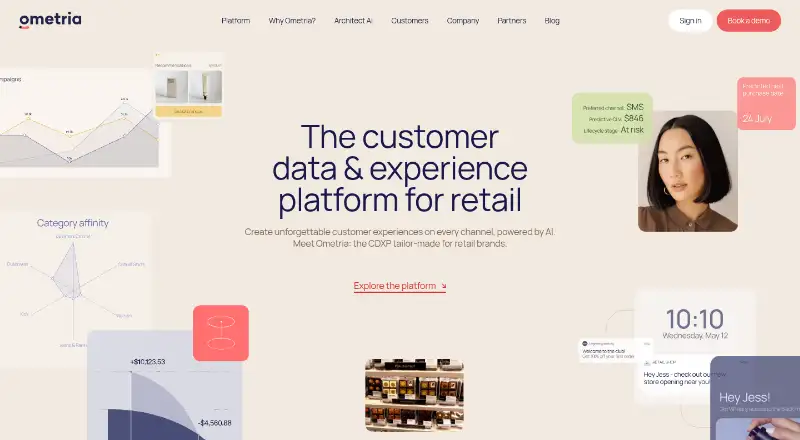
What Ometria is
Ometria is a customer data and experience platform built exclusively for retail brands. It consolidates customer profiles, resolves identities, manages consent, and provides dashboards, reports, and a single customer view. Retail marketing teams can use segmentation, customer analytics, predictive insights, and marketing reporting to plan broadcasts and automated journeys. Delivery channels include email, SMS, mobile push, ads and retargeting, websites, direct mail, in-store and customer service, and customer loyalty. Personalization features include dynamic content, smart templates, coupon pools, product recommendations, and data-powered campaigns. Ometria says Architect AI powers specialist personalization agents and is trained on retail data. Listed integrations include Google Ads, Facebook, Attentive, Freshdesk, Stylitics, Trustpilot, Yotpo, and Zendesk; some connections require backend configuration or a third-party app. Mobile app integration uses Android, iOS, and React Native SDKs. Web personalization can be delivered by JavaScript, a headless API, or both, but enablement and pricing require contacting a Customer Success Representative. Ometria is headquartered in London and was founded in 2013. Pricing is on request.
Good
- Combines customer profiles, identity resolution, and consent management
- Supports cross-channel broadcasts and automated journeys
- Includes predictive insight and marketing reporting
- Offers mobile app integration SDKs
Watch out
- Pricing is available on request
- Web personalization enablement and pricing require contacting Customer Success
- Some integrations require backend configuration or a third-party app
Who it suits
Ometria is aimed at retail brands and retail marketing teams that need customer data capabilities alongside cross-channel campaign delivery. Teams considering web personalization should account for its separate enablement and pricing process.
Verdict
Ometria focuses its customer data and campaign tools on retail, with broad listed channels and personalization features. Prospective customers should confirm pricing, integration requirements, and web personalization availability with the company.
Plans and prices
From Ometria's own pricing page, checked 30 Sep 2026.
| Plan | Price | What it gives you |
|---|---|---|
| Ometria | Priced on request | Contact Customer Success Representative for pricing |
The facts
Each one read from Ometria's own pages, with the date it was checked.
What it does
- Additional partners
- Ometria also works with Antavo, GiveX, LoyaltyLion, LoudCrowd, Mention Me, Movable Ink, Nosto, Wisepops, Yieldify and Zapier.checked 30 Sep 2026
- AI
- Ometria says Architect AI powers a suite of specialist agents for personalization.checked 30 Sep 2026
- API security
- Ometria’s help documentation says unused API keys should be revoked and created, viewed, and revoked keys can be reviewed in security audit logs.checked 30 Sep 2026
- Audience
- Ometria is intended for retail brands and retail marketing teams.checked 30 Sep 2026
- Campaign orchestration
- The platform lists real-time customer audiences, broadcast building, personalization and dynamic content, smart templates, and a cross-channel journey builder.checked 30 Sep 2026
- CDP features
- CDP features include dashboards, reports and a single customer view.checked 30 Sep 2026
- Channels
- Listed delivery channels include email, SMS, ads and retargeting, mobile push, website, direct mail, in-store and customer service, and customer loyalty.checked 30 Sep 2026
- Core capabilities
- The platform combines customer data consolidation and insight with cross-channel experience delivery.checked 30 Sep 2026
- Customer profiles
- The platform consolidates customer profiles, resolves identities, and manages consent.checked 30 Sep 2026
- Data protection
- Ometria says personal data is processed only according to documented controller instructions and that clients are notified of breaches without undue delay.checked 30 Sep 2026
- Insights
- Its listed capabilities include advanced segmentation, customer insight and analytics, predictive insight, and marketing reporting.checked 30 Sep 2026
- Integration constraint
- Ometria says web personalization enablement and pricing require contacting a Customer Success Representative, and the offering is separate from website overlays and product recommendations.checked 30 Sep 2026
- Integrations
- Ometria lists connections including Google Ads, Facebook, Attentive, Freshdesk, Stylitics, Trustpilot, Yotpo, and Zendesk, with some other connections configured in Ometria’s backend or a third-party app.checked 30 Sep 2026
- Marketing channels
- CXP supports broadcast and automated marketing through email, text messages and push notifications.checked 30 Sep 2026
- Personalization
- CXP includes dynamic coupon pools, product recommendations, email templates and data-powered campaign personalization.checked 30 Sep 2026
- Product
- Ometria describes itself as a customer data and experience platform built for retail brands.checked 30 Sep 2026
- Product focus
- Ometria is a customer data and experience platform built exclusively for retail.checked 30 Sep 2026
- Retail focus
- Ometria says it is built exclusively for retail and describes its AI as trained on retail data.checked 30 Sep 2026
- Security certifications
- Ometria states that its information security management system is certified to ISO/IEC 27001 and its privacy information management system to ISO 27701.checked 30 Sep 2026
The company
- Company
- Ometria says it was founded in 2013 and its about page lists 200 clients and 150 employees.checked 30 Sep 2026
- Company scale
- Ometria reports 200 clients, 150 employees and more than 250 million customer profiles.checked 30 Sep 2026
- Founded
- 2013checked 28 Sep 2026
- Headquarters
- London, United Kingdomchecked 28 Sep 2026
Where it runs
- Mobile app integration
- Ometria’s help page lists Android, iOS, and React Native SDKs for app integration and push notifications.checked 30 Sep 2026
The full review of Ometria
Ometria is a retail-only customer data and experience platform that unifies shopper profiles with analytics and campaign execution. It suits retail marketing teams coordinating personalized activity across multiple channels, especially where loyalty, ecommerce and POS data need to work together. The trade-off is a sales-led buying process and integration conditions that require close validation.
Overview
Founded in 2013 and headquartered in London, Ometria reports 200 clients, 150 employees and more than 250 million customer profiles. Its customer data platform consolidates profiles, resolves identities and manages consent, while its experience tools connect those insights to broadcasts, automation and personalization. Ometria says the product is built exclusively for retail and that its Architect AI specialist agents are trained on retail data, a focus that should be more relevant to retailers than a general-purpose customer platform.
Security credentials are substantial for a marketing system handling customer information: Ometria states that its information security management system is certified to ISO/IEC 27001 and its privacy information management system to ISO 27701. It also says personal data is processed only under documented controller instructions and that clients are notified of breaches without undue delay.
Key features
Unified customer data
Unified shopper profiles, identity resolution, consent management, dashboards, reports and a single customer view give teams a shared basis for audience decisions. Advanced segmentation, customer insight and analytics, predictive insight and marketing reporting are useful when a retailer wants campaign targeting and measurement to draw from the same customer record rather than disconnected channel databases.
Campaign orchestration
Real-time audiences, broadcast building, smart templates, dynamic content and a cross-channel journey builder cover both one-off sends and automated journeys. Email, SMS and mobile push support direct engagement, while the broader channel set includes ads and retargeting, websites, direct mail, in-store and customer service, and loyalty. Dynamic coupon pools, product recommendations and data-powered personalization add commercial relevance, provided the underlying catalog and customer data are connected correctly.
Retail integrations and AI
Connections include Google Ads, Facebook, Attentive, Freshdesk, Stylitics, Trustpilot, Yotpo and Zendesk, alongside partners such as Antavo, LoyaltyLion, Movable Ink, Nosto, Wisepops, Yieldify and Zapier. Some connections are configured in Ometria's backend or through a third-party app, so implementation ownership matters. Architect AI supplies specialist personalization agents, but buyers should still establish which workflows and data they can use during onboarding.
Web and mobile delivery
Android, iOS and React Native SDKs support app integration and push notifications. Web personalization can use JavaScript, a headless API or both, which accommodates different website architectures. Enablement and pricing require a Customer Success Representative, and this capability is separate from website overlays and product recommendations. Shopify Markets does not support parent/sub-market configurations, B2B setups or retail POS catalogs, a material limitation for retailers using those arrangements.
API security controls include revoking unused keys and reviewing key creation, viewing and revocation in security audit logs. That is a useful operational safeguard for teams managing several integrations.
Pricing
Ometria uses custom pricing. The Ometria plan is billed through a Customer Success Representative, with no published price, seat allowance, quota or trial term. This structure can suit a retailer requiring a scoped implementation and negotiated support, but it prevents straightforward budget comparison and makes a demo and integration assessment essential before commitment. There is no cheaper self-serve tier described, so smaller teams should weigh the likely sales and setup overhead against their channel and data requirements.
Platforms
Ometria supports Android, iOS, web and API access. Its mobile SDKs cover Android, iOS and React Native apps, while web personalization is available through JavaScript, a headless API or a combination. The API route is useful for custom commerce and data stacks; retailers should confirm how their required connectors are delivered and maintained.
Who it's for
Ometria is aimed at retail brands and retail marketing teams that need unified shopper profiles, advanced segmentation, loyalty support and coordinated campaigns across email, text, push, advertising and offline touchpoints. It is a stronger fit for organizations with enough customer volume and integration capability to benefit from a retail-specific data model. It is less suitable for a small business seeking transparent monthly pricing, a free plan or a quick standalone email tool, and Shopify merchants with unsupported Markets or POS configurations need another approach.
Pros and cons
- Pros: Retail-only positioning and retail-trained Architect AI align the product with merchandising and shopper-marketing use cases.
- Pros: Identity resolution, consent, predictive insight and cross-channel journeys connect customer understanding to activation.
- Pros: Broad channel coverage includes digital, mobile, advertising, direct mail, in-store, service and loyalty touchpoints.
- Pros: ISO/IEC 27001 and ISO 27701 certifications provide documented security and privacy-management assurance.
- Cons: Custom pricing and a demo-led process make cost and implementation effort difficult to assess in advance.
- Cons: Web personalization requires separate commercial enablement, and Shopify Markets has notable configuration exclusions.
- Cons: Backend or third-party setup for some integrations can add coordination work for lean teams.
Alternatives
For a broader CRM with a freemium entry point, Zoho CRM offers a Free plan for three users and a Standard plan at $23 a month billed annually; choose it when sales and contact management matter more than Ometria's retail-specific orchestration.
BlueConic is a paid customer data platform with free access subject to profile, volume and usage limits and no support obligations; it is worth considering when a constrained free starting point is more important than a full retail campaign suite.
Hightouch provides a free tier with two active syncs and hourly frequency, making it a better choice when the primary need is moving warehouse data into destinations rather than managing end-to-end retail journeys.
Salesforce for Restaurants is a paid, restaurant-oriented Salesforce offering; pick it when restaurant operations and CRM workflows are the priority.
WebEngage is another paid cross-channel engagement option. Aptos Retail is a paid retail platform. Comarch Accounts Payable Automation is paid software for accounts-payable automation. Treasure AI Composable CDP is a paid composable CDP with no free plan and warehouse credits applying to query execution.
Verdict
Choose Ometria if you are a retail brand that needs one system to reconcile shopper data, build advanced audiences and run personalized journeys across digital and physical channels. Its retail specialization, broad orchestration and governance credentials are the main reasons to shortlist it. Look elsewhere if you require published pricing, a self-serve free tier, minimal integration work or support for the Shopify Markets configurations Ometria excludes.
Alternatives to Ometria
- 1

RudderStack Customer Data Platform
Free planOpen sourceAndroidiOSWebAPI8.5From $265 a month - 2

Hightouch
Free planAndroidiOSWebAPI8.2From $350 a month - 3

Twilio Segment
Free planAndroidiOSWebAPI8.2From $120 a month - 4
Manago AI (formerly SALESmanago)
Free planAndroidiOSWebAPI8.1From €30 a month - 5

Leadspace
Free planWebAPIExtension7.7From $49 a month - 6
SAP Analytics Cloud
AndroidiOSWebAPI7.6From $36 a month