Apache Unomi
Apache Unomi is a free, open-source Java server for managing customer, lead, and visitor data and using it to personalize customer experiences.
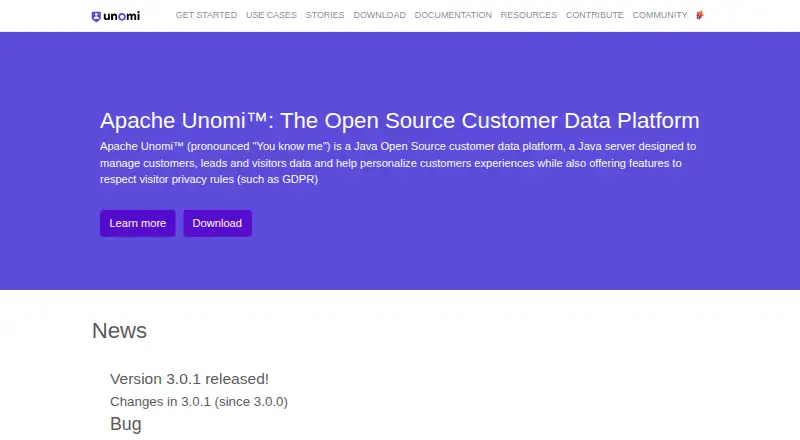
What Apache Unomi is
Apache Unomi is a free, open-source Java server for managing customer, lead, and visitor data and using it to personalize customer experiences. It tracks users, builds profiles progressively, and associates collected events with those profiles. Rules can trigger actions when profile events arrive, and dynamic segments group profiles. Its privacy REST API can support controls for tracking, data review, anonymization, and deletion, but developers must expose these controls because Unomi has no default privacy interface.
Unomi runs as an OSGi application inside Apache Karaf, stores data in Elasticsearch, and exchanges JSON through HTTP REST requests. Its plugin system allows additions such as conditions, actions, beacon tracking, and push notifications. Listed uses include website personalization, mobile app data collection, store beacon connections, and sending scored leads to a CRM; named integration targets include CMSs, CRMs, issue trackers, and native mobile apps. The project offers Docker images and a Java quick-start guide, and describes installation as unzip and run. It identifies Unomi as the reference implementation of the OASIS Customer Data Platform specification. Support channels include user and developer mailing lists, a monthly online meeting, Slack, and a JIRA bug tracker. The project advises verifying downloads with signatures or checksums.
Good
- Builds profiles from user activity and associated events.
- Rules can respond to collected profile events.
- Dynamic segments group customer profiles.
- Provides a privacy REST API for data controls.
- Supports plugins and external system integrations.
Watch out
- Privacy controls have no default user interface.
- Requires developers to expose privacy controls themselves.
- Uses Elasticsearch for storage.
Who it suits
Apache Unomi suits developers building customer-data and personalization systems who can integrate its REST API and expose privacy controls. Its listed use cases cover websites, mobile apps, store beacons, and CRM lead workflows.
Verdict
Apache Unomi provides profile management, event handling, segmentation, and personalization capabilities in an extensible server. Teams should account for the developer work required to make its privacy controls available to users.
Plans and prices
From Apache Unomi's own pricing page, checked 14 Oct 2026.
| Plan | Price | What it gives you |
|---|---|---|
| Apache Unomi | Priced on request | Pricing available upon request |
The facts
Each one read from Apache Unomi's own pages, with the date it was checked.
What it does
- Authentication
- From version 3.1, public endpoints require tenant public API keys while administrative operations use private tenant keys or system credentials.checked 14 Oct 2026
- Container setup
- The getting-started guide provides Docker Compose instructions exposing Unomi ports 8181, 9443 and 8102 alongside Elasticsearch.checked 14 Oct 2026
- Deployment
- The project publishes binary tar.gz and ZIP distributions plus source ZIP archives, with a five-minute quick-start installation guide.checked 14 Oct 2026
- Documentation depth
- Documentation covers installation, advanced plugin development, migrations, integration patterns, REST usage and GraphQL.checked 14 Oct 2026
- Extensibility
- Apache Unomi runs as an OSGi application inside Apache Karaf and supports plugins such as conditions, actions, beacon tracking, and push notifications.checked 4 Oct 2026
- GitHub project status
- The GitHub README describes the main branch as unstable and recommends version branches for stable source builds.checked 14 Oct 2026
- GraphQL API
- A beta GraphQL API is available but disabled by default and must be enabled through a GraphQL distribution or feature.checked 14 Oct 2026
- Integrations
- The getting started page names CMSs, CRMs, issue trackers, and native mobile applications as systems Unomi can integrate with.checked 4 Oct 2026
- Java API
- Published Javadocs expose packages for profiles, actions, campaigns, conditions, goals, rules, segments, services, GraphQL and privacy.checked 14 Oct 2026
- Latest release
- The download page identifies Unomi 3.0.1, released July 20, 2026, as the latest release.checked 14 Oct 2026
- Latest release change
- The homepage lists a 3.0.1 fix for a small bug in the context.json endpoint.checked 14 Oct 2026
- License
- The source code is distributed under the Apache License 2.0.checked 14 Oct 2026
- Limit: update follow-through
- A G2 reviewer complained that updates did not consistently address certain errors.checked 14 Oct 2026
- Limit: usability
- A G2 reviewer described navigation as difficult and the interface graphics as crowded.checked 14 Oct 2026
- Multi-tenancy
- Unomi 3.1 documentation describes tenant isolation for profiles, events, segments, rules and schemas.checked 14 Oct 2026
- Personalization
- The project supports website personalization based on audience data and segments.checked 14 Oct 2026
- Plugin extensibility
- Plugins can add conditions, actions and services such as beacon tracking or push notifications using OSGi and JSON descriptors.checked 14 Oct 2026
- Praise: data consolidation
- A G2 reviewer praised collecting client information in one place and using it to generate suitable offers.checked 14 Oct 2026
- Praise: readable charts
- A G2 reviewer said the charts were easy to read after data collection and that content collection was easy to implement initially.checked 14 Oct 2026
- Privacy controls
- Its privacy REST API supports profile access, tracking preferences, data review, anonymization and profile deletion.checked 14 Oct 2026
- Privacy UI limit
- Apache Unomi does not include a default user interface for its privacy controls; developers expose those controls themselves.checked 4 Oct 2026
- Privacy UI limitation
- Apache Unomi does not include a default user interface for exposing privacy controls; developers must build that interface.checked 14 Oct 2026
The company
- Company headquarters
- LinkedIn lists the Apache Software Foundation headquarters at 1000 N West Street, Suite 1200, Wilmington, Delaware.checked 14 Oct 2026
- Company legal name
- The Apache Software Foundation is a nonprofit open-source software organization established in 1999.checked 14 Oct 2026
The full review of Apache Unomi
Apache Unomi is an open-source Java server for customer, lead, and visitor data, built for teams that can operate infrastructure and develop integrations. It is a strong foundation for profile-driven personalization, but not a finished customer-data application for nontechnical users.
Overview
Unomi associates tracked users and incoming events with progressively built profiles. Its rules engine can react to profile events, while dynamic segments classify profiles as their data changes. That combination supports event-driven personalization and audience management without forcing a particular marketing interface or workflow.
The project positions Unomi as the reference implementation of the OASIS Customer Data Platform specification. It stores information in Elasticsearch and communicates through HTTP REST requests with JSON. Stated applications include website personalization, mobile-app collection, store-beacon connections, and sending scored leads to a CRM. Its architecture is described as highly scalable and intended to simplify external data integration, though operating a server and connecting surrounding systems remains the customer's responsibility.
Key features
Profiles, events, and audience logic
Real-time profiles, identity resolution, streaming ingestion, and audience activation cover the path from activity collection to usable audiences. Rules can trigger actions as events arrive, and segments update as profile characteristics change. This suits development teams building their own personalization or lead-scoring behavior; organizations wanting prebuilt campaigns will need another layer.
Privacy controls
The privacy REST API can let users control tracking, inspect collected data, anonymize records, or delete profile information. Unomi does not provide a default privacy-control interface, so developers must expose those functions in a website, app, or account area. That is flexible for custom experiences but adds essential implementation work for any deployment that promises user-facing privacy controls.
Extensibility and integration
Running as an OSGi application inside Apache Karaf, Unomi supports plugins for conditions, actions, beacon tracking, and push notifications. Its HTTP and JSON model is suited to CMSs, CRMs, issue trackers, and native mobile applications. Docker images and a Java quick-start guide lower deployment friction, while the documented unzip-and-run approach is useful for initial setup. Teams still need Java, Elasticsearch, integration, and ongoing operations expertise.
Pricing
Apache Unomi is free open-source software. The Apache Unomi plan costs nothing, under the Apache License v2. There is no free trial because the software itself is free. This removes per-seat or usage charges, but infrastructure, engineering, integrations, and support remain part of the ownership decision.
Platforms
Unomi is offered as an API and web-accessible, self-hosted server for Linux environments. Its server orientation fits organizations that need deployment control and can manage their own runtime rather than buyers seeking a hosted service.
Who it's for
Choose Unomi when you have developers to run a Java server, connect data sources, design profile and segment logic, and build the privacy interface your users require. It is especially relevant for website or mobile personalization, beacon-based store scenarios, and CRM lead activation where an extensible server matters more than packaged screens.
Look elsewhere if you need a managed customer-data platform, turnkey consent and privacy pages, or a vendor-owned implementation path. Unomi's open architecture is an advantage only when your team can take responsibility for the surrounding product.
Pros and cons
Pros
- Open-source cost model: the software is free under Apache License v2, with no plan-level seat or event fee.
- End-to-end event foundation: profiles, identity resolution, streaming ingestion, rules, segments, and activation support custom audience workflows.
- Broad extensibility: OSGi plugins and REST/JSON integration accommodate custom conditions, actions, beacons, notifications, and external systems.
- Self-hosting control: Linux deployment, Docker images, and Elasticsearch storage suit teams that need control over data and infrastructure.
- Documented security process: releases include signature files, and vulnerability reports follow Apache's security handling process.
Cons
- No default privacy UI: developers must build the screens and flows that let users review, anonymize, or delete data.
- Operational burden: running Java, Karaf, Elasticsearch, integrations, and upgrades is a poor match for teams seeking a hosted service.
- Product-building required: the server supplies extensible primitives rather than a complete marketing interface or ready-made workflow.
Alternatives
RudderStack Customer Data Platform is the better choice when you want a freemium hosted-style option with Android and iOS coverage, 250,000 events per month on its free tier, 16 SDK sources, and more than 200 cloud destinations.
Manago AI (formerly SALESmanago) suits buyers seeking a paid platform with a free trial and mobile applications rather than a self-hosted open-source server.
Twilio Segment is preferable for a freemium service with a free trial, web and mobile platforms, 1,000 monthly visitors, and 700-plus integrations on its free plan.
BlueConic offers a free-access subscription for teams willing to work within profile, volume, and usage limits without support obligations.
Lytics fits organizations wanting a free personalization engine with native WordPress and Drupal integrations.
Tracardi is another self-hosted, open-source route, though its free version limits events per second, tenancy, automation, and event validation.
Hightouch is aimed at API and web teams focused on data synchronization, with two active syncs and hourly frequency on its free plan.
Leadspace is a lead-focused alternative with a free one-seat Starter plan and 25 daily credits.
Browse the Customer Data Platforms category for more options.
Verdict
Apache Unomi is best for engineering-led organizations that want a free, extensible server for real-time profiles, event rules, segmentation, and personalized experiences. Choose it for control and customization; look elsewhere when a managed product or ready-to-use privacy experience matters more than an open foundation.
Alternatives to Apache Unomi
- 1

RudderStack Customer Data Platform
Free planOpen sourceAndroidiOSWebAPI8.5From $265 a month - 2

Hightouch
Free planAndroidiOSWebAPI8.2From $350 a month - 3

Twilio Segment
Free planAndroidiOSWebAPI8.2From $120 a month - 4
Manago AI (formerly SALESmanago)
Free planAndroidiOSWebAPI8.1From €30 a month - 5

Leadspace
Free planWebAPIExtension7.7From $49 a month - 6
SAP Analytics Cloud
AndroidiOSWebAPI7.6From $36 a month