
Argilla
Argilla is a collaboration tool for AI engineers and domain experts building datasets with human feedback.
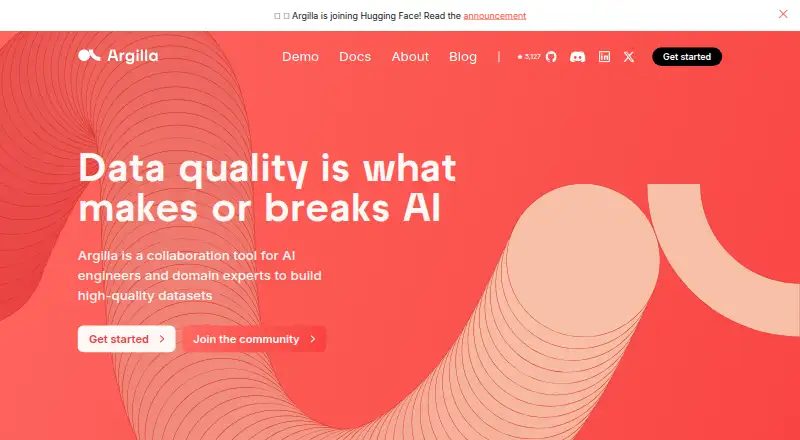
What Argilla is
Argilla is a collaboration tool for AI engineers and domain experts building datasets with human feedback. It supports NLP, LLM, and multimodal projects, including text classification, named entity recognition, retrieval-augmented generation, and preference tuning. Contributors can provide labels, ratings, rankings, or written responses. Annotation tools include filters, AI feedback suggestions, and semantic search. Argilla works with text and images, while custom fields can represent audio, video, or other material rendered as base64 or HTML. It is compatible with Hugging Face and spaCy, with tutorials for SetFit and LlamaIndex. Teams can deploy it on Hugging Face Spaces or a local machine or server using Docker Compose. Its Python SDK connects to a server through an API URL and key, and the server provides REST API documentation. Datasets and records can be imported from or exported to Python, local disk, and the Hugging Face Hub. Argilla has a free plan and supports OAuth2 sign-in through Hugging Face, GitHub, and Google.
Good
- Collects labels, ratings, rankings, and text responses.
- Annotation includes filters and semantic search.
- Supports text and images, with custom audio and video fields.
- Offers a Python SDK and REST API documentation.
- Free plan; can be deployed on local infrastructure.
Watch out
- Does not train models.
- Free Hugging Face Spaces storage loses data when the Space restarts.
- Anonymous usage and error telemetry is enabled unless disabled.
Who it suits
Argilla suits AI teams that need domain experts to contribute structured feedback to datasets. It is also a fit for teams that want to deploy locally or on Hugging Face Spaces and move data through Python or the Hugging Face Hub.
Verdict
Argilla provides dataset annotation and feedback tools for NLP, LLM, and multimodal work, with import and export options and a free plan. Teams should arrange separate model training and consider persistent storage when using Hugging Face Spaces.
Plans and prices
From Argilla's own pricing page, checked 30 Sep 2001.
| Plan | Price | What it gives you |
|---|---|---|
| Argilla | Free | Free, open-source software; deploy on Hugging Face Spaces or your own infrastructure |
The facts
Each one read from Argilla's own pages, with the date it was checked.
What it does
- AI workflows
- It supports collecting human feedback for NLP, LLM, and multimodal projects, including tasks such as text classification, named entity recognition, retrieval-augmented generation, and preference tuning.checked 30 Sep 2001
- Annotation tools
- Users can label data with filters, AI feedback suggestions, and semantic search.checked 30 Sep 2001
- Authentication
- Argilla supports OAuth2 authentication with Hugging Face, GitHub, and Google providers by default.checked 30 Sep 2001
- Data formats
- Argilla supports text and images, and custom fields can represent audio, video, or other data rendered as base64 or HTML.checked 30 Sep 2001
- Data persistence limit
- On Hugging Face Spaces, data on ephemeral free storage is lost when the Space restarts.checked 30 Sep 2001
- Data portability
- Datasets and records can be imported from and exported to Python, local disk, or the Hugging Face Hub.checked 30 Sep 2001
- Deployment
- Argilla can be deployed on Hugging Face Spaces or on a local machine or server using Docker Compose.checked 30 Sep 2001
- Feedback types
- Datasets can collect feedback such as labels, ratings, rankings, and text responses.checked 30 Sep 2001
- Integrations
- The docs describe compatibility with Hugging Face and spaCy, and tutorials show integrations with SetFit and LlamaIndex.checked 30 Sep 2001
- Model training limit
- Argilla does not train models; its FAQ recommends using a separate machine-learning framework such as Hugging Face Transformers.checked 30 Sep 2001
- Privacy and telemetry
- Argilla reports anonymous usage and error telemetry, says it does not collect dataset records, names, or metadata, and allows telemetry to be disabled with an environment variable.checked 30 Sep 2001
- Purpose
- Argilla is a collaboration tool for AI engineers and domain experts to build high-quality datasets.checked 30 Sep 2001
- SDK and API
- A Python SDK connects to an Argilla server using its API URL and API key, and the server exposes REST API documentation.checked 30 Sep 2001
- Support
- The product site directs users to its community for support and use-case discussion.checked 30 Sep 2001
The full review of Argilla
Overview
Argilla is a dataset collaboration and annotation tool for AI engineers working with domain experts. It is best suited to teams collecting human feedback for NLP, LLM, or multimodal projects. Its strength is flexible feedback and data portability; it is not a model-training platform.
Key features
Workflows cover text classification, named entity recognition, retrieval-augmented generation, and preference tuning. Annotators can filter records, search semantically, and use AI feedback suggestions. Feedback can be captured as labels, ratings, rankings, or written responses, making Argilla useful for evaluation as well as conventional labeling.
Text and images are supported directly. Custom fields can represent audio, video, and other data rendered as base64 or HTML, which broadens its reach but may require teams to shape those formats for their own annotation process. Review workflows, model-assisted labeling, and annotation across text, images, and audio/video support collaborative work.
A Python SDK connects to an Argilla server using its API URL and API key, and the server exposes REST API documentation. Datasets and records can be imported from and exported to Python, local disk, or the Hugging Face Hub. Compatibility with Hugging Face and spaCy, plus tutorials for SetFit and LlamaIndex, make it a natural fit for teams already using those tools.
Argilla can run on Hugging Face Spaces or on a local machine or server with Docker Compose. Spaces offer a hosted route, but data on ephemeral free storage is lost when the Space restarts; teams relying on persistent datasets should plan their deployment accordingly. OAuth2 sign-in supports Hugging Face, GitHub, and Google by default. Argilla reports anonymous usage and error telemetry, says it does not collect dataset records, names, or metadata, and provides an environment variable to disable telemetry.
Pricing
| Plan | Price | What it includes |
|---|---|---|
| Argilla | free | Free, open-source software; deploy on Hugging Face Spaces or your own infrastructure. |
The free plan is the whole offering described here, making it a strong fit for teams able to host and operate their own annotation environment without a subscription. Its trade-offs are operational rather than tier-based: Argilla does not train models, and free ephemeral storage on Spaces will not preserve data through a restart. Use a separate machine-learning framework such as Hugging Face Transformers for training, and choose a deployment with appropriate persistence for important datasets.
Platforms
Argilla supports API, Linux, self-hosted, and web use. Docker Compose enables local or server deployment; Hugging Face Spaces is another deployment option.
Who it's for
Choose Argilla if AI engineers and domain experts need to collaborate on feedback datasets, especially when work spans varied feedback types or needs exchange with Python and the Hugging Face Hub. It is less suitable as a standalone solution for teams that expect model training or want to rely on ephemeral free Spaces storage for durable data.
Pros and cons
Pros
- Labels, ratings, rankings, and text responses accommodate both annotation and richer feedback tasks.
- Import and export to Python, local disk, and the Hugging Face Hub give teams several routes for moving datasets.
- Open-source deployment can run on Hugging Face Spaces or a team's own infrastructure.
Cons
- Model training requires a separate machine-learning framework, so training teams need another tool in their workflow.
- Free ephemeral storage on Hugging Face Spaces loses data when the Space restarts, making deployment choice important for persistence.
- Audio, video, and other custom data depend on base64 or HTML representations rather than direct support described for text and images.
Alternatives
For a broader comparison, browse Data Labeling Software and AI Data Labeling Tools.
- Potato is another free, self-hosted annotation option with all features included and no usage limits; consider it if those terms matter more than Argilla's feedback workflows and integrations.
- CVAT offers a free Community plan for personal use and small teams, as well as a hosted free plan capped at one member, one project, three tasks, and 1 GB; choose it if those specific use cases fit.
- Label Studio is another freemium annotation option with a free plan and free trial.
- Doccano is a free open-source annotation tool installable with pip, Docker, or Docker Compose; consider it for that deployment route.
- Datasaur has a free tier limited to one user, 5,000 labels a year, and 100 MB of storage, plus a Growth trial of up to 14 days; it may suit a solo user whose work fits those caps.
- Roboflow offers a free tier with 10 monthly credits, enough for about 30 model trainings or 80,000 inferences; consider it if that credit-based allowance suits your workload.
- LightlyStudio offers a free open-source version under the Apache License 2.0.
- BasicAI offers private-cloud deployment starting at $6,600 a year, with customizable payment cycles and options for seats, storage, model calls, and on-premise deployment.
Verdict
Argilla is a strong choice for AI teams that need collaborative, flexible feedback collection and portable datasets without paying for the software. Its main advantage is the combination of varied annotation workflows and deployment control; look elsewhere or add another tool if you need model training, and avoid relying on ephemeral Spaces storage for persistent work.
Alternatives to Argilla
- 1

Label Studio
Free planOpen sourceWebAPILinuxmacOS8.2From $99 a month - 2

Roboflow
Free planAndroidiOSWebAPI7.5From $39 a month - 3

CVAT
Free planWebAPISelf-hosted6.8From $1.92 a month - 4
Supervisely
Free planWebAPISelf-hosted6.8From €199 a month - 5
doccano
Free planAndroidiOSWebAPI6.7Free plan - 6
Prodigy
WebAPILinuxmacOS6.7$390, paid once