Potato
Potato is an open-source platform for annotating text, audio, images, video and qualitative data.
What Potato is
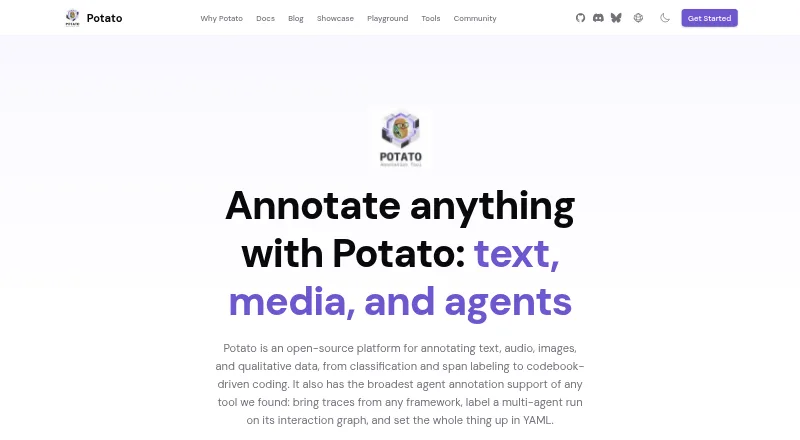
Potato is an open-source platform for annotating text, audio, images, video and qualitative data. Annotation tasks are configured in YAML, and its maker says an interface can be built without programming. The homepage lists 61 annotation types, including classification, spans, bounding boxes, polygons and qualitative coding. Potato also supports annotating multi-agent teams on an interaction graph and evaluating computer-use, voice and video agents. AI assistance can suggest labels, highlight keywords, check quality and consistency, pre-annotate material and generate explanations. Listed integrations include OpenAI, Anthropic Claude, Google Gemini, Ollama, HuggingFace, OpenRouter, vLLM, YOLO and LangChain. Imports include text, images, audio, video, PDF and HTML documents; exports include JSON, JSONL, CSV, CoNLL, Hugging Face, COCO and YOLO. It runs locally or on users’ own servers and supports offline use. The free self-hosted plan includes all features and has no usage limits. Potato is licensed under GNU GPL version 3 or later, and installation with pip requires Python 3.7 or later.
Good
- Supports 61 listed annotation types.
- Works locally and supports offline use.
- Imports and exports multiple data formats.
- Free plan includes all features without usage limits.
Watch out
- Self-hosted only; users must run it themselves.
- Installation requires Python 3.7 or later.
Who it suits
Potato suits research and project teams that need to create annotation tasks across multiple media types. It is for users prepared to run the software themselves rather than use a managed cloud tier.
Verdict
Potato covers varied annotation tasks and data formats in a free, self-hosted package. Its lack of a managed cloud tier makes deployment the user's responsibility.
Plans and prices
From Potato's own pricing page, checked 29 Sep 2001.
| Plan | Price | What it gives you |
|---|---|---|
| Free | Free | Self-hosted · all features included · Free; no paid tiers or usage limits |
The facts
Each one read from Potato's own pages, with the date it was checked.
What it does
- Agent evaluation
- Potato supports annotating multi-agent teams on an interaction graph and evaluating computer-use, voice, and video agents.checked 29 Sep 2001
- AI features
- AI assistance includes label suggestions, keyword highlighting, quality checking, pre-annotation, explanation generation, and consistency checking.checked 29 Sep 2001
- Annotation types
- The homepage lists 61 annotation types, including classification, spans, bounding boxes, polygons, video, audio, and qualitative coding.checked 29 Sep 2001
- Crowdsourcing
- Potato documents integrations with Prolific and Amazon Mechanical Turk, including participant tracking and quality or approval workflows.checked 29 Sep 2001
- Data formats
- The integrations page lists imports for text, image, audio, video, and PDF or HTML documents, and exports including JSON, JSONL, CSV, CoNLL, Hugging Face, COCO, and YOLO.checked 29 Sep 2001
- Installation
- The maker’s quick start instructs users to install Potato with pip and requires Python 3.7 or later.checked 29 Sep 2001
- Integrations
- Listed integrations include OpenAI, Anthropic Claude, Google Gemini, Ollama, HuggingFace, OpenRouter, vLLM, YOLO, and LangChain.checked 29 Sep 2001
- License
- Potato is released under GNU GPL version 3 or later and may be used, modified, redistributed, and used commercially, subject to the license terms.checked 29 Sep 2001
- Notable limitation
- Potato is self-hosted only, so users must run it themselves; the maker says there is no managed cloud tier.checked 29 Sep 2001
- Privacy and deployment
- Potato runs locally or on users’ own servers; the maker says this keeps data on their infrastructure and supports offline use.checked 29 Sep 2001
- Support
- The FAQ directs users to Discord or the documentation for questions; the About page provides a team contact email.checked 29 Sep 2001
- Task setup
- Annotation tasks are configured in YAML, and the maker says building an annotation interface requires no programming.checked 29 Sep 2001
- What it does
- Potato is an open-source platform for annotating text, audio, images, video, and qualitative data.checked 29 Sep 2001
The full review of Potato
Overview
Potato is an open-source annotation platform for text, audio, images, video, and qualitative data. It suits teams that want to define their own annotation tasks and run them on their infrastructure. Its broad task coverage and included AI assistance make it versatile; self-hosting is the trade-off.
Key features
Tasks are configured in YAML, and Potato’s maker says an annotation interface can be built without programming. That lowers the barrier to custom workflows, though users still need to install and operate the software themselves. The homepage lists 61 annotation types, including classification, spans, bounding boxes, polygons, and qualitative coding, covering work that would otherwise call for separate tools.
Potato also supports annotation of multi-agent teams on an interaction graph and evaluation of computer-use, voice, and video agents. These capabilities make it relevant to teams assessing agent behavior, not only labeling conventional datasets.
AI assistance includes label suggestions, keyword highlighting, pre-annotation, explanation generation, quality checking, and consistency checking. Integrations include OpenAI, Anthropic Claude, Google Gemini, Ollama, HuggingFace, OpenRouter, vLLM, YOLO, and LangChain. These options can help incorporate model assistance into annotation work, while review workflows remain available for checking labels.
For distributed labeling, Potato documents Prolific and Amazon Mechanical Turk integrations, with participant tracking and quality or approval workflows. It imports text, image, audio, video, and PDF or HTML documents; exports include JSON, JSONL, CSV, CoNLL, Hugging Face, COCO, and YOLO. That range is useful when projects span modalities or need output in established dataset formats.
Pricing
Free — free. Potato’s free plan is self-hosted and includes all features, with no paid tiers or usage limits. It is a strong fit for individuals and teams that can manage their own deployment and want the full feature set without subscription costs. There is no managed cloud tier, so the price advantage comes with responsibility for running the software.
Platforms
Potato is available through web, API, and self-hosted deployments, with support for Linux, macOS, and Windows. The quick start uses pip and requires Python 3.7 or later. Local or own-server operation keeps data on users’ infrastructure and supports offline use, which benefits privacy-conscious projects but requires installation and ongoing operation. Support is directed through Discord or documentation, with a team contact email also provided.
Who it's for
Potato is best suited to research groups, data teams, and developers who need varied annotation types, AI-assisted labeling, or agent evaluation and are comfortable running software themselves. Its GPL version 3 or later license permits use, modification, redistribution, and commercial use subject to the license terms. Teams seeking a managed service should look elsewhere.
Pros and cons
- Pros: The free plan includes all features and has no usage limits, making the full platform accessible without tier-based caps.
- Pros: Support for text, image, audio, video, and qualitative data, plus multiple import and export formats, suits varied project pipelines.
- Pros: Local or own-server deployment keeps data on the user’s infrastructure and supports offline work.
- Cons: Self-hosting is the only deployment option, so users must handle installation and operation rather than relying on a managed cloud service.
- Cons: The pip installation requires Python 3.7 or later, which may add setup work for teams without a suitable environment.
Alternatives
Browse Data Labeling Software for more options. Argilla is another free, open-source self-hosted option, with deployment on Hugging Face Spaces or users’ own infrastructure. CVAT is worth considering for its free Community plan for personal use and small teams, or its online free plan with one member, one project, three tasks, and 1 GB of storage.
Label Studio is a freemium option with a free trial. Doccano is a free alternative installable with pip, Docker, or Docker Compose. Datasaur offers a free plan capped at one user, 5,000 labels per year, and 100 MB of storage, with a Growth trial of up to 14 days. Roboflow offers a free tier with 10 monthly credits, described as enough for about 30 model trainings or 80,000 inferences. LightlyStudio has a free open-source version under the Apache License 2.0. BasicAI offers private-cloud deployment starting at $6,600 a year, with customizable payment cycles and deployment options.
Verdict
Choose Potato if you need broad annotation coverage, model-assisted labeling, or agent evaluation and can operate a self-hosted tool. Its all-features free plan is compelling for that audience; look elsewhere if you need a managed cloud deployment.
Alternatives to Potato
- 1

Label Studio
Free planOpen sourceWebAPILinuxmacOS8.2From $99 a month - 2
LightlyStudio
Free planOpen sourceWebAPILinuxmacOS7.6Free plan - 3

Roboflow
Free planAndroidiOSWebAPI7.5From $39 a month - 4
Doccano
Free planWebAPILinuxmacOS7.0Free plan - 5
Segments.ai
Free planWebAPI7.0Free plan - 6

CVAT
Free planWebAPISelf-hosted6.8From $1.92 a month