
Roboflow
Roboflow is an end-to-end platform for building, deploying and monitoring computer vision applications.
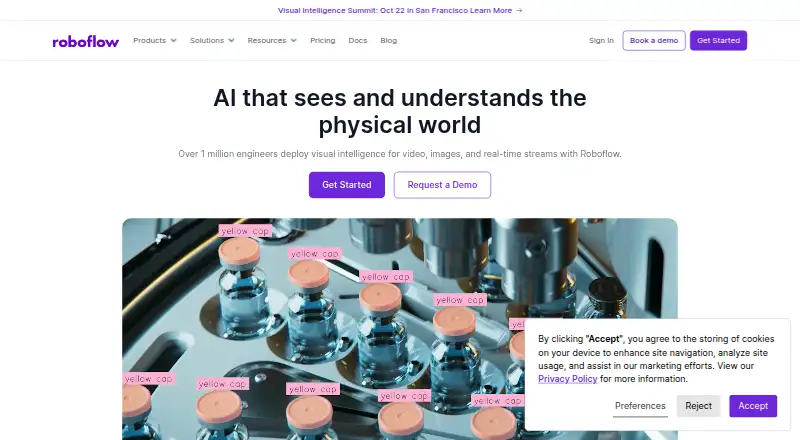
What Roboflow is
Roboflow is an end-to-end platform for building, deploying and monitoring computer vision applications. It supports dataset work including image annotation, video frame extraction, preprocessing, augmentation and exports in JSON, XML, CSV, TXT and more. Annotation types include bounding boxes, polygons, segmentation masks, classification labels and keypoints. Its hosted inference API runs models on autoscaling infrastructure with load balancing and burst support. Deployment options include roboflow.js, NVIDIA Jetson, Luxonis OAK, iOS, self-hosting, VPC and on-premise. Roboflow also integrates with cloud services, Kubernetes, Android, SageMaker and Google Colab. Core includes 20 credits, a private workspace and models. Roboflow states that it encrypts data in transit and at rest and is SOC 2 Type 2 compliant.
Good
- Supports five annotation types, including keypoints.
- Exports datasets in JSON, XML, CSV, TXT and more.
- Offers hosted inference with load balancing and burst support.
- Model weights are downloadable on every plan through Inference or MCP for select models.
- Provides knowledge base, documentation, forums and tutorials.
Watch out
- Training is limited to one model at a time by default.
- Core lists a limit of 20 projects.
- Direct in-app model-weight downloads are an Enterprise feature.
Who it suits
Roboflow suits developers and enterprises building computer vision applications, especially teams that need annotation, model deployment and dataset collaboration. Its self-hosting, VPC and on-premise options may suit organizations with deployment or data-sovereignty requirements.
Verdict
Roboflow brings dataset preparation, model hosting and deployment options together for computer vision work. Check the plan limits and the distinction between broadly downloadable weights and Enterprise in-app downloads before choosing a plan.
Plans and prices
From Roboflow's own pricing page, checked 21 Oct 2026.
| Plan | Price | What it gives you |
|---|---|---|
| Free Tier | Free | 10 credits/month · 20 projects · private workspace and models · self-hosted inference included · 10 credits included a month |
| Core | $39 a month | Starts with 10 free credits/month; $39/month adds 10 credits (20 total) · 20 projects · unlimited admin team members · billed monthly |
| Enterprise | Priced on request | Core features plus priority GPU access · volume pricing · uptime SLA · US or EU data sovereignty · enterprise support · Custom pricing; contact sales |
The facts
Each one read from Roboflow's own pages, with the date it was checked.
What it does
- Active learning
- Workflows can save inference images and predictions into datasets to support later model training and improvement.checked 21 Oct 2026
- API and SDKs
- The product offers a REST API and Python SDK, and documentation shows that the inference client can target either Roboflow Cloud or a self-hosted server.checked 21 Oct 2026
- Audience
- Roboflow describes its platform as designed for developers and enterprises building computer vision applications.checked 1 Oct 2026
- Cloud inference
- Roboflow provides a GPU-backed autoscaling cloud API for running model inference and Workflows.checked 21 Oct 2026
- Dataset management
- Dataset tools support image annotation, versioning, preprocessing, augmentation, and format conversion for common label formats.checked 21 Oct 2026
- Developer documentation
- The documentation covers datasets, models, deployments, Workflows, agents, and developer references, with installation, compatibility, Docker, model, API, and troubleshooting material for Inference Models.checked 21 Oct 2026
- Edge deployment
- Roboflow Inference can run on devices including NVIDIA Jetson, Raspberry Pi, and GPU servers; the pricing page says self-hosted inference is included.checked 21 Oct 2026
- Enterprise data controls
- Enterprise plans include a data sovereignty guarantee for the US or EU and enterprise support through email, tickets, and chat.checked 1 Oct 2026
- Enterprise security controls
- Enterprise features include SSO, role-based access control, scoped API keys, custom roles, folder permissions, and audit logs.checked 21 Oct 2026
- Feature availability limit
- The plan comparison reserves capabilities such as SSO, RBAC, workflow version history, and model monitoring for Enterprise or add-ons.checked 21 Oct 2026
- Hosted inference
- Its hosted inference API runs models on autoscaling infrastructure with load balancing and burst support.checked 1 Oct 2026
- Hosted service licensing
- Roboflow’s hosted platform is sold through subscription plans, and model licensing varies by model and deployment method.checked 21 Oct 2026
- Inference API limit
- The Serverless Cloud API accepts uploads up to 20 MB, and the documentation recommends resizing larger images before sending them.checked 21 Oct 2026
- Integrations
- Roboflow lists 38 integrations, including AWS S3, CVAT, Labelbox, Amazon SageMaker, Google Colab, Kubernetes, Jetson, Raspberry Pi, iOS, and Zapier.checked 21 Oct 2026
- Jetson compatibility
- JetPack 6.1 Docker support is marked stable for Orin devices, while bare-metal support is experimental; JetPack 5.1 requires a custom Docker build.checked 21 Oct 2026
Money
- Cloud cost limit
- Cloud inference, dedicated deployments, and certain cloud-based Workflow steps consume credits; local inference with Roboflow Inference is free on all plans.checked 21 Oct 2026
- Limit: billing and cancellation complaints
- Trustpilot reviewers report unexpected charges, confusing credit usage, difficulty cancelling, and problems getting billing support; the page cautions that reviews may not be representative because the company has not invited customers to review.checked 21 Oct 2026
- Limit: cost and feature access
- G2 review summaries identify expense, lack of features, and limited functionality as recurring concerns, including advanced features being restricted on lower tiers.checked 21 Oct 2026
The company
- Company founding
- Roboflow’s About page says its founders launched the company in 2020 after working on a real-time Sudoku-solving augmented reality game in 2019.checked 21 Oct 2026
- Company funding
- Fortune reported that Roboflow raised a $40 million Series B led by GV on November 19, 2024.checked 21 Oct 2026
- Company headquarters
- Roboflow’s terms list a Des Moines, Iowa address at 500 Locust Street.checked 21 Oct 2026
- Company history
- Roboflow says Brad Dwyer and Joseph Nelson launched the company in 2020 after working on a computer vision project in 2019.checked 1 Oct 2026
- Company legal name
- Roboflow’s terms identify the company as Roboflow, Inc.checked 21 Oct 2026
- Founded
- 2020checked 23 Sep 2026
The full review of Roboflow
Overview
Roboflow is a computer vision platform for preparing datasets, developing models and putting vision applications into service. It suits developers and organizations building their own vision workflows; its breadth is useful, but plan quotas and deployment needs deserve a close look before committing.
Annotation, dataset processing, model training, hosted inference and deployment options sit within one platform. That makes Roboflow a practical choice when a project needs more than labeling alone, though teams seeking a ready-made video surveillance product may be better served by a specialized alternative.
Key features
Annotation and dataset preparation
Teams can label bounding boxes, polygons, segmentation masks, classification labels and keypoints, with model-assisted labeling to support annotation work. JPG, PNG, WEBP, AVIF and BMP are supported image formats. Video frame extraction, preprocessing and augmentation help prepare data for training; exports include JSON, XML, CSV, TXT and more than 30 other formats. This range is valuable for varied model workflows, while one-model-at-a-time training by default can constrain teams that need parallel experiments.
Team collaboration and API access support shared work and integration into development processes. The feature set is particularly relevant to teams managing datasets alongside model development rather than needing only a labeling interface.
Inference, deployment and security
The hosted inference API uses autoscaling infrastructure with load balancing and burst support, a useful fit for applications whose request load can vary. Deployment options span roboflow.js, NVIDIA Jetson, Luxonis OAK, iOS, self-hosting, VPC and on-premise, with integrations including AWS S3, Google Cloud, Azure, Zapier, Kubernetes, Android, Amazon SageMaker and Google Colab. That flexibility is a strength for teams choosing between cloud and edge environments, but buyers should match the option to their own architecture.
Roboflow states that it is SOC 2 Type 2 compliant, encrypts data in transit and at rest, and offers HIPAA-compliant infrastructure with BAAs. Its trust center includes AES 256-bit encryption, audit logging, multifactor authentication, backups and data-erasure controls. Enterprise adds a US or EU data-sovereignty guarantee and priority support through email, tickets and chat. A knowledge base, developer documentation, forums and YouTube tutorials support other users.
Weights can be downloaded on every plan through Roboflow Inference or MCP for select models; only Enterprise adds direct downloads in the app. That distinction matters if in-app access is part of the intended workflow.
Pricing
Roboflow is freemium, with a free plan and a 14-day trial. The plan comparison gives these terms:
- Free Tier — free: 10 credits a month, described as enough to train about 30 models or run 80,000 inferences. It is a way to begin without subscription cost, but the monthly credit allowance caps sustained use.
- Core — $39 a month, billed monthly: 20 total credits, a private workspace and private models, enough to train about 60 models or run 160,000 inferences, and a 20-project limit. It suits individual developers or smaller teams needing private work, though the project cap and one-model-at-a-time training default may limit more expansive workflows.
- Enterprise — custom pricing: priority GPUs, volume pricing, an uptime SLA, US or EU data sovereignty and enterprise support. It fits organizations that need these controls and service commitments; the price is custom.
Roboflow's pricing note also says paid plans start at $79/mo (annual). Since Core is separately priced at $39 a month billed monthly, compare the billing term as well as credits and project limits when choosing. Enterprise project limits are custom. The plans' weights-download distinction is also worth weighing: broadly, weights are downloadable through Inference or MCP for select models, while direct in-app downloads are an Enterprise feature.
Platforms
Roboflow lists Android, iOS, API, self-hosted and web platforms. Its deployment choices also cover edge hardware and private infrastructure, including NVIDIA Jetson, Luxonis OAK, VPC and on-premise environments. This range gives teams options across application and deployment settings rather than limiting use to a browser-hosted workflow.
Who it's for
Roboflow is best suited to developers and enterprises building computer vision applications that need dataset preparation, model workflows and flexible deployment in the same service. It is less compelling for a team that only wants a preconfigured video analytics or moderation tool, or for one that needs several models training concurrently by default.
Pros and cons
- Pro: Broad annotation types, preprocessing, augmentation and extensive export formats support varied computer vision dataset workflows.
- Pro: Hosted inference and cloud, edge, self-hosted and on-premise deployment options accommodate different operating environments.
- Pro: A free tier includes 10 monthly credits and API access is available, allowing work to start without a paid subscription.
- Pro: Enterprise includes an uptime SLA, priority GPUs, data-sovereignty terms and expanded support for organizations with operational requirements.
- Con: Training one model at a time by default may slow teams that depend on parallel experimentation.
- Con: Core is capped at 20 projects, and the 10-credit free tier limits how much work can be sustained without upgrading.
- Con: Direct in-app model-weight downloads require Enterprise; other plans rely on Inference or MCP for select models.
Alternatives
For a self-hosted network video recorder, choose Frigate: its free open-source plan runs as a Docker container on a Docker host, unlike Roboflow's broader dataset and model-development focus. For managed content moderation through an API, Amazon Rekognition Content Moderation offers a 12-month Free Tier with 60 free video analysis minutes per month, including Content Moderation.
Camio offers usage-based service levels matched to needs. Scylla Command Center offers an Enterprise plan with 100+ video wall displays, multi-site central management and redundancy features. Triya AI is another paid option. Videonetics AI Video Analytics offers a demo and 30-day free trial. Lumeo has a free plan and a Core plan at $99 a month with 10 streams included, while Vaidio AI Vision Platform offers a perpetual software license.
Explore category comparisons for AI Video Analytics Software, Image Annotation Software, AI Image Annotation Tools, AI Image Recognition Software, Data Labeling Software and AI Data Labeling Tools.
Verdict
Choose Roboflow if you are building computer vision applications and want dataset preparation, hosted inference and multiple deployment routes within one platform. Its breadth and free entry point are persuasive; look elsewhere if you need a purpose-built analytics product, parallel model training by default or direct in-app weight downloads without Enterprise.
Getting started
- Open https://roboflow.com/.
- Choose the web platform or an available Android, iOS, API, or self-hosted route.
- Start with the free plan or review the paid plans.
- Use dataset tools to annotate, preprocess, augment, or export data.
- Choose a hosted inference or listed deployment option for your application.
Limits worth knowing
The free plan includes 10 credits a month, described as enough to train about 30 models or run 80,000 inferences. Core lists 20 total credits and 20 projects; training is limited to one model at a time by default.
Questions
Is Roboflow free?
Yes. The Free Tier costs nothing and includes 10 credits a month.
What does Core cost?
Core is listed at $39 a month, billed monthly, with 20 total credits, a private workspace, and private models.
What platforms does Roboflow support?
Listed platforms are Android, API, iOS, self-hosted, and web.
Can I export trained model weights?
Weights are downloadable on every plan through Roboflow Inference or MCP for select models. Enterprise also offers direct downloads in the app.
What integrations does Roboflow offer?
Integrations include AWS S3, Google Cloud, Azure, Zapier, Kubernetes, NVIDIA Jetson, iOS, Android, Amazon SageMaker, and Google Colab.
What does Enterprise include?
Enterprise has custom pricing, priority GPUs, volume pricing, an uptime SLA, US or EU data sovereignty, and enterprise support.
Alternatives to Roboflow
- 1
Sighthound AI
Free planAndroidiOSWebAPI8.1From $2,500 a year - 2
Google Cloud Vision API
Free planWebAPILinuxmacOS7.9$0.60 usage-based - 3
DeepFace
Free planOpen sourceWebAPILinuxmacOS7.8Free plan - 4
MediaPipe
Free planOpen sourceAndroidiOSWebAPI7.8Free plan - 5
CompreFace
Free planOpen sourceWebAPILinuxmacOS7.7Free plan - 6

Face++
Free planAndroidiOSWebAPI7.7Free plan