
Amazon Rekognition Content Moderation
Amazon Rekognition Content Moderation uses machine learning and managed APIs to automate moderation of images and videos.
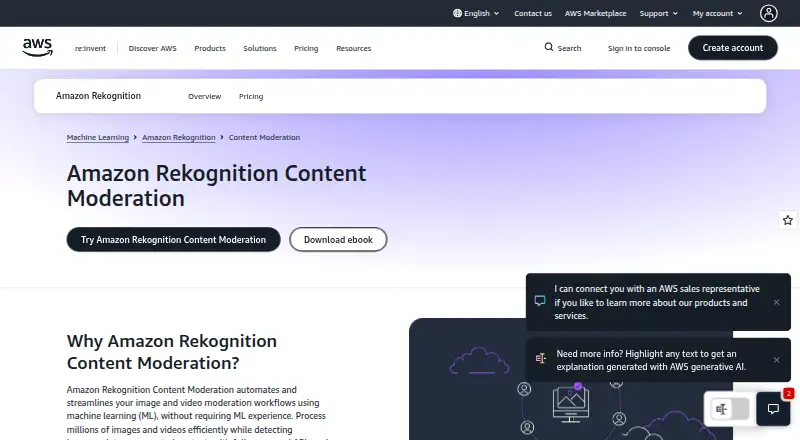
What Amazon Rekognition Content Moderation is
Amazon Rekognition Content Moderation uses machine learning and managed APIs to automate moderation of images and videos. It detects categories that include explicit or suggestive content, violence, drugs, tobacco, alcohol, hate symbols, gambling, and disturbing content. Results provide labels, confidence scores, and timestamps for video, which can support rules organized by a hierarchical taxonomy. Customers can train a Custom Moderation adapter for image analysis with as few as 20 annotated images. The service can connect low-confidence predictions to Amazon Augmented AI for review by teams or third-party reviewers. For stored video, the StartContentModeration API analyzes a video in an Amazon S3 bucket and publishes completion status to an Amazon SNS topic. AWS bills according to images or video duration processed, with no minimum fee or upfront commitment. The Free Tier lasts 12 months from account creation and includes 60 video-analysis minutes per month and two custom-adapter training hours per month. Images and videos passed to the service may be stored and used to improve it unless customers opt out; stored content is encrypted at rest using AWS KMS.
Good
- Detects multiple image and video moderation categories.
- Results include labels, confidence scores, and video timestamps.
- Custom adapter training can use as few as 20 images.
- Low-confidence predictions can go to human review.
- No minimum fees or upfront commitments.
Watch out
- Text moderation is not supported.
- Free Tier lasts 12 months from account creation.
- Content may be stored and used for service improvement unless customers opt out.
- Charges depend on images or video duration processed.
Who it suits
This service suits teams moderating image and video content in areas such as social media, gaming, ecommerce, advertising, and media and entertainment. It also fits teams that need human review for low-confidence results or image rules tailored with a custom adapter.
Verdict
Amazon Rekognition Content Moderation combines managed image and video detection with custom adapters and optional human review. Consider its usage-based charges and content-handling terms when planning a moderation workflow.
Plans and prices
From Amazon Rekognition Content Moderation's own pricing page, checked 2 Oct 2026.
| Plan | Price | What it gives you |
|---|---|---|
| Amazon Rekognition Custom Moderation adapter | Free | Tiered image pricing · custom adapter can be trained with as few as 20 annotated images · $0.0012 per image for the first 1 million images in the US East (N. Virginia) example; training is $5 per hour |
| Amazon Rekognition Free Tier | Free | 60 free video analysis minutes per month, including Content Moderation · 2 free training hours per month for a custom moderation adapter · Free Tier lasts 12 months from account creation |
| Amazon Rekognition Video Content Moderation | $0.10 a month | Pay per video minute · no upfront costs or minimum fees · $0.10/min for stored video analysis in the us-east-1 example |
| Custom Moderation adapter | — | adapter can train with as few as 20 annotated images · 2 free training hours/month for 12 months · training billed once by minute; inference billed by monthly image volume |
| Standard image moderation (DetectModerationLabels, Group 2) | — | tiered monthly image volume · no upfront fee or minimum · pay as you go |
| Video content moderation | — | 60 free video-analysis minutes/month for 12 months · stored-video analysis from S3 · streaming video uses Kinesis Video Streams separately · pay as you go |
The facts
Each one read from Amazon Rekognition Content Moderation's own pages, with the date it was checked.
What it does
- API pagination
- GetContentModeration supports MaxResults and NextToken pagination when a video produces many moderation labels.checked 15 Oct 2026
- API workflow
- For stored video, StartContentModeration analyzes a video in an Amazon S3 bucket and publishes completion status to an Amazon SNS topic.checked 2 Oct 2026
- Compliance
- AWS states that third-party audits cover Rekognition under SOC, PCI, FedRAMP, HIPAA, and other compliance programs.checked 15 Oct 2026
- Confidence control
- Developers can set MinConfidence to trade recall for precision when filtering moderation results.checked 15 Oct 2026
- Custom models
- Custom Moderation trains an adapter on annotated images and supplies its AdapterID to DetectModerationLabels to improve results for a specific use case.checked 15 Oct 2026
- Data handling
- Images and videos passed to Rekognition may be stored and used to improve the service unless the customer opts out; the stored content is encrypted at rest using AWS KMS.checked 2 Oct 2026
- Deployment model
- TrustRadius classifies Amazon Rekognition as SaaS and reports no mobile application.checked 15 Oct 2026
- Detected categories
- The API detects adult content, violence, weapons, disturbing imagery, drugs, alcohol, tobacco, hate symbols, gambling, and rude gestures.checked 15 Oct 2026
- Detection results
- The service returns detected labels and video timestamps with confidence scores, which can be used with a hierarchical taxonomy to create granular rules.checked 2 Oct 2026
- Documentation depth
- AWS documentation covers getting started, SDK installation, images, stored video, streaming video, moderation APIs, custom adapters, and human review workflows.checked 15 Oct 2026
- Hierarchical labels
- Moderation results use a three-level taxonomy with L1, L2, and L3 labels and include each label's taxonomy level.checked 15 Oct 2026
- Human review
- The service integrates with Amazon Augmented AI so teams or third-party reviewers can assess low-confidence predictions.checked 2 Oct 2026
- Human review integration
- Amazon Augmented AI is integrated so human reviewers can handle a smaller set of machine-flagged content.checked 15 Oct 2026
- Image API
- Images can be moderated synchronously with DetectModerationLabels or asynchronously with StartMediaAnalysisJob and GetMediaAnalysisJob.checked 15 Oct 2026
- Input requirements
- The documented image procedure accepts JPEG or PNG input supplied as bytes or as an Amazon S3 object.checked 15 Oct 2026
- Integrations
- TrustRadius lists Amazon S3, Amazon SageMaker, Amazon Comprehend, Amazon Translate, and Amazon Transcribe as integrations.checked 15 Oct 2026
- Licence
- Rekognition is presented as a managed AWS SaaS/API service; the reviewed product pages do not provide an open-source licence or self-hosted distribution.checked 15 Oct 2026
- Limit: complexity and configuration
- Gartner reviewers describe initial setup as complicated and slow, with rigid configuration and data limitations.checked 15 Oct 2026
The company
- Company founded
- AWS states it launched in 2006.checked 15 Oct 2026
- Company headquarters
- LinkedIn lists Seattle, Washington as AWS headquarters.checked 15 Oct 2026
- Company legal name
- The maker is Amazon Web Services (AWS), the cloud business of Amazon.com, Inc.checked 15 Oct 2026
- Company size
- LinkedIn lists AWS company size as 10,001+ employees.checked 15 Oct 2026
- Founded
- 2006checked 28 Sep 2026
- Headquarters
- Seattle, Washington, United Stateschecked 28 Sep 2026
The full review of Amazon Rekognition Content Moderation
Amazon Rekognition Content Moderation is a cloud API for screening images and video in automated workflows. It suits teams building moderation into social, gaming, ecommerce, advertising, or media products. Choose it for configurable visual detection and scaling; look elsewhere if text or audio moderation is essential.
Overview
The service detects explicit or suggestive content, violence, drugs, tobacco, alcohol, hate symbols, gambling, and disturbing content. It returns labels and confidence scores, plus timestamps for video, giving teams a basis for setting category-specific rules with a hierarchical taxonomy. That makes it more useful than a single blanket flag when different content types call for different responses.
Rekognition is infrastructure for a moderation workflow, not a complete review desk. Teams can store uploads in Amazon S3 and route low-confidence results to Amazon Augmented AI for human assessment. For stored video, StartContentModeration analyzes a video in an S3 bucket and publishes its completion status to an Amazon SNS topic. AWS says the service can handle workloads from a few items to millions, but usage-based billing means processed image counts and video duration should be part of cost planning.
Key features
Visual detection and custom rules
Confidence scores, video timestamps, and a hierarchical taxonomy let teams tune their response to what was detected and how certain the model is. Image and video moderation are supported, but text and audio moderation are not, so teams handling those formats need other tools or workflows.
Custom moderation adapter
Teams can train a Custom Moderation adapter with as few as 20 annotated images for image analysis tailored to their use case. This can help address specialized image categories without relying only on the standard detection behavior, though training incurs an hourly charge.
Human escalation and integrations
Amazon Augmented AI can send low-confidence predictions to internal teams or third-party reviewers. S3 storage and SNS completion notifications support a cloud-based processing flow, but buyers should account for the surrounding AWS components when designing their workflow.
Security and data handling
API endpoints support HTTPS, and AWS documentation says communications use TLS. Images and videos may be stored and used to improve the service unless customers opt out; stored content is encrypted at rest with AWS KMS. Third-party auditors assess Rekognition within multiple AWS compliance programs, while customers remain responsible for determining their own compliance obligations. The opt-out and customer compliance responsibilities matter for teams processing sensitive or regulated media.
Pricing
Rekognition is paid, with usage-based charges and no minimum fees, licenses, or upfront commitments. AWS says charges depend on the number of images or video duration processed. The pricing note starts from $0.01; actual costs depend on the operation, region, and usage.
- Amazon Rekognition Free Tier: free. For 12 months from account creation, it includes 60 free video analysis minutes per month, including Content Moderation, and 2 free training hours per month for a custom moderation adapter. This is useful for time-limited evaluation or modest early workloads, but the free allowance expires after 12 months.
- Amazon Rekognition Custom Moderation adapter: free, with image analysis billed at $0.0012 per image for the first 1 million images in the US East (N. Virginia) example. Training costs $5 per hour, and image pricing is tiered. This is the relevant option for teams adapting image moderation, but the apparent monthly price does not include per-image analysis or training charges.
- Amazon Rekognition Video Content Moderation: $0.10 a month, with stored video analysis billed at $0.10/min in the us-east-1 example. It is a pay-per-video-minute option without upfront costs or minimum fees, so it favors variable workloads but requires attention to video duration.
Platforms
Rekognition is available through API and web access and runs in the cloud. Its supported visual capabilities include image classification, object detection, face recognition, OCR, real-time alerts, and behavior and event detection. These capabilities broaden its usefulness as a visual analysis service, but do not change its lack of text or audio moderation.
Who it's for
Social platforms, games, ecommerce services, advertisers, and media businesses can use Rekognition when they need automated image or video screening and can build around AWS APIs. It is best for teams able to manage usage-based costs, data-handling choices, and human escalation. It is not the right standalone choice for teams that need moderation across text, audio, or a ready-made reviewer workspace.
Pros and cons
- Pros: Broad visual content categories, confidence scores, and video timestamps support more granular moderation decisions.
- Pros: Custom adapters can be trained from as few as 20 annotated images, allowing image analysis to be tailored to a specific use case.
- Pros: Human review through Amazon Augmented AI and usage billing without minimum fees or upfront commitments suit workflows with variable volume.
- Cons: It does not moderate text or audio, so it cannot cover every content format on its own.
- Cons: Per-image, per-minute, and adapter training charges make spend dependent on workload and require forecasting.
- Cons: Customers must opt out if they do not want submitted media stored and used to improve the service, and they remain responsible for their own compliance assessment.
Alternatives
Consider Roboflow if you want a freemium vision platform with Android, iOS, API, web, and self-hosted access; its free tier includes 10 credits a month, enough to train about 30 models or run 80,000 inferences.
Frigate is an alternative for buyers seeking an open-source NVR that runs as a Docker container, with a free option and a $50 a year Frigate+ subscription.
Choose Camio if usage-based video service levels matched to your needs are a better fit; its service levels use custom pricing.
Slinai may suit camera-based analytics needs, with a free plan for one camera and a paid Core plan.
Google Cloud Video Intelligence is another API and web option for stored-video annotation, with a free allowance of the first 1,000 minutes per month for each listed feature.
Scylla Command Center is an alternative for enterprise video-wall and multi-site management, with custom pricing.
Spot AI offers a dashboard-only free tier with limited video analysis volume and no hardware or Spot AI Support; paid services use fees specified in an Order Form.
Triya AI is another alternative.
For broader category comparisons, see AI Content Moderation Software, Social Media Moderation Software, AI Video Analytics Software, and AI Image Recognition Software.
Verdict
Amazon Rekognition Content Moderation is a strong fit for teams that need scalable, configurable image and video screening within an AWS-oriented workflow. Its custom adapters, human-review path, and usage-based billing are the main reasons to choose it. Look elsewhere if text or audio moderation is central, or if data-handling terms and variable processing costs do not fit your requirements.
Getting started
- Open the Amazon Rekognition Content Moderation website.
- Use the API or web platform.
- Store uploaded content in Amazon S3 for stored-video analysis.
- Use StartContentModeration to analyze a video in an S3 bucket and publish completion status to an Amazon SNS topic.
- Opt out if you do not want submitted images or videos used to improve the service.
Limits worth knowing
The Free Tier lasts 12 months from account creation and includes 60 video-analysis minutes and two custom-adapter training hours per month. The listed stored-video example charges $0.10 per minute in us-east-1; the custom-adapter example charges $0.0012 per image for the first million images in US East (N. Virginia), with training at $5 per hour.
Questions
What does Amazon Rekognition Content Moderation cost?
The listed starting price is $0.01. Billing depends on the number of images or video duration processed, with no minimum fees or upfront commitments.
Is there a free plan?
Yes. The Free Tier lasts 12 months from account creation and includes 60 video-analysis minutes per month and two monthly training hours for a custom moderation adapter.
Which platforms does it support?
The listed platforms are API and web, and deployment is cloud-based.
Can it moderate text or audio?
No. The listed capabilities include image and video moderation, not text or audio moderation.
Can teams review uncertain results?
Yes. Amazon Augmented AI can route low-confidence predictions to teams or third-party reviewers.
How does it handle submitted content?
Images and videos may be stored and used to improve the service unless customers opt out. Stored content is encrypted at rest using AWS KMS.
Alternatives to Amazon Rekognition Content Moderation
- 1
Google Cloud Vision API
Free planWebAPILinuxmacOS7.9$0.60 usage-based - 2
Sightengine
Free planWebAPISelf-hosted7.5From $29 a month - 3
WebPurify
Free planAndroidiOSWebAPI7.4From $5 a month - 4
Tisane API
Free planWebAPILinuxmacOS7.1From $99 a month - 5
Alibaba Cloud Content Moderation
iOSWebAPI7.0$0.09 usage-based - 6

Hive Moderation
Free planWebAPIExtension6.9Free plan