Google Cloud Video Intelligence
Google Cloud Video Intelligence is a cloud API that analyzes stored and streaming video, returning metadata for content discovery and video applications.
What Google Cloud Video Intelligence is
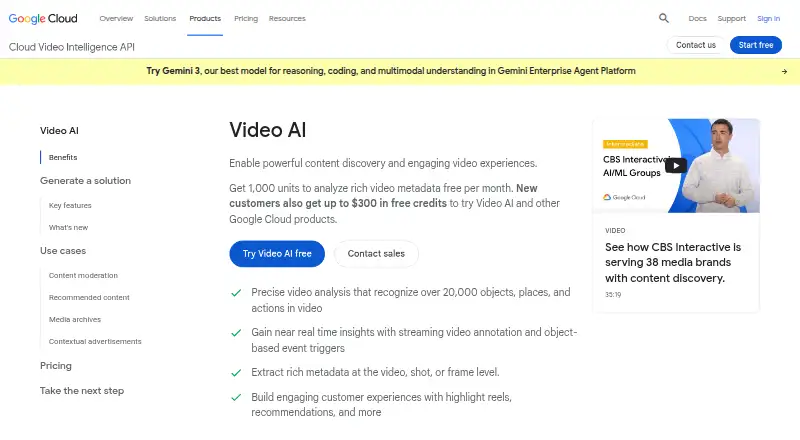
Google Cloud Video Intelligence is a cloud API that analyzes stored and streaming video, returning metadata for content discovery and video applications. Results can be extracted at the video, shot, or frame level. Google says its models recognize over 20,000 objects, places, and actions. Documented capabilities include label and shot-change detection, explicit-content detection, and face, logo, object, and person detection, as well as speech and text recognition. Streaming annotation can provide near real-time insights and support event triggers based on objects. Google lists content moderation, recommendations, searchable media archives, and contextual ad placement as use cases. Client libraries and a command-line quickstart provide programmatic access. For each listed feature, stored and streaming annotation each include the first 1,000 minutes per month free; partial minutes round up. Beyond that amount, per-minute rates vary by feature and annotation type. The service is paid, with prices from $0.05, and a free trial is available. Other Google Cloud resources used by a project may incur separate charges. Celebrity recognition is listed as a restricted-access feature.
Good
- Returns metadata at video, shot, or frame level.
- Recognizes over 20,000 objects, places, and actions.
- Includes speech and text recognition.
- Streaming annotation supports object-based event triggers.
- First 1,000 monthly minutes per listed feature are free.
Watch out
- Partial minutes round up.
- Rates beyond the free allowance vary by feature and type.
- Other Google Cloud resources may cost extra.
- Celebrity recognition is restricted-access.
Who it suits
The API suits developers and teams building video search, moderation, recommendation, or advertising workflows. Its stored and streaming analysis options serve different video-processing needs.
Verdict
Video Intelligence offers a broad set of video annotation capabilities, including streaming analysis and multiple metadata levels. Check the differing per-minute rates and restricted access to celebrity recognition when assessing fit.
Plans and prices
From Google Cloud Video Intelligence's own pricing page, checked 7 Oct 2026.
| Plan | Price | What it gives you |
|---|---|---|
| Video Intelligence API — stored video annotation | Free | Beyond 1,000 minutes/month: label detection $0.10/min · shot detection $0.05/min · explicit content detection $0.10/min · speech transcription $0.048/min · object tracking, text detection, and logo detection $0.15/min · face detection, person detection, and celebrity recognition $0.10/min · Per minute; partial minutes round up; first 1,000 minutes per month are free for each listed feature |
| Video Intelligence API — streaming video annotation | Free | Beyond 1,000 minutes/month: label detection $0.12/min · shot detection $0.07/min · explicit content detection $0.12/min · object tracking $0.17/min · Per minute; partial minutes round up; first 1,000 minutes per month are free for each listed feature |
The facts
Each one read from Google Cloud Video Intelligence's own pages, with the date it was checked.
What it does
- API access
- Google provides client libraries and a command-line quickstart for interacting with the API programmatically.checked 7 Oct 2026
- Compliance
- Google Cloud says it undergoes independent verification and offers certifications, attestations, and audit reports to help demonstrate compliance.checked 7 Oct 2026
- Features
- Documented features include label, shot change, explicit content, face, logo, object, person, speech, and text detection or recognition.checked 7 Oct 2026
- Metadata detail
- The service extracts metadata at the video, shot, or frame level.checked 7 Oct 2026
- Purpose
- The API analyzes stored and streaming video and returns metadata for content discovery and video applications.checked 7 Oct 2026
- Recognition
- Google says its models recognize over 20,000 objects, places, and actions in video.checked 7 Oct 2026
- Restricted feature
- Celebrity recognition is listed under restricted-access features in the Video Intelligence API documentation.checked 7 Oct 2026
- Streaming
- Streaming video annotation can provide near real-time insights and support object-based event triggers.checked 7 Oct 2026
- Support
- The documentation page links to Google Cloud support and community forums.checked 7 Oct 2026
- Use cases
- Google lists content moderation, recommendations, searchable media archives, and contextual ad placement as use cases.checked 7 Oct 2026
- Volume pricing
- Google advises customers requesting annotations for more than 100,000 video minutes per month to contact sales about discounts.checked 7 Oct 2026
Money
- Cloud Storage costs
- Google notes that other Google Cloud resources used by a project, such as Compute Engine or Cloud Storage, may incur separate charges.checked 7 Oct 2026
The full review of Google Cloud Video Intelligence
Google Cloud Video Intelligence is a cloud API for developers and media teams that need machine-generated metadata from video. It is a strong fit for searchable libraries, moderation pipelines, and applications that need both batch and near-real-time analysis. Choose it when broad annotation coverage matters more than having a finished video-management interface.
Overview
The API analyzes stored and streaming video and returns metadata at video, shot, or frame level. Google says its models recognize more than 20,000 objects, places, and actions, giving teams a wide base for indexing and application features without building every recognition model themselves.
This is infrastructure for software and workflows, not a turnkey media-archive product. Client libraries and a command-line quickstart support programmatic integration, and the service runs in the cloud through API and web access. A project can also incur separate charges for resources such as Compute Engine or Cloud Storage.
Key features
- Wide annotation set: Label, shot-change, explicit-content, face, logo, object, person, speech, and text detection or recognition cover discovery, moderation, transcription, and enrichment tasks.
- Granular metadata: Video-, shot-, and frame-level results let an application choose broad indexing or precise event timing, which is useful for searchable archives and downstream automation.
- Streaming analysis: Streaming annotation can produce near-real-time insights and trigger events based on detected objects. It is the better choice for live reactions, but its listed per-minute rates are higher than stored-video rates.
- Operational triggers: Real-time alerts, object detection, and behavior or event detection support workflows that need action rather than a static catalog of tags.
- Compliance resources: Google Cloud undergoes independent verification and offers certifications, attestations, and audit reports, a consideration for organizations with formal compliance requirements.
- Restricted capability: Celebrity recognition is restricted-access, so teams should not assume it is available as a standard, immediately enabled feature.
Pricing
Video Intelligence is paid, with pricing from $0.05. The free allowance is applied per listed feature: the first 1,000 minutes per month are free, partial minutes round up, and usage beyond that is billed per minute.
Stored video annotation
The stored-video plan is free. After the monthly allowance, label detection costs $0.10 per minute, shot detection $0.05 per minute, explicit content detection $0.10 per minute, and speech transcription $0.048 per minute. This is the sensible starting point for batch indexing and archive processing, especially when workloads stay near the free caps.
Streaming video annotation
The streaming plan is also free, with the same first-1,000-minutes-per-feature allowance. Beyond it, label detection is $0.12 per minute, shot detection $0.07, explicit content detection $0.12, and object tracking $0.17. Those higher rates make continuous or high-volume live analysis more expensive than deferred processing.
Customers seeking annotations for more than 100,000 video minutes per month can contact sales about discounts. Budget separately for other Google Cloud services used by the project; those charges are not included in these annotation rates. A free plan and free trial make evaluation possible, but the per-feature quotas and rounded minutes matter when estimating production spend.
Platforms
Google Cloud Video Intelligence is offered through API and web platforms. Its cloud deployment and client libraries favor engineering teams integrating analysis into their own applications rather than users seeking a standalone desktop or mobile tool.
Who it's for
It suits developers building video applications, media organizations creating searchable archives, and teams implementing content moderation, recommendations, or contextual ad placement. Streaming support is relevant to systems that need near-real-time alerts or object-triggered actions. It is less suitable for buyers wanting an out-of-the-box video surveillance or library-management interface, or for projects that cannot accommodate usage-based, per-feature billing.
Pros and cons
- Pro: More than 20,000 recognized objects, places, and actions provide broad coverage for varied video workflows.
- Pro: Video-, shot-, and frame-level metadata supports both coarse cataloging and precise event handling.
- Pro: Stored and streaming modes, plus real-time alerts and event triggers, cover batch and live applications.
- Pro: The first 1,000 minutes per month for each listed feature are free, lowering the barrier to prototyping.
- Con: Each annotation type has its own rate, so combining features can make costs harder to forecast.
- Con: Streaming analysis costs more than the corresponding listed stored-video operations.
- Con: Cloud Storage, Compute Engine, and other project resources can add separate charges.
- Con: Celebrity recognition requires restricted access rather than being an ordinary default feature.
Alternatives
Browse the AI Video Analytics Software category for more options.
- Roboflow is a freemium, web and API-oriented choice when custom model training and inference quotas matter; its free tier includes 10 credits per month.
- Frigate is the better fit for an open-source NVR running as a Docker container on a self-hosted Docker host.
- Amazon Rekognition Content Moderation suits teams focused specifically on content moderation and wanting a 12-month free tier with 60 video-analysis minutes per month.
- Camio fits buyers seeking usage-based service levels matched to their needs through Camio or an approved partner.
- Slinai is an alternative for camera-centric analytics with a free one-camera month and self-hosted, web, and API access.
- Scylla Command Center targets enterprise deployments requiring multi-site central management and large video-wall environments.
- Spot AI offers a dashboard-oriented free tier with limited analysis volume and no hardware.
- Triya AI is another paid option with Android, iOS, self-hosted, and web platforms.
Verdict
Choose Google Cloud Video Intelligence if you are building a cloud video workflow that benefits from many annotation types, precise metadata levels, and optional streaming triggers. Its main advantage is breadth in one API; look elsewhere if you need predictable all-in pricing, a ready-made management application, or unrestricted celebrity recognition.
Alternatives to Google Cloud Video Intelligence
- 1
Google Cloud Vision API
Free planWebAPILinuxmacOS7.9$0.60 usage-based - 2
Sightengine
Free planWebAPISelf-hosted7.5From $29 a month - 3
Alibaba Cloud Content Moderation
iOSWebAPI7.0$0.09 usage-based - 4

Hive Moderation
Free planWebAPIExtension6.9Free plan - 5

CleanSpeak
WebAPILinuxmacOS6.8 - 6

Azure AI Speech
Free planWebAPISelf-hosted6.7Free plan