
Camio
Camio is a video surveillance platform that uses AI and machine learning to search camera footage and alert users to events.
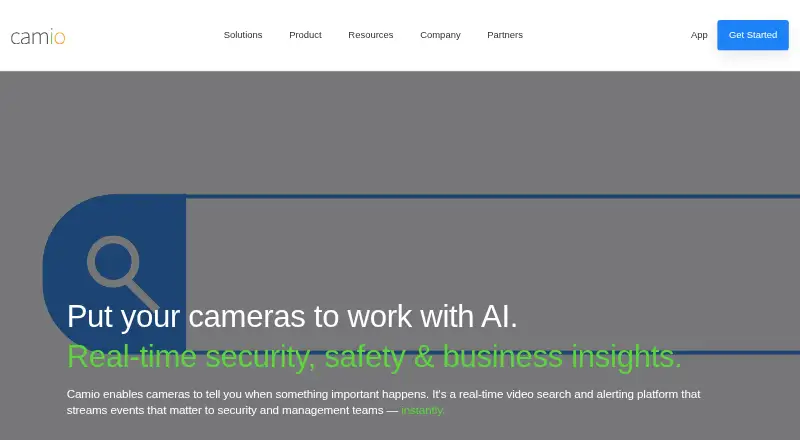
What Camio is
Camio is a video surveillance platform that uses AI and machine learning to search camera footage and alert users to events. Users can enter natural-language queries and turn searches into automatic alerts. The platform accepts H.264 streams from IP cameras, NVRs, and VMSs, while human and vehicle motion events stream continuously for triage in a web browser. Object classification can identify people, vehicles, PPE, and other objects; custom classifiers can be trained from as few as 500 examples. Alerts can be sent by email, voice, Slack, or webhooks, and audit logs can be routed to Google BigQuery or Splunk. Camio says cloud video history can be stored for 30 days or more. It describes a hybrid deployment using a Camio Box gateway and a containerized video processing pipeline that can run across platforms and chipsets. The platform is available through Android, iOS, Linux, macOS, Windows, web, API, and self-hosted options. Pricing is on request, with usage-based plans and a free 7-day trial.
Good
- Searches video with natural-language queries.
- Classifies people, vehicles, PPE, and other objects.
- Routes alerts through email, voice, Slack, or webhooks.
- Supports cloud video history of 30 days or more.
- Offers a free 7-day trial.
Watch out
- Pricing is available on request.
- Plans are usage-based.
- Custom classifiers require as few as 500 examples.
Who it suits
Camio suits organisations in manufacturing, biotech, retail, real estate, higher education, or finance that need camera-video search and event alerts. It may also suit teams that want alerts routed to collaboration tools or webhooks.
Verdict
Camio combines searchable camera video with alerts, object classification, and multiple deployment options. Ask about usage-based pricing and service levels to determine whether it fits your deployment.
Plans and prices
From Camio's own pricing page, checked 21 Oct 2026.
| Plan | Price | What it gives you |
|---|---|---|
| Usage-based | $4.99 a month | starts at $4.99 per camera · advanced labeling and high-volume use cost more · per camera / month; scales with search, storage and features |
| Camio service levels | Priced on request | price depends on motion hours · retention · stream count · bitrate/resolution · forensic search and alert usage · advanced object labeling · usage-based; contact Camio or approved partner |
The facts
Each one read from Camio's own pages, with the date it was checked.
What it does
- Access control
- Camio describes integrations with access control systems including Openpath, Lenel, Brivo, C-CURE, and Kisi.checked 3 Oct 2026
- Analytics
- Object classification can identify people, vehicles, PPE, and other objects; custom classifiers can be trained from as few as 500 examples.checked 3 Oct 2026
- API and hooks
- The API exposes resources for cameras and other account data, and hooks can notify callback URLs for query matches, power loss and completed jobs.checked 21 Oct 2026
- API authentication
- The public API uses OAuth tokens supplied in an Authorization header or access_token query parameter.checked 21 Oct 2026
- Audit logging
- Significant user events can be streamed to Google BigQuery or routed to Splunk for audit analysis.checked 21 Oct 2026
- Automatic alerts
- Alerts can be delivered by email, voice, Slack, or webhooks to authorized personnel.checked 21 Oct 2026
- Camera requirement
- Camio requires H.264 video over RTSP for camera and NVR connections; H.265, HEVC and MJPEG are unsupported.checked 21 Oct 2026
- Camio Box capacity
- The Box FAQ says one Box generally handles three 1080p streams, with additional Boxes used for more cameras.checked 21 Oct 2026
- Cloud history
- Camio stores recorded video in encrypted cloud storage, with 30 days or more of history described for its standard offering.checked 21 Oct 2026
- Compliance positioning
- Camio's solutions page says its biotech and pharma offering can retain video for SOC 2 and HIPAA compliance and its financial-services offering provides 90-day encrypted video for PCI compliance.checked 21 Oct 2026
- Deployment
- Camio offers a Camio Box gateway and says its containerized video processing pipeline can run across different platforms and chipsets.checked 3 Oct 2026
- Deployment model
- Camio describes an open containerized pipeline that can run across platforms and a SaaS deployment that is often remote and completed in under an hour.checked 21 Oct 2026
- Event monitoring
- Human and vehicle motion events stream continuously for triage in a web browser.checked 3 Oct 2026
- Event streaming
- Event Streaming continuously presents human and vehicle motion events for rapid triage in a browser.checked 21 Oct 2026
- Integrations
- Camio documents integrations with access systems including Brivo, Kisi and Lenel, and storage providers including Google Cloud Storage, Oracle OCI, Amazon S3, Backblaze and Wasabi.checked 21 Oct 2026
- Intended users
- Camio names manufacturing, biotech, retail, real estate, higher education, and finance among the industries using its video surveillance platform.checked 3 Oct 2026
- Legal name
- Camio's pricing terms identify the operating company as Camiolog, Inc.checked 21 Oct 2026
Where it runs
- App availability limit
- AppBrain reports that the Camio Android app was removed from Google Play on June 17, 2019 and is no longer downloadable there.checked 21 Oct 2026
- Limit: Android app stability
- AppBrain comments report crashes, overheating or rebooting on some older phones, confusing navigation and a requirement to keep the recording display on.checked 21 Oct 2026
- Limit: browser live streaming
- Camio's help center states that Box-connected live streaming is browser-only; mobile apps show the latest snapshot at about one frame per second.checked 21 Oct 2026
Money
- Billing terms
- Paid accounts are charged monthly through Stripe, prepaid fees are non-refundable, and unused partial periods receive no credit.checked 21 Oct 2026
The company
- Company funding
- Crunchbase lists Camio as a private San Mateo company with nine investors, including M2O and Freestyle Capital, and an undisclosed venture Series Unknown round.checked 21 Oct 2026
- Company launch and size
- Dealroom lists San Mateo headquarters, a January 2013 launch date and 11–50 employees; it records a February 2014 Freestyle Capital seed investment and a January 2016 M2O round, both with undisclosed amounts.checked 21 Oct 2026
- Company profile
- LinkedIn lists Camio as a privately held software company founded in 2011 with 11–50 employees and headquarters in Oakland, California.checked 21 Oct 2026
The full review of Camio
Camio is an AI video platform for searching camera footage and routing event alerts. It suits organizations with ongoing surveillance operations that need to connect video monitoring with operational tools. Its strongest appeal is the combination of searchable footage, continuous event triage, and flexible deployment.
Overview
Camio applies machine learning to video from IP cameras, NVRs, and video management systems, turning footage into searchable events rather than leaving staff to review recordings manually. Natural-language queries can become automatic alerts, while human and vehicle motion events stream continuously in a browser for triage. That makes Camio a stronger fit for active monitoring workflows than for buyers who only need a basic video archive.
The hybrid deployment model includes a Camio Box gateway, and its containerized video-processing pipeline is designed to run across different platforms and chipsets. This breadth can help organizations fit processing into varied environments, though custom, usage-based pricing makes cost planning less straightforward than a fixed subscription.
Key features
Searches can cover H.264 streams and turn into alerts, helping teams look for particular events without watching every feed. Object classification identifies people, vehicles, PPE, and other objects; custom classifiers can be trained from as few as 500 examples. That supports site-specific monitoring, but the usefulness of a custom classifier depends on having examples appropriate to the task.
Camio says cloud video history can be stored for 30 days or more. Alerts can be delivered by email, voice, Slack, or webhooks, and audit logs can be sent to Google BigQuery or Splunk. Access-control integrations include Openpath, Lenel, Brivo, C-CURE, and Kisi, giving security teams several ways to connect video events with existing systems.
Camio says sensitive data is encrypted at rest with AES-256 and in transit with TLS 1.3. Its secure event streaming works without opening inbound network ports, a practical advantage for deployments where exposing ports is undesirable. A help center and request form provide support channels.
Pricing
Camio offers usage-based service levels matched to customer needs, with custom pricing through Camio or an approved partner. A free 7-day trial gives prospective buyers a short evaluation window, but it does not replace the pricing conversation: organizations should clarify expected usage and service levels before committing. No seat or quota terms are established here, so buyers should confirm any operational limits directly.
Platforms
Camio supports Android, iOS, Linux, macOS, Windows, web, API, and self-hosted deployments. The combination of cloud history, a gateway option, and containerized processing provides flexibility across different environments, although the appropriate deployment will depend on an organization's camera setup and infrastructure.
Who it's for
Camio names manufacturing, biotech, retail, real estate, higher education, and finance among the industries using its surveillance platform. It is best suited to organizations that need searchable camera footage, ongoing motion-event triage, and alert routing into communication, analytics, or access-control workflows. Smaller deployments seeking a simple, predictably priced recorder may find the usage-based model and broader capabilities unnecessary.
Pros and cons
Pros
- Natural-language searches can become automatic alerts, reducing reliance on manual footage review.
- Continuous browser-based motion-event streams support active triage of human and vehicle activity.
- Classifier coverage, custom training, and integrations with alerting, logging, and access-control systems accommodate varied operational workflows.
- Hybrid deployment, a gateway, and containerized processing offer options for different platforms and chipsets.
Cons
- Usage-based custom pricing requires buyers to contact Camio or a partner, making costs harder to compare upfront.
- The advertised trial lasts only 7 days, giving organizations a limited period to assess fit.
- Custom classifiers require suitable examples, even though training can start with as few as 500.
Alternatives
Browse AI Video Analytics Software to compare more options in the category.
- Roboflow is a better fit for teams seeking a freemium computer-vision platform with a free tier that includes 10 monthly credits for model training or inference.
- Frigate suits self-hosters who want an open-source NVR running as a Docker container, with a free plan and an optional annual subscription.
- Amazon Rekognition Content Moderation is worth considering for API-focused video moderation, with a 12-month free tier that includes 60 video-analysis minutes per month.
- Slinai offers a free one-camera plan with one month of use and 24–72-hour clip history, making it a more constrained starting point for small deployments.
- Google Cloud Video Intelligence is an API-oriented alternative for stored-video annotation, with the first 1,000 minutes per month free for each listed feature.
- Scylla Command Center is an alternative for organizations considering a multi-site video-wall management system.
- Spot AI offers a free dashboard tier with limited video analysis volume and no hardware or support.
- Triya AI is another paid video-analytics alternative.
Verdict
Camio is a strong choice for organizations that need to search ongoing camera feeds, triage motion events, and route alerts into existing security and operational systems. Its flexible deployment options and broad integrations are the main reasons to choose it; buyers who need predictable costs or only basic recording should look elsewhere.
Getting started
- Open Camio's website and request access or a pricing discussion
- Start the advertised free seven-day trial
- Connect H.264 streams from IP cameras, NVRs, or VMSs
- Choose web, API, self-hosted, or supported device access
- Create natural-language searches and convert them into alerts
- Configure email, voice, Slack, webhook, BigQuery, or Splunk destinations
Limits worth knowing
The free trial lasts seven days. Ongoing access uses usage-based service levels matched to needs, with pricing supplied on request.
Questions
Does Camio offer a free trial?
Yes. Camio advertises a free seven-day trial.
How is Camio priced?
Camio uses usage-based service levels matched to needs. Pricing is available by contacting Camio or an approved partner.
What video sources can it accept?
Camio accepts H.264 streams from IP cameras, NVRs, and VMSs.
Which platforms and deployment models are supported?
It supports Android, iOS, Linux, macOS, Windows, web, API, and self-hosted use. Camio describes hybrid deployment with a Camio Box and containerized processing.
What notifications and integrations are available?
Alerts can go through email, voice, Slack, or webhooks. Audit logs can route to Google BigQuery or Splunk, and access-control integrations include Openpath, Lenel, Brivo, C-CURE, and Kisi.
How long can video history be stored?
Camio says cloud video history can be stored for 30 days or more.