CompreFace
CompreFace is a free, open-source face recognition service that makes its capabilities available through a REST API.
What CompreFace is
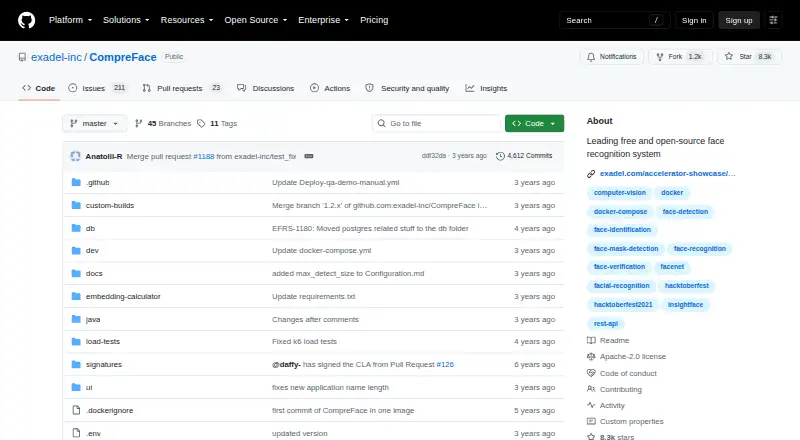
CompreFace is a free, open-source face recognition service that makes its capabilities available through a REST API. Its functions include face recognition and verification, face and landmark detection, mask detection, head pose detection, and age and gender recognition. The project says setup does not require machine-learning experience. It is delivered as a Docker Compose configuration and can run as a standalone server, in the cloud, or in a hybrid deployment. The documented setup covers Windows, macOS, and Linux and requires Docker with Docker Compose or Docker Desktop. CompreFace supports CPU and GPU models, with an x86 processor supporting AVX among the requirements. A user interface and role-management system help control access to the services. The project names FaceNet and InsightFace among its libraries and links JavaScript, Python, and .NET SDK repositories. It is self-hosted and licensed under Apache 2.0. The quick start uses a release archive and the docker-compose up -d command. Users can report ideas and bugs on GitHub or join its community chat.
Good
- Free and open-source under Apache 2.0
- Offers recognition, verification, and multiple detection functions
- Supports CPU and GPU models
- Provides role management and service access controls
- Links JavaScript, Python, and .NET SDKs
Watch out
- Requires Docker and Docker Compose or Docker Desktop
- Lists an x86 processor with AVX among requirements
Who it suits
CompreFace suits developers or teams that need face-analysis capabilities through an API and can run a Docker-based service. Its self-hosted setup and access controls may also suit organizations that want to manage service access themselves.
Verdict
CompreFace combines several face-analysis functions with an API, role controls, and self-hosted deployment. Setup depends on Docker, and its documented hardware requirements include an x86 processor with AVX support.
Plans and prices
From CompreFace's own pricing page, checked 4 Oct 2026.
| Plan | Price | What it gives you |
|---|---|---|
| CompreFace | Free | free and open-source; Docker-based deployment; CPU and GPU support |
| Free | Free | face recognition · verification · detection · landmark, mask, age, gender and head-pose plugins · REST API · Docker deployment |
The facts
Each one read from CompreFace's own pages, with the date it was checked.
What it does
- Access management
- The web interface includes roles and permissions for controlling access to face services.checked 15 Oct 2026
- Age recognition
- An age-recognition plugin is listed among the available services.checked 15 Oct 2026
- API documentation depth
- The repository documentation includes endpoint descriptions for subjects, examples, recognition, verification, detection, embeddings and base64 requests.checked 15 Oct 2026
- Cloud and on-premises
- Official feature documentation says the software can be deployed in the cloud or on premises.checked 15 Oct 2026
- CPU and GPU
- The project documents model variants that run on both CPU and GPU hardware.checked 15 Oct 2026
- Data-control positioning
- The project presents self-hosting and on-premises deployment as ways to keep face data under the operator’s control.checked 15 Oct 2026
- Deployment
- It is delivered as a Docker Compose configuration and can run as a standalone server or be deployed in the cloud.checked 4 Oct 2026
- Deployment model
- CompreFace is distributed as Docker Compose configuration and can run as a standalone server or in cloud environments.checked 15 Oct 2026
- Documentation scope
- The documentation index also covers configuration, architecture and scalability, custom builds, migration, roles, plugins, Kubernetes and installation options.checked 15 Oct 2026
- Extensibility
- The project invites contributors to add SDKs, plugins and integrations such as Home Assistant or DreamFactory.checked 15 Oct 2026
- Face detection
- A face-detection service is included alongside recognition and verification.checked 15 Oct 2026
- Face recognition
- The service can identify enrolled people from submitted images.checked 15 Oct 2026
- Face verification
- The API supports comparing faces to verify whether they belong to the same person.checked 15 Oct 2026
- Gender recognition
- A gender-recognition plugin is available.checked 15 Oct 2026
- Hardware
- CompreFace supports CPU and GPU models and lists an x86 processor with AVX support among its requirements.checked 4 Oct 2026
- Independent deployment example
- A 2026 technical article used CompreFace with Immich, Home Assistant, UniFi Protect and Double Take in a self-hosted doorbell workflow.checked 15 Oct 2026
- Integrations
- The project invites contributors to add support for other platforms such as Home Assistant or DreamFactory; it does not describe these as built-in integrations on the page.checked 4 Oct 2026
- Landmark detection
- A plugin provides facial-landmark detection.checked 15 Oct 2026
- Licence
- CompreFace is released under the Apache 2.0 open-source licence.checked 15 Oct 2026
- Limit: Docker operational burden
- An independent project report said CompreFace required multiple Docker instances, complicating deployment on machines without Docker or docker-compose.checked 15 Oct 2026
- Limit: ecosystem maintenance
- A Home Assistant community thread described CompreFace as having gone many months without an update and noted that it does not understand Frigate by itself.checked 15 Oct 2026
- Limit: hardware and containers
- Open-Awesome warns that x86 with AVX excludes many ARM devices and that Docker may be unsuitable where containerization is unavailable.checked 15 Oct 2026
The company
- Company headquarters and founding
- LinkedIn lists Walnut Creek, California as headquarters and 1998 as the founding year.checked 15 Oct 2026
- Legal name and owner
- Crunchbase identifies the legal entity as Exadel, Inc. and says it was acquired by Sun Capital Partners.checked 15 Oct 2026
The full review of CompreFace
Overview
CompreFace is a free, open-source service for developers who want to put several face-analysis tasks behind an API on infrastructure they control. It is a strong fit when self-hosting and control over access matter more than avoiding deployment work.
Key features
One REST API covers recognition, verification and detection, plus landmark, mask and head-pose detection, age recognition and gender recognition. That breadth can spare an application from relying on separate services for each task, though teams should choose it only if they can operate the underlying deployment. CompreFace supports custom models and CPU and GPU models, and is based on libraries including FaceNet and InsightFace.
A UI panel and role-management system provide a way to manage roles and control access to face-recognition services. JavaScript, Python and .NET SDK repositories give developers starting points for connecting applications. The project invites contributors to add support for platforms such as Home Assistant and DreamFactory; those are not built-in integrations.
Deployment comes as a Docker Compose configuration. The quick start downloads a release archive and launches the service with docker-compose up -d; it can run on a standalone server or be deployed in the cloud. The project says no prior machine-learning expertise is needed, but that does not remove the operational requirement for Docker and Docker Compose or Docker Desktop. Hardware requirements include an x86 processor with AVX support.
Self-hosting keeps deployment under the user's control, which the project presents as an added data-security guarantee. The software is released under the Apache 2.0 license. Support is community-oriented, with bug and idea reporting on GitHub and a community chat.
Pricing
CompreFace has one plan: CompreFace — free. It is free and open-source, with Docker-based deployment and CPU and GPU support. There are no paid tiers or usage quotas in the plan details provided, so the tradeoff is not a cheaper feature-limited tier; it is taking responsibility for deployment and operation yourself.
Platforms
CompreFace is listed for API, Linux, macOS, web, Windows and self-hosted use. Its setup instructions cover Windows, macOS and Linux, and require Docker plus Docker Compose or Docker Desktop. That makes it flexible across common desktop and server environments, but not a ready-to-use hosted service.
Who it's for
Choose CompreFace if you need multiple face-analysis functions, want API access and role controls, and can run Docker-based software on compatible hardware. It is less suitable for teams seeking a managed service, a mobile-first deployment, or a setup that avoids server administration and hardware prerequisites.
Pros and cons
- Pros: A broad set of face-analysis functions is available through one REST API, reducing the need to assemble separate services.
- Pros: Free, open-source software with self-hosted deployment, CPU and GPU support, and custom models gives teams room to manage their own deployment.
- Pros: A UI and role management address access control, while SDK repositories support JavaScript, Python and .NET integration.
- Cons: Docker and Docker Compose or Docker Desktop are required, and the documented hardware requirements include an x86 processor with AVX support.
- Cons: Teams must manage their own deployment; contributors, rather than built-in integrations, are invited to add support for platforms such as Home Assistant and DreamFactory.
Alternatives
Browse AI Image Recognition Software for more options in the category.
MediaPipe is the better fit when on-device ML solutions and a framework across Android and iOS matter more than CompreFace's self-hosted face-analysis API.
Choose Google Cloud Vision API if you want a pay-as-you-go image API rather than operating a Docker deployment; its usage is billed per image, with each feature applied counted as a billable unit.
LandingLens may suit teams who want a project-oriented vision tool with a free plan that includes 1,000 credits per month, unlimited projects, three users, up to 10,000 images per project and one active project.
Roboflow is worth considering when model training and inference quotas are central: its free tier includes 10 credits a month, described as enough to train about 30 models or run 80,000 inferences.
DeepDetect is another self-hosted option, with an open-source single-machine plan that supports CPU or GPU, but does not include a GPU.
Amazon Rekognition Content Moderation is an alternative for API-based content moderation.
Imagga API is an alternative image API with a free plan that includes 100 requests and basic tagging, categorization, cropping and color solutions.
Nyckel is another API option; its free plan includes 100 invokes per month, up to 200 samples and up to five functions, then charges $0.005 per invoke beyond included usage.
Verdict
CompreFace is a compelling choice for developers and teams that want a free, self-hosted API spanning several face-analysis tasks, with role controls and CPU/GPU support. Pick it for deployment control and breadth; look elsewhere if Docker-based operation or the x86 AVX requirement does not suit your environment.
Alternatives to CompreFace
- 1
DeepFace
Free planOpen sourceWebAPILinuxmacOS7.8Free plan - 2

Face++
Free planAndroidiOSWebAPI7.7Free plan - 3

Azure AI Speech
Free planWebAPISelf-hosted6.7Free plan - 4

FacePhi Selphi
AndroidiOSWebAPI6.4 - 5

PimEyes
Free planWeb6.4Free plan - 6
FaceFirst
AndroidiOSWeb5.2