
Label Studio
Label Studio is an open-source data labeling platform for text, images, audio, video, time series, and multimodal data.
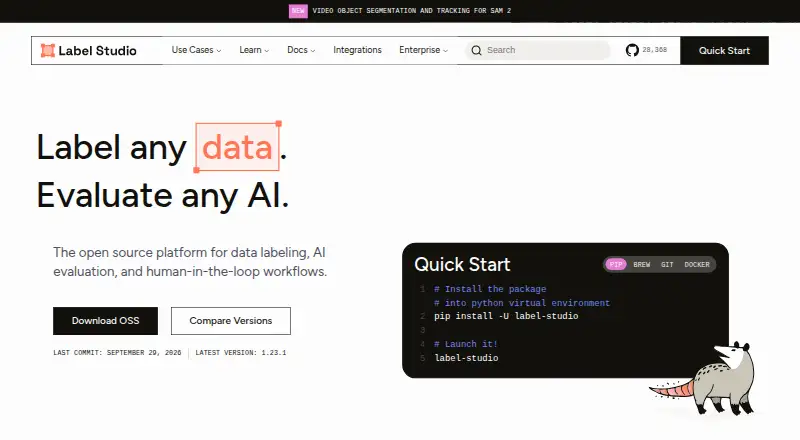
What Label Studio is
Label Studio is an open-source data labeling platform for text, images, audio, video, time series, and multimodal data. Its configurable interface, project templates, data management, and annotation import and export support labeling workflows, while custom machine-learning backends can provide predictions. Enterprise adds automated active-learning loops. The integration directory spans cloud storage, foundation-model APIs, computer vision, speech and audio, machine-learning frameworks, and infrastructure; listed storage choices include Amazon S3, Google Cloud Storage, Azure Blob Storage, Databricks, Redis, and local storage. APIs, a Python SDK, and webhooks enable programmatic management. It can be installed on premises or in the cloud using options such as pip, Docker, Ubuntu, source, or Anaconda. Security documentation describes TLS between application components, HTTPS, and secured cookies. Enterprise is described as SOC 2 and HIPAA compliant and supports cloud or on-prem deployments, SSO, and SCIM 2.0. Community Edition is free; Starter Cloud costs $99 a month, with each additional user at $49 a month.
Good
- Labels text, images, audio, video, and time series
- Configurable interface and reusable project templates
- Custom ML backends can provide predictions
- APIs, Python SDK, and webhooks
- Community Edition is free
Watch out
- Enterprise uses custom pricing
- Starter Cloud costs $99 a month
- Additional Starter Cloud users cost $49 a month
Who it suits
It suits teams preparing labeled datasets across several media types, from individual community users to organizations needing managed cloud or on-prem deployment. Developers can use its APIs, Python SDK, and webhooks to connect labeling work to other systems.
Verdict
Label Studio covers varied annotation needs and supports both programmatic integration and several deployment routes. Community Edition is free, while hosted Starter Cloud and Enterprise provide different paid options.
Plans and prices
From Label Studio's own pricing page, checked 15 Oct 2026.
| Plan | Price | What it gives you |
|---|---|---|
| Community Edition | Free | open-source edition · self-hosted deployment |
| Starter Cloud | $99 a month | up to 12 users · hosted service · support portal · RBAC · quality workflows · automated task distribution · $99 per month; $49 per month for each additional user |
| Enterprise | Priced on request | cloud or on-premises · SSO with SAML or LDAP · enhanced quality workflows and analytics · SOC2 and HIPAA compliant cloud or on-premises · Custom pricing |
The facts
Each one read from Label Studio's own pages, with the date it was checked.
What it does
- APIs
- The platform provides APIs, a Python SDK, and webhooks for programmatic management and integration.checked 29 Sep 2026
- Audio features
- Audio workflows include transcription, waveform or spectrogram annotation, speaker diarization and emotion recognition.checked 15 Oct 2026
- Community scale
- HumanSignal reports more than 250,000 Label Studio users, millions of labeled samples and more than 20,000 GitHub stars.checked 15 Oct 2026
- Data handling
- Input media can remain in external storage and be delivered through presigned URLs, while project settings and annotations are stored in the internal database or configured external stores.checked 15 Oct 2026
- Data types
- The editions support labeling text, images, audio, video, time series data, and multimodal data.checked 29 Sep 2026
- Deployment
- Label Studio can be installed on premises or in the cloud using pip, Docker, Ubuntu, source, or Anaconda.checked 29 Sep 2026
- Documentation depth
- The documentation includes installation, Kubernetes and air-gapped deployment, storage, API, Python SDK, webhooks, frontend extension and troubleshooting sections.checked 15 Oct 2026
- Enterprise compliance
- The Enterprise offering is described as SOC 2 and HIPAA compliant and is available in cloud or on-prem deployments.checked 29 Sep 2026
- Enterprise identity
- Enterprise supports single sign-on with SAML or LDAP, and the security page also describes SCIM 2.0 support.checked 29 Sep 2026
- Funding
- HumanSignal says it has raised $30 million from Redpoint Ventures, Unusual Ventures, Bow Capital and Swift Ventures.checked 15 Oct 2026
- Image classification
- The platform supports putting images into categories for image-classification projects.checked 15 Oct 2026
- Integrations
- The integrations directory lists cloud storage, foundation model APIs, computer vision, speech and audio, ML frameworks, and infrastructure integrations.checked 29 Sep 2026
- Labeling tools
- The platform provides a configurable labeling interface, project templates, data management, and annotation import and export.checked 29 Sep 2026
- License
- The public Label Studio repository is released under the Apache-2.0 license.checked 15 Oct 2026
- Limit: documentation and SSO
- A G2 reviewer asked for more documentation and reported challenges connecting some SSO providers.checked 15 Oct 2026
- Limit: pricing and throughput
- A G2 reviewer described pricing as high and cited a community-edition limit of one request per second plus a 5,000 prediction quota.checked 15 Oct 2026
- ML workflows
- Custom ML backends can provide predictions, and Enterprise adds automated active learning loops.checked 29 Sep 2026
The company
- Company headquarters and size
- LinkedIn lists HumanSignal headquarters in San Francisco, California and company size of 51–200 employees.checked 15 Oct 2026
- Company legal name
- Crunchbase identifies the legal entity as HumanSignal, Inc., also known as Heartex and Label Studio.checked 15 Oct 2026
- Founded
- HumanSignal is listed as founded in 2019.checked 15 Oct 2026
- Maker
- The company says HumanSignal was founded in 2019 and that Label Studio originated from its founding team’s work.checked 29 Sep 2026
Money
- Free trial
- The Enterprise product is available through a free trial, and the pricing page offers a Starter free trial.checked 29 Sep 2026
Where it runs
- GetApp review sentiment
- GetApp reports that 100% of its two Label Studio Enterprise reviews are positive.checked 15 Oct 2026
- Machine-learning integration
- Models can supply predictions for pre-labeling and support continuous active learning.checked 15 Oct 2026
The full review of Label Studio
Overview
Label Studio is an open-source data-labeling platform for preparing datasets and bringing machine-learning predictions into annotation work. It is best suited to teams that need configurable workflows across different media types, with the option to integrate through code or self-host. Its breadth is a strength, but the hosted plan’s per-user pricing and Enterprise-only active learning may steer small or automation-focused teams elsewhere.
Key features
Label Studio handles text, images, audio, video, time series, and multimodal data. A configurable interface, project templates, data management, and annotation import and export give teams a foundation for organizing varied projects rather than limiting them to one annotation format. For image work, annotation options include rectangles, ellipses, keypoints, polygons, brush masks, and image classification.
Custom ML backends can supply predictions to support model-assisted labeling. That makes it possible to connect annotation work to a team’s own models, while Enterprise adds automated active learning loops for teams that need that more automated workflow. The integrations directory spans cloud storage, foundation model APIs, computer vision, speech and audio, ML frameworks, and infrastructure; storage options include Amazon S3, Google Cloud Storage, Azure Blob Storage, Databricks, Redis, and local storage.
APIs, a Python SDK, and webhooks support programmatic management and integration, a meaningful advantage for teams building labeling into existing processes. Export formats include JSON, JSON_MIN, CSV, TSV, COCO, Pascal VOC XML, YOLO, PNG, and NumPy, giving image-focused workflows several common downstream options.
Deployment can be on premises or in the cloud, with installation routes including pip, Docker, Ubuntu, source, and Anaconda. The security documentation describes TLS for application-component interactions and HTTPS and secured cookies in the web app. Enterprise is described as SOC 2 and HIPAA compliant and supports cloud or on-premises deployment, SAML or LDAP single sign-on, and SCIM 2.0.
Pricing
Community Edition: free. The open-source edition is the natural starting point for individuals and teams comfortable with community support through Slack and GitHub issues. It avoids a subscription, but the listed plan does not include a hosted service or dedicated support.
Starter Cloud: $99 a month, billed $99 per month, with $49 per month for each additional user. It includes hosted service, up to 12 users, and a support portal. The seat ceiling makes it a practical hosted option for a small team, but teams beyond 12 users need another arrangement; the additional-user rate also matters as a team grows.
Enterprise: custom pricing. It offers cloud or on-prem deployment, SSO with SAML or LDAP, and highest-priority support with response-time SLAs. Its stated compliance credentials and automated active learning make it the fit for organizations with those requirements, though the custom price means it is not a transparent low-cost upgrade.
Platforms
Label Studio supports API, Linux, macOS, self-hosted, web, and Windows. Its installation choices and cloud or on-prem deployment make it flexible across infrastructure preferences, while teams that want a managed service can choose Starter Cloud. Community users rely on Slack and GitHub issues; Starter Cloud adds a support portal, and Enterprise adds priority support with response-time SLAs.
Who it's for
Choose Label Studio if your annotation work spans several data types, you need configurable projects and varied export formats, or you want APIs and custom ML backends to connect labeling with other systems. Community Edition suits users who can manage their own deployment and accept community support. Starter Cloud fits smaller teams that prefer hosting to be handled, while Enterprise is aimed at organizations needing identity controls, compliance, deployment flexibility, or active learning automation.
It is less compelling for teams seeking an inexpensive hosted plan at larger seat counts, or for organizations that require automated active learning without Enterprise.
Pros and cons
- Pros: Supports six broad data categories, including multimodal data, making it useful beyond image-only annotation.
- Pros: APIs, a Python SDK, webhooks, and custom ML backends support integration into programmatic workflows.
- Pros: Community Edition is free, and deployment options range from self-hosting to a hosted cloud plan.
- Cons: Starter Cloud is capped at 12 users, with an additional $49 per month for each additional user.
- Cons: Automated active learning loops are reserved for Enterprise, so teams needing that workflow must move to custom pricing.
- Cons: Community users depend on Slack and GitHub issues rather than the support portal or SLA-backed support of paid plans.
Alternatives
- Roboflow is worth considering for teams that want a free tier with 10 monthly credits, described as enough for about 30 model trainings or 80,000 inferences.
- CVAT may suit personal users and small teams looking for a free, MIT-licensed community plan.
- Labellerr offers a free Researcher Plan with 2,500 data credits, one seat, one workspace, and up to 10 projects, making it a possible fit for students and researchers.
- Supervisely has a free Community plan with 5 GB storage, 10,000 files, and two members for teams weighing those limits against Label Studio’s options.
- Ultralytics Platform is another free-plan option, with storage, upload, model, training-job, and deployment allowances.
- Pixano is an alternative free product.
- Labelbox is another freemium alternative with a free plan.
- BasicAI offers private-cloud deployment starting at $6,600 a year, with customizable payment cycle and deployment options.
For more options, browse Image Annotation Software, AI Image Annotation Tools, AI Data Labeling Tools, Data Labeling Software, and Video Annotation Software.
Verdict
Label Studio is a strong choice for teams that need flexible annotation across media types and value code-driven integration or deployment control. Its free open-source edition lowers the barrier to entry, and its Enterprise tier addresses more demanding identity, compliance, and automation needs. Look elsewhere if you need a hosted service for a growing team without per-seat cost or active learning automation outside a custom-priced plan.
Getting started
- Visit the Label Studio website.
- Choose Community Edition or Starter Cloud, or contact the provider about Enterprise.
- Install using pip, Docker, Ubuntu, source, or Anaconda, or use a cloud deployment.
- Create a project and select a template and labeling interface.
- Import data, configure annotations, and connect a custom ML backend if needed.
- Export annotations in a supported format or manage work through the APIs, Python SDK, or webhooks.
Limits worth knowing
Community Edition is free, while Starter Cloud supports up to 12 users and charges $49 a month for each additional user. Enterprise pricing is custom; automated active learning loops are an Enterprise feature.
Questions
Is Label Studio free?
Yes. Community Edition is free and open source. Starter Cloud costs $99 a month, plus $49 a month for each additional user.
Which platforms does it support?
The listed platforms are API, Linux, macOS, self-hosted, web, and Windows.
Can it use machine learning predictions?
Yes. Custom ML backends can provide predictions, and Enterprise adds automated active learning loops.
What data types and annotations does it support?
Supported data includes text, images, audio, video, time series, and multimodal data. Annotation types include rectangles, ellipses, keypoints, polygons, brush masks, and image classification.
What deployment options are available?
Label Studio can be deployed on premises or in the cloud using routes including pip, Docker, Ubuntu, source, or Anaconda.
Who makes Label Studio, and what are its Enterprise options?
HumanSignal says Label Studio originated from its founding team's work, and that the company was founded in 2019. Enterprise is available in cloud or on-premises deployments and is described as SOC 2 and HIPAA compliant; it supports SAML or LDAP single sign-on and SCIM 2.0.
Alternatives to Label Studio
- 1

Roboflow
Free planAndroidiOSWebAPI8.3From $39 a month - 2
VGG Image Annotator
Free planOpen sourceWebLinuxmacOSSelf-hosted7.7Free plan - 3
MakeSense.ai
Free planOpen sourceWebLinuxmacOSSelf-hosted7.6Free plan - 4
Segments.ai
Free planWebAPI7.0Free plan - 5

CVAT
Free planWebAPISelf-hosted6.9Free plan - 6
Supervisely
Free planWebAPISelf-hosted6.9From €199 a month