Prodigy
Prodigy is a downloadable developer tool for creating training and evaluation data for machine learning models.
What Prodigy is
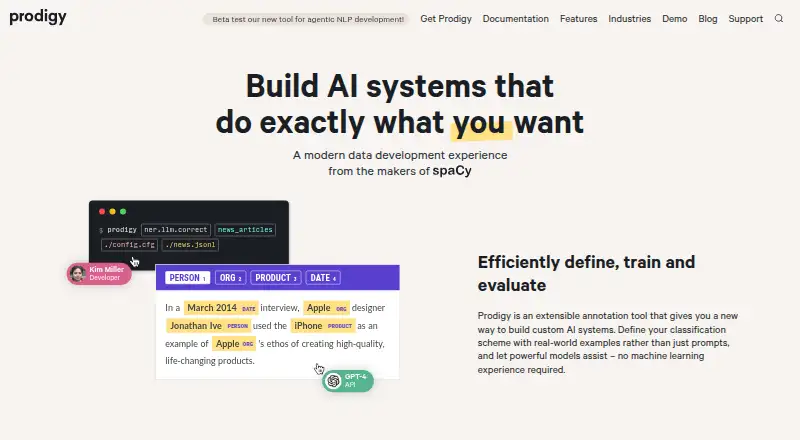
Prodigy is a downloadable developer tool for creating training and evaluation data for machine learning models. Its customizable browser app supports annotation of text, images, audio, video, relations, and multiple-choice tasks. Computer vision workflows include image classification, segmentation, and object detection. Built-in recipes cover work such as named entity recognition, text classification, dependency parsing, transcription, speaker diarization, training, and evaluation. Active learning models are available for named entity recognition, text classification, part-of-speech tagging, and dependency parsing. Developers can customize workflows with Python recipes and build interfaces using HTML, CSS, and JavaScript. Prodigy supports spaCy, offers plugins for Hugging Face models, and integrates with major LLM API providers. Data can be accessed through Python or the command line, stored in SQLite, MySQL, or PostgreSQL, or exported to JSON. The tool runs on the user's own machines, does not connect to the maker's or third-party servers, and can operate on an air-gapped machine. It is designed for developers with basic Python and command-line familiarity, though annotation can be done in its web app without programming.
Good
- Supports text, image, audio, and video annotation
- Custom workflows use Python recipes
- Data can be stored locally or exported to JSON
- Can operate on an air-gapped machine
Watch out
- No free plan
- Requires basic Python and command-line familiarity
- Hosted trials are not offered to individuals
Who it suits
Prodigy suits developers building machine-learning data workflows, especially those who need local or air-gapped operation. Annotation tasks can be completed in the web app without programming, but the tool assumes basic Python and command-line familiarity.
Verdict
Prodigy offers broad annotation workflows and local data handling for machine-learning projects. Its developer-oriented customization and privacy options suit users comfortable with Python and command-line tools.
Plans and prices
From Prodigy's own pricing page, checked 30 Sep 2001.
| Plan | Price | What it gives you |
|---|---|---|
| Personal | $390, paid once | 12 months of free upgrades · basic HTTP authentication · community forum support · unlimited personal and professional use · per lifetime license (excl. tax) |
| Company | $490, paid once | 12 months of free upgrades · HTTP auth and SSO with OpenID Connect · priority forum and email support · seats transferable within the company · per seat, in packs of 5 seats (excl. tax) |
The facts
Each one read from Prodigy's own pages, with the date it was checked.
What it does
- Active learning
- Prodigy includes active learning models for named entity recognition, text classification, part-of-speech tagging, and dependency parsing.checked 30 Sep 2001
- Annotation
- Its customizable browser-based app supports annotation workflows for text, images, audio, video, relations, multiple choice, and more.checked 30 Sep 2001
- Audience
- Prodigy is designed as a developer tool and assumes basic familiarity with Python and the command line, while annotation tasks can be completed in its web app without programming experience.checked 30 Sep 2001
- Built-in workflows
- Built-in recipes cover tasks including named entity recognition, text classification, dependency parsing, transcription, speaker diarization, training, and evaluation.checked 30 Sep 2001
- Computer vision
- Prodigy supports image classification, segmentation, and object detection.checked 30 Sep 2001
- Customization
- Users can create custom workflows with Python recipes and build interfaces using HTML, CSS, and JavaScript.checked 30 Sep 2001
- Data access
- Data is accessible through a Python API and command-line interface and can be stored in SQLite, MySQL, or PostgreSQL or exported to JSON.checked 30 Sep 2001
- Deployment
- The standard Python web server can be deployed on any cloud provider or entirely on-premise.checked 30 Sep 2001
- Eligibility limit
- The maker says it refuses to provide Prodigy to organizations primarily engaged in military, law enforcement, intelligence, or national security work, with regulatory agencies and tax authorities exempted.checked 30 Sep 2001
- Integrations
- Prodigy has first-class support for spaCy, plugins for Hugging Face models, and integrations with major LLM API providers.checked 30 Sep 2001
- Privacy
- Prodigy runs on the user's own machines, does not connect to the maker's or third-party servers, and can operate on an air-gapped machine.checked 30 Sep 2001
- Purpose
- Prodigy is a downloadable developer tool for creating training and evaluation data for machine learning models.checked 30 Sep 2001
- Support
- The Personal license includes community forum support; Company licenses include priority forum and email support.checked 30 Sep 2001
The company
- Headquarters
- Berlin, Germanychecked 28 Sep 2001
Money
- Trial
- The maker offers hosted virtual-machine trials to companies and organizations, and can arrange a trial license and installer for privacy-sensitive use cases; hosted trials are not offered to individuals.checked 30 Sep 2001
Alternatives to Prodigy
- 1

Label Studio
Free planOpen sourceWebAPILinuxmacOS8.2From $99 a month - 2
LightlyStudio
Free planOpen sourceWebAPILinuxmacOS7.6Free plan - 3

Roboflow
Free planAndroidiOSWebAPI7.5From $39 a month - 4
Doccano
Free planWebAPILinuxmacOS7.0Free plan - 5
Segments.ai
Free planWebAPI7.0Free plan - 6

CVAT
Free planWebAPISelf-hosted6.8From $1.92 a month