doccano
doccano is a free, open-source tool for labeling text and other data for human review and machine-learning work.
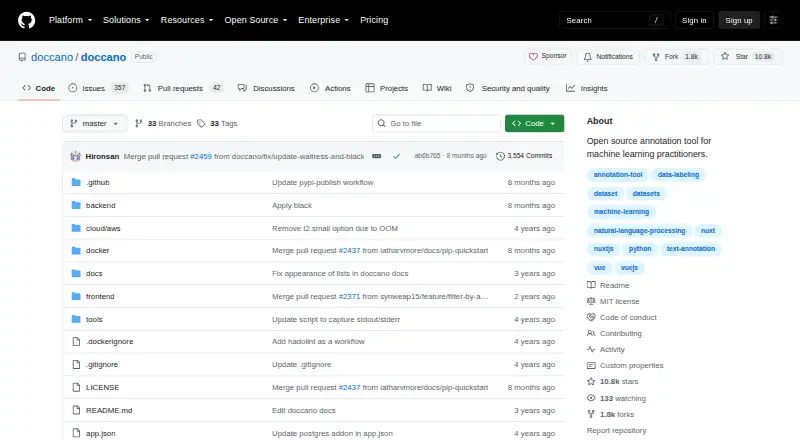
What doccano is
doccano is a free, open-source tool for labeling text and other data for human review and machine-learning work. It supports text classification, sequence labeling, and sequence-to-sequence tasks, with examples such as sentiment analysis, named-entity recognition, and summarization. A project workflow lets users create projects, import datasets, add collaborators, set guidelines, annotate, and export labeled results. Collaboration features include multi-language and mobile support, emoji support, and a dark theme. doccano provides REST APIs for connecting scripts and machine-learning models, and supports text, image, and audio modalities, model-assisted labeling, human review workflows, and custom ontologies. It can be self-hosted, with installation documented through pip, Docker, or Docker Compose on Linux, Windows, and macOS machines running Python 3.8 or newer. Deployment options include AWS, Heroku, or Docker elsewhere. Imported datasets can use Amazon S3 or Google Cloud Storage. SQLite 3 is the default database, and PostgreSQL and other systems are also documented. Celery handles long-running imports and exports. The installation guide warns that upgrading a SQLite3 installation can result in database loss.
Good
- Free, open-source software under the MIT license.
- Supports text, image, and audio modalities.
- Collaborative annotation with mobile and multi-language support.
- REST APIs integrate with scripts and machine-learning models.
- Self-hosted installation options include pip, Docker, and Compose.
Watch out
- SQLite upgrades can result in database loss.
- Requires Python 3.8 or newer on Linux, Windows, or macOS.
Who it suits
doccano suits teams and practitioners who need to label datasets collaboratively, including for classification, entity recognition, or summarization. It also fits users who want self-hosting and API-based integration with scripts or models.
Verdict
doccano brings annotation, review workflows, and dataset export together in a free, self-hosted tool. Check the SQLite upgrade warning before choosing its default database.
Plans and prices
From doccano's own pricing page, checked 30 Sep 2001.
| Plan | Price | What it gives you |
|---|---|---|
| MIT-licensed software | Free | free of charge · use, copy, modify, publish, distribute, sublicense, sell |
The facts
Each one read from doccano's own pages, with the date it was checked.
What it does
- API
- doccano provides REST APIs for integrating it with scripts and machine-learning models.checked 30 Sep 2001
- Cloud deployment
- The project documents one-click deployment options for AWS and Heroku and deployment anywhere by Docker.checked 30 Sep 2001
- Collaboration
- Features include collaborative annotation, multi-language support, mobile support, emoji support, and a dark theme.checked 30 Sep 2001
- Database options
- SQLite 3 is the default database, and the documentation also describes PostgreSQL and other database systems.checked 30 Sep 2001
- Installation
- The official project documents installation with pip, Docker, and Docker Compose.checked 30 Sep 2001
- Purpose
- doccano is an open-source text annotation tool for humans and machine-learning practitioners.checked 30 Sep 2001
- Runtime requirement
- The documentation says doccano can be installed on Linux, Windows, or macOS machines running Python 3.8 or newer.checked 30 Sep 2001
- Security status
- The GitHub repository says no SECURITY.md security policy has been detected and no security advisories have been published.checked 30 Sep 2001
- Storage integrations
- Supported cloud storage backends for imported datasets are Amazon S3 and Google Cloud Storage.checked 30 Sep 2001
- Support
- The documentation directs users who are stuck to the FAQ and says help and feedback can be sent to the author.checked 30 Sep 2001
- Task queue integrations
- doccano uses Celery for long-running import and export tasks and documents SQLite3, RabbitMQ, and Redis as message-broker options.checked 30 Sep 2001
- Task types
- It supports text classification, sequence labeling, and sequence-to-sequence tasks.checked 30 Sep 2001
- Upgrade limitation
- The installation documentation cautions that upgrading a SQLite3 installation can lose its database.checked 30 Sep 2001
- Use cases
- The project lists sentiment analysis, named-entity recognition, and text summarization as examples.checked 30 Sep 2001
- Workflow
- Users can create projects, import datasets, add users, define annotation guidelines, annotate data, and export labeled datasets.checked 30 Sep 2001
The full review of doccano
Overview
doccano is an open-source annotation platform for turning datasets into labeled material for machine-learning work. It is best suited to teams that want control over deployment and a direct path from project setup to dataset export.
Its strongest case is a flexible, free workflow with APIs and several deployment routes; its clearest operational caution is the risk of losing a SQLite database during an upgrade.
Key features
doccano covers text classification, sequence labeling, and sequence-to-sequence tasks, with examples such as sentiment analysis, named-entity recognition, and text summarization. These task types make it a focused choice for structuring text labels rather than a general-purpose project suite.
A typical workflow moves from project creation and dataset import through adding users, defining annotation guidelines, labeling, and exporting the finished dataset. Collaborative annotation and human review workflows give teams a way to coordinate and check labeling, while custom ontologies and model-assisted labeling support more tailored projects.
The platform supports text, image, and audio modalities, alongside multi-language and mobile support, emoji support, and a dark theme. REST APIs connect it to scripts and machine-learning models. The API is useful for fitting annotation into an existing pipeline, though doccano's documented task types are specifically text-oriented.
Installation is documented through pip, Docker, and Docker Compose. The documented machine requirement is Python 3.8 or newer on Linux, Windows, or macOS; deployment options include Docker and one-click AWS and Heroku routes. Imported datasets can use Amazon S3 or Google Cloud Storage. Celery handles long-running import and export work, with SQLite3, RabbitMQ, and Redis documented as broker options.
SQLite 3 is the default database, and PostgreSQL and other database systems are also described. The upgrade warning matters: an upgrade of a SQLite installation can lose its database, so teams should treat database choice and upgrade planning as operational decisions, not afterthoughts.
Pricing
doccano is free, open-source software under the MIT license. Its listed plan costs nothing, and the license permits use, copying, modification, publication, distribution, sublicensing, and sale. That makes it an unusually permissive option for individuals and organizations that can manage their own deployment.
There are no paid tiers or plan-based seat and usage caps in the pricing model. The tradeoff is that self-hosting places setup, deployment, and database upkeep with the user rather than bundling them into a paid hosted plan.
Platforms
doccano is available for web and self-hosted use, with support across Linux, macOS, Windows, Android, and iOS, as well as API access. The documented installation routes and Python requirement make it practical for teams with a suitable machine or container environment; cloud deployment is documented for AWS and Heroku.
Who it's for
Choose doccano if you need collaborative dataset annotation, human review, and export in a free tool you can deploy and integrate yourself. It fits machine-learning practitioners and teams that value open licensing, custom label structures, and API-based workflows.
It is a weaker fit for teams that want a managed service or cannot take responsibility for database upgrades and deployment. The SQLite warning is particularly relevant for small installations that might otherwise accept the default without planning how to protect data.
Pros and cons
- Pro: The MIT license and free plan allow broad use, including modification and redistribution, without a paid tier.
- Pro: Projects, guidelines, collaborative annotation, review, and export form a complete labeling workflow rather than a standalone labeling screen.
- Pro: REST APIs, Docker deployment, and S3 and Google Cloud Storage import backends help connect it to data and model workflows.
- Con: Self-hosted deployment means the team owns installation and database decisions instead of relying on a bundled hosted service.
- Con: Upgrading a SQLite installation can lose its database, making the default choice risky without an upgrade and backup plan.
- Con: The documented task types are text-focused, even though the supported modalities also include image and audio.
Alternatives
For a broader comparison, browse AI Data Labeling Tools.
- LabelU is another free option with API, macOS, self-hosted, web, and Windows platforms; consider it if that platform mix better fits your environment.
- Label Studio has a free plan and free trial, with API, Linux, macOS, self-hosted, web, and Windows support. Its freemium model may suit readers who want to consider more than a free-only offering.
- Alibaba Cloud PAI iTAG offers manual labeling free, while OSS storage and data transfer are billed separately; choose it if that distinction fits your team's cost model.
- BRAT is a free, MIT-licensed, self-hosted option for Linux, macOS, and web; it is worth considering when that platform set meets your needs.
- Roboflow has a free tier with 10 monthly credits, enough for about 30 model trainings or 80,000 inferences, and a Core plan at $39 a month. Consider it if those model and inference allowances suit your workload.
- CVAT offers a free MIT-licensed Community plan for personal use and small teams, plus an online free plan limited to 1 member, 1 project, 3 tasks, and 1 GB. Its online limits may fit a small trial, while doccano has no plan-based caps in its free model.
- Argilla is free, open-source software deployable on Hugging Face Spaces or your own infrastructure; consider it if either deployment route is preferable.
- BasicAI offers private-cloud deployment starting at $6,600 a year, with customizable payment cycles, seats, storage, model calls, and on-premise options. It suits readers specifically seeking configurable private-cloud deployment and prepared for that starting price.
Verdict
doccano is a strong choice for machine-learning teams that want free, permissively licensed annotation with collaboration, review, and export under their own deployment control. Its APIs and infrastructure options add practical flexibility. Look elsewhere if you need a managed service, and do not rely on the default SQLite setup without accounting for the documented upgrade data-loss risk.
Getting started
- Choose a Linux, Windows, or macOS machine running Python 3.8 or newer, or a documented cloud deployment option.
- Install doccano with pip, Docker, or Docker Compose.
- Create a project and import a dataset.
- Add users and define annotation guidelines.
- Annotate the data and export the labeled dataset.
Questions
Does doccano cost anything?
doccano is free of charge and MIT-licensed. The license permits use, copying, modification, publication, distribution, sublicensing, and sale.
What tasks does it support?
It supports text classification, sequence labeling, and sequence-to-sequence tasks. Listed examples include sentiment analysis, named-entity recognition, and text summarization.
Can doccano be self-hosted?
Yes. Installation is documented with pip, Docker, and Docker Compose, and the project also describes AWS and Heroku deployment options.
Which operating systems can run it?
The documentation describes installation on Linux, Windows, or macOS machines running Python 3.8 or newer.
Does it provide an API?
Yes. doccano provides REST APIs for integration with scripts and machine-learning models.
Which storage and database options are documented?
Imported datasets can use Amazon S3 or Google Cloud Storage. SQLite 3 is the default database, and PostgreSQL and other systems are also described.
Alternatives to doccano
- 1

Label Studio
Free planOpen sourceWebAPILinuxmacOS8.2From $99 a month - 2

Roboflow
Free planAndroidiOSWebAPI7.5From $39 a month - 3

CVAT
Free planWebAPISelf-hosted6.8From $1.92 a month - 4
Supervisely
Free planWebAPISelf-hosted6.8From €199 a month - 5
Prodigy
WebAPILinuxmacOS6.7$390, paid once - 6
VGG Image Annotator
Free planWebLinuxmacOSWindows6.6Free plan