Amion
Amion helps medical groups, hospitals, and health systems create, manage, and share on-call and shift schedules.
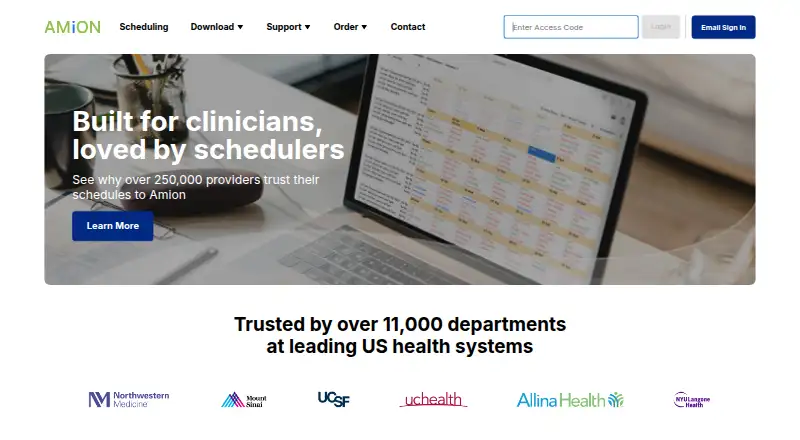
What Amion is
Amion helps medical groups, hospitals, and health systems create, manage, and share on-call and shift schedules. Scheduling tools include rules, patterns, templates, and an autoscheduler. Staff can submit work or time-off requests and swap shifts when those options are enabled for their schedule. Amion can bring department schedules together in a central hospital-wide on-call list. Its mobile app supports two-way secure messaging, while messages from the Who’s On List are one-way broadcasts. Listed integrations include Epic, American Messaging, Spok, Verizon, LightningBolt, QGenda, SAML-compatible SSO providers, and Imprivata products. LightningBolt and QGenda integrations display Amion schedules in those applications in the outgoing direction only. Browser access supports viewing schedules, requests, editing, swaps, and personal schedule access across platforms. The OnCall desktop scheduler runs on Windows; Amion says Macs can run it through Winebottler or Windows emulators. Pricing is on request, with Pro, Enterprise, and Residency plans listed.
Good
- Scheduling rules, patterns, templates, and autoscheduler
- Department schedules can form a hospital-wide on-call list
- Mobile app supports two-way secure messaging
- Browser access works across platforms
Watch out
- Requests and swaps depend on schedule settings
- Who’s On List messages are one-way broadcasts
- LightningBolt and QGenda integrations are outgoing only
- Pricing is on request
Who it suits
Amion is intended for medical groups, hospitals, and health systems that coordinate on-call and shift schedules. It can also suit teams needing browser-based schedule access, requests, and shift swaps.
Verdict
Amion brings scheduling, requests, and messaging together for healthcare teams, with plan options for different schedule needs. Consider the enabled schedule features and one-way integration limits before choosing it.
Plans and prices
From Amion's own pricing page, checked 15 Oct 2026.
| Plan | Price | What it gives you |
|---|---|---|
| Single group or residency license | $399 a year | support · online training · mobile app · secure messaging · annual; residency covers an academic year, other licenses follow the calendar year |
| Provider scheduling | $449 a year | providers and midlevels · desktop scheduler · autoscheduler · requests · swaps · calendar sync · annual |
| Enterprise | Priced on request | unlimited schedules · organization controls · EHR and SSO integrations · implementation team · client success manager · training · compliance reporting · custom contract |
| Pro | Priced on request | Up to 10 schedules · Self-serve setup · Mobile and desktop access · Custom rules |
| Residency | Priced on request | Single residency schedule · Self-serve setup · Mobile and desktop access · Block scheduling |
The facts
Each one read from Amion's own pages, with the date it was checked.
What it does
- API evidence
- A public GitHub adapter describes an Amion API for schedule reports but says report formats are inconsistent and difficult to parse.checked 15 Oct 2026
- Automated scheduling
- Rules, patterns, templates and an autoscheduler can space assignments, balance workloads and account for availability, targets, FTE percentages and work preferences.checked 15 Oct 2026
- Calendar sync
- Personal schedules can subscribe to iPhone, Google Calendar, Outlook and other online-calendar systems; feeds include 300 future days and the prior two weeks.checked 15 Oct 2026
- Desktop installation
- The OnCall desktop scheduler is installed as an executable into a local c:\OnCall directory, with separate installations recommended for collaborating schedulers.checked 15 Oct 2026
- Documentation
- Amion Academy provides learning paths covering provider schedules, residency scheduling, rules, automation, reporting, Amion Next and switchboard workflows.checked 15 Oct 2026
- EHR limitation
- The listed QGenda and LightningBolt connections are outgoing schedule displays, and the ShiftAdmin integration was discontinued after QGenda acquired it in 2021.checked 15 Oct 2026
- Enterprise view
- Amion combines department schedules into a central hospital-wide on-call list.checked 30 Sep 2026
- Founder and origin
- Stuart Karon developed the first version in 1998 to help his wife build a large residency schedule.checked 15 Oct 2026
- Integration limitation
- LightningBolt and QGenda integrations display Amion schedules in those applications in the outgoing direction only.checked 30 Sep 2026
- Integrations
- Listed integrations include Epic, American Messaging, Spok, Verizon, LightningBolt, QGenda, SAML identity providers and Imprivata products.checked 15 Oct 2026
- Limit: dated product
- KLAS reviewers call the software old or antiquated and say it has not been enhanced enough.checked 15 Oct 2026
- Limit: mobile reliability
- Apple reviewers report crashes, logouts, schedule discrepancies, awkward navigation and missing or degraded features after updates.checked 15 Oct 2026
- Limit: reporting
- A KLAS reviewer says Amion lacks enough reporting-interface depth for their needs.checked 15 Oct 2026
- Limit: support and training
- KLAS reviewers report confusing support ownership, limited training and technical-support shortcomings.checked 15 Oct 2026
- Messaging
- The product supports secure app messaging, group paging, alpha-numeric paging and SMS or pager delivery through configured carriers.checked 15 Oct 2026
- Messaging security
- Amion says mobile messages are encrypted in transit and on Doximity servers, and message content is removed from temporary device storage when the app closes.checked 30 Sep 2026
- Network requirements
- IT teams must allow HTTPS access to Amion, Doximity, Google APIs, reCAPTCHA and Bugsnag, while real-time collaborative editing uses WSS on TCP 443.checked 15 Oct 2026
The company
- Company identity
- The Amion support site identifies the company as Amion, LLC.checked 30 Sep 2026
- Company ownership
- Doximity announced its Amion acquisition on February 8, 2022, with the transaction expected to close April 1, 2022.checked 15 Oct 2026
- Founded
- 1998checked 23 Sep 2026
- Headquarters
- Boston area, Massachusetts, United Stateschecked 23 Sep 2026
- Maker
- The current support site identifies the operating entity as Amion, LLC.checked 15 Oct 2026
Where it runs
- Desktop platform
- The OnCall desktop scheduler runs on Windows; Amion says it can run on Macs through Winebottler or Windows emulators such as Parallels and VMware Fusion.checked 30 Sep 2026
- Limit: Android experience
- Chrome-Stats summarizes frequent crashes, logouts, failed syncing, slow performance, intrusive ads and an interface that feels like a browser.checked 15 Oct 2026
The full review of Amion
Overview
Amion is a scheduling platform for medical groups that coordinate on-call coverage and shifts. It is best suited to hospitals and residency programs that need structured scheduling across one or many departments. Its strongest case is the combination of configurable schedules and a hospital-wide on-call view; buyers should weigh custom pricing and schedule-dependent staff tools before committing.
Key features
Rules, patterns, templates, and an autoscheduler give coordinators ways to build recurring coverage without relying on a single scheduling method. Staff can manage availability, handle open shifts, and submit work or time-off requests and shift swaps when those tools are enabled for their schedule. That flexibility suits teams with established scheduling workflows, but it makes confirming which features are enabled an important part of adoption.
Amion can combine department schedules into a central hospital-wide on-call list, a practical advantage for organizations that need to see coverage beyond one service. The mobile app supports two-way secure messaging; messages sent from the Who’s On List are one-way broadcasts, so they are suited to distributing updates rather than holding a conversation.
Listed integrations include Epic, American Messaging, Spok, Verizon, LightningBolt, QGenda, SAML-compatible single sign-on providers, and Imprivata products. The LightningBolt and QGenda integrations display Amion schedules in those applications in the outgoing direction only, a meaningful constraint for teams expecting schedules to sync both ways. Amion says mobile messages are encrypted in transit and on Doximity servers, and message content is removed from temporary device storage when the app closes. Its stated app security standards include end-to-end 256-bit AES encryption, SSL with 2048-bit RSA, NIST Level 3 certification, and cryptographic modules validated to FIPS 140-2 Level 1+ standards.
Pricing
Amion is paid, with custom pricing. Pro includes up to 10 schedules, self-serve setup, mobile and desktop access, and custom rules; it is the clearest fit for smaller teams that can manage setup themselves. Residency covers a single residency schedule, self-serve setup, mobile and desktop access, and block scheduling, making it the focused option for one program. Both narrower plans trade the broader organization-level controls and services of Enterprise for a defined schedule scope.
Enterprise offers unlimited schedules, organization-wide settings and controls, EHR and SSO integrations, dedicated implementation and client success, training and onboarding, and usage and compliance reporting. It is the plan aimed at organizations coordinating at scale or needing implementation support and reporting. All three plans have custom pricing, so organizations must request a quote to compare their costs.
Platforms
Amion supports Android, iOS, macOS, web, and Windows. Browser access supports schedule viewing, work requests, online editing, swaps, and personal schedule access on any platform. The OnCall desktop scheduler runs on Windows; on Macs, Amion says it can run through Winebottler or Windows emulators such as Parallels and VMware Fusion. Email and phone support operates Monday through Friday, 6:00 am–5:00 pm Pacific, with 24-hour urgent support.
Who it's for
Amion is a strong candidate for medical groups, hospitals, health systems, and residency programs that need rules-based on-call or shift scheduling, especially where schedules from several departments need a central view. Teams should look elsewhere if they require two-way syncing through LightningBolt or QGenda, or if one-way broadcasts do not meet their communication needs.
Pros and cons
- Pros: Rules, patterns, templates, and autoscheduling support different ways to organize recurring coverage.
- Pros: A hospital-wide on-call list brings department schedules together for a broader view of coverage.
- Pros: Browser-based schedule access, requests, editing, and swaps work across platforms.
- Cons: Requests and swaps depend on which features are enabled for a schedule, so teams need to align the setup with their workflows.
- Cons: Who’s On List messages are broadcasts rather than two-way conversations, and the LightningBolt and QGenda integrations only send schedules outward from Amion.
- Cons: Custom pricing makes plan costs something buyers must obtain directly.
Alternatives
For a residency-focused comparison, see Medical Residency Scheduling Software; for broader clinical staffing options, see Healthcare Staff Scheduling Software.
TigerConnect Physician Scheduling is another paid option with Android, iOS, Linux, macOS, web, and Windows support; its plan uses enterprise-wide pricing, with sales handling demos and pricing. Aurora-Med is a paid alternative available for Linux, macOS, self-hosted use, web, and Windows. Lightning Bolt is worth comparing for teams that prefer per-seat licensing; a net increase in scheduled individuals requires additional licenses. MedHub is another paid option, supporting Android, API, iOS, and web.
CoverED may suit a residency program looking for a bundled license: it has no free plan, offers a free trial, and its residency program license is $30 a month (billed $25/mo annual), with a separate workspace, resident roles, custom rotation blocks, and per-block site assignment. Calerity is a paid, web-based alternative developed by Plum Flower Software. MedRez.net has no free plan but offers a free trial; its one-program-or-specialty plan is $450 a year for one year of scheduling, with a half-year option also available at an unstated price. VitalScheduler is a web-based paid alternative with no free plan and a free trial; its listed plan is $9 a month, with 30 days free and no card required before the $9 monthly charge.
Verdict
Choose Amion if your hospital, health system, or residency program needs configurable medical schedules and a central view of on-call coverage across departments. Its scheduling range and enterprise view are the strongest reasons to choose it. Look elsewhere if your workflow depends on two-way LightningBolt or QGenda syncing, conversational broadcasts, or a published price before requesting a quote.
Alternatives to Amion
- 1

CoverED
AndroidiOSWeb6.8From $30 a month - 2
MedRez.net
AndroidiOSWeb6.6From $450 a year - 3
Resident Vacation Scheduler
Free planiOS6.6$299 one-time - 4
TigerConnect Physician Scheduling
AndroidiOSWebAPI6.6 - 5
MyEvaluations
AndroidiOSWeb6.5From $299 a month - 6

New Innovations
AndroidiOSWeb6.4