
MedHub
MedHub provides medical education management software for undergraduate medical education and graduate residency programs.
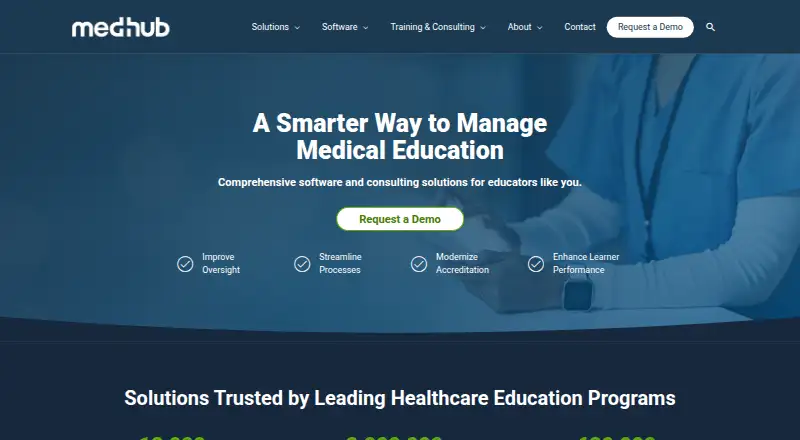
What MedHub is
MedHub provides medical education management software for undergraduate medical education and graduate residency programs. Its UME tools include student and schedule management, curriculum mapping, competency tracking, evaluations, accreditation maintenance, and reporting. For GME, it supports residency scheduling, evaluations, onboarding, accreditation management, and reimbursement optimization. A curriculum and assessment solution adds board exam readiness tools, performance analytics, and AI risk assessment. The mobile app covers evaluations, work hours, calendars, procedure logs, reminders, talk-to-text, and offline task syncing. Listed interfaces include AAMC ERAS, ACGME, NPDB, NPPES, PeopleSoft, Epic, Oracle, Comet LMS, Qgenda, and Kronos. Institutions can request API access through their GME office. MedHub lists 128-bit SSL encryption, available multifactor authentication, FERPA and SOC 2 compliance, and 99.95% uptime. Pricing is on request, and the site invites institutions to request a demo. Support tickets are submitted through an institution’s MedHub URL.
Good
- Covers both undergraduate and graduate medical education.
- Mobile app includes offline task syncing.
- Lists interfaces with education, clinical, and scheduling systems.
- API access is available through an institution’s GME office.
- Lists FERPA and SOC 2 compliance.
Watch out
- Pricing is available on request, not listed publicly.
- API access is managed through the institution’s GME office.
- Support tickets require an institution’s MedHub URL.
Who it suits
MedHub is aimed at institutions managing undergraduate medical education or residency programs. Its mobile tools also suit learners and staff who need access to evaluations, calendars, logs, and reminders.
Verdict
MedHub brings curriculum, assessment, and residency administration into software for medical education institutions. Institutions considering it need to request pricing and coordinate API access through their GME office.
The facts
Each one read from MedHub's own pages, with the date it was checked.
What it does
- API
- MedHub provides an API with predefined calls for external systems to access its database; its API specifications say institutions manage API access through the GME Office.checked 4 Oct 2026
- API access
- MedHub offers an API with predefined calls, and API access is requested through an institution’s GME office.checked 3 Oct 2026
- Curriculum and assessment
- MedHub describes a curriculum and assessment solution with board exam readiness tools, performance analytics, and AI risk assessment.checked 3 Oct 2026
- GME features
- Its GME software supports scheduling, evaluations, resident onboarding, accreditation management, and reimbursement optimization.checked 3 Oct 2026
- GME management
- Its GME platform supports residency scheduling, evaluations, onboarding, accreditation management, and reimbursement optimization.checked 4 Oct 2026
- Industry interfaces
- Listed interfaces include AAMC ERAS, ACGME, NPDB, and NPPES for resident demographics, survey and milestone data, and NPI checks or verification.checked 4 Oct 2026
- Integrations
- MedHub lists integrations and data feeds for PeopleSoft, Epic, Lawson, Banner, Oracle, Comet LMS, Echo, Morrissey, Cactus, AMCOM, Kronos, and Qgenda.checked 4 Oct 2026
- Purpose
- MedHub provides medical education software and consulting for undergraduate and graduate medical education institutions.checked 4 Oct 2026
- Reliability
- MedHub states platform uptime of 99.95% across 24/7/365 operations.checked 3 Oct 2026
- Sales model
- MedHub invites institutions to request a demo; its opened pages do not state product plan prices.checked 4 Oct 2026
- Security
- MedHub lists 128-bit SSL encryption, multifactor authentication availability, FERPA compliance, SOC 2 compliance, and 99.95% uptime.checked 4 Oct 2026
- Security and compliance
- The maker states that MedHub supports 128-bit SSL encryption, available multifactor authentication, and FERPA and SOC 2 compliance.checked 3 Oct 2026
- Security protocols
- Its security summary describes encrypted data transfers, encrypted backups, daily incremental and weekly full backups, breach notification, and FERPA obligations for educational records.checked 4 Oct 2026
- Single sign-on
- MedHub supports single sign-on using SAML and Shibboleth, and says more than 50% of its clients provide users SSO access.checked 4 Oct 2026
- Support
- Users can submit support tickets through their institution’s MedHub URL, and the listed support number is 866.766.0625, extension 1.checked 3 Oct 2026
- Support and training
- MedHub describes personalized support, an on-demand Learning Portal, training series, and live and on-demand training sessions.checked 4 Oct 2026
- Training and consulting
- MedHub offers live and on-demand training and in-house strategic advisory services for UME and GME institutions.checked 3 Oct 2026
- UME features
- Its UME software supports student and schedule management, reporting, and curriculum mapping.checked 3 Oct 2026
- UME management
- Its UME software includes curriculum mapping, competency tracking, evaluations, accreditation maintenance, and scheduling tools.checked 4 Oct 2026
The company
- Headquarters
- Minneapolis, Minnesota, United Stateschecked 23 Sep 2026
Where it runs
- Mobile app
- The mobile app supports calendars, evaluations, work-hour submissions, procedure logs, reminders, and offline task syncing.checked 4 Oct 2026
- Mobile platforms
- The MedHub app is offered through the Apple App Store and Google Play.checked 4 Oct 2026
The full review of MedHub
MedHub is a medical education management platform for undergraduate medical education and graduate residency programs. It is best suited to institutions that need curriculum and assessment alongside residency administration, rather than a standalone scheduling tool. Its breadth is compelling for that institutional remit, but custom pricing and GME-office-managed API access make it a coordinated purchase.
Overview
MedHub spans student and schedule management for undergraduate programs and the operational demands of graduate medical education. Its combination of curriculum mapping, assessment, resident onboarding, accreditation management, and reimbursement optimization can consolidate work across education programs. That breadth is most useful to institutions seeking a shared platform; organizations needing only a narrow scheduling function may find the scope harder to justify.
Key features
UME and GME administration
UME tools cover curriculum mapping, competency tracking, evaluations, accreditation maintenance, reporting, and scheduling. GME adds residency and call scheduling, evaluations, onboarding, accreditation management, and reimbursement optimization. Conflict checks support scheduling workflows. Together, these capabilities address more than rota creation, though institutions should weigh that range against their actual needs.
Curriculum, assessment, and mobile work
MedHub’s curriculum and assessment solution includes board exam readiness tools, performance analytics, and AI risk assessment. The mobile app supports evaluations, work hours, calendars, procedure logs, reminders, talk-to-text, and offline task syncing. Offline syncing and reminders are practical advantages for residents working away from a desk; app functionality also makes the platform more than a browser-based administrative system.
Connections, access, and reliability
Interfaces include AAMC ERAS, ACGME, NPDB, NPPES, PeopleSoft, Epic, Oracle, Comet LMS, Qgenda, and Kronos. SAML and Shibboleth single sign-on are supported. The API uses predefined calls, with access managed through an institution’s GME office—a fit for centrally governed deployments, but a coordination step for teams seeking direct integration access.
MedHub states that it uses 128-bit SSL encryption, offers multifactor authentication, and is FERPA- and SOC 2-compliant. Its security summary describes encrypted client-data transfers, daily incremental backups, weekly full backups, and a documented continuity plan. The company states 99.95% uptime across 24/7/365 operations. Live and on-demand training, a Learning Portal, and strategic advisory services support institutional rollout.
Pricing
MedHub uses a paid, custom-pricing model; institutions are invited to request a demo and pricing. There are no public plan tiers or seat limits to compare, so it is not a self-serve purchase with a visible entry price. Institutions should involve their GME office early, particularly if API access is part of the deployment.
Platforms
MedHub supports web, Android, iOS, and API access. The mobile apps are distributed through the Apple App Store and Google Play. Rotation scheduling, call scheduling, conflict checks, and mobile access are supported.
Who it's for
MedHub is a strong candidate for medical schools and residency institutions that want curriculum, assessment, accreditation, evaluations, and scheduling in one system, with established interfaces and institutional controls. It is less suited to a small team seeking a low-friction scheduling-only tool or transparent pricing before contacting sales.
Pros and cons
Pros
- Broad education coverage: UME curriculum and competency tools sit alongside GME onboarding, accreditation, evaluations, and scheduling.
- Useful mobile workflows: Work hours, procedure logs, reminders, talk-to-text, and offline task syncing support resident tasks beyond the desktop.
- Institutional connectivity: A wide set of named interfaces, SSO support, and a predefined-call API accommodate connected deployments.
- Operational safeguards: The stated compliance, backup, continuity, and uptime provisions address institutional reliability concerns.
Cons
- Custom pricing: Institutions must request pricing, making budget comparison less direct.
- API access requires institutional coordination: Requests go through the GME office, which may slow teams that need to arrange integrations.
- Potentially more platform than needed: Its breadth is a weaker fit when the requirement is only residency scheduling.
Alternatives
Compare medical residency scheduling software if you want to assess the category before choosing a platform.
Amion is worth considering for programs that prioritize self-serve setup and mobile and desktop access; its Pro plan supports up to 10 schedules, while Enterprise supports unlimited schedules.
Aurora-Med is another paid option, with Linux, macOS, Windows, web, and self-hosted platforms.
Lightning Bolt may suit organizations evaluating per-seat clinical team scheduling; additional licenses are required when the number of scheduled individuals grows.
TigerConnect Physician Scheduling is an alternative with enterprise-wide pricing and sales-led demos.
New Innovations, Medtrics, and MyEvaluations are other paid, web-based options; MyEvaluations has no free plan.
CallGrid is a web-based scheduling alternative with a free trial and a listed price of $125 a month, billed monthly based on active resident count; a $25/month minimum covers up to 25 residents, and each program is billed separately.
Verdict
Choose MedHub if your institution needs one platform for medical education administration across UME and GME, especially when mobile resident workflows and institutional integrations matter. Its main case against itself is practical: custom pricing and GME-office-controlled API access call for institutional coordination, while narrower scheduling needs may be better served by a more focused alternative.
Alternatives to MedHub
- 1
Amion
AndroidiOSWebAPI7.8From $399 a year - 2

CoverED
AndroidiOSWeb6.8From $30 a month - 3
MedRez.net
AndroidiOSWeb6.6From $450 a year - 4
Resident Vacation Scheduler
Free planiOS6.6$299 one-time - 5
TigerConnect Physician Scheduling
AndroidiOSWebAPI6.6 - 6
MyEvaluations
AndroidiOSWeb6.5From $299 a month