Resident Vacation Scheduler
Resident Vacation Scheduler helps U.S. ACGME-accredited residency and fellowship programs plan vacation weeks.
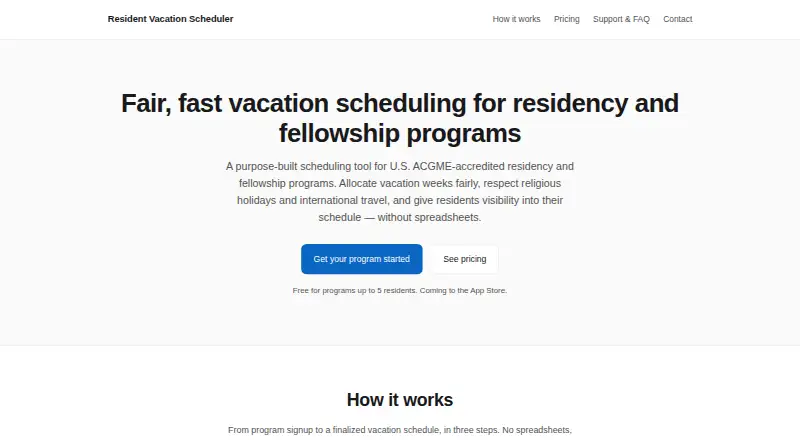
What Resident Vacation Scheduler is
Resident Vacation Scheduler helps U.S. ACGME-accredited residency and fellowship programs plan vacation weeks. Vacation rounds follow PGY seniority, check conflicts within each training level, and enforce a program-wide limit on how many residents may be away in a week. For religious holidays, the scheduler can let requests override same-level conflicts; if every overlapping request is religious, it can also loosen the weekly cap. Consecutive weeks requested for international travel stay together. Programs can run schedules for multiple academic years at once, and residents retain access to past schedules after the year covered by a purchase ends.
Administrators sign in with Apple or Google, while residents join through a unique one-time access code. The privacy policy says data travels over HTTPS, session tokens are kept on-device in encrypted storage, and user data is not sold or shared with advertisers for marketing. It names Render, Neon, Cloudflare, Apple Sign In, and Google Sign In as service providers. The iOS app is completing App Store review; its iPhone listing requires iOS 15.1 or later. The free plan covers up to five residents. Paid options are one-time purchases for one GME academic year: Starter costs 299.00 USD for up to 20 residents, Standard costs 699.00 USD for up to 50, Pro costs 999.00 USD for up to 150, and Institutional costs 3500.00 USD for unlimited residents through a direct license.
Good
- Vacation rounds use PGY seniority and check level conflicts.
- A global weekly cap manages how many residents are away.
- Religious holiday requests can receive conflict and cap exceptions.
- Consecutive international travel weeks stay together.
- Multiple academic years can run in parallel.
- Residents can access past schedules after a purchase year ends.
Watch out
- The free plan supports up to five residents.
- The app is for iPhone and requires iOS 15.1 or later.
- Paid plans cover one GME academic year per purchase.
Who it suits
It suits U.S. ACGME-accredited residency and fellowship programs that need to allocate vacation weeks by PGY seniority, including programs in surgery, internal medicine, pediatrics, and subspecialties. Smaller programs can begin with up to five residents on the free plan, while larger programs can choose a paid tier sized to their resident count.
Verdict
Choose Resident Vacation Scheduler if your U.S. ACGME-accredited program needs vacation allocation with seniority, conflict checks, and support for religious holidays or consecutive international travel weeks. The free tier serves up to five residents; larger programs should weigh the one-year purchase tiers, and teams outside the iPhone platform should look elsewhere.
Plans and prices
From Resident Vacation Scheduler's own pricing page, checked 7 Oct 2026.
| Plan | Price | What it gives you |
|---|---|---|
| Free | Free | Up to 5 residents · No payment; self-service signup for up to 5 residents |
| Starter | $299, paid once | Up to 20 residents · Apple in-app purchase · One purchase covers one GME academic year |
| Standard | $699, paid once | Up to 50 residents · Apple in-app purchase · One purchase covers one GME academic year |
| Pro | $999, paid once | Up to 150 residents · Apple in-app purchase · One purchase covers one GME academic year |
| Institutional | $3,500, paid once | Unlimited residents · Direct license; contact the maker · One purchase covers one GME academic year |
The facts
Each one read from Resident Vacation Scheduler's own pages, with the date it was checked.
What it does
- Access and sign-in
- Administrators can sign in with Apple or Google, while residents join using a unique one-time access code.checked 7 Oct 2026
- Data deletion
- Users can delete accounts and associated data in the app or by email, and administrators can delete resident profiles.checked 7 Oct 2026
- Fair allocation
- Vacation rounds use PGY seniority and automatically enforce per-level conflicts and a global cap on residents off in a week.checked 7 Oct 2026
- Intended users
- The maker describes the product as suitable for U.S. ACGME-accredited programs across surgery, internal medicine, pediatrics, and subspecialties.checked 7 Oct 2026
- International travel
- Consecutive vacation weeks requested for international travel are kept together.checked 7 Oct 2026
- Multi-year schedules
- Programs can run multiple academic years in parallel, and residents can still view past schedules after the purchase year ends.checked 7 Oct 2026
- Privacy and security
- The privacy policy says data is transmitted over HTTPS, session tokens are stored on-device using encrypted storage, and data is not sold or shared with advertisers for marketing.checked 7 Oct 2026
- Purpose
- The product schedules vacation weeks for U.S. ACGME-accredited residency and fellowship programs.checked 7 Oct 2026
- Religious holidays
- The scheduler can bypass same-level conflicts for religious holidays and relax the global cap when all overlapping requests are religious.checked 7 Oct 2026
- Service providers
- The privacy policy names Render for API hosting, Neon for PostgreSQL database hosting, Cloudflare for website hosting, and Apple Sign In and Google Sign In.checked 7 Oct 2026
- Support
- The maker directs users to contact [email protected] for questions and early access.checked 7 Oct 2026
Where it runs
- Platform availability
- The maker says the iOS app is completing App Store review; the App Store lists the app for iPhone and requires iOS 15.1 or later.checked 7 Oct 2026
The full review of Resident Vacation Scheduler
Resident Vacation Scheduler allocates vacation weeks for U.S. ACGME-accredited residency and fellowship programs. It is a strong fit for small programs that need seniority-based allocation and defined exceptions; the free tier is capped at five residents, and iPhone is the only supported platform.
Overview
This is a focused vacation scheduler, not a comprehensive residency scheduling system. Its rules address common allocation pressures—who gets priority, how many residents can be away, and how to handle certain overlapping requests. That focus is useful when vacation planning is the specific gap, but programs needing rotation scheduling will need another tool.
Key features
- Seniority and conflict controls: Vacation rounds use PGY seniority, check conflicts within each level, and enforce a program-wide cap on residents off in a week. This gives administrators consistent allocation guardrails, though the product does not replace broader scheduling tools.
- Religious holiday exceptions: Same-level conflicts can be bypassed for religious holidays, and the global cap can be relaxed when all overlapping requests are religious. Programs can accommodate these requests without abandoning the standard rules for every vacation week.
- International travel: Consecutive vacation weeks requested for international travel stay together, a practical benefit for residents whose travel requires more than one week away.
- Schedules across years: Programs can run multiple academic years in parallel, and residents can view past schedules after the purchase year ends. That preserves access to prior plans without extending the purchase term.
- Access and privacy: Administrators sign in with Apple or Google; residents join with a unique one-time code. The privacy policy says data is transmitted over HTTPS, session tokens use encrypted on-device storage, and user data is not sold or shared with advertisers for marketing. Users can delete accounts and associated data in the app or by email, while administrators can delete resident profiles.
Pricing
The free plan costs nothing, requires no payment, and supports self-service signup for up to 5 residents. It is a sensible starting point for a small program, but the five-resident cap rules out larger cohorts.
Paid tiers are one-time purchases covering one GME academic year, rather than annual renewals. Starter costs $299, paid once for up to 20 residents; Standard costs $699, paid once for up to 50; and Pro costs $999, paid once for up to 150. Each is an Apple in-app purchase, so the right tier depends on program size and requires another purchase for a later academic year.
Institutional costs $3,500, paid once for unlimited residents, covers one GME academic year, and is sold by direct license through the maker. It suits programs that exceed the Pro limit, but is a substantial step up from the capped tiers. The maker invites questions and early-access inquiries at [email protected].
Platforms
The app is for iPhone and requires iOS 15.1 or later. The maker says it is completing App Store review. Programs whose administrators or residents need Android, desktop, or web access should look elsewhere.
Who it's for
The product is aimed at U.S. ACGME-accredited programs in surgery, internal medicine, pediatrics, and subspecialties. It makes the most sense for teams that need vacation allocation with seniority, conflict checks, religious-holiday exceptions, or protected consecutive travel weeks—not for programs seeking rotation scheduling.
Pros and cons
- Pros: PGY-based rounds combine with per-level checks and a weekly cap, reducing the burden of managing those constraints separately.
- Pros: Religious-holiday exceptions and consecutive international travel weeks address cases that a rigid allocation process can mishandle.
- Pros: The free tier supports up to five residents, and past schedules remain viewable after the purchase year.
- Cons: Rotation scheduling is not included, so programs needing it must use another solution.
- Cons: iPhone-only availability excludes teams that need another platform.
- Cons: Paid tiers cover only one academic year, and the unlimited-resident Institutional license costs $3,500, paid once.
Alternatives
Medical Residency Scheduling Software is the category list for comparing broader options. Consider TigerConnect Physician Scheduling if cross-platform coverage matters: it supports Android, iOS, Linux, macOS, web, and Windows, with enterprise-wide pricing through sales. Aurora-Med is another paid option, available for Linux, macOS, self-hosted, web, and Windows.
Lightning Bolt may suit teams looking for clinical team scheduling across mobile, desktop, and web platforms; its licenses are per seat, with additional licenses required for a net increase in scheduled individuals. Amion offers a Pro plan for up to 10 schedules with self-serve setup, mobile and desktop access, and custom rules; its Enterprise plan supports unlimited schedules and organization-wide settings.
GME Manager is worth considering for a web-based workflow: its LaunchPad Pilot is free for 30 days, self-guided, and requires no credit card or commitment to convert. New Innovations is a paid alternative with Android, iOS, and web support. MedHub is another paid option, available on Android, iOS, and web, with API support.
CoverED may be a better fit for teams seeking a broader residency-program license: its bundled plan is $30 a month, billed $25/mo annual, and includes a separate workspace, resident roles, custom rotation blocks, and per-block site assignment. It also offers a free trial.
Verdict
Choose Resident Vacation Scheduler when a U.S. ACGME-accredited program needs vacation allocation built around seniority, conflict checks, and specific religious-holiday or international-travel exceptions. Its free tier is practical for up to five residents, while larger programs can buy a one-year tier sized to their roster. Look elsewhere if rotation scheduling or access beyond iPhone is essential.
Getting started
- Open the product website for information or to contact the maker about early access.
- Use an iPhone with iOS 15.1 or later when the app is available.
- Sign in as an administrator with Apple or Google.
- Have residents join with their unique one-time access codes.
- Choose the free tier for up to five residents, or select a one-time purchase sized to the program.
Limits worth knowing
The free plan supports up to five residents. Paid options cover one GME academic year and range from 20 residents on Starter to unlimited residents on Institutional.
Questions
Is there a free plan?
Yes. Free supports up to five residents.
What do paid plans cost?
Starter is $299, paid once-time purchase for up to 20 residents; Standard is 699.00 USD for up to 50; Pro is 999.00 USD for up to 150; and Institutional is 3500.00 USD for unlimited residents. Each purchase covers one GME academic year.
Which devices can run the app?
The app is listed for iPhone and requires iOS 15.1 or later. The maker says the iOS app is completing App Store review.
How do administrators and residents sign in?
Administrators can use Apple or Google sign-in. Residents join with a unique one-time access code.
Can the schedule handle religious holidays and international travel?
It can bypass same-level conflicts for religious holidays, and relax the global cap when all overlapping requests are religious. Consecutive vacation weeks requested for international travel stay together.
Can programs manage past and future academic years?
Programs can run multiple academic years in parallel. Residents can still view past schedules after the purchase year ends.
Alternatives to Resident Vacation Scheduler
- 1
Amion
AndroidiOSWebAPI7.8From $399 a year - 2

CoverED
AndroidiOSWeb6.8From $30 a month - 3
MedRez.net
AndroidiOSWeb6.6From $450 a year - 4
TigerConnect Physician Scheduling
AndroidiOSWebAPI6.6 - 5
MyEvaluations
AndroidiOSWeb6.5From $299 a month - 6

New Innovations
AndroidiOSWeb6.4