GME Manager
GME Manager is a residency management platform currently offered as the Family Medicine Edition.
What GME Manager is
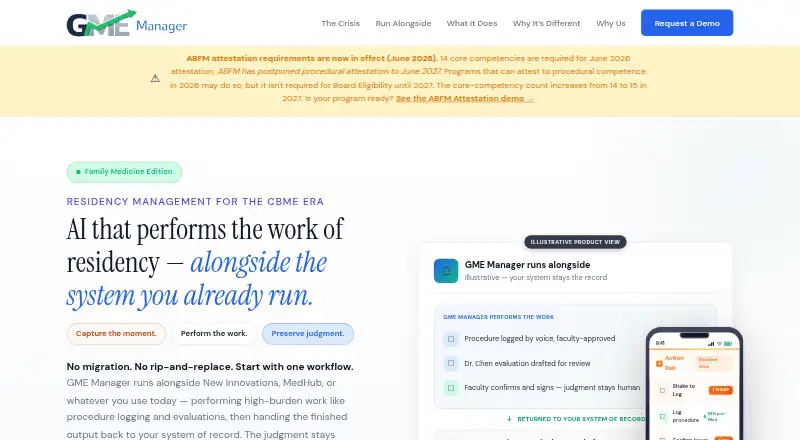
GME Manager is a residency management platform currently offered as the Family Medicine Edition. Its initial pilot workflows are procedure logging and evaluations, supported by voice-first logging, AI-drafted evaluations, and tools for competency evidence, committee preparation, and program reporting. It is designed to run alongside New Innovations, MedHub, or a program’s existing platform, returning completed records without requiring migration. Programs can configure imports for setup data and export completed records after human review; direct integrations are listed as planned. A live hStream integration can provide identity and single sign-on when enabled by an institution. Faculty retain final decisions, and AI-generated documentation requires human confirmation. The privacy information says the service does not store protected health information or identifiable patient data; procedure logs use de-identified patient references. Security measures described include role-based access, administrative multifactor authentication, encryption, monitoring, and incident response. It is web-based, with mobile access listed as both. Pricing is on request, and a 30-day self-guided trial is available without a credit card or commitment to convert.
Good
- Works alongside existing residency platforms without migration.
- Voice-first procedure logging and AI-drafted evaluations.
- Faculty retain final decisions on documentation.
- Does not store identifiable patient data or PHI.
- 30-day self-guided trial requires no credit card.
Watch out
- Direct integrations are listed as planned.
- No binding uptime commitment unless specified in an agreement.
- Pricing is available on request.
Who it suits
The platform is aimed at residency program directors, coordinators, faculty, and residents or fellows. It may suit programs seeking initial procedure-logging and evaluation workflows alongside their current platform.
Verdict
GME Manager focuses on procedure logging and evaluations while allowing programs to keep their current platform. Consider its human-review requirements, planned direct integrations, and uptime terms when assessing fit.
Plans and prices
From GME Manager's own pricing page, checked 8 Oct 2026.
| Plan | Price | What it gives you |
|---|---|---|
| LaunchPad Pilot | Free | 30 days · self-guided · no credit card · no commitment to convert |
The facts
Each one read from GME Manager's own pages, with the date it was checked.
What it does
- AI features
- The product describes voice-first procedure logging, AI-drafted evaluations, and tools for competency evidence, committee preparation, and program reporting.checked 8 Oct 2026
- Availability limit
- The terms say there is no binding uptime commitment unless an Order Form or Institutional Agreement specifies one.checked 8 Oct 2026
- Data exchange
- Programs can use configured imports for setup data and exports of completed, human-reviewed records; direct integrations are listed as planned.checked 8 Oct 2026
- Human review
- The site says faculty retain final decisions and AI-generated documentation requires human confirmation.checked 8 Oct 2026
- Initial workflows
- Procedure logging and evaluations are the initial workflows for the pilot.checked 8 Oct 2026
- Integration
- The site says hStream integration is live, including identity and single sign-on when enabled for an institution.checked 8 Oct 2026
- Intended users
- The platform describes four user roles: program directors, coordinators, faculty, and residents or fellows.checked 8 Oct 2026
- Privacy
- The privacy information says GME Manager does not store protected health information or identifiable patient data, and procedure logs use de-identified patient references.checked 8 Oct 2026
- Purpose
- GME Manager is a residency management platform currently offered as the Family Medicine Edition.checked 8 Oct 2026
- Run-alongside workflow
- It is designed to work alongside New Innovations, MedHub, or a program’s current platform, returning completed records without requiring migration.checked 8 Oct 2026
- Security
- The terms describe safeguards including role-based access, administrative multifactor authentication, encryption in transit and at rest, security monitoring, and incident response.checked 8 Oct 2026
- Support
- Support is offered through in-product help, ticket submission, and email, with standard hours Monday through Friday, 8 a.m. to 8 p.m. Eastern Time, excluding company holidays.checked 8 Oct 2026
The company
- Headquarters
- Boulder, Colorado, United Stateschecked 28 Sep 2026
The full review of GME Manager
GME Manager is a web and mobile-access residency management platform offered in a Family Medicine Edition. It is aimed at programs that want focused procedure logging and evaluation workflows alongside an existing system rather than a forced replacement. Its strongest case is lower-disruption adoption with faculty-controlled AI documentation; programs that require contractual uptime guarantees should look carefully at the terms.
Overview
GME Manager is built to operate with New Innovations, MedHub, or another current platform, returning completed records instead of requiring a data migration. That makes it a practical add-on for a residency program trying to introduce new documentation workflows without retraining around a wholly new system. The pilot begins with procedure logging and evaluations, so it is more specialized than a complete residency administration suite.
Programs can configure imports for setup data and export completed, human-reviewed records. Direct integrations are planned, which means teams expecting automatic two-way exchange with their existing platform may need interim data processes. The product is currently positioned around Family Medicine rather than a broad set of specialty editions.
Key features
Procedure logging and evaluations
Voice-first procedure logging is intended to reduce the friction of capturing activity during a busy clinical schedule. AI-drafted evaluations, competency-evidence tools, committee-preparation support, and program-reporting tools address the follow-on work of turning records into reviewable documentation. The value is greatest for programs seeking a consistent workflow from entry through review, not for organizations looking for AI to make assessment decisions.
Faculty retain final decisions, and AI-generated documentation requires human confirmation. That safeguard keeps accountability with educators, but it also means the platform does not remove the review workload; it organizes and accelerates it.
Identity, privacy, and security
hStream integration is live and can provide identity and single sign-on when an institution enables it. GME Manager says it does not store protected health information or identifiable patient data, while procedure logs use de-identified patient references. Its stated safeguards include role-based access, administrative multifactor authentication, encryption in transit and at rest, security monitoring, and incident response.
Support is available through in-product help, tickets, and email during standard hours of Monday through Friday, 8 a.m. to 8 p.m. Eastern Time, excluding company holidays. The terms do not provide a binding uptime commitment unless an Order Form or Institutional Agreement adds one, a material consideration for programs treating the service as operationally critical.
Pricing
GME Manager uses paid, custom pricing, with pricing available on request and a 30-day trial. There is no ongoing free plan. The LaunchPad Pilot costs nothing for 30 days, is self-guided, requires no credit card, and carries no commitment to convert. It is a sensible way for a program to assess the initial workflows without purchase risk, but its short, self-guided format may not answer every implementation question for a large institution.
The published pilot does not state seat or usage quotas. Prospective buyers should clarify those limits, renewal terms, and the commercial scope after the trial before relying on the platform across all four described roles: program directors, coordinators, faculty, and residents or fellows.
Platforms
The service is available on the web with mobile access on both mobile platforms. That combination suits teams moving between office and clinical settings, while platform-specific deployment requirements are less significant than the institution’s identity and data-exchange setup.
Who it's for
GME Manager fits residency programs that already use New Innovations, MedHub, or another system and want to add procedure logging and evaluations without migration. It is particularly appropriate when faculty want AI assistance but insist on human confirmation and final authority. Programs needing a mature, fully integrated replacement, broad specialty coverage beyond the Family Medicine Edition, or a guaranteed service level should evaluate alternatives or negotiate explicit contractual terms.
Pros and cons
Pros
- Works alongside existing platforms: configured imports and exports let programs add workflows without moving their current records.
- Focused documentation automation: voice-first logging and AI drafts target recurring procedure and evaluation work.
- Human-controlled assessment: faculty retain decisions and must confirm generated documentation.
- Live hStream support: enabled institutions can use identity and single sign-on.
- Low-risk pilot: the 30-day LaunchPad Pilot is free, self-guided, and requires no card.
Cons
- Direct integrations are not yet live: teams may depend on configured file exchanges while waiting for planned connections.
- No standing free tier: continued use requires a custom paid arrangement after the pilot.
- Human review remains necessary: AI reduces drafting effort but does not eliminate faculty oversight.
- No default uptime guarantee: a binding commitment exists only if added to an Order Form or Institutional Agreement.
- Family Medicine focus: programs seeking a wider specialty offering may find the current edition narrow.
Alternatives
For a broader category search, see Medical Residency Scheduling Software.
Resident Vacation Scheduler is the better choice when vacation scheduling is the priority and an iOS tool with a free tier for up to five residents is sufficient; its Starter plan is $299, paid once for one GME academic year.
Choose TigerConnect Physician Scheduling instead when you need broad device coverage across Android, iOS, Linux, macOS, web, and Windows and are prepared for enterprise-wide pricing.
Aurora-Med is an alternative paid platform with web, desktop, Linux, and self-hosted deployment options.
Select Lightning Bolt when per-seat clinical team scheduling across major desktop, mobile, and web platforms is the requirement.
Amion suits organizations comparing schedule-focused plans, including a Pro tier for up to 10 schedules and an Enterprise tier with unlimited schedules.
Programs already standardized on a broader residency system can consider New Innovations or MedHub instead of adding a companion workflow.
CoverED is worth considering for a paid residency program license with a free trial and Android, iOS, and web access.
Verdict
Choose GME Manager if your residency program wants a focused Family Medicine workflow for procedure logs and evaluations that can sit beside its current platform, with AI assisting documentation under faculty control. Look elsewhere if direct integrations, guaranteed uptime, or a complete replacement system are non-negotiable.
Alternatives to GME Manager
- 1
Amion
AndroidiOSWebAPI7.8From $399 a year - 2

CoverED
AndroidiOSWeb6.8From $30 a month - 3
MedRez.net
AndroidiOSWeb6.6From $450 a year - 4
Resident Vacation Scheduler
Free planiOS6.6$299 one-time - 5
TigerConnect Physician Scheduling
AndroidiOSWebAPI6.6 - 6
MyEvaluations
AndroidiOSWeb6.5From $299 a month