
ActiveState Platform
ActiveState Platform hosts custom runtimes assembled from source.
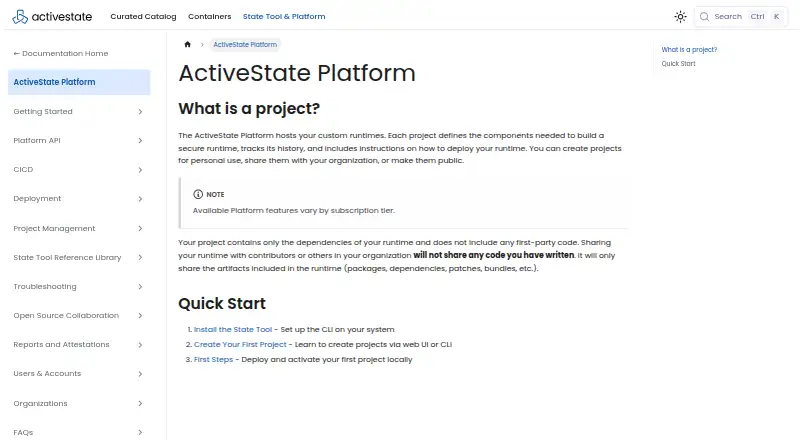
What ActiveState Platform is
ActiveState Platform hosts custom runtimes assembled from source. A project defines the runtime components, records project history, and provides deployment instructions; its artifacts can include packages, dependencies, patches, and bundles, but not contributors’ first-party code. Projects can be personal, shared with an organization, or public. Users create and manage projects through the web interface or State Tool CLI, which is available for Windows, Linux, and macOS, then deploy and activate them locally. Runtimes can be configured by language and package source versions through a browser. The platform supports deployment on Windows 10/11 and Windows Server, macOS 10.15 or later on Intel and Apple Silicon, and Linux distributions with compatible glibc. Its GraphQL API supports programmatic builds across operating systems and languages without users managing build infrastructure. ActiveState describes its build service as using reproducible builds, checksum verification, and isolated build containers. It also provides immutable SBOMs in SPDX formats. The free organization plan is free and limited to public projects; paid organization pricing is not listed.
Good
- Runtime builds are built from source.
- Projects can be personal, shared, or public.
- State Tool CLI supports Windows, Linux, and macOS.
- Provides immutable SBOMs in SPDX formats.
- Free organization plan is available for public projects.
Watch out
- Free organization plan allows public projects only.
- Paid subscription features vary by tier.
- Docker deployment with State Tool is limited to Linux containers.
- Paid organization pricing is not listed.
Who it suits
The platform suits organizations that need to build and manage custom runtimes across languages and operating systems. It also supports grouping projects by company, department, or team and managing member access by role.
Verdict
ActiveState Platform centers on source-built runtimes, project controls, and deployment across supported operating systems. The free organization tier is restricted to public projects, while paid tier details require contacting sales.
Plans and prices
From ActiveState Platform's own pricing page, checked 30 Sep 2026.
| Plan | Price | What it gives you |
|---|---|---|
| Free organization | Free | Public projects only |
| Paid organization | Priced on request | Supports private and public projects · Features vary by subscription tier · Contact sales for Platform Enterprise or Business Tier pricing |
The facts
Each one read from ActiveState Platform's own pages, with the date it was checked.
What it does
- API
- The Platform API uses GraphQL to programmatically build open source software for different operating systems and languages without managing build infrastructure.checked 30 Sep 2026
- Build security
- The maker describes the Platform build service as designed around reproducible builds, checksum verification, and isolated containers for build steps.checked 30 Sep 2026
- CLI
- The State Tool command line interface can be installed on Windows, Linux, and macOS.checked 30 Sep 2026
- Compliance
- ActiveState says it achieved SOC 2 Type 2 certification and provides access to its audit report and third-party penetration testing results through its Trust Center, with some materials available on request.checked 30 Sep 2026
- IDE compatibility
- The maker says any IDE that supports standard package managers can resolve packages from its Curated Catalog, including VS Code, PyCharm, IntelliJ IDEA, Eclipse, Visual Studio, and Cursor.checked 30 Sep 2026
- IDE integrations
- The documentation describes integrations for Visual Studio Code, PyCharm, and Jupyter Notebook or JupyterLab; the Jupyter integration is currently for Python projects only.checked 30 Sep 2026
- Integrations
- The maker lists JFrog Artifactory, Sonatype Nexus, Kubernetes, Cloudera, CI/CD pipelines, IDEs, Trivy, and Wiz as integrations.checked 30 Sep 2026
- Notable limit
- Docker deployment with the State Tool is currently available only for Linux containers.checked 30 Sep 2026
- Pricing scope
- The published annual per-language Curated Catalog tiers are $25,000 for fewer than 100 employees, $50,000 for 100–999 employees, and $150,000 for 1,000 or more employees; the maker says these prices do not apply to legacy Platform subscriptions.checked 30 Sep 2026
- Project management
- Users can create projects through the web UI or CLI and deploy and activate projects locally.checked 30 Sep 2026
- Project sharing
- Projects can be personal, shared with an organization, or public, and sharing a project does not share first-party code written by its contributors.checked 30 Sep 2026
- Project visibility
- Projects can be created for personal use, shared with an organization, or made public.checked 30 Sep 2026
- Purpose
- The Platform hosts custom runtimes whose projects define runtime components, track project history, and provide deployment instructions.checked 30 Sep 2026
- Reports
- The Platform provides immutable SBOMs in SPDX JSON and tag-value formats, conforming to SPDX 2.2.checked 30 Sep 2026
- Runtime building
- Runtimes on the Platform are built from source, with users selecting language and package source versions through the browser.checked 30 Sep 2026
- Runtime builds
- Runtimes created on the Platform are built from source.checked 30 Sep 2026
- Runtime contents
- A project contains runtime artifacts such as packages, dependencies, patches, and bundles, but does not include first-party code.checked 30 Sep 2026
- Security
- The deployment documentation says packages are built and tested by ActiveState and downloads are cryptographically verified.checked 30 Sep 2026
- Support
- The State Tool troubleshooting documentation directs users with errors to [email protected].checked 30 Sep 2026
- Supported systems
- Projects support deployment on Windows 10/11 and Windows Server, macOS 10.15 or later on Intel and Apple Silicon, and Linux distributions with compatible glibc.checked 30 Sep 2026
- Support limits
- Platform features vary by subscription tier, and legacy Platform Enterprise or Business Tier subscription pricing is available by contacting an account representative or sales team.checked 30 Sep 2026
The company
- Company history
- ActiveState says it has secured open source since 1997.checked 30 Sep 2026
- Founded
- 1997checked 28 Sep 2026
- Headquarters
- Vancouver, BC, Canadachecked 28 Sep 2026
The full review of ActiveState Platform
Overview
ActiveState Platform is a service for assembling and managing custom language runtimes. Each project describes the runtime components, records project history, and supplies deployment instructions. Its artifacts can include packages, dependencies, patches, and bundles; it does not contain contributors’ first-party application code. Projects may be personal, shared within an organization, or public, and sharing a project does not expose that first-party code.
Runtimes are built from source. Users choose language and package source versions in a browser, or create projects through the web interface or the State Tool command-line interface. Projects can then be deployed and activated locally. ActiveState says it has worked on securing open source since 1997 and is headquartered in Vancouver, BC, Canada.
Key features
- Builds and verification: ActiveState describes its build service as using reproducible builds, checksum verification, and isolated containers for build steps. Deployment documentation says packages are built and tested by ActiveState and downloads are cryptographically verified.
- Project and team controls: Organizations can group projects for a company, department, or team, manage member access, and set runtime permissions by user role.
- Interfaces and integrations: The State Tool CLI is available for Windows, Linux, and macOS. Listed integrations include JFrog Artifactory, Sonatype Nexus, Kubernetes, Cloudera, CI/CD pipelines, IDEs, Trivy, and Wiz. IDEs supporting standard package managers can resolve packages from the Curated Catalog; named examples include VS Code, PyCharm, IntelliJ IDEA, Eclipse, Visual Studio, and Cursor. The documentation also describes integrations for Visual Studio Code, PyCharm, and Jupyter Notebook or JupyterLab, with Jupyter support currently limited to Python projects.
- API and reporting: A GraphQL API supports programmatic builds of open source software for different operating systems and languages without requiring users to manage build infrastructure. The Platform provides immutable SBOMs in SPDX JSON and tag-value formats, conforming to SPDX 2.2.
- Security and compliance: ActiveState reports SOC 2 Type 2 certification and offers its audit report and third-party penetration testing results through its Trust Center; some materials are available on request. Vulnerability alerts and license compliance are listed capabilities.
Pricing
The pricing model is freemium, with a free plan, pricing on request, and a 14-day trial. The Free organization plan costs nothing and is limited to public projects. A paid organization supports private and public projects, but features vary by subscription tier. The listed annual per-language Curated Catalog prices are $25,000 for fewer than 100 employees, $50,000 for 100–999 employees, and $150,000 for 1,000 or more employees. These prices do not apply to legacy Platform subscriptions. Contact sales or an account representative for Platform Enterprise or Business Tier pricing.
Platforms
The Platform is listed for API, Linux, macOS, web, and Windows. Projects support deployment on Windows 10/11 and Windows Server; macOS 10.15 or later on Intel and Apple Silicon; and Linux distributions with compatible glibc. Docker deployment with the State Tool is currently limited to Linux containers. Self-hosted deployment is not listed as available.
Who it's for
ActiveState Platform is intended for organizations that need to define, manage, and deploy language runtimes with team-level project access controls. Its multi-language and container coverage, source-based runtime builds, and package security reporting may suit teams managing software supply-chain requirements alongside development environments. The CLI, API, and IDE compatibility can support workflows that use local activation, automation, or standard package managers. The Platform is not a complete application-code repository: runtime projects describe their dependencies and related artifacts, not first-party code.
Pros and cons
- Pros: Source builds, cryptographic download verification, immutable SPDX SBOMs, vulnerability alerts, license compliance, and role-based project permissions are documented capabilities. Projects can be created in either the browser or CLI.
- Cons: The free organization plan only allows public projects. Paid features vary by subscription tier, and legacy subscription prices require contacting sales. Docker deployment through the State Tool is limited to Linux containers, and Jupyter integration is currently for Python projects only.
Alternatives
For adjacent tools, consider Sonatype Nexus Repository, Snyk Open Source, DepsHub, Endor Labs, Socket, Depfu, FOSSA, and Updatecli. Readers comparing categories can also browse Dependency Management Software, Development Environment Management Tools, Python Package Managers, Development Environment Managers, and Software Supply Chain Security Software.
Verdict
ActiveState Platform brings runtime definition, source builds, deployment guidance, access management, and supply-chain reporting into a single service. Its distinctions include projects that exclude first-party code, a choice of browser, CLI, and API workflows, and published build and package verification practices. The free tier is confined to public projects, while private-project access and the scope of paid features depend on subscription tier. Teams weighing it should match their operating systems, container needs, IDE workflow, and pricing requirements to those limits before choosing a plan.
Getting started
- Open the ActiveState Platform website.
- Create a project in the web UI or with the State Tool CLI.
- Choose a language and package source versions through the browser.
- Select personal, organization-shared, or public project visibility.
- Deploy and activate the project locally on a supported system.
Limits worth knowing
The free organization plan is limited to public projects. Paid organization features vary by tier; annual per-language Curated Catalog tiers are $25,000 for fewer than 100 employees, $50,000 for 100–999 employees, and $150,000 for 1,000 or more employees. Those published prices do not apply to legacy Platform subscriptions; legacy Enterprise or Business Tier pricing is available by contacting sales.
Questions
Is there a free plan?
Yes. The Free organization plan costs nothing and allows public projects only.
Is there a free trial?
Yes, the pricing note lists a 14-day trial.
Which platforms are supported?
The Platform supports deployment on Windows 10/11 and Windows Server, macOS 10.15 or later on Intel and Apple Silicon, and Linux distributions with compatible glibc. The State Tool is available for Windows, Linux, and macOS.
What does a project contain?
A project defines runtime components, tracks project history, and provides deployment instructions. Its artifacts can include packages, dependencies, patches, and bundles, but not contributors’ first-party code.
What does the paid plan cost?
Published annual per-language Curated Catalog tiers cost $25,000 for fewer than 100 employees, $50,000 for 100–999 employees, and $150,000 for 1,000 or more employees. These prices do not apply to legacy Platform subscriptions, whose Enterprise or Business Tier pricing is available through sales.
Does it integrate with development tools?
The maker lists JFrog Artifactory, Sonatype Nexus, Kubernetes, Cloudera, CI/CD pipelines, IDEs, Trivy, and Wiz as integrations. IDEs that support standard package managers can resolve packages from the Curated Catalog; documented IDE integrations include Visual Studio Code, PyCharm, and Jupyter Notebook or JupyterLab, with Jupyter support currently for Python projects.