
Updatecli
Updatecli automates file updates through YAML manifests.
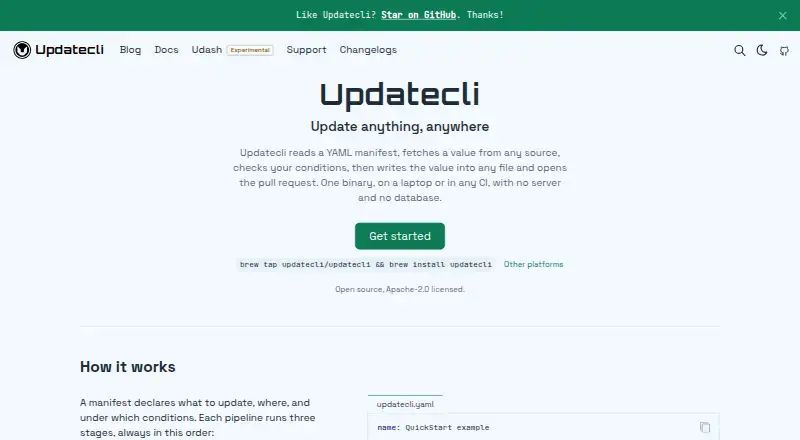
What Updatecli is
Updatecli automates file updates through YAML manifests. A pipeline retrieves values from sources, checks conditions, then updates targets; if a required condition is not met, the target is skipped. It can create pull or merge requests, while autodiscovery scans repositories and creates manifests for supported ecosystems such as Dockerfiles, Helm, Terraform, npm, and Go. Its plugins connect with tools and services including GitHub, GitLab, Gitea, Azure DevOps, Bitbucket, Jenkins, Docker, Maven, and HTTP APIs. The GitHub SCM plugin can clone a repository and push changes to a working branch, but opening a pull request requires a separate action. Updatecli is an Apache-2.0 open-source project with a free plan listed as free. It runs as a statically linked binary without a runtime dependency, server, or database, and supports Linux, macOS, Windows, containers, and self-hosting. Udash reporting is experimental, requires the --experimental flag, and may change without the usual deprecation cycle.
Good
- Free plan listed as free
- Runs without a server or database
- Autodiscovery covers several software ecosystems
- Manifests can be packaged as OCI artifacts
Watch out
- Udash reporting is experimental and may change
- Opening GitHub pull requests requires a separate action
Who it suits
It suits teams that want to automate repository updates from manifests and reuse policies across repositories. Its local or CI execution and integrations support a range of development workflows.
Verdict
Updatecli combines conditional, manifest-driven updates with broad ecosystem and source-control integrations. Teams considering Udash should account for its experimental status.
Plans and prices
From Updatecli's own pricing page, checked 4 Oct 2026.
| Plan | Price | What it gives you |
|---|---|---|
| Open source | Free | Apache-2.0 licensed · single binary · runs locally or in CI |
The facts
Each one read from Updatecli's own pages, with the date it was checked.
What it does
- Autodiscovery
- It can scan repositories and generate manifests for Helm charts, Dockerfiles, go.mod, GitHub Actions workflows, Terraform providers, and other ecosystems.checked 4 Oct 2026
- Credential handling
- The GitHub plugin recommends using environment variables or secret management tools instead of hardcoding tokens in manifests.checked 4 Oct 2026
- Execution
- Updatecli is a single statically linked binary with no runtime dependency, server, or database requirement.checked 4 Oct 2026
- Experimental feature
- Udash is described as an experimental dashboard for reports published by Updatecli pipelines.checked 4 Oct 2026
- Experimental feature limit
- Udash reporting is experimental and requires the --experimental flag; its API and interface may change without the usual deprecation cycle.checked 3 Oct 2026
- GitHub workflow
- The GitHub SCM plugin clones repositories and can push changes on a working branch; a separate GitHub pull-request action is needed to open a pull request.checked 3 Oct 2026
- How it runs
- It is a single statically linked binary with no runtime dependency, server, or database requirement.checked 3 Oct 2026
- Integrations
- Its plugin catalog includes integrations for GitHub, GitLab, Gitea, Bitbucket, Azure DevOps, Docker, Helm, Maven, npm, PyPI, Terraform, and more.checked 4 Oct 2026
- License
- The project describes Updatecli as open source and Apache-2.0 licensed.checked 3 Oct 2026
- Policies
- Manifests can be packaged as OCI artifacts and reused across repositories.checked 4 Oct 2026
- Purpose
- Updatecli uses YAML manifests to fetch values, check conditions, update files, and open pull or merge requests.checked 4 Oct 2026
- Security
- The project asks users to report vulnerabilities privately through a GitHub security advisory or email.checked 4 Oct 2026
- Support
- Community support is free, and commercial services include guaranteed response times, custom development or integration, migration assistance, training, and ongoing support contracts.checked 4 Oct 2026
- Supported systems
- Project releases provide builds for Linux, macOS, and Windows, as well as container images.checked 4 Oct 2026
- Telemetry
- OpenTelemetry distributed tracing is opt-in, disabled by default, and configured through standard environment variables.checked 3 Oct 2026
- Update checks
- Conditions can check whether requirements hold before targets are updated, and targets are skipped when a condition is not met.checked 3 Oct 2026
- What it does
- Updatecli reads YAML manifests, retrieves values, checks conditions, updates files, and can create pull or merge requests.checked 3 Oct 2026
- Workflow
- Each pipeline runs source, condition, and target stages in that order.checked 4 Oct 2026
The full review of Updatecli
Updatecli automates repository updates through YAML-defined pipelines, from fetching values to changing files and opening pull or merge requests. It suits teams that want to run update workflows locally or in CI and keep their rules reusable across repositories. Its open-source, single-binary approach is compelling for that job, though teams should treat Udash reporting as experimental.
Overview
Each pipeline runs source, condition, and target stages in order: it retrieves values, checks whether requirements hold, then updates files. A failed condition skips the target, giving teams a way to keep updates from proceeding when prerequisites are not met. Manifests can also be packaged as OCI artifacts and reused across repositories, which helps standardize update policy without tying it to one repository.
Updatecli is a single statically linked binary with no runtime dependency, server, or database requirement. That keeps deployment relatively lean: it can run locally or in CI, and supports self-hosting. It is open source under Apache-2.0.
Key features
Discovery and integrations
Autodiscovery scans repositories and generates manifests for supported ecosystems including Dockerfiles, Helm, Terraform, npm, and Go. That can reduce the initial work of defining update rules, while manually authored YAML provides control over the pipeline. Documented plugins span source, condition, target, SCM, and action stages, with integrations including GitHub, GitLab, Gitea, Azure DevOps, Bitbucket, Jenkins, Docker, Maven, and HTTP APIs.
The GitHub SCM plugin can clone repositories and push changes on a working branch, but it does not itself open a pull request; that requires a separate GitHub pull-request action. Teams should account for that distinction when assembling a workflow. GitHub credentials should be supplied through environment variables or secret-management tools rather than hardcoded in manifests.
Verification and reporting
Release checksums and container images can be verified with the project’s documented Cosign commands. OpenTelemetry distributed tracing is available but opt-in, disabled by default, and configured through standard environment variables. Udash, the dashboard for pipeline reports, is experimental, requires the --experimental flag, and may change without the usual deprecation cycle. It is best treated as a feature to evaluate cautiously, not a stable reporting dependency.
Pricing
The Open source plan costs free and includes Apache-2.0 licensing, a single binary, and local or CI execution. Updatecli is free, with community support also free. Commercial services offer guaranteed response times, custom development or integration work, migration assistance, training, and ongoing support contracts; those services use custom pricing.
The free plan is a strong fit for teams comfortable operating the tool themselves.
Platforms
Updatecli supports Linux, macOS, and Windows releases, and provides container images. It can run locally or in CI and supports self-hosted deployment. This makes it suitable for teams choosing their own execution environment rather than relying on a required hosted service.
Who it's for
Updatecli is a good fit for engineering teams that want conditional, manifest-driven updates across languages and container workflows, especially when they value reusable policies, self-hosting, and an open-source tool. It is less suited to teams seeking a stable built-in reporting dashboard or guaranteed support without a commercial services arrangement.
Pros and cons
- Pros: A free Apache-2.0 single binary runs locally or in CI without a server or database, keeping operational requirements modest.
- Pros: Conditions can block updates when requirements are unmet, and OCI-packaged manifests can carry shared policies across repositories.
- Pros: Autodiscovery and broad documented plugin coverage span multiple ecosystems and source-control tools.
- Cons: Opening a GitHub pull request requires a separate action beyond the SCM plugin’s branch-push capability.
- Cons: Udash is experimental, requires an explicit flag, and can change without a standard deprecation cycle.
- Cons: Community support is free, but guaranteed response times and implementation assistance belong to commercial services.
Alternatives
For a wider comparison, see Dependency Management Software.
- Renovate is worth comparing if you want a freemium alternative with cloud or self-hosted options and job scheduling or API access in its Community plan.
- DepsHub may suit teams looking for a freemium option whose Open Source plan includes unlimited public repositories, team members, and security alerts, plus basic integrations and chat support.
- ActiveState Platform is an alternative for teams considering a free organization plan limited to public projects, with a paid organization option at custom pricing.
- Depfu may fit public or personal-account repositories needing unlimited dependency updates on its free Open Source/Personal plan, or teams considering a paid Starter plan at $29 a month.
- Snyk Open Source is an alternative for teams seeking software composition analysis, with a free plan covering five projects.
- Kusari is another freemium option; its team co-created and actively maintains GUAC.
- Socket may suit teams looking for a freemium option with a paid Team plan at $25 a month per developer, a five-developer minimum, and 5,000 scans per month.
- FOSSA is an alternative with a free plan covering five projects, ten contributing developers, one release group, and five dependency levels for scans.
Verdict
Choose Updatecli if you want a free, self-hostable way to define conditional repository updates in reusable YAML pipelines, with broad ecosystem and source-control integrations. Look elsewhere if a stable reporting dashboard is central to your workflow or you need guaranteed support as part of the standard offering.
Alternatives to Updatecli
- 1

Renovate
Free planOpen sourceWebAPISelf-hosted7.8From $250 a year - 2

GitHub CodeQL
Free planWebExtensionLinuxmacOS7.5From $30 a month - 3

Endor Labs
Free planWebAPIExtensionLinux7.4Free plan - 4

Snyk Open Source
Free planWebAPILinuxmacOS7.3From $25 a month - 5

ActiveState Platform
Free planWebAPILinuxmacOS7.2Free plan - 6

Socket
Free planWebAPIExtensionLinux7.2From $25 a month