
Snyk Open Source
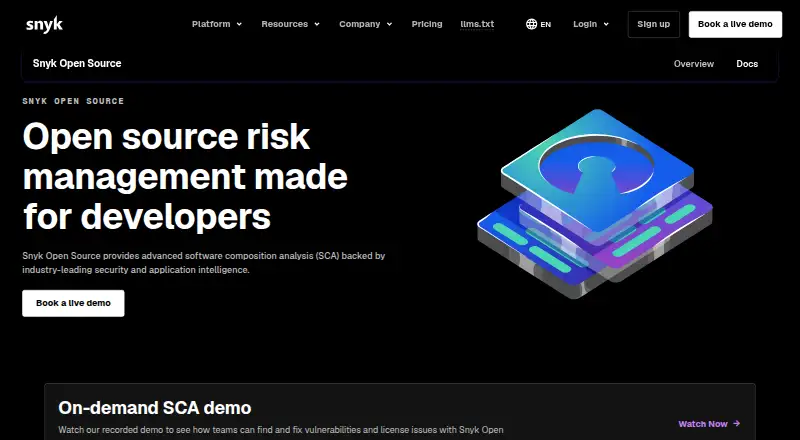
Snyk Open Source is a software composition analysis tool for finding and addressing security vulnerabilities and license issues in open source dependencies.
What Snyk Open Source is
Snyk Open Source is a software composition analysis tool for finding and addressing security vulnerabilities and license issues in open source dependencies. Developers can scan dependencies in IDEs and the CLI, check pull requests before merging, add security guardrails to CI/CD pipelines, and monitor projects for newly identified vulnerabilities. Its risk scoring considers reachability, exploit maturity, and EPSS/CVSS scores, with business and application context available to refine priorities. Snyk can create pull requests containing required upgrades and patches, with customizable templates for titles, descriptions, and commit messages. It also supports ongoing evaluation against regulatory and internal policies, reporting, and automated license-policy enforcement. Listed integrations include GitHub, Jira, Bitbucket Server, and IntelliJ. Supported languages and ecosystems span C/C++, JavaScript, Python, and many others, though Rust support is limited. The Free plan is $0.00 per month for 5 projects. Team is $25.00 per month, billed monthly, for up to 10 developers and 100 projects, with next business day support.
Good
- Scans dependencies in IDEs and the CLI.
- Can check pull requests before merging.
- Automated pull requests can include upgrades and patches.
- Continuous monitoring flags newly identified vulnerabilities.
- Free plan includes 5 projects.
Watch out
- Free plan is limited to 5 projects.
- Team plan supports up to 10 developers.
- Rust support is limited.
- Team plan costs $25.00 per month, billed monthly.
Who it suits
Snyk Open Source suits developers securing dependencies and teams that need license policy controls. Its policy reporting is also intended for security engineers and GRC teams.
Verdict
Snyk Open Source combines dependency risk analysis, remediation, and license controls across development workflows. Compare project and developer limits with the plan that fits your team.
Plans and prices
From Snyk Open Source's own pricing page, checked 30 Sep 2026.
| Plan | Price | What it gives you |
|---|---|---|
| Free | Free | 5 projects · access to Snyk Open Source (SCA) · billed monthly |
| Team | $25 a month | Up to 10 developers · 100 projects · Snyk Open Source (SCA) · Jira integration · next business day support · billed monthly |
| Enterprise | Priced on request | Credits apply across Snyk capabilities · Open Source priced at 1 credit per active contributor per day · Contact Sales for pricing |
The facts
Each one read from Snyk Open Source's own pages, with the date it was checked.
What it does
- Automated remediation
- Snyk can generate one-click pull requests with required upgrades and patches, and customizable PR templates let organizations set titles, descriptions, and commit messages.checked 30 Sep 2026
- Continuous monitoring
- Snyk Open Source automatically monitors projects for newly identified vulnerabilities.checked 30 Sep 2026
- Development coverage
- It scans dependencies in IDEs and the CLI, checks pull requests before merge, adds security guardrails to CI/CD pipelines, and monitors live environments.checked 30 Sep 2026
- Governance and reporting
- It supports continuous evaluation against regulatory and internal security policies using real-time and historical reporting.checked 30 Sep 2026
- Integrations
- Snyk lists integrations including GitHub, Jira, Bitbucket Server, and IntelliJ.checked 30 Sep 2026
- Intended users
- The product page describes Snyk Open Source as developer-first, while its policy reporting is packaged for security engineers and GRC teams.checked 30 Sep 2026
- License compliance
- License compliance includes automated policy enforcement, customizable policies, and visibility into open source license use across projects.checked 30 Sep 2026
- Purpose
- Snyk Open Source provides software composition analysis to help developers find, prioritize, and fix security vulnerabilities and license issues in open source dependencies.checked 30 Sep 2026
- Risk prioritization
- Its risk scoring evaluates factors including reachability, exploit maturity, and EPSS/CVSS scores, with business and application context available to refine prioritization.checked 30 Sep 2026
- Security and compliance
- Snyk says its controls are externally reviewed annually for ISO 27001 and ISO 27017, and its SOC 2 Type II controls are assessed annually.checked 30 Sep 2026
- Support
- The Team plan includes next business day support.checked 30 Sep 2026
- Supported languages
- Snyk Open Source supports C/C++, Dart and Flutter, Elixir, Go, Java and Kotlin, JavaScript, .NET, PHP, Python, Ruby, Scala, Swift and Objective-C, and TypeScript; Rust support is limited.checked 30 Sep 2026
The company
- Founded
- 2015checked 28 Sep 2026
- Headquarters
- Boston, Massachusetts, USAchecked 28 Sep 2026
Money
- Plan limits
- The Free plan allows 5 projects and the Team plan allows 100 projects; Team is listed for development teams of up to 10 developers.checked 30 Sep 2026
The full review of Snyk Open Source
Overview
Snyk Open Source is a software composition analysis tool for finding and addressing vulnerabilities and license issues in open-source dependencies. It is best suited to development teams that want dependency checks woven into coding, review, and CI/CD workflows, with security and GRC teams able to use its policy reporting. Its breadth is a strength, but the project and developer caps make plan choice important as teams grow.
Key features
Snyk checks dependencies in IDEs and the CLI, scans pull requests before merge, adds guardrails to CI/CD, and monitors projects for newly identified vulnerabilities. That reach can catch issues at several stages rather than relying on a single scan; automated fixes can generate pull requests with required upgrades or patches, and teams can customize their PR templates.
Prioritization considers reachability, exploit maturity, and EPSS/CVSS scores, with business and application context available to refine the result. This helps teams distinguish actionable risk from a raw vulnerability count. Policy evaluation and real-time and historical reporting serve ongoing governance, while customizable license policies provide a way to enforce compliance across projects.
Integrations include GitHub, Jira, Bitbucket Server, and IntelliJ. Supported ecosystems include C/C++, Dart and Flutter, Elixir, Go, Java and Kotlin, JavaScript, .NET, PHP, Python, Ruby, Scala, Swift and Objective-C, and TypeScript; Rust support is limited. Package ecosystems include npm, pnpm, Yarn, Maven, Gradle, Pip, Poetry, pipenv, and setup.py.
Pricing
The Free plan costs nothing, billed monthly, and includes Snyk Open Source (SCA) for up to 5 projects. It is a useful starting point for an individual or small evaluation, but the project cap will constrain broader adoption.
Team costs $25 a month, billed monthly, and covers up to 10 developers and 100 projects. It adds Jira integration and next business day support. For a development team within those limits, that is the clearest paid fit; teams needing more developers or projects should not assume this tier will stretch to cover them.
Enterprise has custom pricing, with credits applying across Snyk capabilities and Open Source priced at 1 credit per active contributor per day. That contributor-based model is worth weighing for organizations with changing contributor counts, alongside the custom quote.
Platforms
Snyk lists API, Linux, macOS, web, and Windows platforms. The deployment model is hybrid, with cloud deployment options. It supports registry and image scanning, SBOM generation, Kubernetes and Terraform analysis, and CloudFormation analysis, as well as custom policies and security rules. It does not provide runtime protection.
Who it's for
Snyk Open Source suits developer teams that want dependency analysis integrated into IDEs, pull requests, and CI/CD, especially when automated remediation and continuous monitoring matter. Its policy controls and reporting also make it relevant to security engineers and GRC teams. The Free plan is narrow at 5 projects; Team is more practical for teams of up to 10 developers with no more than 100 projects. Larger organizations can consider Enterprise, but should account for contributor-based credits.
Pros and cons
- Pros: Checks across IDE, CLI, pull requests, CI/CD, and monitored projects help teams address dependency risk throughout development.
- Pros: Reachability-aware prioritization and one-click remediation pull requests can help focus work and shorten the path to an upgrade or patch.
- Pros: Customizable license policies and real-time and historical reporting support ongoing governance.
- Cons: Free is capped at 5 projects, and Team at 100 projects and 10 developers, so growing teams may need to move to custom-priced Enterprise.
- Cons: Rust support is limited, and runtime protection is not included.
Alternatives
For container-focused workflows, compare Docker Desktop, which offers a free Personal tier with one Docker Scout-enabled repo and 100 Docker Hub pulls per hour, plus a private Docker Hub repo. Choose Kubescape instead if you want a free, Apache 2.0 CLI and Kubernetes operator that can be self-hosted. Deepfence ThreatMapper is a free option with no limits or hidden features.
RapidFort may suit teams seeking a free container-image offering: its free tier provides five curated near-zero-CVE images from a limited catalog, with daily rebuilds and patching. Sysdig Secure is a paid alternative whose licensing is based on host count, or compute instances for CSPM.
For other security and dependency tools, compare Grype, Trivy, and Dockle, each offered as a free tool. Explore Container Security Software, SAST Tools, Infrastructure as Code Security Software, Container Image Scanning Tools, Static Analysis Tools, and Dependency Management Software for category comparisons.
Verdict
Choose Snyk Open Source if your team wants dependency risk analysis, prioritized findings, remediation pull requests, and license governance integrated into development workflows. Its main advantage is that connected coverage; its main drawback is that the free and Team project limits can make growth a pricing decision, while runtime protection is outside its scope.
Getting started
- Open the Snyk Open Source product website.
- Choose the Free plan or review the Team plan at $25 a month, billed monthly.
- Use the product through its listed web, Linux, macOS, Windows, or API platforms.
- Connect development workflows using listed integrations such as GitHub, Jira, Bitbucket Server, or IntelliJ.
Limits worth knowing
The Free plan allows 5 projects. Team allows 100 projects and is listed for development teams of up to 10 developers.
Questions
Is there a free plan?
Yes. Free costs nothing and allows 5 projects.
What does Team cost?
Team costs $25 a month, billed monthly. It covers up to 10 developers and 100 projects and includes Jira integration and next business day support.
What platforms does Snyk Open Source support?
Its listed platforms are API, Linux, macOS, web, and Windows.
Which integrations are listed?
Listed integrations include GitHub, Jira, Bitbucket Server, and IntelliJ.
Which languages are supported?
Supported languages include C/C++, Dart and Flutter, Elixir, Go, Java and Kotlin, JavaScript, .NET, PHP, Python, Ruby, Scala, Swift and Objective-C, and TypeScript. Rust support is limited.
How is Enterprise priced?
Enterprise pricing is by contacting sales. Open Source is priced at 1 credit per active contributor per day, with credits applying across Snyk capabilities.
Alternatives to Snyk Open Source
- 1
DeepFilterNet
Free planOpen sourceAPILinuxmacOSSelf-hosted7.6Free plan - 2
Endor Labs
Free planWebAPIExtensionLinux7.4Free plan - 3
Grype
Free planOpen sourceLinuxmacOSSelf-hostedWindows7.4Free plan - 4
Scantist
Free planWebAPISelf-hosted7.3$200 one-time - 5
Socket
Free planWebAPIExtensionLinux7.2From $25 a month - 6
DepWarden
Free planWebAPILinuxmacOS7.1From $19 a month