
DepsHub
DepsHub automates dependency updates, license checks, and vulnerability scanning for software projects.
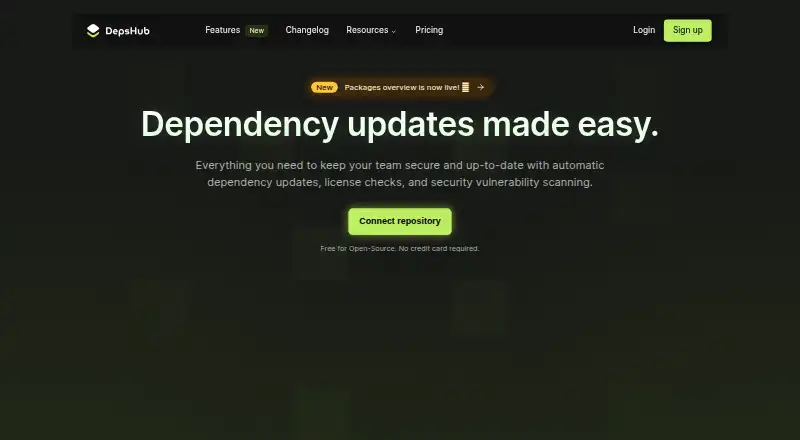
What DepsHub is
DepsHub automates dependency updates, license checks, and vulnerability scanning for software projects. Its Autopilot checks for newer versions and creates pull requests, and the feature page says AI updates can handle major updates automatically. Smart scheduling aims to keep dependencies current while reducing unnecessary updates. Autopilot supports monorepos and multi-language projects. DepsHub monitors dependencies for license changes, provides license details, and can export an SBOM in CycloneDX format. It scans for known vulnerabilities and says it integrates with popular security advisories. Listed integrations include GitHub, GitLab, Bitbucket, Linear, Jira, and Zapier. The pricing FAQ lists JavaScript, Python, Go, Rust, Java, and PHP as currently supported languages. The Open Source plan is free for open-source repositories; the homepage also describes free access for personal projects. Professional costs $19 a month per code contributor and includes unlimited public and private repositories, team members, security alerts, and integrations. DepsHub lists Linux, macOS, Windows, web, and self-hosted deployment.
Good
- Autopilot creates pull requests for dependency updates.
- Supports monorepos and multi-language projects.
- Exports SBOMs in CycloneDX format.
- Professional includes unlimited public and private repositories.
Watch out
- Professional costs $19 a month per code contributor.
- Enterprise pricing is custom and not listed.
- Free Open Source plan is for open-source repositories.
Who it suits
DepsHub suits teams or personal projects that need dependency update automation alongside license and vulnerability checks. Its free Open Source plan is specifically for open-source repositories.
Verdict
DepsHub combines update pull requests with license and vulnerability checks, plus a free plan for open-source repositories. Professional pricing is per code contributor, so account for that when comparing plans.
Plans and prices
From DepsHub's own pricing page, checked 29 Sep 2026.
| Plan | Price | What it gives you |
|---|---|---|
| Open Source | Free | Unlimited public repositories · Unlimited team members · Unlimited security alerts · Basic integrations · Basic chat support |
| Professional | $19 a month | Per code contributor · Unlimited public and private repositories · Unlimited team members · Unlimited security alerts · Unlimited integrations · 24/7 chat support · $19/ per month |
| Enterprise | Priced on request | Contact for a custom plan · Custom plan |
The facts
Each one read from DepsHub's own pages, with the date it was checked.
What it does
- AI updates
- The feature page says AI updates can handle major updates automatically.checked 29 Sep 2026
- Automatic updates
- Autopilot checks for updates and creates pull requests when new versions are found.checked 29 Sep 2026
- Integrations
- The site lists GitHub, GitLab, Bitbucket, Linear, Jira, and Zapier integrations.checked 29 Sep 2026
- License checks
- DepsHub monitors dependencies for license changes, provides license details, and can export an SBOM in CycloneDX format.checked 29 Sep 2026
- Purpose
- DepsHub provides automatic dependency updates, license checks, and security vulnerability scanning.checked 29 Sep 2026
- Scheduling
- Smart scheduling keeps dependencies reasonably fresh while reducing unnecessary updates.checked 29 Sep 2026
- Security and privacy
- The privacy policy says DepsHub takes reasonable measures to protect personal information and does not sell, trade, or rent it to third parties.checked 29 Sep 2026
- Self-hosting
- The pricing page includes a self-hosted FAQ question but does not display an answer.checked 29 Sep 2026
- Support
- The pricing page lists basic chat support for Open Source and 24/7 chat support for Professional.checked 29 Sep 2026
- Supported languages
- The pricing FAQ lists JavaScript, Python, Go, Rust, Java, and PHP as currently supported languages.checked 29 Sep 2026
- Vulnerability scanning
- DepsHub scans dependencies for known vulnerabilities and says it integrates with popular security advisories.checked 29 Sep 2026
Money
- Free eligibility
- The Open Source plan is free for Open Source repositories, and the homepage also describes free access for personal projects.checked 29 Sep 2026
Where it runs
- Monorepos
- The autopilot feature supports monorepos and multi-language projects.checked 29 Sep 2026
The full review of DepsHub
DepsHub is a dependency-management service that combines update pull requests with license checks and vulnerability scanning. It suits maintainers and teams who want those recurring tasks in one repository workflow. Its appeal is broad automation and an open-source plan; professional use costs $19 a month per code contributor.
Overview
DepsHub brings dependency updates, licensing visibility, and known-vulnerability scanning together. Autopilot checks for newer versions and opens pull requests, keeping proposed changes reviewable instead of silently changing dependencies. That approach is useful for teams that want regular upkeep but still want control over what gets merged.
It supports monorepos and multi-language projects, with JavaScript, Python, Go, Rust, Java, and PHP named as supported languages. Container coverage is also included in its ecosystem coverage. Integrations span GitHub, GitLab, Bitbucket, Linear, Jira, and Zapier, giving teams several ways to connect repository and project workflows.
Key features
Updates with scheduling
Smart scheduling aims to keep dependencies reasonably current while reducing unnecessary update activity. AI updates can handle major updates automatically, which may reduce manual attention for larger version changes. The trade-off is that pull requests still need to fit a team's review and release process; automation does not remove that decision point.
License and security checks
DepsHub monitors dependencies for license changes, provides license details, and can export an SBOM in CycloneDX format. That makes it relevant to teams tracking both dependency changes and license compliance, rather than only version freshness. Vulnerability scanning covers known issues and integrates with popular security advisories, with security alerts unlimited on both published plans.
The privacy policy says DepsHub takes reasonable measures to protect personal information and does not sell, trade, or rent it to third parties. The pricing page also includes a self-hosted FAQ question, and self-hosted deployment is identified as supported.
Pricing
The Open Source plan costs nothing and is free for open-source repositories; personal projects are also described as eligible for free access. It includes unlimited public repositories, unlimited team members, unlimited security alerts, basic integrations, and basic chat support. This is a strong starting point for public projects, but private repositories and unlimited integrations are reserved for Professional.
Professional costs $19 a month, billed $19 per month, per code contributor. It adds unlimited public and private repositories and unlimited integrations while retaining unlimited team members and security alerts, plus 24/7 chat support. The contributor-based price matters: teams should account for the number of code contributors when comparing costs, even though team-member seats are unlimited.
Enterprise has custom pricing and requires contacting DepsHub for a custom plan. No feature bundle is given for that tier, so buyers should establish its terms directly before choosing it.
Platforms
DepsHub is available on Linux, macOS, web, and Windows. Its ecosystem coverage includes multiple languages and containers, making it applicable to varied development environments.
Who it's for
DepsHub is best suited to open-source maintainers and development teams that want dependency updates, license oversight, and vulnerability alerts in one service. The free plan is particularly fitting for public repositories; teams with private code or a need for unlimited integrations will need Professional. Buyers who require self-hosting should confirm the deployment arrangement and plan terms before committing.
Pros and cons
- Pros: Pull-request-based updates preserve review before changes are merged.
- Pros: License monitoring, CycloneDX SBOM export, and vulnerability scanning consolidate useful dependency checks.
- Pros: The open-source plan includes unlimited public repositories, team members, and security alerts at no charge.
- Cons: Professional pricing is per code contributor, so cost rises with contributor count.
- Cons: The free plan has basic integrations and is limited to public repositories.
- Cons: Enterprise terms are custom, requiring a sales conversation rather than a published fixed price.
Alternatives
Dependency Management Software is the broader category directory for comparing tools in this space.
- ActiveState Platform may suit readers seeking a free organization plan restricted to public projects, with a paid enterprise option priced through sales.
- Sonatype Nexus Repository is worth considering for readers who want a free Community Edition with full ecosystem support, CI/CD integration, and an external PostgreSQL option.
- Snyk Open Source may fit teams comparing project-limited free access with a paid Team plan at $25 a month.
- Endor Labs offers a free Developer plan for individual developers, including local scans via AURI MCP server without an account.
- Socket may appeal to teams comparing a Team plan priced at $25 a month per developer, with a five-developer minimum.
- Updatecli is a free, Apache-2.0-licensed option that runs locally or in CI as a single binary.
- Depfu offers free dependency updates for public and personal account repositories, with a Starter plan at $29 a month.
- FOSSA may be a fit for readers looking at a free plan capped at five projects and ten contributing developers.
Verdict
Choose DepsHub if you want dependency update pull requests alongside license checks, SBOM export, and vulnerability scanning, especially for open-source repositories that can use its free plan. Look elsewhere if the per-contributor Professional price does not fit your team or if you need clearer, fixed Enterprise terms before selecting a deployment.
Getting started
- Open the DepsHub website.
- Select the Open Source, Professional or Enterprise plan.
- Connect a listed code-hosting or workflow integration.
- Choose the web, Linux, macOS or Windows access route.
- Configure Autopilot scheduling for dependency update pull requests.
- Enable license checks, SBOM export or vulnerability scanning.
Limits worth knowing
The Open Source plan is free for open-source repositories and includes unlimited public repositories, team members and security alerts, but only basic integrations and basic chat support. Professional costs $19 a month per code contributor; Enterprise uses custom pricing.
Questions
Does DepsHub have a free plan?
Yes. Open Source is free for open-source repositories, with unlimited public repositories, team members and security alerts. The homepage also describes free access for personal projects.
How much is Professional?
Professional costs $19 a month, billed per code contributor, with unlimited public and private repositories, team members, security alerts and integrations.
Which programming languages are supported?
The pricing FAQ lists JavaScript, Python, Go, Rust, Java and PHP.
Which integrations does DepsHub list?
Integrations listed are GitHub, GitLab, Bitbucket, Linear, Jira and Zapier.
Can DepsHub export an SBOM?
Yes. License checks can export an SBOM in CycloneDX format.
What support comes with each plan?
Open Source includes basic chat support, while Professional includes 24/7 chat support.
Alternatives to DepsHub
- 1

Renovate
Free planOpen sourceWebAPISelf-hosted7.8From $250 a year - 2

GitHub CodeQL
Free planWebExtensionLinuxmacOS7.5From $30 a month - 3

Endor Labs
Free planWebAPIExtensionLinux7.4Free plan - 4

Snyk Open Source
Free planWebAPILinuxmacOS7.3From $25 a month - 5

ActiveState Platform
Free planWebAPILinuxmacOS7.2Free plan - 6

Socket
Free planWebAPIExtensionLinux7.2From $25 a month