
Whisper
Whisper is a free, open-source speech recognition model for multilingual transcription, translation, language identification, and voice activity detection.
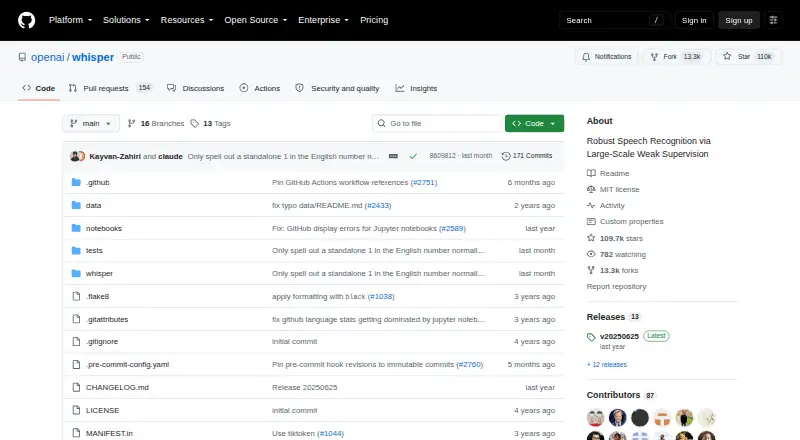
What Whisper is
Whisper is a free, open-source speech recognition model for multilingual transcription, translation, language identification, and voice activity detection. It can transcribe audio through documented command-line and Python interfaces, and can translate speech from multiple languages into English. The repository lists six model sizes—tiny, base, small, medium, large, and turbo—with different speed and memory tradeoffs; the stated VRAM requirements range from approximately 1 GB to 10 GB, depending on size. Whisper runs on Linux, macOS, Windows, and self-hosted deployments. Installation is documented through pip and requires the ffmpeg command-line tool; Rust may be needed if a prebuilt tiktoken wheel is unavailable. The code and model weights are released under the MIT License. OpenAI says the model was trained using 680,000 hours of multilingual, multitask supervised data collected from the web. Performance varies widely by language, and the model does not outperform models specialized for LibriSpeech. Turbo is not trained for translation; the repository recommends multilingual models for translating non-English speech into English.
Good
- Supports multilingual recognition and speech translation.
- Offers six model sizes with speed and memory tradeoffs.
- Command-line and Python transcription interfaces are documented.
- Code and model weights use the MIT License.
- Runs on Linux, macOS, Windows, and self-hosted deployments.
Watch out
- Requires ffmpeg for installation.
- Models require approximately 1 GB to 10 GB of VRAM.
- Performance varies widely by language.
- Turbo is not trained for translation.
Who it suits
Whisper may suit developers and researchers building speech-processing applications or exploring multilingual transcription and translation. It is also an option for people comfortable installing and running command-line or Python software locally.
Verdict
Whisper provides multilingual speech-processing capabilities with several model sizes and local deployment options. Consider the installation requirements, hardware range, and language-dependent performance when choosing a model.
Plans and prices
From Whisper's own pricing page, checked 21 Oct 2026.
| Plan | Price | What it gives you |
|---|---|---|
| Self-hosted Whisper | Free | Python 3.8–3.11 expected · ffmpeg required · approximately 1–10 GB VRAM depending on model · MIT-licensed code and model weights; local installation |
| Whisper (open-source code and model weights) | Free | MIT-licensed code and model weights · install locally with Python and ffmpeg |
| Whisper API | $0.01 a month | 25 MiB maximum upload for legacy whisper-1 · streaming unsupported · Free tier 3 RPM and 200 RPD · $0.006 per minute of transcription |
The facts
Each one read from Whisper's own pages, with the date it was checked.
What it does
- API endpoints
- The model documentation lists transcription and translation capabilities and OpenAI API endpoint families including audio transcription.checked 21 Oct 2026
- API input handling
- The Audio API requires an uploaded file in a supported audio format and does not accept links to audio files.checked 21 Oct 2026
- API model
- OpenAI exposes whisper-1 as a general-purpose transcription model with audio input and text output.checked 21 Oct 2026
- API rate limits
- The documented Free tier allows 3 requests per minute and 200 requests per day, while Build allows 2,500 requests per minute.checked 21 Oct 2026
- API streaming limitation
- OpenAI states that streaming is not supported with the whisper-1 model.checked 21 Oct 2026
- API upload limit
- For legacy whisper-1 transcription uploads, the maximum request size is 25 MiB.checked 21 Oct 2026
- Automatic language identification
- Language identification is a built-in task alongside transcription and translation.checked 21 Oct 2026
- Developer extensibility
- The repository points users to third-party web demos, integrations, platform ports and other extensions through GitHub Discussions.checked 21 Oct 2026
- Export formats
- txt,vtt,srt,tsv,json,jsonlchecked 20 Sep 2026
- Hallucination criticism
- TechCrunch reported October 26, 2024 concerns from researchers that Whisper can insert invented words or passages, including in medical contexts.checked 21 Oct 2026
- Hardware
- The listed models require approximately 1 GB to 10 GB of VRAM, depending on model size.checked 7 Oct 2026
- Hardware requirements
- Approximate required VRAM ranges from about 1 GB for tiny and base to about 10 GB for large.checked 21 Oct 2026
- Independent accuracy test
- A September 2026 FreeTTS test measured 11.9% word error for large-v3 with voice-activity filtering and previous-text conditioning disabled, versus 14.8% on defaults.checked 21 Oct 2026
- Independent forensic limitation
- A Frontiers study found Whisper best among tested systems on poor-quality forensic-like audio but with about 50% word error, making it unsuitable for forensic use.checked 21 Oct 2026
- Installation
- The official installation command is pip install -U openai-whisper, with a Git installation option also documented.checked 21 Oct 2026
- Installation requirements
- The repository documents installation through pip and requires the ffmpeg command-line tool; Rust may be needed if a prebuilt tiktoken wheel is unavailable.checked 7 Oct 2026
- Integrations and examples
- The repository links a Google Colab example and invites users to share third-party extensions and integrations in GitHub Discussions.checked 7 Oct 2026
- Intended users
- OpenAI describes the open-sourced models and inference code as a foundation for building applications and further research on robust speech processing.checked 7 Oct 2026
- Language support
- Whisper supports multilingual speech recognition and translation into English, with the repository tokenizer listing available languages.checked 21 Oct 2026
- Licence
- Whisper code and model weights are released under the MIT License.checked 21 Oct 2026
The company
- Company business
- Crunchbase describes OpenAI as developing artificial-intelligence models and deploying machine-learning software tools.checked 21 Oct 2026
- Company founding
- OpenAI was founded in December 2015.checked 21 Oct 2026
- Company headquarters and size
- LinkedIn lists OpenAI headquarters in San Francisco, California and company size of 1,001–5,000 employees.checked 21 Oct 2026
- Company legal name
- Crunchbase lists the legal name as OpenAI OpCo, LLC and also lists OpenAI LP and OpenAI Group PBC as alternate names.checked 21 Oct 2026
The full review of Whisper
Overview
Whisper is an open-source model for transcribing multilingual speech, translating speech into English, identifying languages, and detecting voice activity. It is best for developers and researchers who want local inference or a foundation for speech-processing applications. Its breadth and MIT license are strong advantages, but the model’s memory needs and uneven results across languages call for a deliberate choice.
Key features
Whisper supports transcription with timestamps, spoken-language identification, voice activity detection, and translation of speech from multiple languages into English. It exports TXT, VTT, SRT, TSV, JSON, and JSONL, making it useful for both subtitle workflows and applications that need structured transcript data.
OpenAI says the model was trained on 680,000 hours of multilingual, multitask supervised data collected from the web. That broad training base supports general-purpose use, but performance varies widely by language. Whisper also does not outperform models specialized for LibriSpeech, so it is not the automatic choice for every language or a focused speech benchmark.
Six model sizes—tiny, base, small, medium, large, and turbo—trade speed against memory, with roughly 1 GB to 10 GB of VRAM required depending on the model. Smaller options can suit tighter hardware budgets; larger ones require more capacity. Turbo is not trained for translation, so choose a multilingual model for translating non-English speech into English.
The repository provides command-line and Python interfaces for audio transcription. Installation uses pip and requires ffmpeg; Rust may also be needed if a prebuilt tiktoken wheel is unavailable. These are reasonable requirements for development environments, but less convenient for users seeking a ready-to-use desktop app. A Google Colab example offers one starting point, and GitHub Discussions invites users to share third-party extensions and integrations.
Pricing
Whisper (open-source code and model weights): free. The MIT-licensed code and weights can be installed locally with Python and ffmpeg. There is no paid plan to unlock the core model; the cost to consider is the hardware needed for the chosen model size and the work of setting up the environment. This suits developers and researchers who want control over deployment, not users looking for a managed service.
Platforms
Whisper supports Linux, macOS, and Windows, and can be self-hosted. Its command-line and Python interfaces make it a fit for users comfortable working with a local installation rather than a hosted, point-and-click workflow.
Who it's for
Whisper is a strong fit for developers building speech features and researchers exploring robust speech processing: the open-source code, model weights, local deployment, and multiple model sizes provide room to adapt an implementation. It can also suit users who need timestamped transcripts or subtitle exports. Those who need dependable results for a particular language, have limited VRAM, or want a finished consumer-facing transcription app should weigh other options.
Pros and cons
- Pros: MIT-licensed code and weights support local deployment and further development without a paid core plan.
- Pros: Transcription, English translation, language identification, and voice activity detection cover several speech tasks in one model family.
- Pros: Timestamp support and six export formats accommodate subtitle, transcript, and structured-data workflows.
- Cons: Model requirements span about 1 GB to 10 GB of VRAM, which can rule out larger choices on constrained machines.
- Cons: Performance varies widely by language, and specialized LibriSpeech models can outperform it on that benchmark.
- Cons: Installation requires ffmpeg and may require Rust, adding setup work compared with a ready-made app.
Alternatives
For a comparable local, open-source option with broader media tools, consider SmartSub: its free plan includes local transcription, translation, text-to-speech, and subtitle rendering with no local usage limits, plus optional paid cloud services. VideoCaptioner is another free, MIT-licensed option for Linux, macOS, Windows, and self-hosted use.
Choose Captions instead if you want an Android, iOS, web, or API service with AI video creation and editing features; its Max plan is $24.99 a month and includes 500 credits per month. CaptionRoom offers a free editor with manual captions, exports up to 1080p and .srt, and no watermark. For API or web localization features, SRTGen has a free tier with SRT, VTT, and TXT export and a five-minute screen-recording limit. Moonshot is a web option with a free allowance of five minutes to upload and preview, 15 AI credits, and no video export. Fluen AI Subtitle Generator provides a free allowance of up to three files, up to 90 minutes each, across API, extension, macOS, web, and Windows. GetCaptions offers a free Starter plan with 60 minutes of transcription per month and a five-minute-per-video limit.
Browse AI Video Caption Generators, LLM Evaluation Tools, Speech Recognition Software, Speech-to-Text Software, Transcription Software, and Text-to-Speech Software for more options by category.
Verdict
Choose Whisper if you are a developer or researcher who values open-source local speech processing, multiple tasks, and flexible model sizes. Its main advantage is a capable, MIT-licensed foundation with no core software charge; its main reasons to look elsewhere are language-dependent performance, VRAM demands, and installation work.
Alternatives to Whisper
- 1

Captions
Free planAndroidiOSWebAPI9.1From $4.99 a month - 2

SRTGen
Free planWebAPI8.3From $4 a month - 3
Fluen AI Subtitle Generator
Free planWebAPIExtensionmacOS8.2Free plan - 4
ZapCap
Free planAndroidiOSWebAPI8.1From $8 a month - 5
ngram
Free planWebAPIExtension8.1From $29 a month - 6
Wavel AI
Free planWebAPILinuxmacOS8.1From $16 a month