Walrus
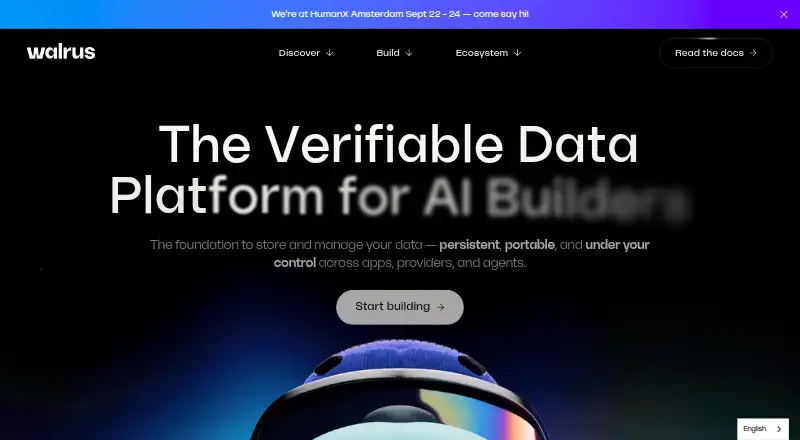
Walrus is a verifiable data platform for storing and managing information across apps, providers, and agents.
What Walrus is
Walrus is a verifiable data platform for storing and managing information across apps, providers, and agents. Its decentralized storage protocol is coordinated onchain through Sui. Storage costs $0.023/GB/month, paid in WAL, with SUI used for transaction gas; data expires when its paid storage period ends. Walrus Memory is designed to give AI agents persistent, portable memory across apps and sessions. It supports semantic remember and recall, automatic fact extraction, and AI-generated answers grounded in stored memories. Listed agent support includes native MCP, first-party plugins for OpenClaw and NemoClaw, and compatibility with major LLMs. Developers can use TypeScript and Python SDKs, along with a relayer, smart contract, indexer, and dashboard. Memory encryption and Sui smart contracts govern retrieval, ownership, and programmable access, including scoped delegation. Separately, Walrus Console is in a closed, invite-only Mainnet beta: each space allows up to 5 GB and five folders, and uploads are capped at 100 MiB. Walrus Memory has a launch-period plan at no cost, with usage limits that may change.
Good
- Memory supports semantic recall and automatic fact extraction
- Lists native MCP and plugins for OpenClaw and NemoClaw
- Provides TypeScript and Python SDKs
- Client-side encryption is listed
Watch out
- Console access is closed and invite-only
- Console uploads are capped at 100 MiB
- Console spaces allow up to 5 GB and five folders
- Stored data expires when paid duration ends
Who it suits
Walrus Memory may suit developers and AI-agent builders seeking persistent memory across applications and sessions. The Console is currently limited to invite-only beta access, while storage costs and expires according to its paid duration.
Verdict
Walrus combines decentralized storage with an agent-memory offering and developer tools. Note that the Console has strict beta limits and the free launch-period Memory plan has usage limits that may change.
Plans and prices
From Walrus's own pricing page, checked 4 Oct 2026.
| Plan | Price | What it gives you |
|---|---|---|
| Walrus Memory (launch period) | Free | Usage limits apply; pricing may evolve over time |
The facts
Each one read from Walrus's own pages, with the date it was checked.
What it does
- Agent integrations
- Walrus Memory lists native MCP support, first-party plugins for OpenClaw and NemoClaw, and compatibility with major LLMs.checked 4 Oct 2026
- Console availability and limits
- Walrus Console is in a closed, invite-only Mainnet beta; each space holds up to 5 GB and five folders, with uploads capped at 100 MiB.checked 4 Oct 2026
- Developer support
- Walrus Memory provides TypeScript and Python SDKs, a relayer, smart contract, indexer, and dashboard.checked 4 Oct 2026
- Encryption
- Console encrypts files client-side with Seal before upload, stores ciphertext, and does not see plaintext or decryption keys.checked 4 Oct 2026
- Failure tolerance
- Walrus states that its decentralized storage design can remain resilient even if two thirds of nodes fail.checked 4 Oct 2026
- Memory access control
- Sui smart contracts enforce ownership and programmable access rules, and owners can grant scoped delegate access to agents, users, or services.checked 4 Oct 2026
- Memory encryption
- Walrus Memory encrypts memories before storage and decrypts them only when an authorized signed request retrieves them.checked 4 Oct 2026
- Memory operations
- Walrus Memory supports semantic remember and recall, automatic fact extraction, and AI-generated answers grounded in stored memories.checked 4 Oct 2026
- Memory purpose
- Walrus Memory gives AI agents persistent, portable memory across apps and sessions.checked 4 Oct 2026
- Storage expiry
- Walrus storage is time-bound and data expires when its paid storage duration runs out.checked 4 Oct 2026
- Storage pricing
- Storage is priced at $0.023/GB/month and paid in WAL, with SUI used for transaction gas.checked 4 Oct 2026
- Underlying network
- Walrus is a decentralized storage protocol coordinated onchain through Sui.checked 4 Oct 2026
- What it is
- Walrus is a verifiable data platform for storing and managing data across apps, providers, and agents.checked 4 Oct 2026
The company
- Founded
- 2024checked 28 Sep 2026
- Maker
- Walrus was created by Mysten Labs, the team behind Sui.checked 4 Oct 2026
Money
- Small-file cost limit
- Each blob carries fixed metadata overhead, and the docs recommend using Walrus Quilt to batch small files and reduce that overhead.checked 4 Oct 2026
The full review of Walrus
Walrus is a verifiable, distributed data platform that combines decentralized storage with persistent memory for AI agents and a developer stack. It is most compelling for developers building apps or agents that need programmable ownership and portable data rather than a conventional file host. The main decision is whether its time-limited storage, token-based payments, and still-restricted Console fit your operational model.
Overview
Created by Mysten Labs, the team behind Sui, Walrus coordinates storage onchain through the Sui network. Storage costs $0.023/GB/month, paid in WAL, while SUI covers transaction gas. A paid duration is part of every storage decision: when that term ends, the data expires. That ongoing-renewal requirement rules it out for archives that must remain available indefinitely without maintenance.
Walrus also includes Walrus Memory, designed to give AI agents persistent, portable context across applications and sessions. The combination makes Walrus more than a storage endpoint, but it also means teams should evaluate both infrastructure and agent-access requirements before committing.
Compare decentralized storage services when you want to weigh this model against other decentralized approaches.
Key features
Distributed storage with explicit trade-offs
Walrus describes a design that can remain resilient even if two thirds of its nodes fail. That is a meaningful durability characteristic for applications that prefer distribution over dependence on one provider. It does not provide permanence, however: retention follows the paid storage window. Every blob also carries fixed metadata overhead, so large numbers of tiny files cost less efficiently than consolidated objects. Walrus recommends Walrus Quilt to batch small files and reduce that overhead.
Encrypted Console storage
Console encrypts files on the client with Seal before upload. It stores ciphertext and does not see plaintext or decryption keys, which is the right architecture for users who want the storage service separated from file contents. Console is still a closed, invite-only Mainnet beta. Each space is limited to 5 GB and five folders, and individual uploads cannot exceed 100 MiB, making it unsuitable for unrestricted team drives or large media workflows.
Memory for agents
Walrus Memory supports semantic remember and recall, automatic extraction of facts, and AI-generated answers grounded in saved memories. Native MCP support, first-party plugins for OpenClaw and NemoClaw, and compatibility with major LLMs give agent builders several integration paths. Memories are encrypted before storage and decrypted only after an authorized signed request retrieves them.
Sui smart contracts enforce ownership and programmable access rules. Owners can grant narrowly scoped delegate access to agents, users, or services, which is more precise than handing an application broad account credentials. Developers get TypeScript and Python SDKs plus a relayer, smart contract, indexer, and dashboard. The result is a substantial integration surface, although it is aimed at teams comfortable assembling decentralized components rather than buyers seeking a turnkey consumer service.
Pricing
Storage
Storage is $0.023/GB/month in WAL, with SUI required for transaction gas. Because storage expires after its paid duration, budgeting must include renewals when data needs to persist. The fixed per-blob metadata overhead further favors batching small objects.
Walrus Memory (launch period)
The launch-period Memory plan costs nothing. Usage limits apply, and pricing may evolve over time. It is a sensible way to evaluate agent-memory workflows, but teams should not treat the current free access as a permanent production price or assume unlimited usage.
Platforms
Walrus supports api, linux, macos, web, and windows. Its SDKs and supporting services make the API the natural center of a developer deployment, while the web Console provides a graphical route where beta access and limits permit.
Who it's for
Choose Walrus if you are building applications or AI agents that need decentralized storage, cryptographic ownership, portable memory, and scoped delegation. It is particularly suited to developers who can manage WAL and SUI and who value client-side or application-managed encryption.
Look elsewhere if you need permanent retention without renewals, a generally available file console, spaces larger than 5 GB, uploads above 100 MiB, or predictable long-term pricing for Memory. The current Console restrictions also make it a poor primary workspace for broad, everyday file collaboration.
Pros and cons
Pros
- Programmable ownership: Sui contracts support scoped delegation to agents, users, and services.
- Strong privacy model: Console encrypts before upload, and Memory decrypts only after an authorized signed request.
- Useful agent tooling: Semantic recall, fact extraction, grounded answers, MCP, plugins, SDKs, and indexing components cover a broad developer workflow.
- Distributed resilience: Walrus says the network can withstand failure of two thirds of its nodes.
Cons
- Not permanent storage: Data expires when the paid term ends.
- Token complexity: Storage uses WAL and transactions use SUI, adding operational overhead.
- Restricted Console: Invite-only beta, 5 GB spaces, five folders, and 100 MiB uploads limit practical file use.
- Small-file inefficiency: Fixed blob metadata overhead makes batching necessary for many tiny objects.
- Uncertain free Memory terms: Usage limits apply and pricing may change.
Alternatives
- Sia is a better fit when you want an open-source project with Android, iOS, desktop, web, API, and self-hosted options.
- Peergos suits buyers prioritizing a fully open-source stack, including its server and reproducible builds, with self-hosting available.
- Carbide Network is worth considering for its provider and personal-storage plans across mobile and desktop platforms.
- Aleph Cloud (formerly Aleph.im) offers paid decentralized infrastructure with a free static-website tier.
- Stratos is an alternative freemium decentralized-storage option with broad platform coverage.
- Arweave is an alternative decentralized storage service with broad client and self-hosted platform support.
- Datum Storage is preferable when a one-terabyte first-year free allowance and straightforward monthly expansion are more useful.
- Filebase is a better match for S3-style, web/API access with a defined 5 GB free tier and paid Pro plan.
Verdict
Walrus is a strong choice for developers and agent builders who want decentralized, encrypted data with contract-enforced ownership and portable AI memory. Choose it for programmable access and an integrated storage-and-memory architecture. Look elsewhere when permanent retention, unrestricted file-console capacity, or stable, conventional pricing matters more than those capabilities.
Alternatives to Walrus
- 1

Sia
Free planOpen sourceAndroidiOSWebAPI8.4From $7.99 a month - 2

Aleph Cloud (formerly Aleph.im)
Free planOpen sourceWebAPILinuxmacOS8.1$0.01 usage-based - 3
Datum Storage
Free planAndroidiOSWebAPI7.9From $3.99 a month - 4
Carbide Network
Free planAndroidiOSAPImacOS7.6$0.01 usage-based - 5

Peergos
Free planAndroidWebLinuxmacOS6.9Free plan - 6

Storj
WebAPILinuxmacOS6.8From $29 a month