
Sia
Sia offers encrypted, decentralized cloud storage through a consumer app and tools for developers building storage into apps.
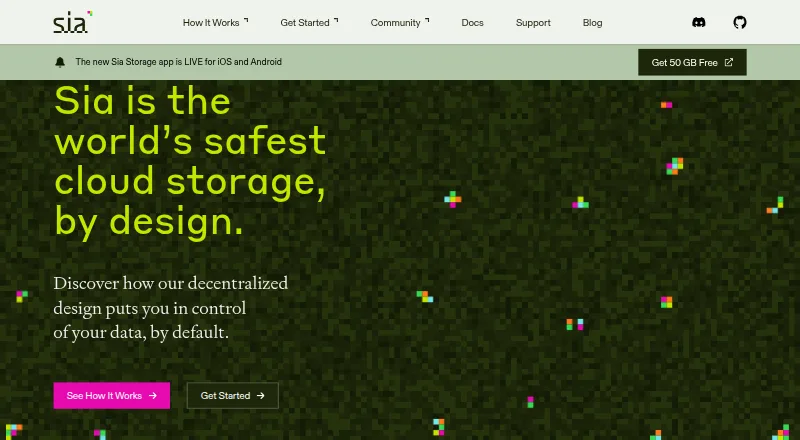
What Sia is
Sia offers encrypted, decentralized cloud storage through a consumer app and tools for developers building storage into apps. Files are encrypted on the user’s device before upload. Sia says files are stored redundantly across independent hosts around the world and can be downloaded in parallel from multiple hosts. Its peer-to-peer network has no central access point or single point of failure. The Free plan includes 50 GB of storage; Plus lists 500 GB for $7.99 a month, Pro lists 5 TB for $14.99 a month, and Unlimited lists 10 TB for $19.99 a month, with 4.99 USD/TB-mo over the included Unlimited capacity. Separately, the network lists median rates of $3.53/TB/month for storage at 3X redundancy, $0.03/TB for upload, and $2.25/TB for download. Developers can use storage SDKs for Rust, Go, Python, and JavaScript. The S3-compatible s3d gateway works with rclone, Cyberduck, Nextcloud, Duplicati, and other S3 clients. The SDK can connect to an indexer hosted by the user. Sia is described as an open-source project supported by the nonprofit Sia Foundation and community donations.
Good
- Files are encrypted on the user's device before upload.
- Free plan includes 50 GB of storage.
- Data is redundantly stored across independent hosts.
- SDKs are listed for four programming languages.
- S3-compatible gateway works with several named tools.
Watch out
- Unlimited plan lists 4.99 USD/TB-mo over included capacity.
- Network storage, upload, and download rates are listed separately from consumer plans.
Who it suits
Sia suits people looking for cloud storage and developers building applications on Sia. Its SDK and self-hosted indexer option may suit developers who want to manage their own connection to the network.
Verdict
Sia combines consumer storage with developer tools on a peer-to-peer network. Compare the consumer plan capacities with separately listed network rates to understand which pricing applies to your use.
Plans and prices
From Sia's own pricing page, checked 15 Oct 2026.
| Plan | Price | What it gives you |
|---|---|---|
| Free | Free | 50 GB · 3 apps · 500 Mbps |
| Plus | $7.99 a month | 500 GB · 3 apps · 500 Mbps · $7.99/mo |
| Pro | $14.99 a month | 5 TB · 5 apps · 1 Gbps · $14.99/mo |
| Unlimited | $19.99 a month | 10 TB + $4.99/TB-mo over · 100 apps · 5 Gbps · $19.99/mo |
The facts
Each one read from Sia's own pages, with the date it was checked.
What it does
- Availability
- The app says files are redundantly stored across independent hosts worldwide and can be downloaded in parallel from multiple hosts.checked 29 Sep 2026
- Client-side encryption
- Sia Storage encrypts files on the user device before upload, so storage providers cannot read them.checked 15 Oct 2026
- Decentralized design
- The network operates without a central access point or gatekeeper, according to Sia.checked 15 Oct 2026
- Desktop downloads
- Sia provides Windows, macOS and Linux desktop and terminal downloads for hostd, renterd and walletd.checked 15 Oct 2026
- Developer SDKs
- First-party SDKs are offered for Rust, Go, Python, Dart and JavaScript, with JavaScript support for Node and browsers and Dart support for Flutter.checked 15 Oct 2026
- Documentation
- Sia publishes setup guides, API documentation, SDK references, configuration details and Docker instructions.checked 15 Oct 2026
- Erasure coding
- The storage app splits data into 30 shards and says any 10 shards can reconstruct it.checked 15 Oct 2026
- File organization
- The mobile app supports folders, tags, favorites, search and file-type filtering.checked 15 Oct 2026
- File versioning
- The app records updated file versions and lets users browse prior versions.checked 15 Oct 2026
- Foundation formation
- The Sia Foundation says it was created in 2020 to support the network, protocol and ecosystem.checked 15 Oct 2026
- Integrations
- The S3-compatible s3d gateway is described as working with rclone, Cyberduck, Nextcloud, Duplicati, and any S3 client.checked 29 Sep 2026
- Licence
- Public Sia Foundation repositories including renterd, hostd, s3d and the storage app are marked MIT licensed.checked 15 Oct 2026
- Limit: Google Play reviewer
- The store listing includes a complaint that the app used too much local storage and sometimes missed files.checked 15 Oct 2026
- Network design
- Sia describes its storage network as peer-to-peer, with no central access point or single point of failure.checked 29 Sep 2026
- Network durability
- Sia says each object is spread across independent providers and remains recoverable if up to 20 of 30 providers go offline.checked 15 Oct 2026
- Network pricing
- The network page lists median prices of $3.53/TB/month for storage at 3X redundancy, $0.03/TB for upload, and $2.25/TB for download.checked 29 Sep 2026
- No infrastructure requirement
- The SDK is designed to connect directly to the network without application buckets or a per-app backend.checked 15 Oct 2026
The company
- Company address
- Google Play identifies The Sia Foundation, Inc. at 75 N Main St Ste 6016, Randolph, Massachusetts, United States.checked 15 Oct 2026
- Company name
- The Sia Storage site identifies The Sia Storage Company.checked 29 Sep 2026
- Company origin
- Sia was conceived at HackMIT in 2013 and its mainnet launched in 2015.checked 15 Oct 2026
- Company type
- LinkedIn lists The Sia Foundation as a Boston-based nonprofit software-development organization with 11–50 employees.checked 15 Oct 2026
- Founded
- 2013checked 23 Sep 2026
Where it runs
- Limit: Apple reviewer
- An early reviewer said uploads from the device were slow in the first release.checked 15 Oct 2026
- Multi-device sync
- Encrypted libraries can synchronize across devices through an indexer.checked 15 Oct 2026
The full review of Sia
Sia is a decentralized storage service with a consumer app and tools for developers adding storage to their own apps. It suits privacy-conscious users and builders comfortable with a peer-to-peer network; its main appeal is device-side encryption, while consumer-plan capacity and network usage rates are separate choices.
Overview
Sia encrypts files on the user’s device before upload, and says nobody else can read them. Files are redundantly held across independent hosts worldwide and can be downloaded from multiple hosts in parallel. That distributed design avoids reliance on a central access point, but it also makes Sia a more specialized choice than a conventional cloud drive.
The project, founded in 2013, describes itself as open source and supported by the nonprofit Sia Foundation and community donations. The Sia Storage site identifies The Sia Storage Company. Sia supports IPFS and describes its network type as hybrid. Support is available through Discord’s help channel or [email protected].
Key features
- Encryption before upload: Files are encrypted on the device, a strong fit for people who want storage hosts unable to read their files.
- Redundant, distributed storage: Independent hosts and parallel downloads spread storage and retrieval across the network rather than a single access point.
- SDKs for app builders: Rust, Go, Python, and JavaScript SDKs provide several routes for integrating Sia storage into applications.
- S3-compatible gateway: The s3d gateway works with rclone, Cyberduck, Nextcloud, Duplicati, and other S3 clients, giving users familiar integration options.
- Self-hosting option: The SDK can connect to any indexer, including one the user hosts, which gives technically capable operators more control over their setup.
Pricing
The consumer plans have straightforward capacity and app limits. The Free plan costs nothing and includes 50 GB storage, 3 apps, and 500 Mbps; it is a useful way to start, but the storage ceiling is modest. Plus costs $7.99 a month for 500 GB, 3 apps, and 500 Mbps. Pro costs $14.99 a month for 5 TB, 5 apps, and 1 Gbps, making it the more capable tier for larger libraries and faster listed bandwidth.
Unlimited costs $19.99 a month and includes 10 TB, 100 apps, and 5 Gbps, with additional storage at $4.99/TB-mo over. It offers substantially more headroom, though the overage rate matters for users who exceed the included 10 TB. The consumer tiers make capacity and speed trade-offs explicit; choose by storage needs rather than assuming the network rates below apply to these plans.
For network use, median rates are $3.53/TB/month for storage at 3X redundancy, $0.03/TB for upload, and $2.25/TB for download. These usage-based rates are a separate developer/network pricing route, not a substitute for the consumer plan prices. They suit builders estimating storage and transfer costs by volume, but variable usage requires tracking uploads and downloads.
Platforms
Sia supports Android, iOS, Linux, macOS, Windows, web, API, and self-hosted use. Desktop and mobile apps make it accessible beyond developer workflows, while API and self-hosting options extend it to custom deployments.
Who it's for
Sia is a good fit for people prioritizing device-side encryption and distributed storage, and for developers who want to build on a peer-to-peer network. Its SDKs, S3-compatible gateway, and self-hosted indexer option offer meaningful flexibility. It is less suited to someone who wants only a conventional drive without engaging with separate consumer and network pricing models.
Pros and cons
- Pros: Encryption occurs before upload; redundant independent hosts and parallel downloads support a distributed model; SDKs cover four languages; the S3-compatible gateway works with several named tools and other S3 clients.
- Cons: The free tier stops at 50 GB; the Unlimited plan charges $4.99/TB-mo beyond its 10 TB allowance; developers must distinguish consumer subscriptions from usage-based network rates.
Alternatives
For more options in this category, browse Decentralized Storage Services.
Choose Peergos if having a fully open-source product, including its server, and reproducible builds is the deciding factor; it has no free plan. Carbide Network is another option with Android, iOS, macOS, Windows, and API support, and a home-provider plan with estimated earnings of $24/year per TB at $0.002/GB.
Walrus has a free launch-period plan, though usage limits apply and pricing may evolve. Stratos is another freemium alternative with a free plan and broad desktop, mobile, web, API, and self-hosted platform coverage.
For an API- and web-focused option, Filebase has a free tier with 5 GB shared storage, 500 pinned files, 10 GB IPFS egress, free object egress, and one bucket. Pinata is another API/web freemium option, with a Picnic plan at $20 a month for 1 agent, 1 TB storage, one gateway plus CDN, 5 million requests, and 500 GB bandwidth.
DeNet Storage is a paid alternative without a free plan. ArDrive offers a free plan and one-time file payments, with no storage cap and uploads under 100 KB free.
Verdict
Choose Sia if you want device-side encryption and distributed storage, or if you are building an application that can benefit from its SDKs and S3-compatible gateway. Its clearest advantage is keeping files encrypted before they leave the device; look elsewhere if you need a simpler single-price model or expect to outgrow the consumer capacity tiers.
Getting started
- Visit the Sia website.
- Choose the consumer Free plan or a listed paid plan.
- Use Sia’s app on Android, iOS, Linux, macOS, or Windows, or access it on the web.
- For development, choose an SDK for Rust, Go, Python, or JavaScript.
- For S3-compatible access, use the s3d gateway with a compatible client.
- For self-hosting, configure the SDK to connect to an indexer you host.
Limits worth knowing
The Free plan includes 50 GB of storage, 3 apps, and 500 Mbps. Unlimited includes 10 TB and lists an additional charge of 4.99 USD/TB-mo over that capacity.
Questions
Is Sia free?
Yes. Its Free plan costs nothing and includes 50 GB of storage, 3 apps, and 500 Mbps.
What do the paid plans cost?
Plus is $7.99 a month, Pro is $14.99 a month, and Unlimited is $19.99 a month. Unlimited lists 4.99 USD/TB-mo over its included 10 TB.
Which platforms can I use?
Sia lists Android, iOS, Linux, macOS, Windows, and web. Its platform list also includes API and self-hosted.
Is Sia open source?
Sia describes itself as an open-source project supported by the nonprofit Sia Foundation and community donations.
Which developer tools and integrations are available?
Storage SDKs are listed for Rust, Go, Python, and JavaScript. The S3-compatible s3d gateway works with rclone, Cyberduck, Nextcloud, Duplicati, and S3 clients.
Who makes Sia?
The Sia Storage site identifies The Sia Storage Company. Sia says the open-source project is supported by the nonprofit Sia Foundation and community donations.
Alternatives to Sia
- 1

Aleph Cloud (formerly Aleph.im)
Free planOpen sourceWebAPILinuxmacOS8.1$0.01 usage-based - 2
Datum Storage
Free planAndroidiOSWebAPI7.9From $3.99 a month - 3
Carbide Network
Free planAndroidiOSAPImacOS7.6$0.01 usage-based - 4

Peergos
Free planAndroidWebLinuxmacOS6.9Free plan - 5

Storj
WebAPILinuxmacOS6.8From $29 a month - 6

Pinata
Free planWebAPI6.7From $20 a month