
Aleph Cloud (formerly Aleph.im)
Aleph Cloud, formerly Aleph.im, is a distributed cloud platform for storage, computing, and blockchain indexing.
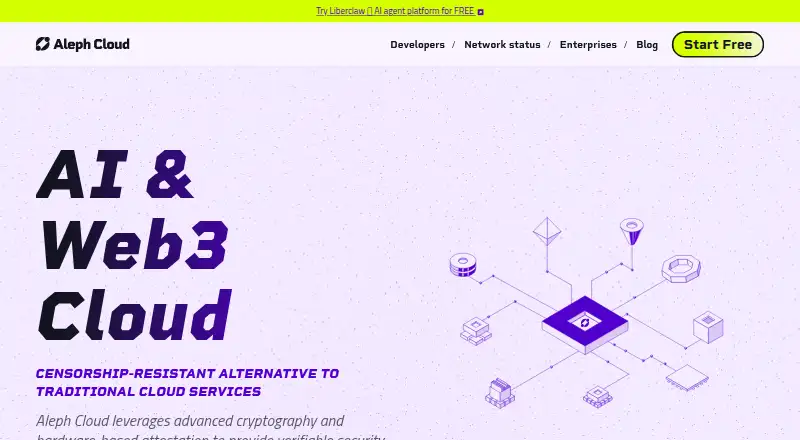
What Aleph Cloud (formerly Aleph.im) is
Aleph Cloud, formerly Aleph.im, is a distributed cloud platform for storage, computing, and blockchain indexing. Its compute offerings include VPS instances, confidential VMs, GPU instances, and serverless functions. Block storage uses SSDs and is listed from 1 MB to 20 TB. For websites, it supports frameworks such as Next.js, React, and Vue.js, with IPFS for storage and distribution. Developers can use SDKs, APIs, command-line tools, Docker, and Kubernetes; enterprise integrations also include Terraform, GitHub Actions, and webhooks. The platform lists support for Ethereum, Arbitrum, Solana, Binance Chain, Cosmos, Avalanche, Polkadot, Polygon, Base, Sonic, Optimism, and Tezos. Aleph Cloud says Trusted Execution Environments protect data during computation. Its enterprise materials describe zero-trust design, audit logs, telemetry, and deployment for GDPR and data-residency requirements. Billing uses credits deducted as resources are used; workloads may be reclaimed if the balance runs out. Static website hosting is free, while the VPS starter packer is $1.94 a month.
Good
- Offers VPS, confidential VMs, GPU instances, and serverless functions
- Static website hosting costs nothing
- Supports IPFS website distribution
- Lists integrations including Docker, Kubernetes, and Terraform
- Credits can be topped up with fiat, USDC, or ALEPH
Watch out
- Workloads may be reclaimed when the credit balance runs out
- Program resources are not yet available for credit payment
- VPS starter packer costs $1.94 a month
Who it suits
Aleph Cloud may suit AI and ML startups, gaming studios, DeFi protocols, and enterprises seeking distributed cloud services. Its listed tools and integrations also address teams building websites, applications, or blockchain-related workloads.
Verdict
Aleph Cloud combines cloud compute, storage, website hosting, and blockchain indexing in a distributed platform. Check its credit billing model and the hold-based limit for program resources before choosing it.
Plans and prices
From Aleph Cloud (formerly Aleph.im)'s own pricing page, checked 15 Oct 2026.
| Plan | Price | What it gives you |
|---|---|---|
| VPS 1 vCPU | Free | 1 vCPU · 2 GB RAM · 20 GB HD · hourly pay-as-you-go |
| Static website hosting | Free | Static websites · IPFS distribution · basic bandwidth · Free tier for static websites; basic bandwidth included. |
| Block storage | Free | 1 MB to 20 TB volumes · high-availability SSD · usage-based |
| VPS 2 vCPU | $0.01 a month | 2 vCPU · 4 GB RAM · 40 GB HD · hourly pay-as-you-go |
| VPS 4 vCPU | $0.01 a month | 4 vCPU · 8 GB RAM · 80 GB HD · hourly pay-as-you-go |
| GPU instances | $0.06 a month | Up to 12 vCPU · 18–72 GB RAM · 20–48 GB VRAM · hourly pay-as-you-go |
| VPS starter packer — Pay-as-you-go | $1.94 a month | 1 vCPU · 2.00 GB RAM · 20 GB SSD · Unlimited traffic · $1.94/month |
The facts
Each one read from Aleph Cloud (formerly Aleph.im)'s own pages, with the date it was checked.
What it does
- API
- The public REST API uses https://api.aleph.im/api/v0/ as its base URL, with official.aleph.cloud offered as an alternative endpoint.checked 15 Oct 2026
- API documentation status
- The REST reference warns that many documented endpoints may not match the current Python client and that some live endpoints remain undocumented.checked 15 Oct 2026
- Audience
- The homepage identifies AI and ML startups, gaming studios, DeFi protocols, and enterprises as user groups.checked 4 Oct 2026
- Blockchain indexing
- Aleph Cloud includes an indexing framework for blockchain data, including EVM and Solana indexing workflows.checked 15 Oct 2026
- Blockchain support
- The homepage lists Ethereum, Arbitrum, Solana, Binance Chain, Cosmos, Avalanche, Polkadot, Polygon, Base, Sonic, Optimism, and Tezos as supported blockchains.checked 4 Oct 2026
- Compliance
- The enterprise page describes zero-trust design, audit logs and telemetry, and deployment for GDPR and data-residency requirements.checked 4 Oct 2026
- Compute
- Its listed services include VPS instances, confidential VMs, GPU instances, and serverless functions.checked 4 Oct 2026
- Confidential VMs
- Confidential virtual machines are marketed as protecting workload data and logic from the surrounding network.checked 15 Oct 2026
- Development tools
- The product offers SDKs, APIs, CLI tools, and Docker and Kubernetes support.checked 4 Oct 2026
- Documentation depth
- The developer hub covers storage, messaging, compute, confidential instances, functions, hosting, indexing, SDKs, CLI commands and API references.checked 15 Oct 2026
- Documentation licence
- The public Aleph Cloud documentation repository is released under the MIT license.checked 15 Oct 2026
- Enterprise compliance claims
- The enterprise page states support for GDPR and data-residency requirements, audit logs, zero-trust design and confidential VMs.checked 15 Oct 2026
- Funding
- Aleph.im announced a $10 million funding round on 20 January 2022 led by Stratos Technologies and backed by multiple crypto investors.checked 15 Oct 2026
- GPU computing
- GPU instances target AI inference, machine-learning training, rendering and simulations, with pricing advertised from $0.055 per hour.checked 15 Oct 2026
- Immutable volumes
- Immutable volumes provide distributed file storage intended to preserve data integrity and availability.checked 15 Oct 2026
- Integration: Eclipse
- Aleph Cloud announced Eclipse support on 16 April 2025, combining its storage, messaging and compute with Eclipse's modular stack.checked 15 Oct 2026
- Integrations
- The site identifies Ubisoft, Request Finance, HyperSwap, 3MERA, Robotter and Aurora among organizations associated with its ecosystem.checked 15 Oct 2026
- Integration: Sonic
- Aleph Cloud announced Sonic blockchain integration on 11 April 2025 for decentralized messaging, storage and compute.checked 15 Oct 2026
- IPFS storage
- The network offers decentralized IPFS-based file and website storage designed to resist censorship and central-server outages.checked 15 Oct 2026
- Limit: documentation maturity
- The official GitHub repository labels the documentation as a work in progress.checked 15 Oct 2026
- Limit: inconsistent pricing
- BestCloudMining reports that Aleph Cloud's products page and computing page publish conflicting VPS starting prices.checked 15 Oct 2026
- Limit: legal transparency
- BestCloudMining reports that it could not find a reachable legal entity, governing law or usable terms-of-service page.checked 15 Oct 2026
Money
- Billing
- The console describes a credit-based system where credits are deducted as resources are consumed and workloads may be reclaimed when the balance runs out.checked 4 Oct 2026
The company
- Founded
- Solana Compass lists the project as founded in January 2019 by Jonathan Schemoul.checked 15 Oct 2026
The full review of Aleph Cloud (formerly Aleph.im)
Overview
Aleph Cloud brings compute, storage, website hosting, and blockchain indexing into one distributed platform. It is most compelling for teams building AI, gaming, DeFi, or blockchain products that need several of those services together. Its breadth is useful, but credit-based billing and the hold-based limit on program resources deserve close attention.
Key features
Compute options include VPS instances, confidential VMs, GPU instances, and serverless functions. That variety can cover both general hosting and specialized workloads; teams looking for a simple file-storage service may not need the extra scope. Block storage is high-availability SSD storage, with capacity ranging from 1 MB to 20 TB.
Website hosting supports Next.js, React, and Vue.js, with IPFS handling storage and distribution. The free static-site tier makes it possible to start without a hosting charge, although its included bandwidth is described only as basic. For developers, SDKs, APIs, and CLI tools sit alongside Docker and Kubernetes support. Enterprise integrations add Terraform, GitHub Actions, and webhooks, which should fit more readily into existing deployment pipelines.
The platform supports indexing for Ethereum, Arbitrum, Solana, Binance Chain, Cosmos, Avalanche, Polkadot, Polygon, Base, Sonic, Optimism, and Tezos. That breadth is a clear fit for projects spanning multiple chains, but less relevant to teams that need only conventional compute or storage.
Aleph Cloud says Trusted Execution Environments keep data encrypted and private during computation. Its enterprise offering describes a zero-trust design, audit logs, telemetry, and deployment for GDPR and data-residency requirements. These are relevant capabilities for sensitive workloads, but they do not remove the need for a customer's own security and compliance assessment.
Billing uses credits deducted as resources are consumed. Users can top up with fiat, USDC, or ALEPH; if the balance runs out, workloads may be reclaimed. More importantly, program resources cannot currently be paid for with credits and use a hold-based model instead. This split makes it essential to understand how a chosen workload is charged before relying on it.
Pricing
The free static website hosting tier costs nothing and includes static websites, IPFS distribution, and basic bandwidth. It is a sensible starting point for lightweight sites, but does not promise unlimited bandwidth.
The VPS starter packer — Pay-as-you-go plan costs $1.94 a month, billed $1.94/month. It includes 1 vCPU, 2.00 GB RAM, 20 GB SSD, and unlimited traffic, a defined small-server package for modest workloads. The credit model still matters: consumption draws down the balance, and workloads may be reclaimed when credits are exhausted.
The pricing model is paid, with a free plan and a starting price of 0.00 USD. There is no seat count or trial term to weigh for these plans. The hold-based payment restriction for program resources is the more consequential qualification for teams planning to use them.
Platforms
Aleph Cloud supports API, Linux, macOS, web, and Windows. That range suits teams connecting through developer interfaces as well as users managing the service from common desktop and web environments.
Who it's for
The strongest case is for AI and machine-learning startups, gaming studios, DeFi protocols, and enterprises that can use its mix of compute, storage, web hosting, and blockchain infrastructure. Teams that value confidential computing or need to connect infrastructure to existing container and automation workflows also have relevant options. It is less persuasive for buyers who want only basic storage or who need predictable billing without workload-reclamation risk.
Pros and cons
- Pros: A broad set of compute options, SSD storage, and IPFS hosting can serve several infrastructure needs on one platform.
- Pros: Multi-chain indexing and developer integrations, including Docker, Kubernetes, Terraform, and GitHub Actions, suit blockchain teams and established deployment workflows.
- Pros: The free static-site tier and the $1.94/month VPS entry plan provide low-cost ways to start with distinct workloads.
- Cons: Credit exhaustion can lead to workloads being reclaimed, so teams must manage balances rather than assume uninterrupted operation.
- Cons: Program resources remain on a hold-based model rather than credit payment, complicating a consistent billing approach.
- Cons: Basic bandwidth on free static hosting may constrain sites with heavier traffic needs.
Alternatives
For a broader comparison, see Decentralized Storage Services. Choose Sia when an open-source project supported by the Sia Foundation and community donations is the priority; it has a free plan and broader mobile and self-hosted platform support. Peergos is worth considering for fully open-source software, including its server, and reproducible builds; its self-host plan is free, though it has no free plan overall.
Carbide Network is a storage-focused alternative with a home-provider option billed at $0.002/GB and an estimated $24/year per TB, or personal storage billed at $0.002/GB. Walrus offers a free launch-period plan with usage limits, and its pricing may evolve. Stratos is another freemium service with a free plan and broad platform support, including self-hosting.
Datum Storage may suit buyers prioritizing a one-terabyte free-storage offer for the first year; additional storage costs $3.99 a month per terabyte. For IPFS object storage, Filebase has a free plan with 5 GB shared storage, 500 pinned files, 10 GB IPFS egress, free object egress, and one bucket; its Pro plan costs $7.50 a month. Pinata is an API and web option with a $20.00/month Picnic plan that includes one agent, 1 TB storage, one gateway plus CDN, five million requests, and 500 GB bandwidth.
Verdict
Aleph Cloud is a strong candidate for teams that want distributed compute, storage, IPFS hosting, and blockchain indexing in a single developer-oriented platform. Its breadth and integration options are the main reasons to choose it; the credit balance and hold-based program-resource model are the main reasons to look elsewhere if continuity and straightforward payment handling are paramount.
Getting started
- Open the Aleph Cloud website
- Choose the web console, API, Linux, macOS, or Windows access route
- Create or access a cloud workspace
- Use free static website hosting or select the VPS starter pack
- Top up credits with fiat, USDC, or ALEPH before consuming paid resources
Limits worth knowing
Static website hosting is free with basic bandwidth. The VPS starter pack is $1.94 per month for 1 vCPU, 2.00 GB RAM, 20 GB SSD, and unlimited traffic; workloads may be reclaimed when the credit balance runs out.
Questions
Is Aleph Cloud free?
Static website hosting is listed as free and includes basic bandwidth and IPFS distribution. Paid resources use credit-based billing.
What does the VPS starter plan cost?
The VPS starter pack pay-as-you-go plan is listed at $1.94 a month, with 1 vCPU, 2.00 GB RAM, 20 GB SSD, and unlimited traffic.
Which platforms can access Aleph Cloud?
The listed platforms are API, Linux, macOS, web, and Windows.
Which tools integrate with Aleph Cloud?
Integrations include Docker, Kubernetes, Terraform, GitHub Actions, APIs, and webhooks.
How does billing work?
Credits are deducted as resources are consumed. Users can top up with fiat, USDC, or ALEPH, and workloads may be reclaimed when the balance runs out.
Which blockchains are supported?
The homepage lists Ethereum, Arbitrum, Solana, Binance Chain, Cosmos, Avalanche, Polkadot, Polygon, Base, Sonic, Optimism, and Tezos.
Alternatives to Aleph Cloud (formerly Aleph.im)
- 1

Sia
Free planOpen sourceAndroidiOSWebAPI8.4From $7.99 a month - 2
Datum Storage
Free planAndroidiOSWebAPI7.9From $3.99 a month - 3
Carbide Network
Free planAndroidiOSAPImacOS7.6$0.01 usage-based - 4

Peergos
Free planAndroidWebLinuxmacOS6.9Free plan - 5

Storj
WebAPILinuxmacOS6.8From $29 a month - 6

Pinata
Free planWebAPI6.7From $20 a month