Stratos
Stratos is a distributed infrastructure network that brings together computation, storage, network traffic, blockchain, and decentralized databases.
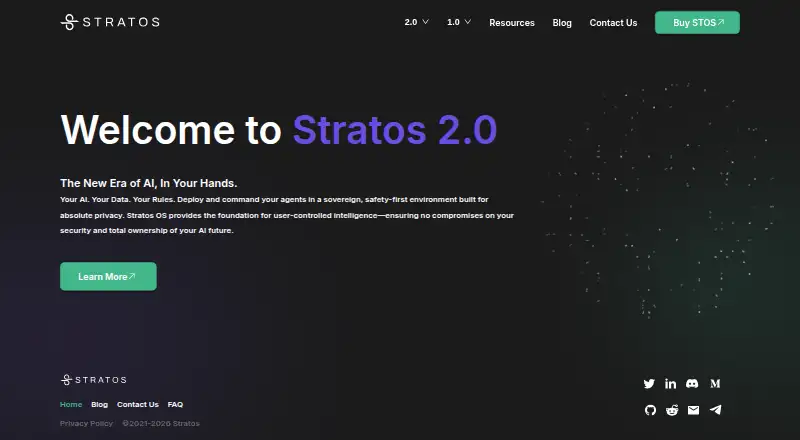
What Stratos is
Stratos is a distributed infrastructure network that brings together computation, storage, network traffic, blockchain, and decentralized databases. It is intended to support blockchain application developers, including Dapp developers, who can deploy, store, and execute code and data on its infrastructure. Its four core modules are blockchain, decentralized storage, decentralized databases, and decentralized computing. The network uses Proof-of-Stake for its value layer, Proof-of-Traffic for resources, and Proof-of-Authority for meta-services; Proof-of-Traffic rewards participants according to their network traffic contributions. Stratos IPFS, or SPFS, is an IPFS cluster for persistent storage. Its guide covers uploading, fetching, pinning, unpinning, and sharing files through API and WebUI instructions. A free private access token has usage limitations that a subscription can expand. Gateway API requests require an access token and are subject to tier-based rate and traffic limits. Stratos lists Android, iOS, Linux, macOS, web, Windows, API, and self-hosted access, and is headquartered in Canada.
Good
- Combines blockchain, storage, databases, and computing.
- SPFS supports common IPFS file operations.
- Private access token is free with usage limits.
- Lists Android, iOS, Linux, macOS, and web access.
Watch out
- Gateway requests require an access token.
- API use has tier-based rate and traffic limits.
- Free private-token use has limitations.
Who it suits
Stratos is aimed at blockchain application and Dapp developers who need decentralized infrastructure for code and data. Its SPFS tools may also suit users who need IPFS-compatible file operations.
Verdict
Stratos brings several decentralized infrastructure services together, with SPFS file operations and network APIs among its documented capabilities. Consider its access-token requirements and usage limits when evaluating it.
The facts
Each one read from Stratos's own pages, with the date it was checked.
What it does
- AI positioning
- Stratos 2.0 presents Stratos OS as a sovereign, safety-first environment for deploying and commanding AI agents with user-controlled data.checked 2 Oct 2026
- API gateway
- Stratos APIs require a Gateway Access Token and usage is subject to rate and traffic limits based on the access tier.checked 2 Oct 2026
- API integration
- The gateway supports Stratos ecosystem RPC and API services and requires requests to use a Gateway Access Token.checked 30 Sep 2026
- Consensus and rewards
- Stratos uses Proof of Traffic to reward participants according to their contributions to network traffic.checked 30 Sep 2026
- Consensus layers
- The value, resource and meta-service layers use Proof-of-Stake, Proof-of-Traffic and Proof-of-Authority respectively.checked 2 Oct 2026
- Core components
- Its four core modules are blockchain, decentralized storage, decentralized databases, and decentralized computing.checked 30 Sep 2026
- Core modules
- Stratos services comprise blockchain, decentralized storage, decentralized databases and decentralized computing.checked 2 Oct 2026
- Core network
- Stratos is a distributed infrastructure network providing computation, storage and network traffic resources on one platform.checked 2 Oct 2026
- Decentralized computing
- Stratos decentralized computing is an edge-computing network offering low latency and a Trusted Execution Environment.checked 2 Oct 2026
- Decentralized database
- Stratos decentralized database is described as scalable, high-availability, non-schema, non-maintenance and without a single point of failure.checked 2 Oct 2026
- Developer workflow
- Stratos says developers can deploy, store, and execute code and data on its decentralized infrastructure.checked 30 Sep 2026
- Intended users
- The documentation says Stratos is intended to support blockchain application developers, including Dapp developers.checked 30 Sep 2026
- IPFS compatibility
- The SPFS guide refers users to the IPFS Kubo RPC API for RPC details and documents compatible file operations.checked 30 Sep 2026
- Network APIs
- The Stratos mainnet provides RPC, REST and gRPC endpoints plus a block explorer.checked 2 Oct 2026
- Privacy compliance
- Stratos says its privacy policy applies to Stratos Network and that the company complies with Canadian federal and provincial privacy laws including PIPEDA.checked 2 Oct 2026
- Private storage access
- The SPFS guide says a private access token provides exclusive access to personal storage and that data remains inaccessible to others unless explicitly shared.checked 30 Sep 2026
- Product scope
- Stratos describes itself as a distributed infrastructure network providing computation, storage, and network traffic.checked 30 Sep 2026
- Proof of Traffic
- Proof-of-Traffic rewards network participants and contributors according to their contributions to network traffic.checked 2 Oct 2026
- Rate limits
- Gateway API usage is subject to rate and traffic limits determined by the access tier.checked 30 Sep 2026
- SPFS file operations
- The SPFS guide documents uploading, fetching, pinning, unpinning, and sharing files through its API and WebUI instructions.checked 30 Sep 2026
Where it runs
- Dapp data mesh
- Stratos is designed as a decentralized data mesh where blockchain developers can deploy, store and execute code and data on decentralized infrastructure.checked 2 Oct 2026
- Node platform
- Stratos provides a precompiled full-chain binary for Ubuntu 18.04 or newer on amd64, with source compilation available for other systems.checked 2 Oct 2026
Money
- Free access limit
- The SPFS guide says its private access token is free with usage limitations that can be expanded through a subscription.checked 30 Sep 2026
The company
- Headquarters
- Canadachecked 28 Sep 2026
The full review of Stratos
Overview
Stratos is a decentralized infrastructure network for blockchain and Dapp developers who want to deploy code and data across storage, computing and network services. Its breadth is appealing, but using its storage and APIs means working with access tokens and tier-based limits.
The network brings blockchain, decentralized storage, databases and computing under one umbrella. Stratos also positions its 2.0 environment for deploying and commanding AI agents, built on Stratos OS.
Key features
Network services and incentives
Developers can deploy, store and execute code and data on Stratos infrastructure. Its value, resource and meta-service layers use Proof-of-Stake, Proof-of-Traffic and Proof-of-Authority respectively. Proof-of-Traffic rewards participants for their contributions to network traffic; STOS is also used for staking or delegation, mining rewards, transaction fees and prepaying for resource-network services. That range gives the network a coherent internal incentive and payment model, but makes STOS part of the operating picture for users engaging with those services.
SPFS storage
Stratos IPFS (SPFS) is a Stratos-maintained IPFS cluster backed by decentralized storage for persistent data. Its API and WebUI instructions cover uploading, fetching, pinning, unpinning and sharing files, and its guide points to the IPFS Kubo RPC API for RPC details. A private access token gives exclusive access to personal storage; data stays inaccessible to others unless explicitly shared. The token is free within usage limits, which can be expanded by subscription. This is a useful privacy boundary, though teams should account for the token and possible subscription as usage grows.
Computing, databases and APIs
Stratos describes its computing service as an edge network with low latency and a Trusted Execution Environment. Its decentralized database is designed for high availability without a fixed schema, ongoing maintenance or a single point of failure. Those are broad service goals rather than a substitute for checking fit against a particular workload. The mainnet provides RPC, REST and gRPC endpoints plus a block explorer. API requests require a Gateway Access Token, and rate and traffic limits depend on the access tier.
Pricing
Stratos uses a freemium model with a free plan. The SPFS private access token costs nothing but has usage limitations; a subscription can expand them. Gateway API access also depends on an access tier, with rate and traffic limits set accordingly. The practical trade-off is straightforward: free access lets developers explore SPFS, but sustained storage or API use may require a paid tier.
Platforms
Stratos is available across Android, iOS, Linux, macOS, Windows, web, API and self-hosted environments. For node operators, it supplies a precompiled full-chain binary for Ubuntu 18.04 or newer on amd64; other systems can use source compilation. The range suits developers and operators working across different environments, though the binary path is specifically described for Ubuntu on amd64.
Who it's for
Stratos is best suited to blockchain and Dapp developers who want storage, compute, database and network services within one decentralized infrastructure ecosystem. Its documented SPFS file operations and multiple network API types offer concrete starting points. Readers seeking a straightforward storage-only service, or who do not want access tokens and tier-based usage limits in their workflow, should compare alternatives.
Pros and cons
Pros
- Broad infrastructure scope: Blockchain, storage, databases and computing share one network, which may suit developers assembling a decentralized application stack.
- Useful SPFS operations: Uploading, fetching, pinning, unpinning and sharing are documented through API and WebUI workflows.
- Private storage access: Personal data remains inaccessible to others unless explicitly shared.
- Multiple API interfaces: Mainnet RPC, REST and gRPC endpoints support different integration approaches.
Cons
- Token-gated use: SPFS and gateway APIs require access tokens, adding a prerequisite to storage and integration work.
- Usage ceilings matter: Free SPFS access is limited, while gateway rate and traffic limits vary by tier.
- Node binary scope is narrow: The precompiled option targets Ubuntu 18.04 or newer on amd64; other systems require source compilation.
Alternatives
For a broad category comparison, browse Decentralized Storage Services. Choose Sia if an open-source project supported by the Sia Foundation and community donations is a better fit; it also offers a free plan across a similar spread of platforms. Filebase is a more storage-focused option with a free tier capped at 5 GB shared storage, 500 pinned files and 10 GB IPFS egress, or a Pro plan at $7.50 a month. Consider Pinata when its defined plans fit: Picnic costs $20 a month for 1 agent, 1TB storage, 1 gateway plus CDN, 5 Million requests and 500GB bandwidth; Fiesta costs $100 a month for 3 agents, 5TB storage, 3 gateways plus CDN, with additional plan terms dependent on the stated details.
Carbide Network is another option, with Home provider and Personal storage plans listed as free and billed at $0.002/GB. DeNet Storage may suit readers willing to use prepaid GAS balances; it has no free plan and its listed storage examples use 1,200 GAS purchased upfront. Choose Peergos if fully open-source software, including the server, and reproducible builds are priorities; it has no free plan. 4EVERLAND and Lighthouse are also freemium services with free plans.
Verdict
Stratos is a strong candidate for blockchain and Dapp developers who want storage, computing, databases and network APIs within one decentralized infrastructure network. SPFS’s documented file operations and private access model are its clearest practical draw. Look elsewhere if you need predictable, uncapped usage without access-token and tier constraints, or prefer a storage-only service with clearly defined plan quotas.
Alternatives to Stratos
- 1

Sia
Free planOpen sourceAndroidiOSWebAPI8.4From $7.99 a month - 2

Aleph Cloud (formerly Aleph.im)
Free planOpen sourceWebAPILinuxmacOS8.1$0.01 usage-based - 3
Datum Storage
Free planAndroidiOSWebAPI7.9From $3.99 a month - 4
Carbide Network
Free planAndroidiOSAPImacOS7.6$0.01 usage-based - 5

Peergos
Free planAndroidWebLinuxmacOS6.9Free plan - 6

Storj
WebAPILinuxmacOS6.8From $29 a month