Carbide Network
Carbide Network is a distributed storage service that connects files with independent providers.
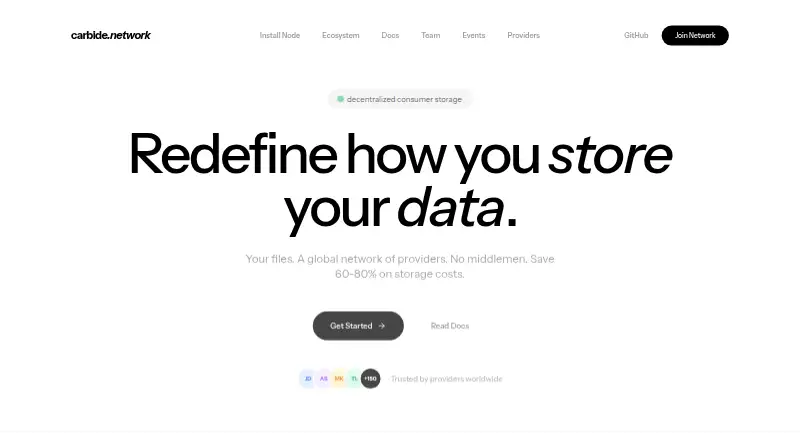
What Carbide Network is
Carbide Network is a distributed storage service that connects files with independent providers. Its personal offering is aimed at photos, documents and backups, with photo and video auto-sync, an encrypted vault, expiring share links and up to 10x redundancy. Files are encrypted on the user's device with AES-256-GCM, and the service describes its architecture as zero-knowledge. Encrypted chunks are spread among providers, with users able to choose 1–10 copies. Users manage their own private encryption keys; Carbide cannot recover data if keys are lost. Business features include role-based team workspaces, audit logs, retention policies and geographic redundancy across 30+ regions. Developers can use API-first, S3-compatible storage, a versioned API and a Swift SDK. Apps are listed for macOS, Windows, iOS and Android, alongside API access. Personal storage is billed at $0.002/GB. The network is provided as-is without warranties, and performance depends on independent participants.
Good
- On-device AES-256-GCM encryption
- Choose from 1 to 10 copies
- Personal features include auto-sync and expiring links
- Business redundancy spans 30+ regions
Watch out
- Lost private keys cannot be recovered by Carbide
- Performance depends on independent network participants
- Network is provided without warranties
Who it suits
Carbide may suit individuals seeking encrypted storage for personal files and organizations needing team controls or geographic redundancy. Developers can also consider its API-first, S3-compatible storage.
Verdict
Carbide offers personal, business and developer storage options with client-side encryption and configurable redundancy. Users are responsible for their encryption keys, and network performance is not guaranteed.
Plans and prices
From Carbide Network's own pricing page, checked 3 Oct 2026.
| Plan | Price | What it gives you |
|---|---|---|
| Home provider | Free | 95% uptime · estimated earnings $24/year per TB · $0.002/GB |
| Personal storage | Free | Storage starts at $0.002/GB · pay for storage used · $0.002/GB |
| Professional provider | Free | 99% uptime · estimated earnings $48/year per TB · $0.004/GB |
| Enterprise provider | $0.01 a month | 99.9% uptime · estimated earnings $96/year per TB · $0.008/GB |
The facts
Each one read from Carbide Network's own pages, with the date it was checked.
What it does
- API
- The discovery service exposes a versioned API for provider registration and search, marketplace quotes, and health checks.checked 3 Oct 2026
- Business features
- The business offering lists role-based team workspaces, audit logs, retention policies, and geographic redundancy across 30+ regions.checked 3 Oct 2026
- Business use
- The business offering lists team workspaces with role-based access, audit logs, retention policies, and geographic redundancy across 30+ regions.checked 3 Oct 2026
- Developer support
- The developer docs describe a Swift SDK with async APIs for provider discovery, upload, download, and key management.checked 3 Oct 2026
- Distribution
- Encrypted file chunks are distributed across independent providers, with user-selectable redundancy from 1 to 10 copies.checked 3 Oct 2026
- Distribution and redundancy
- Encrypted chunks are distributed across independent providers, and users can choose 1–10 copies.checked 3 Oct 2026
- Encryption
- The site says files are encrypted on the user’s device with AES-256-GCM and that providers cannot see the data under its zero-knowledge architecture.checked 3 Oct 2026
- Integrations
- The developer docs describe settlement through Solana programs and USDC payments, and state that the discovery service can be self-hosted.checked 3 Oct 2026
- Key responsibility
- The terms say users manage their own private encryption keys and Carbide cannot recover data if keys are lost.checked 3 Oct 2026
- Performance caveat
- The terms state that the network is provided as-is without warranties and that performance depends on the aggregate behavior of independent participants.checked 3 Oct 2026
- Personal features
- The personal offering lists photo and video auto-sync, an encrypted vault, expiring share links, and up to 10x redundancy.checked 3 Oct 2026
- Personal use
- The personal offering is for photos, documents, and backups, with photo and video auto-sync, an encrypted vault, expiring share links, and up to 10x redundancy.checked 3 Oct 2026
- Pricing model
- The site says provider marketplace pricing starts at $0.002/GB and providers compete on price and quality.checked 3 Oct 2026
- Privacy data
- The privacy policy says Carbide collects public wallet addresses, encrypted file sharding metadata, and provider performance statistics.checked 3 Oct 2026
- Product
- Carbide describes itself as a decentralized storage network that connects users’ files with a global network of providers.checked 3 Oct 2026
- Provider earnings
- The site lists Home at $0.002/GB, Professional at $0.004/GB, and Enterprise at $0.008/GB, with estimated earnings per TB per year for each tier.checked 3 Oct 2026
- Provider requirements
- The terms say providers agree to maintain uptime and redundancy levels set by their node configuration, and failure to provide data may lead to loss of earnings or slashing of collateral.checked 3 Oct 2026
- Provider setup
- The docs say providers can install carbide-node through a Homebrew tap and that it auto-registers on the Solana registry when configured.checked 3 Oct 2026
- Support
- The developer docs identify Telegram as the fastest way to reach a contributor and GitHub issues as an option for tracked work.checked 3 Oct 2026
- Support and community
- The site links to documentation, GitHub, Twitter, and Telegram; it does not state a support response time or service level on the opened pages.checked 3 Oct 2026
Where it runs
- Available platforms
- The site says Carbide is available on macOS, Windows, and iOS, and also describes an Android app for managing, uploading, and sharing files.checked 3 Oct 2026
The full review of Carbide Network
Overview
Carbide Network is a distributed storage service for personal files, business workspaces and developers building storage products. It suits people who value device-side encryption and adjustable redundancy, provided they can safeguard their own keys.
Its appeal is the choice of personal, business and API-based storage in one network; its central compromise is that neither lost keys nor uneven network performance can be solved by relying on Carbide.
Key features
Encrypted, distributed files
Carbide encrypts files on the user’s device with AES-256-GCM, then distributes encrypted chunks across independent providers. Users can choose from one to 10 copies, allowing them to set redundancy rather than accept a single fixed arrangement. Providers cannot see file contents under Carbide’s zero-knowledge architecture, although the privacy policy says Carbide collects public wallet addresses, encrypted-file sharding metadata and provider performance statistics.
Users manage their private encryption keys, and Carbide cannot recover data if those keys are lost. This puts control in the user’s hands, but makes careful key custody essential; it is a poor match for anyone who expects password resets or provider-assisted recovery.
Personal, business and developer tools
Personal storage includes photo and video auto-sync, an encrypted vault, expiring share links and up to 10x redundancy. That set covers everyday file storage and backups, while expiring links are useful for sharing files without leaving access open indefinitely.
Business workspaces add role-based access, audit logs, retention policies and geographic redundancy across more than 30 regions. These controls are relevant to teams that need access governance and records, but the network is provided without warranties and performance depends on independent participants.
For developers, Carbide describes its storage as API-first and S3-compatible, with a Swift SDK for iOS uploads, downloads, encryption and key management. Its versioned discovery API supports provider registration and search, marketplace quotes and health checks. Developers can also self-host the discovery service; settlement uses Solana programs and USDC payments.
Provider participation
Providers can install carbide-node through a Homebrew tap, and configured nodes auto-register on the Solana registry. Provider tiers set different earnings rates and uptime commitments, but those are not passive returns: operators agree to maintain uptime and redundancy for their node configuration, and failure to provide data can mean lost earnings or slashed collateral.
Pricing
Carbide’s personal storage plan is free, with storage billed at $0.002/GB for use. It avoids a monthly subscription, but the total cost grows with stored data rather than being capped by a stated allowance.
The provider plans are priced at free for Home, billed at $0.002/GB, with 95% uptime and estimated earnings of $24/year per TB; free for Professional, billed at $0.004/GB, with 99% uptime and estimated earnings of $48/year per TB; and $0.01 a month for Enterprise, billed at $0.008/GB, with 99.9% uptime and estimated earnings of $96/year per TB. The higher tiers pair greater estimated earnings with stricter uptime targets, so they make sense only for providers able to meet those commitments. Collateral can be slashed for failure to provide data.
The $0.00 entry price for personal storage is not unlimited free storage: usage is billed per gigabyte. The provider plan figures are distinct from personal storage pricing and should not be read as storage subscriptions.
Platforms
Carbide is available on macOS, Windows and iOS, and its Android app supports file management, uploads and sharing. An API broadens its reach for developers, but the consumer-facing platform list does not include Linux or a web app.
Who it's for
Carbide is most compelling for privacy-conscious individuals who can protect their own keys, teams that need role-based workspaces and retention controls, and developers seeking S3-compatible distributed storage or provider discovery tools. It is less suitable for users who need guaranteed performance, recoverable keys, or a traditional fixed storage allowance.
Pros and cons
- Pros: Device-side AES-256-GCM encryption and user-selectable one-to-10-copy redundancy give users control over privacy and distribution.
- Pros: Personal sync and sharing, team governance features, and developer APIs address several distinct storage needs.
- Cons: Users bear full responsibility for private keys, with no recovery if they lose them.
- Cons: Network performance is not guaranteed, because it depends on independent participants.
- Cons: Provider earnings come with uptime and redundancy obligations, and data failures can cost earnings or collateral.
Alternatives
For a broader category comparison, see Decentralized Storage Services.
- Sia is a better fit for readers seeking a free plan and an open-source project supported by the Sia Foundation and community donations.
- Peergos is worth considering for readers who prioritize a fully open-source service, including its server, with reproducible builds.
- Aleph Cloud (formerly Aleph.im) offers a free tier for static website hosting with basic bandwidth and IPFS distribution, making it a more targeted choice for static sites.
- Walrus has a free launch-period plan, though its usage limits apply and pricing may evolve.
- Stratos is another freemium decentralized-storage option.
- Datum Storage offers one free terabyte for the first year, followed by additional storage at US$3.99 per terabyte per month.
- Filebase is a better fit for users who want a defined free object-storage allowance: its free tier includes 5 GB shared storage, 500 pinned files, 10 GB IPFS egress and one bucket.
- Pinata offers API and web plans, including Picnic at $20 a month with 1TB storage, one gateway plus CDN, five million requests and 500GB bandwidth.
Verdict
Choose Carbide if you want distributed storage with device-side encryption, adjustable redundancy and options for personal, team or developer use—and are prepared to protect your keys. Look elsewhere if recoverability or guaranteed performance matters more than control over encryption and copies.
Getting started
- Visit the Carbide Network website.
- Choose personal storage, a business offering, or developer storage based on your needs.
- Use the app on a listed platform, or connect through the API.
- For provider participation, install carbide-node through the Homebrew tap and configure it to register on the Solana registry.
Limits worth knowing
Personal storage costs nothing, with storage billed at $0.002/GB for usage. Users can choose 1 to 10 copies, but must safeguard their own keys; lost keys cannot be recovered.
Questions
What does Carbide cost for personal storage?
The Personal storage plan is free, with storage billed at $0.002/GB for storage used.
Which devices and platforms are supported?
Carbide lists macOS, Windows, iOS, Android, and API access.
How does file encryption work?
Files are encrypted on the user’s device with AES-256-GCM, then distributed as encrypted chunks. Users manage their own private keys.
Can Carbide recover a lost encryption key?
No. Carbide says it cannot recover data if a user loses their private encryption keys.
What developer options are available?
Carbide describes its storage as API-first and S3-compatible, lists a Swift SDK, and provides a versioned API for provider registration and search, marketplace quotes, and health checks.
How can a storage provider earn through Carbide?
Provider plans list Home at $0.002/GB, Professional at $0.004/GB, and Enterprise at $0.008/GB. The listed estimated earnings are $24, $48, and $96 per year per TB, respectively.
Alternatives to Carbide Network
- 1

Sia
Free planOpen sourceAndroidiOSWebAPI8.4From $7.99 a month - 2

Aleph Cloud (formerly Aleph.im)
Free planOpen sourceWebAPILinuxmacOS8.1$0.01 usage-based - 3
Datum Storage
Free planAndroidiOSWebAPI7.9From $3.99 a month - 4

Peergos
Free planAndroidWebLinuxmacOS6.9Free plan - 5

Storj
WebAPILinuxmacOS6.8From $29 a month - 6

Pinata
Free planWebAPI6.7From $20 a month