Vosk
Vosk is a free, open-source toolkit for offline speech recognition, intended as a practical library for applications.
What Vosk is
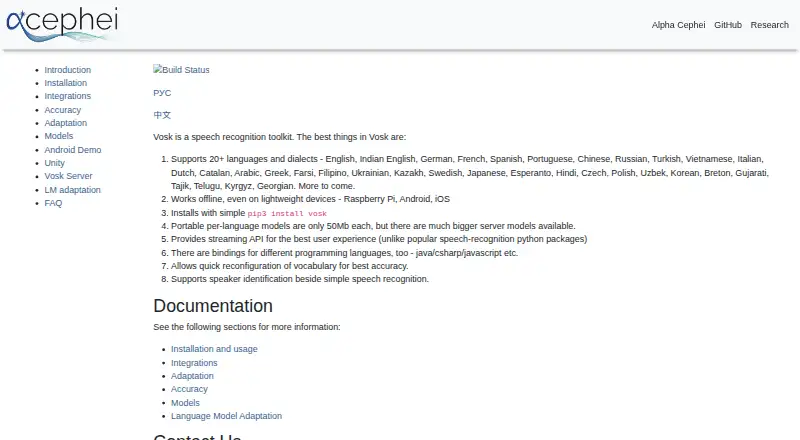
Vosk is a free, open-source toolkit for offline speech recognition, intended as a practical library for applications. It supports more than 20 languages and dialects and provides a streaming API. It can run offline on lightweight devices such as Raspberry Pi, Android, and iOS. Developers can reconfigure vocabulary, and most small models support dynamic vocabulary changes. Small models are typically around 50 MB and need about 300 MB of runtime memory; large server models can require up to 16 GB. Developer bindings include Python, Java, C#, and JavaScript, while Vosk Server has implementations for WebSocket, gRPC, MQTT, and WebRTC. Listed integrations include Asterisk, FreeSWITCH, Jigasi, and UniMRCP. The server can be installed with Docker and configured to use a locally mounted model folder. Listed systems include Linux x86_64 and arm64, Raspberry Pi 3/4, macOS x86 and M1, and Windows x86 and 64 for the Python package. ARMv6 and Windows ARM64 are unsupported; iOS builds are available on request. The API repository identifies its license as Apache-2.0.
Good
- Supports more than 20 languages and dialects.
- Works offline, including on Raspberry Pi and mobile.
- Provides a streaming API.
- Small models typically need about 300 MB of runtime memory.
- Server supports WebSocket, gRPC, MQTT, and WebRTC.
Watch out
- Large server models can require up to 16 GB.
- ARMv6 is not supported.
- Windows ARM64 is not supported.
- iOS builds are available on request.
Who it suits
Vosk suits developers building applications that need offline or streaming speech recognition. Its different model sizes and language bindings offer options for lightweight devices and server deployments.
Verdict
Vosk is a free toolkit with offline recognition, streaming, and developer interfaces for application use. Check its model memory needs and listed system limitations before choosing a deployment.
Plans and prices
From Vosk's own pricing page, checked 11 Oct 2026.
| Plan | Price | What it gives you |
|---|---|---|
| Vosk Open Source | Free | offline speech recognition · mobile and server · 10 platforms |
The facts
Each one read from Vosk's own pages, with the date it was checked.
What it does
- API access
- Yeschecked 20 Sep 2026
- Deployment
- The server can be installed with Docker and configured to use a locally mounted model folder.checked 11 Oct 2026
- Developer interfaces
- The project provides bindings for Python, Java, C#, and JavaScript, among other languages.checked 11 Oct 2026
- Export formats
- TXT,SRTchecked 20 Sep 2026
- Integrations
- The integrations page lists Asterisk, FreeSWITCH, Jigasi, and UniMRCP integrations.checked 11 Oct 2026
- Intended users
- The FAQ describes Vosk as a practical, plug-and-play speech recognition library for applications, while suggesting Kaldi for research.checked 11 Oct 2026
- Languages
- The toolkit supports more than 20 languages and dialects.checked 11 Oct 2026
- License
- The Vosk API GitHub repository identifies its license as Apache-2.0.checked 11 Oct 2026
- Model sizes
- Small models are typically around 50 MB and require about 300 MB of runtime memory; large server models can require up to 16 GB.checked 11 Oct 2026
- Offline use
- Vosk works offline, including on lightweight devices such as Raspberry Pi, Android, and iOS.checked 11 Oct 2026
- Product
- Vosk is a speech recognition toolkit for offline speech recognition.checked 11 Oct 2026
- Server protocols
- Vosk Server has implementations for WebSocket, gRPC, MQTT, and WebRTC.checked 11 Oct 2026
- Speaker identification
- Vosk supports speaker identification alongside speech recognition.checked 11 Oct 2026
- Streaming
- Vosk provides a streaming API for speech recognition.checked 11 Oct 2026
- Support
- The project directs users to GitHub issues, email, Telegram, and an invitation-only WeChat group for questions.checked 11 Oct 2026
- Supported systems
- The installation page lists Linux x86_64, Linux arm64, Raspberry Pi 3/4, macOS x86 and M1, and Windows x86 and 64 for its Python package.checked 11 Oct 2026
- Timestamp support
- Yeschecked 20 Sep 2026
- Vocabulary
- Vosk allows vocabulary reconfiguration, and its models page says most small models support dynamic vocabulary changes.checked 11 Oct 2026
Where it runs
- Platform limits
- The installation page says ARMv6 and Windows ARM64 are not supported, and iOS builds are available on request.checked 11 Oct 2026
The full review of Vosk
Vosk is a speech-recognition toolkit for developers building voice input into applications, especially when recognition must work offline. Its strengths are flexible deployment and streaming; the main trade-off is choosing a model and target system that fit the available memory and support.
Overview
Vosk is a software component, not a ready-to-use transcription workspace. It supports more than 20 languages and dialects and can recognize speech without an internet connection, including on Raspberry Pi, Android, and iOS devices. That makes it a strong candidate for applications that need local processing or cannot rely on continuous connectivity. The project positions Vosk as a practical library for applications; researchers seeking a speech-recognition research toolkit may prefer Kaldi.
Hardware fit depends on the model. Small models are typically around 50 MB and require about 300 MB of runtime memory, while large server models can require up to 16 GB. The smaller option opens the door to lightweight deployments, but developers need to account for memory before selecting a model for a device or server.
Key features
Offline streaming recognition
Vosk offers a streaming API alongside offline recognition, which suits software that needs to process incoming speech continuously without making a network connection a requirement. Speaker identification, speaker labels, and timestamp support can add structure to the output. TXT and SRT are the supported export formats, useful for plain transcripts and subtitle files.
Vocabulary and developer interfaces
Vocabulary reconfiguration lets developers adapt recognition to an application’s terminology; most small models support dynamic vocabulary changes. Bindings include Python, Java, C#, and JavaScript, among other languages, giving application teams several ways to integrate the toolkit. Vosk Server supports WebSocket, gRPC, MQTT, and WebRTC, and can be installed with Docker and configured to use a locally mounted model folder. These choices offer deployment flexibility, though they are most valuable to teams prepared to integrate and configure software rather than looking for a turnkey user interface.
Integrations and support
Listed integrations include Asterisk, FreeSWITCH, Jigasi, and UniMRCP, making Vosk relevant to developers working with those systems. Questions can be directed to GitHub issues, email, Telegram, or an invitation-only WeChat group. The Vosk API repository uses the Apache-2.0 license.
Pricing
Vosk Open Source costs nothing and is open source. The free plan includes offline speech recognition for mobile and server use across 10 platforms. There are no paid tiers to compare, so the choice is less about subscription limits than whether the toolkit and its deployment requirements suit the project.
Platforms
Vosk spans Android, iOS, Linux, macOS, Windows, API, and self-hosted deployments. For its Python package, supported systems include Linux x86_64 and arm64, Raspberry Pi 3 and 4, macOS x86 and M1, and Windows x86 and 64. ARMv6 and Windows ARM64 are not supported; iOS builds are available on request. Those constraints matter when targeting older or less common hardware, even though the broader platform range is substantial.
Who it's for
Vosk is best for developers who want offline, streaming speech recognition inside their own applications and can choose a model to match device or server resources. It is less suitable for people who want a finished transcription service with a user-facing workspace, or for research-focused users who need the toolkit the project recommends for that purpose.
Pros and cons
- Pro: Offline operation and support for more than 20 languages and dialects make it useful for applications that need local recognition across varied language needs.
- Pro: Streaming, multiple language bindings, server protocols, and Docker deployment give developers several ways to fit recognition into an application stack.
- Pro: Small models can be around 50 MB, with runtime memory needs of about 300 MB, enabling some lightweight-device deployments.
- Con: Large server models can require up to 16 GB of memory, which can rule out constrained hardware and makes model selection consequential.
- Con: ARMv6 and Windows ARM64 are unsupported, and iOS builds are available on request, limiting straightforward deployment on those targets.
- Con: Vosk is a toolkit rather than a ready-made transcription workspace, so users seeking a finished service should consider another category of product.
Alternatives
For a hosted transcription option with a free plan capped at one seat and 120 transcription minutes per month, consider Notta. Simon Says is another alternative. easytranscript is a further option. Gladia is also worth considering. Happy Scribe offers a free plan with unlimited meeting recordings, a 45-minute per-recording limit, and a 10-minute AI trial. Superwhisper is an alternative with a free plan. Express Scribe offers an unlimited free version for common audio formats. noScribe is a free, open-source alternative for Linux, macOS, and Windows.
Browse transcription software, speech recognition software, and speech-to-text software to compare more options.
Verdict
Choose Vosk if you are building an application that needs offline or streaming speech recognition and want control over model and deployment choices. Its open-source access, language coverage, and developer interfaces are compelling for that role. Look elsewhere if you need a finished transcription workspace, or if the memory and platform requirements do not fit your target system.
Getting started
- Open the Vosk website and review the available models and installation information
- Choose a supported platform such as Android, iOS, Linux, macOS, Windows, Raspberry Pi, or self-hosting
- Select a language model, considering the memory needs of small and large models
- Install the Python package or another available language binding
- For server deployment, install Vosk Server with Docker and mount the local model folder
- Connect through the API or a supported server protocol such as WebSocket, gRPC, MQTT, or WebRTC
Limits worth knowing
Vosk is listed as free and open source. Hardware support excludes ARMv6 and Windows ARM64, and iOS builds require a request.
Questions
Is Vosk free?
Yes. Vosk is listed as free and open source, with an Open Source plan listed as free.
Which platforms does Vosk support?
Platforms include Android, iOS, Linux, macOS, Windows, self-hosted deployments, and API access. The Python package lists Linux x86_64 and arm64, Raspberry Pi 3/4, macOS x86 and M1, and Windows x86 and 64.
Does Vosk work offline?
Yes. It performs offline speech recognition, including on Raspberry Pi, Android, and iOS.
What export formats are available?
Vosk lists TXT and SRT export formats.
Which server protocols and integrations are listed?
Vosk Server implementations cover WebSocket, gRPC, MQTT, and WebRTC. Listed integrations include Asterisk, FreeSWITCH, Jigasi, and UniMRCP.
What license does Vosk use?
The Vosk API GitHub repository identifies the license as Apache-2.0.
Alternatives to Vosk
- 1

Whisper
Free planOpen sourceAPILinuxmacOSSelf-hosted8.9$0.01 usage-based - 2

Notta
Free planAndroidiOSWebExtension8.9From $8.17 a month - 3

Rev AI
Free planAndroidiOSWebAPI8.8Free plan - 4

Superwhisper
Free planAndroidiOSAPILinux8.7From $84.99 a year - 5

Happy Scribe
Free planAndroidiOSAPImacOS8.5From $8.50 a month - 6
Express Scribe
Free planAPILinuxmacOSWindows8.2Free plan