
Gladia
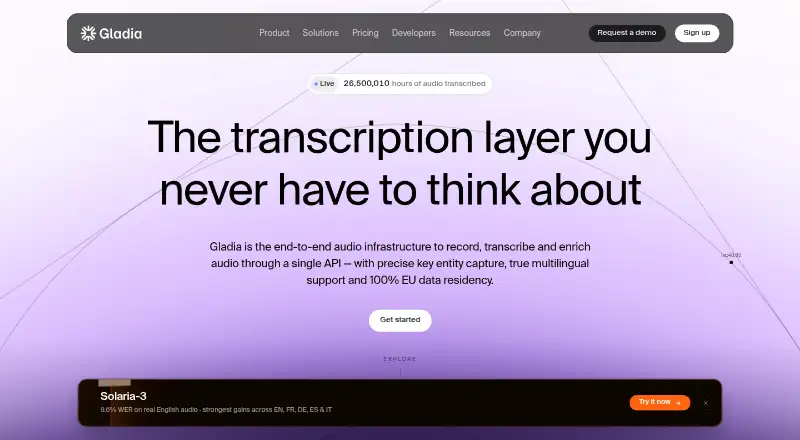
Gladia is an audio service built around an API for recording, transcribing and enriching audio.
What Gladia is
Gladia is an audio service built around an API for recording, transcribing and enriching audio. It supports both asynchronous transcription and real-time speech transcription, including live streaming. Starter includes automatic language detection and switching across 100+ languages. Audio capabilities listed by Gladia include speaker diarization, sentiment analysis, personal information redaction, entity detection and audio-to-LLM processing. Developers can work with Python or Node.js SDKs, WebSocket streaming and REST uploads. Named integrations include Pipecat, LiveKit, Twilio and Retell, with connectors for Zapier, Make and n8n. Transcripts can include speaker labels and timestamps and export as SRT or VTT. New users can receive 50€ in one-time credits that do not expire. A free plan and trial are available; listed Starter rates are $0.61 a month for asynchronous use and $0.75 a month for real-time use. Hourly-call and total-audio limits depend on the tier. Gladia also offers GladiaFlow, a desktop dictation app for Mac and Windows, with code released under the MIT license.
Good
- Supports asynchronous and real-time transcription.
- Starter supports 100+ languages and automatic language switching.
- Offers SDKs for Python and Node.js.
- Exports transcripts as SRT or VTT.
- New users can receive 50€ in non-expiring credits.
Watch out
- Usage limits depend on the selected tier.
- Growth rates require an upfront commitment to unlock savings.
- Listed Starter pay-as-you-go rates are 0.61 USD and $0.75 a month.
Who it suits
Gladia suits developers building transcription or audio-processing features who need API access, streaming options, or language support. Its GladiaFlow desktop app may also suit people seeking real-time voice dictation on Mac or Windows.
Verdict
Gladia combines transcription, audio enrichment and developer tools in an API-based service, with a separate desktop dictation app. Check the tier’s usage limits and listed rates against your expected workload before choosing a plan.
Plans and prices
From Gladia's own pricing page, checked 20 Sep 2026.
| Plan | Price | What it gives you |
|---|---|---|
| Starter - asynchronous | $0.61 a month | 30 real-time concurrent requests · 25 async concurrent requests · 100+ supported languages · Flexible pay-as-you-go |
| Starter - real-time | $0.75 a month | 30 real-time concurrent requests · 25 async concurrent requests · 100+ supported languages · Flexible pay-as-you-go |
| Growth - asynchronous | $0.20 a month | 100+ supported languages · Flexible concurrent request limits · As low as $0.20/hr; commit upfront to unlock savings |
| Growth - real-time | $0.25 a month | 100+ supported languages · Flexible concurrent request limits · As low as $0.25/hr; commit upfront to unlock savings |
| Starter | Free | 30 real-time concurrent requests · 25 async concurrent requests · 50€ in free credits · Pay-as-you-go; Async at $0.61/hr; Real-time at $0.75/hr |
| Enterprise | — | Unlimited concurrent requests · zero data retention · SLAs · premium support with dedicated Slack and Account Manager · custom hosting · Annual plan; custom pricing |
| Growth | Priced on request | Flexible concurrent requests · custom volume discounts · automatic model training opt-out · Async as low as $0.20/hr; Real-time as low as $0.25/hr; commit upfront |
The facts
Each one read from Gladia's own pages, with the date it was checked.
What it does
- API access
- Yeschecked 20 Sep 2026
- Audio intelligence
- The site lists speaker diarization, sentiment analysis, PII redaction, entity detection, and audio-to-LLM processing among its capabilities.checked 8 Oct 2026
- Compliance
- The company lists GDPR, HIPAA, SOC 2 Type II, and ISO 27001 among its compliance credentials.checked 8 Oct 2026
- Data residency
- The Compliance Hub says EU and US workloads are hosted separately on region-specific infrastructure.checked 8 Oct 2026
- Developer tools
- Official SDKs are available for Python and Node.js, with WebSocket streaming and REST upload options.checked 8 Oct 2026
- Export formats
- SRT,VTTchecked 20 Sep 2026
- Integrations
- The site names Pipecat, LiveKit, Twilio, and Retell integrations, plus Zapier, Make, and n8n connectors.checked 8 Oct 2026
- Languages
- The Starter plan includes automatic language detection and switching and supports 100+ languages.checked 8 Oct 2026
- Languages supported
- 100checked 20 Sep 2026
- Open source
- GladiaFlow's code is available on GitHub under the MIT license.checked 8 Oct 2026
- Product
- Gladia provides audio infrastructure to record, transcribe, and enrich audio through an API.checked 8 Oct 2026
- Security
- The Compliance Hub says customer data is not used for model training by default and describes encryption at rest and in transit.checked 8 Oct 2026
- Speaker identification
- Yeschecked 20 Sep 2026
- Support
- Starter and Growth include help center and Discord support; Enterprise includes premium support with dedicated Slack and an account manager.checked 8 Oct 2026
- Timestamp support
- Yeschecked 20 Sep 2026
- Transcription
- It offers async transcription and real-time speech transcription, including live streaming.checked 8 Oct 2026
- Usage limits
- Service limits on hourly calls and total transcribed audio depend on the selected tier.checked 8 Oct 2026
Where it runs
- Desktop app
- GladiaFlow is a real-time voice dictation app for desktop with downloads for Mac and Windows.checked 8 Oct 2026
Money
- Free credits
- New users can receive 50€ in one-time free credits with no monthly reset; the credits do not expire.checked 8 Oct 2026
- Free plan
- Nochecked 20 Sep 2026
The company
- Headquarters
- Rennes, Francechecked 28 Sep 2026
The full review of Gladia
Gladia is audio infrastructure for teams that want to build transcription and audio analysis into a product or workflow. It suits developers who need both live and uploaded-audio processing, while GladiaFlow offers a separate desktop dictation option. The breadth is compelling, but the right tier depends on call volume, concurrency and whether upfront commitments make sense.
Overview
Gladia handles asynchronous transcription and real-time speech, including live streaming, and adds tools for turning audio into more useful data. Its 100+ language support and developer interfaces give product teams room to build multilingual speech features. The API-first focus is less compelling for someone who simply wants a standalone meeting-notes app.
Key features
- Live and asynchronous transcription: Use real-time streaming for live speech or asynchronous processing for recordings. Starter includes automatic language detection and switching across 100+ languages, which is useful for multilingual workloads.
- Audio analysis: Speaker diarization and labeling, sentiment analysis, PII redaction, entity detection and audio-to-LLM processing extend the service beyond raw transcripts. That breadth suits workflows that need structured or privacy-conscious outputs, though each capability should be matched to the application’s requirements.
- Developer integration: Python and Node.js SDKs, WebSocket streaming and REST uploads provide several implementation routes. Named integrations include Pipecat, LiveKit, Twilio and Retell; Zapier, Make and n8n connectors offer options for workflow automation.
- Security and hosting: Gladia says customer data is not used for model training by default and describes encryption at rest and in transit. It lists GDPR, HIPAA, SOC 2 Type II and ISO 27001 credentials, and says EU and US workloads are hosted separately on region-specific infrastructure. Enterprise adds zero data retention and custom hosting.
- Desktop dictation: GladiaFlow is a real-time voice dictation app for Mac and Windows. Its code is available on GitHub under the MIT license, making it a separate option from the API service for desktop users.
Pricing
The free Starter tier costs nothing and uses pay-as-you-go rates of $0.61/hr for asynchronous processing and $0.75/hr for real-time. It includes 50€ in one-time credits, 30 concurrent real-time requests and 25 concurrent async requests. The credits do not expire or reset monthly, so occasional users can try the service without a recurring allowance; sustained workloads will need to account for hourly charges and tier-dependent service limits.
Paid Starter rates are $0.61 a month for Starter - asynchronous and $0.75 a month for Starter - real-time, both billed Flexible pay-as-you-go. Each includes 30 real-time and 25 async concurrent requests and 100+ languages. These tiers suit workloads that need those concurrency limits without committing upfront, but buyers should distinguish the per-month plan figures from the hourly usage rates shown for the free Starter tier.
Growth - asynchronous is $0.20 a month and Growth - real-time is $0.25 a month, billed at rates described as “as low as” $0.20/hr and $0.25/hr respectively. Both require an upfront commitment to unlock savings and support flexible concurrent request limits and 100+ languages. Growth is the better fit for predictable, larger workloads that can commit; its lower starting hourly rates are not the same as a commitment-free price.
The Growth plan has custom pricing, with custom volume discounts, flexible concurrency and automatic model training opt-out. Enterprise also has custom pricing and adds unlimited concurrent requests, zero data retention, custom hosting, SLAs, limitless scaling and premium support through dedicated Slack and an account manager. Starter and Growth include help-center and Discord support. Enterprise is aimed at organizations that need contractual support or hosting controls rather than a published self-serve rate.
Platforms
Gladia supports API, web, macOS and Windows. The API is the core route for application integrations, while GladiaFlow provides desktop dictation downloads for Mac and Windows. Python and Node.js SDKs, WebSocket streaming and REST uploads support developer implementations.
Who it's for
Gladia is best for developers and businesses building speech transcription or audio-enrichment features into products, especially when they need both live and batch processing, multilingual handling or integrations with existing communications and automation tools. It is also a reasonable fit for teams with variable usage that want pay-as-you-go Starter, or predictable volume that can justify Growth commitments. People chiefly seeking a ready-made meeting transcription experience should compare dedicated apps instead.
Pros and cons
- Pro: Live streaming and asynchronous transcription cover both real-time and recorded-audio workflows.
- Pro: Starter supports 100+ languages, automatic language detection and switching, with meaningful concurrency allowances and non-expiring one-time credits.
- Pro: Audio analysis, developer SDKs, streaming and REST interfaces, and named integrations make it adaptable to product and workflow builds.
- Pro: Enterprise includes zero data retention, custom hosting, SLAs and dedicated account support.
- Con: Growth savings require an upfront commitment, so the lower “as low as” hourly rates may not suit uncertain or intermittent workloads.
- Con: Hourly-call and transcription-volume limits depend on tier, requiring buyers to match capacity to usage rather than assume a single universal allowance.
- Con: The API-led product is a less direct choice for users who mainly want a finished meeting-notes application.
Alternatives
For a free plan with 1 seat and 120 transcription minutes per month across Android, iOS, browser extension, desktop and web, consider Notta. Happy Scribe may suit readers who want unlimited meeting recordings with a 45-minute per-recording limit and a 10-minute AI trial. Choose Speechmatics if its free offer of $100 in credits, two concurrent real-time sessions and ten pre-recorded files per second better fits a capped evaluation.
Grain has a free option with one Notetaker seat, 45-minute meetings and 20 bot-recorded meetings for personal email users. noScribe is a free, open-source alternative for Linux, macOS and Windows. Rev may fit users who can work with English-only transcription and a 45-minute monthly AI transcription and caption allowance on its free plan. tl;dv offers unlimited recordings and transcriptions on its free plan. AssemblyAI is another API-oriented option, with $50 in free audio credits, five new streaming connections per minute and five concurrent prerecorded transcriptions.
Browse our Audio Transcription Software, Speech-to-Text Software, Transcription Software and Speech Recognition Software lists to compare category options.
Verdict
Choose Gladia if you are building an audio product or workflow and want live and asynchronous transcription, broad language coverage and audio analysis behind developer-facing tools. Its strongest case is the range of processing and integration options, backed by an enterprise tier with hosting and support controls. Look elsewhere if you want a ready-made meeting-notes app, or if Growth’s upfront commitment does not suit your expected usage.
Getting started
- Visit Gladia's website.
- Choose Starter for free pay-as-you-go access or review the paid tiers.
- Use the API through Python or Node.js SDKs, WebSocket streaming, or REST uploads.
- For desktop dictation, download GladiaFlow for Mac or Windows.
Limits worth knowing
Starter lists 30 concurrent real-time requests and 25 concurrent asynchronous requests, with asynchronous use at $0.61/hr and real-time use at $0.75/hr. Hourly-call and total transcribed-audio limits depend on the selected tier; Growth rates require an upfront commitment.
Questions
Is Gladia free?
Starter is listed as free on a pay-as-you-go basis. New users can receive 50€ in one-time credits that do not expire.
What do paid Starter plans cost?
Starter asynchronous is listed at $0.61 a month, billed flexible pay-as-you-go. Starter real-time is listed at $0.75 a month, billed flexible pay-as-you-go.
Which platforms does Gladia support?
The listed platforms are API, macOS, web, and Windows. GladiaFlow, its desktop dictation app, has downloads for Mac and Windows.
Can Gladia identify speakers and export subtitles?
Yes. It lists speaker identification, speaker labels, and timestamp support, with SRT and VTT export formats.
What developer integrations and tools are available?
Official SDKs are available for Python and Node.js, alongside WebSocket streaming and REST uploads. Named integrations include Pipecat, LiveKit, Twilio, Retell, Zapier, Make, and n8n.
Is GladiaFlow open source?
GladiaFlow's code is available on GitHub under the MIT license.
Alternatives to Gladia
- 1

Superwhisper
Free planAndroidiOSAPILinux8.3From $84.99 a year - 2

Notta
Free planAndroidiOSWebExtension8.2From $8.17 a month - 3
Rev AI
Free planAndroidiOSWebAPI8.1Free plan - 4

Whisper
Free planOpen sourceAPILinuxmacOSSelf-hosted8.1$0.01 usage-based - 5

Happy Scribe
Free planAndroidiOSAPImacOS7.8From $8.50 a month - 6
Simon Says
Free planiOSWebExtensionmacOS7.7From $15 a month