Vinculum Vin OMS
Vinculum Vin OMS centralizes orders, inventory, and returns across marketplaces, webstores, ecommerce frontends, and offline stores in a real-time dashboard.
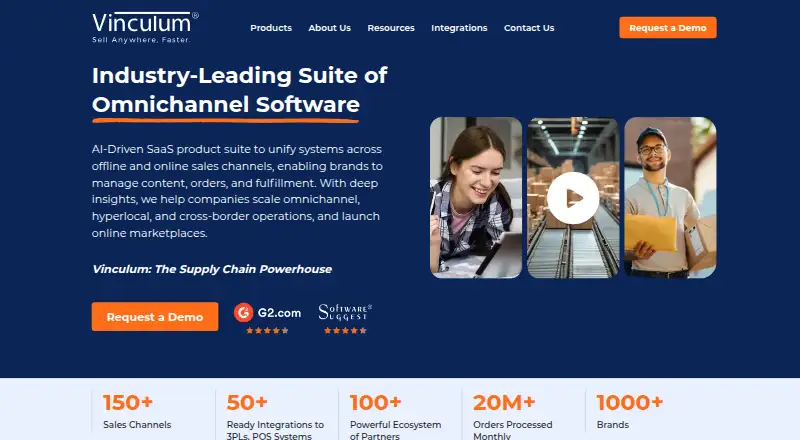
What Vinculum Vin OMS is
Vinculum Vin OMS centralizes orders, inventory, and returns across marketplaces, webstores, ecommerce frontends, and offline stores in a real-time dashboard. It supports multiple warehouses and can route orders using customer location, inventory, and transporter serviceability, including rules for splitting order lines. Workflows cover partial fulfillment, dropship orders, back orders, and back-to-back orders. The system manages stock across channels, while fulfillment processes include pick-and-pack and shipment handoff. Returns workflows cover delivered and non-delivered returns, replacement orders, and warehouse intake. Vinculum says Vin OMS has more than 100 integrations to 3PLs and last-mile fulfillment companies, including shipping labels and tracking status. Listed platforms are Android, API, and web; the Android app supports warehouse tasks such as inbound operations, inventory moves, cycle counts, and order picking. The maker also lists ERP integrations including SAP, Tally, and QuickBooks. Vin OMS is a paid product, but pricing is not published; the product page offers a demo request. Vinculum lists a dedicated account manager and 24x7 customer support.
Good
- Centralizes orders, inventory, and returns across channels
- Supports multi-warehouse routing and order splitting
- More than 100 3PL and last-mile integrations
- Android app supports warehouse operations
- Dedicated account manager and 24x7 customer support
Watch out
- Pricing is not published
- Buyers must request a demo for access to sales information
Who it suits
Vin OMS suits retailers and other businesses managing orders across online and offline sales channels, especially those operating multiple warehouses. The maker describes its audience as including retailers, e-tailers, marketplaces, 3PLs, CPG companies, and marketplace sellers.
Verdict
Vin OMS covers order routing, inventory, fulfillment, and returns across channels and locations. Its paid pricing is available on request, so businesses will need to contact Vinculum to assess the cost.
Plans and prices
From Vinculum Vin OMS's own pricing page, checked 8 Oct 2026.
| Plan | Price | What it gives you |
|---|---|---|
| Vin OMS | Priced on request | Pricing not listed publicly; request a demo |
The facts
Each one read from Vinculum Vin OMS's own pages, with the date it was checked.
What it does
- API and ERP
- Vin eRetail supports standard APIs for integration and data sharing and describes integrations with ERPs including SAP, Tally, and QuickBooks.checked 8 Oct 2026
- Automation rules
- Yeschecked 23 Sep 2026
- Carrier integrations
- Vinculum says the OMS use case has more than 100 integrations to 3PLs and last-mile fulfillment companies, including access to shipping labels and tracking status.checked 8 Oct 2026
- ERP connections
- Vin eRetail lists SAP, Tally, and QuickBooks integrations and says its standard APIs can support integration and data sharing with other systems.checked 8 Oct 2026
- Examples of integrations
- The maker lists integrations across web stores, marketplaces, 3PLs, aggregators, and SaaS or technology partners, including Shopify, Amazon, and Adobe Commerce.checked 8 Oct 2026
- Fulfillment
- The product can route online orders to stores using store inventory, customer location, and transporter serviceability.checked 8 Oct 2026
- Industries
- The maker describes Vin OMS for brands in fashion, beauty, healthcare and pharmacy, jewelry, home improvement, sports, toys, electronics, FMCG, and grocery.checked 8 Oct 2026
- Integration examples
- The maker's integration directory includes marketplaces such as Amazon, Shopee, and Tokopedia, and logistics providers such as DHL, Delhivery, and FedEx.checked 8 Oct 2026
- Integrations
- Vinculum says Vin OMS has 100+ integrations to 3PLs and last-mile fulfillment companies, including access to shipping labels and tracking status.checked 8 Oct 2026
- Intended users
- Vinculum describes Vin eRetail as serving retailers, e-tailers, marketplaces, 3PLs, CPG companies, and marketplace sellers.checked 8 Oct 2026
- Inventory and routing
- Its order-routing engine updates inventory across channels and supports workflows such as partial fulfillment, dropshipping, and back orders.checked 8 Oct 2026
- Inventory management
- The system automatically manages and updates stock across channels to help reduce stock-outs and overstocks.checked 8 Oct 2026
- Mobile support
- Vin eRetail supports an Android app for warehouse tasks including inbound operations, inventory moves, cycle counts, and order picking.checked 8 Oct 2026
- Multi-warehouse routing
- Its warehouse system selects fulfillment locations using customer location, inventory, and serviceability, with rules for splitting order lines.checked 8 Oct 2026
- Order workflows
- It supports configurable workflows for partial fulfillment, dropship orders, back orders, and back-to-back orders.checked 8 Oct 2026
- Pricing availability
- The product pages reviewed offer a demo or contact form but do not state a Vin OMS price.checked 8 Oct 2026
- Privacy
- Vinculum states that it is GDPR compliant and lists privacy measures including a data protection officer, privacy by design, and internal audits.checked 8 Oct 2026
- Purpose
- Vin OMS centralizes orders, inventory, and returns across sales channels and locations in a real-time dashboard.checked 8 Oct 2026
- Returns
- Returns management covers delivered and non-delivered returns and supports replacement orders and warehouse intake.checked 8 Oct 2026
- Sales and download access
- The Vin OMS page provides a request-a-demo form, and its download form asks for contact and company details.checked 8 Oct 2026
- Security
- Vinculum's product page identifies the company as GDPR compliant and ISO/IEC 27001:2013 certified.checked 8 Oct 2026
- Store fulfillment
- Order routing can select a store based on customer location, inventory, and transporter serviceability, with configurable store priorities and order splitting.checked 8 Oct 2026
The company
- Company overview
- Vinculum describes itself as a SaaS product company for omnichannel retailing and online marketplace technology.checked 8 Oct 2026
- Headquarters
- Noida, Uttar Pradesh, Indiachecked 28 Sep 2026
The full review of Vinculum Vin OMS
Vin OMS is Vinculum’s omnichannel order-management platform for coordinating stock, orders, fulfillment, and returns across marketplaces, webstores, stores, and warehouses. It is aimed at retailers, marketplace sellers, brands, and logistics operators running complex, multi-location operations. The strongest case for it is disciplined routing and workflow control across many channels; the main caution is that buying requires a sales conversation and custom pricing.
Overview
Vin OMS places orders, inventory, and returns in a real-time dashboard rather than leaving each channel or location to operate separately. Its order-routing engine keeps stock updated across channels, helping reduce both overselling and excess inventory when the same products are offered in several places.
The platform is built for businesses with operational variation. It covers marketplaces, ecommerce frontends, offline channels, and stores, with support for multiple warehouses and store-based fulfillment. That breadth suits an established omnichannel operation better than a small seller with one storefront and a simple dispatch process.
Key features
Inventory and order workflows
Automatic inventory updates across sales channels give teams a central view of availability and reduce the risk of promising stock that has already been sold elsewhere. Configurable workflows handle partial fulfillment, dropship orders, back orders, and back-to-back orders. These options matter when orders cannot follow one standard path; a straightforward single-channel retailer may find the range unnecessary.
Routing and fulfillment
Vin OMS can route online orders to stores using customer location, available inventory, and transporter serviceability. Configurable store priorities and order-line splitting let an operation decide how to deal with uneven stock or orders that need more than one fulfillment location. Warehouse routing applies the same considerations to customer location, inventory, and serviceability when selecting a dispatch point.
Pick-and-pack workflows and shipment handoff support the operational steps after an order is assigned. Returns cover delivered and non-delivered orders, with replacement-order handling and warehouse intake for returned goods. Together, these workflows address the full order lifecycle rather than stopping at allocation.
Connections and mobile operations
Vinculum says the OMS use case has more than 100 integrations with 3PLs and last-mile fulfillment companies, including shipping labels and tracking status. Examples span Amazon, Shopee, Tokopedia, Shopify, and Adobe Commerce, as well as DHL, Delhivery, and FedEx. Vin eRetail also describes ERP connections for SAP, Tally, and QuickBooks and standard APIs for sharing data with other systems.
The Android warehouse app supports inbound work, inventory moves, cycle counts, and order picking. Android, web, and API access cover the primary deployment options, while the company identifies GDPR compliance and ISO/IEC 27001:2013 certification and cites privacy-by-design measures, a data protection officer, and internal audits. A dedicated account manager and 24x7 customer support are listed for Vin eRetail customers.
Pricing
Vin OMS is sold on a paid, custom-pricing basis. The Vin OMS plan has no public price; prospective customers are directed to request a demo or contact Vinculum. That approach can accommodate a complex rollout, but it prevents a quick cost comparison and means the commercial fit must be established with sales.
There is no published free plan, trial term, seat allowance, usage quota, or renewal term for Vin OMS. Buyers should therefore confirm user access, transaction or integration limits, implementation scope, support terms, and renewal conditions before committing. Custom pricing is most appropriate for organizations that expect a tailored omnichannel deployment, not for a small business seeking a transparent self-serve subscription.
Platforms
Vin OMS supports Android, web, and API access. Android is particularly relevant to warehouse teams performing inbound operations, stock movements, cycle counts, and picking; web and API access support central operations and system integration.
Who it's for
Vin OMS is a strong fit for retailers, e-tailers, marketplace sellers, consumer brands, 3PLs, and CPG businesses managing several channels or locations. Its industry coverage includes fashion, beauty, healthcare and pharmacy, jewelry, home improvement, sports, toys, electronics, FMCG, and grocery. Businesses that need store fulfillment, multi-warehouse routing, exception workflows, and extensive logistics connectivity will benefit most.
It is less compelling for a small seller with one warehouse, one storefront, and uncomplicated returns. Such an operation may not need configurable splitting, dropship and back-order paths, or a sales-led purchasing process.
Pros and cons
- Pro: Real-time, cross-channel inventory updates help limit overselling and stock-outs.
- Pro: Routing can combine location, stock, transporter serviceability, store priorities, and split-order rules.
- Pro: Partial fulfillment, dropship, back-order, back-to-back, and replacement-return workflows cover demanding operations.
- Pro: More than 100 stated logistics integrations, standard APIs, and ERP connections support a connected stack.
- Con: Pricing is custom and unpublished, so budget suitability cannot be judged without a sales process.
- Con: The breadth of controls may be excessive for single-channel businesses with simple fulfillment.
Alternatives
For a broad category search, compare Order Management Software and Order Fulfillment Software. Retailers focused on channel coordination can also review Multichannel Ecommerce Software, while organizations needing governed product information should consider Master Data Management Software.
Choose OpenBoxes when a freemium, self-hosted option with unlimited users is more important than a sales-led OMS deployment. Choose ShipBob when you already use ShipBob and want its free software connection for ecommerce stores, inventory, orders, and shipments.
Sentry WMS is a free, open-source self-hosted alternative. The separate Sentry WMS listing is also free and self-hosted, without first-party ERP or commerce connectors yet. Cin7 Omni suits buyers who want published plan structures with user, integration, and location allowances. Descartes Sellercloud is an option for an annual, order-volume-based subscription with unlimited users and plugins. fulfillmenttools is another enterprise platform sold through a demo, while Orders Now is a free alternative.
Verdict
Choose Vin OMS if your retail or marketplace operation needs centralized control over inventory, routing, fulfillment exceptions, returns, stores, and warehouses, with integrations reaching into logistics and ERP systems. Its main reason to look elsewhere is the same complexity: smaller or simpler sellers may prefer a transparent, self-serve product, and every buyer must obtain a custom quote before knowing the total commitment.
Alternatives to Vinculum Vin OMS
- 1

Pimcore
Free planWebAPILinuxSelf-hosted7.3From $9,900 a year - 2
miniMDM
Free planOpen sourceWebAPISelf-hosted7.0Free plan - 3
AtroCore MDM
Free planWebAPILinuxSelf-hosted6.6From €400 a month - 4
Oracle Product Hub
WebAPI6.3 - 5
 6.3$24,000 one-time
- 6
Precisely EnterWorks
WebAPIWindows6.2