
OpenBoxes
OpenBoxes is an open-source supply chain management system for tracking supplies and medications at healthcare facilities and in disaster relief work.
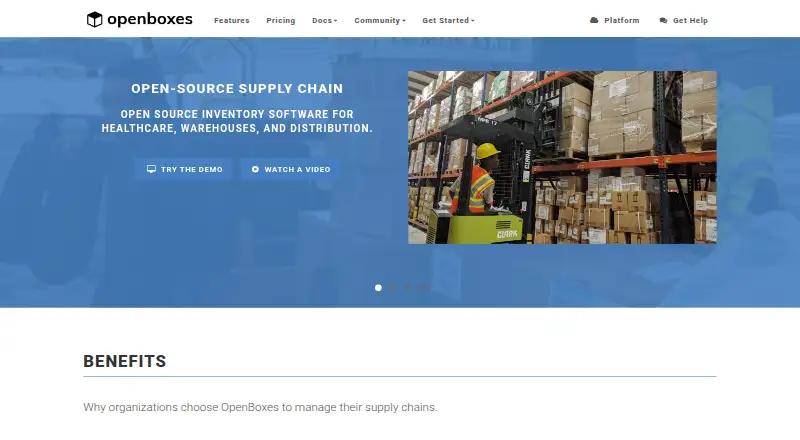
What OpenBoxes is
OpenBoxes is an open-source supply chain management system for tracking supplies and medications at healthcare facilities and in disaster relief work. Built for resource-scarce settings, it has also been adapted for warehouse management, distribution, and other supply chain uses. Inventory records can include facility, bin location, lot or serial number, and expiration date. Procurement and fulfillment features cover purchase orders, supplier management, requisitions, picking, packing, and shipment tracking. Its reports include consumption, stockouts, expirations, transactions, stock analytics, and quantities on hand. A mobile-optimized interface supports barcode scanning, inventory lookups, and mobile receiving and shipping. Organizations can host it in the cloud or on-premise. Cloud use requires consistent internet access; offline on-premise use requires hardware and staff. The Community Self-Hosted plan is free, with unlimited users and no user-license fees.
Good
- Tracks stock by facility, bin, lot, and expiration.
- Includes purchasing, picking, packing, and shipment tracking.
- Mobile interface supports barcode scanning.
- Community self-hosting is free with unlimited users.
- Can be hosted in the cloud or on-premise.
Watch out
- Cloud use requires consistent internet connectivity.
- Offline on-premise operation requires hardware and staff.
- Dedicated Lift has a 12-month minimum term.
Who it suits
OpenBoxes suits healthcare facilities, disaster relief efforts, and organizations managing supplies in resource-scarce settings. Its warehouse and distribution functions may also suit other supply chain operations.
Verdict
OpenBoxes combines inventory tracking, procurement, fulfillment, and reporting, with cloud and self-hosted deployment options. The free Community plan avoids user-license fees, while managed support plans have listed monthly prices and terms.
Plans and prices
From OpenBoxes's own pricing page, checked 29 Sep 2026.
| Plan | Price | What it gives you |
|---|---|---|
| Community Self-Hosted | Free | Unlimited users · Self-managed hosting · Storage on your server · No minimum term |
| Community Edition | Free | self-hosted on-premise or cloud · unlimited users · community support · DIY operations · Free Forever |
| Self-Hosted | $24 a month | DigitalOcean deployment · user pays actual DigitalOcean infrastructure · dedicated support · Starting at |
| Shared OpenBoxes Lift | $75 a month | Up to 10 users · 10 GB storage · 99.0% uptime SLA · 1k API calls/hour · 30 days of backups · From $75 per month |
| OpenBoxes Lift Shared | $75 a month | up to 10 users · 10 GB storage · 1,000 API calls/hour · 99.0% uptime SLA · 30-day backups · Founding-member price; regular $150/mo |
| OpenBoxes Lift Dedicated | $300 a month | up to 50 users · 100 GB storage · 25,000 API calls/hour · 99.5% uptime SLA · dedicated database · Founding-member price; regular $600/mo |
| Dedicated OpenBoxes Lift | $899 a month | Up to 50 users · 100 GB storage · 99.5% uptime SLA · 25k API calls/hour · 60 days of backups · 12-month minimum term · From $899 per month |
| OpenBoxes Lift Enterprise | $1,800 a month | 100 users · 250 GB storage · 50,000 API calls/hour · 99.9% availability target · 6-hour backups · second-region copies · Published base price |
| Enterprise OpenBoxes Lift | Priced on request | Custom users and storage · 99.9% uptime SLA · 24/7 support including holidays · 90+ days of backups · Custom |
The facts
Each one read from OpenBoxes's own pages, with the date it was checked.
What it does
- API authentication
- The Lift API uses tenant-specific endpoints and requires an X-API-Key header with JSON requests.checked 14 Oct 2026
- API capacity
- Documented hourly API limits are 1,000 requests for Shared, 25,000 for Dedicated and 50,000 for Enterprise.checked 14 Oct 2026
- API limitation
- API documentation warns that pagination is inconsistent and that the locations endpoint ignores the max parameter.checked 14 Oct 2026
- Barcode support
- Barcodes can be scanned with handheld devices or mobile-device cameras, and labels can be printed for products, bins and shipments.checked 14 Oct 2026
- Cold-chain control
- Products can carry temperature requirements, with alerts for storage that violates cold-chain rules.checked 14 Oct 2026
- Deployment limits
- The web-based system can be hosted in the cloud or on-premise; the features page says cloud use requires consistent internet connectivity and on-premise offline capability requires hardware and staff.checked 29 Sep 2026
- Designed for
- The system was built for people working in resource-scarce settings and has also been adapted for warehouse management, distribution, and other supply chain contexts.checked 29 Sep 2026
- Documentation depth
- Documentation includes installation, configuration, upgrades, user guidance, authentication, OpenAPI or Swagger, Postman and domain-specific CRUD APIs.checked 14 Oct 2026
- GitHub activity
- The GitHub repository showed roughly 915 stars and 510 forks when reviewed.checked 14 Oct 2026
- Inbound operations
- Inbound workflows support goods receipt against orders or transfers, suggested putaway and inspected returns.checked 14 Oct 2026
- Integrations
- Official integration options include REST APIs, webhooks, n8n, OpenFn, Boomi, Crowdin and DHIS2.checked 14 Oct 2026
- Inventory
- OpenBoxes tracks inventory by facility, bin location, lot or serial number, and expiration date.checked 29 Sep 2026
- Inventory controls
- Inventory is tracked by facility, bin, product, lot or serial number and expiration date, with cycle counts and adjustments.checked 14 Oct 2026
- Licence
- The source repository identifies the project licence as Eclipse Public License 1.0.checked 14 Oct 2026
- License and usage
- OpenBoxes is free to use and modify under the Eclipse Public License, and its pricing page says there are no user-license fees.checked 29 Sep 2026
- Limit: field-service scope
- An independent review says OpenBoxes is not a full field-service suite and lacks dispatching, CRM, customer notifications, invoicing and technician workflows.checked 14 Oct 2026
- Limit: RF scanning
- A 3PL user said the product lacked built-in RF scanning and required custom integration work.checked 14 Oct 2026
- Limit: self-hosting effort
- A reviewer cautioned that self-hosting savings depend on having technical expertise, because hired assistance can remove the cost advantage.checked 14 Oct 2026
- Managed hosting
- OpenBoxes Lift bundles hosting, SSL, backups, monitoring, upgrades and support as a managed cloud service.checked 14 Oct 2026
The company
- Company legal name
- The Lift documentation footer identifies the operating entity as OpenBoxes Solutions LLC.checked 14 Oct 2026
- Company origin
- OpenBoxes originated from Partners In Health supply-chain work after the 2010 Haiti earthquake.checked 14 Oct 2026
- Company size and headquarters
- Crunchbase lists OpenBoxes as a private Milwaukee, Wisconsin company with 1–10 employees.checked 14 Oct 2026
- Founded
- 2010checked 23 Sep 2026
Money
- Limit: logistics billing
- Discussion participants identified multi-client inventory, client-specific billing and operator-layer workflows as gaps for some logistics users.checked 14 Oct 2026
The full review of OpenBoxes
OpenBoxes is supply-chain software for managing stock, purchasing and fulfillment across facilities. It is best suited to healthcare and relief organizations, as well as warehouse operators, that need detailed inventory records and can manage a self-hosted system or pay for managed support. Its free, unlimited-user self-hosted plan is compelling, but hosting and offline operations require organizational capacity.
Overview
Created at Partners In Health after the 2010 Haiti earthquake, OpenBoxes was built to track medical supplies across health facilities in resource-scarce settings. It has since been adapted for warehouse management, distribution and other supply-chain work. The combination of inventory, procurement, fulfillment and reporting makes it a broad operational system rather than a simple stock-counting tool.
Stock records can be organized by facility and bin, with lot or serial numbers and expiration dates. That level of detail is useful for organizations handling medicines or other goods whose location, traceability or shelf life matters. Multi-warehouse support extends the model across sites, though the organization still needs to choose and operate an appropriate deployment.
Key features
Inventory, procurement and fulfillment
Purchase orders and supplier management sit alongside requisitions, picking, packing and shipment tracking. Together, these workflows can connect replenishment to dispatch without relying on separate tools for each step. Cycle counting and barcode scanning support stock control, while the mobile-optimized interface provides inventory lookups and mobile receiving and shipping workflows.
Reporting, integrations and access
Reports cover consumption, stockouts, expirations, transactions, stock analytics and quantity on hand. This range helps teams monitor both movement and availability. Integrations include n8n, OpenFn, Boomi, Crowdin and DHIS2, with REST API, webhooks, ERP integration and EDI support for connecting the system to other operations.
Audit trails, Superuser, Manager and Read-only roles, location-based access restrictions and LDAP authentication provide controls for organizations that need differentiated access and a record of activity. These capabilities are particularly relevant when several facilities and teams share inventory processes.
Pricing
The Community Self-Hosted plan costs nothing, allows unlimited users and carries no minimum term. It avoids user-license fees and stores data on the organization's own server, but hosting is self-managed. Community support is free; teams needing managed support and service levels must consider OpenBoxes Lift.
Shared OpenBoxes Lift is billed From $75 per month and supports up to 10 users, 10 GB storage, a 99.0% uptime SLA, 1k API calls/hour and 30 days of backups. It suits smaller teams seeking managed service within those limits. Dedicated OpenBoxes Lift is billed From $899 per month, with up to 50 users, 100 GB storage, a 99.5% uptime SLA, 25k API calls/hour and 60 days of backups; its 12-month minimum term makes it a more substantial commitment.
Enterprise OpenBoxes Lift has custom pricing, custom users and storage, a 99.9% uptime SLA, 24/7 support including holidays and 90+ days of backups. It is aimed at organizations needing higher service levels and tailored capacity. The broader pricing note says paid plans start at $24/mo, but the published plan terms above distinguish the available Lift tiers and their commitments.
Platforms
OpenBoxes is web-based and supports Android, iOS, API access and self-hosted deployment. Cloud use requires consistent internet connectivity. On-premise offline capability is possible, but requires suitable hardware and staff, so it is not a low-effort route for teams without local IT capacity.
Who it's for
OpenBoxes is a strong fit for healthcare facilities, disaster relief operations and distributors that need traceable stock across locations, procurement and fulfillment workflows, and detailed inventory reporting. It is less suitable for organizations that want offline operation without maintaining infrastructure, or that need a managed service but cannot work within a Lift plan's user, storage, API or term limits.
Pros and cons
- Pros: Unlimited users and no user-license fees on the free self-hosted plan make it viable for large teams that can supply their own hosting.
- Pros: Facility, bin, lot or serial number, and expiration tracking suit inventory where traceability and shelf life matter.
- Pros: Procurement, fulfillment, barcode scanning, cycle counting and mobile receiving and shipping bring key supply workflows together.
- Cons: Free self-hosting shifts hosting and operational responsibility to the organization.
- Cons: Offline on-premise use depends on hardware and staff, while cloud use needs consistent connectivity.
- Cons: Managed Lift plans impose user and storage ceilings at Shared and Dedicated levels, and Dedicated requires a 12-month minimum.
Alternatives
For a different mix of warehouse and order-management options, compare Order Fulfillment Software and Warehouse Management Software. Choose ZhenHub when its free plan and stated order, tracking, warehouse, user, integration and label allowances better fit the operation. Cin7 Omni is an option for teams seeking e-commerce and app integrations with unlimited inventory locations; it has no free plan, and its Standard tier is $349 a month.
Descartes Sellercloud may suit buyers comparing a paid platform with an annual subscription based on order volume and add-ons. fulfillmenttools offers a paid enterprise platform with a free trial and demo-led sales approach. ShipHero WMS is an alternative for brands considering its $1,995 a month Standard WMS plan.
SKULabs is worth comparing for teams whose order, user, channel and warehouse allowances align with its $299 a month Starter plan and add-on charges. EasyEcom EasyOMS is another paid option, with a Starter tier capped at three users, approximately 100,000 SKUs and one warehouse. Linnworks uses custom pricing based on order volume and required features.
Verdict
Choose OpenBoxes if your organization needs traceable, multi-site inventory alongside purchasing and fulfillment, and can either run its own infrastructure or justify managed support. The no-license-fee Community plan is its clearest advantage; the need for hosting capacity, connectivity or a paid Lift commitment is the main reason to look elsewhere.
Getting started
- Visit the OpenBoxes website.
- Choose the free Community Self-Hosted plan or a managed OpenBoxes Lift plan.
- For self-hosting, arrange hosting on your own server; offline on-premise use requires hardware and staff.
- For cloud use, ensure consistent internet connectivity.
- Use the mobile-optimized interface for barcode scanning, inventory lookups, receiving, and shipping.
Limits worth knowing
Community Self-Hosted is self-managed, with storage on your server. Shared OpenBoxes Lift is limited to 10 users and 10 GB storage; Dedicated OpenBoxes Lift is limited to 50 users and 100 GB storage and has a 12-month minimum term.
Questions
Is OpenBoxes free?
Yes. Community Self-Hosted is free, with unlimited users and no user-license fees. Community support is also free.
Can OpenBoxes be self-hosted?
Yes. It can be hosted on-premise or in the cloud. The Community Self-Hosted plan is self-managed, with storage on your server.
Which platforms does OpenBoxes support?
OpenBoxes lists Android, API, iOS, self-hosted, and web.
Does OpenBoxes support barcode scanning?
Yes. Its mobile-optimized interface supports barcode scanning, inventory lookups, and mobile receiving and shipping workflows.
What integrations does OpenBoxes list?
Named integrations include n8n, OpenFn, Boomi, Crowdin, and DHIS2. The features also include REST API, webhooks, ERP integration, and EDI support.
Alternatives to OpenBoxes
- 1

Clougistic
AndroidiOSWebAPI7.6From $199 a month - 2

Extensiv 3PL Warehouse Manager
AndroidiOSWebAPI7.6From $500 a month - 3

Sentry WMS
Free planOpen sourceAndroidWebAPILinux7.6Free plan - 4

Sentry WMS
Free planOpen sourceAndroidWebAPISelf-hosted7.5Free plan - 5

Packiyo WMS
AndroidiOSWebAPI7.4From $599 a month - 6

Ongoing WMS
AndroidiOSWebAPI7.0From €129 a month