
Packiyo WMS
Packiyo WMS is a warehouse management system for third-party logistics providers and ecommerce brands.
What Packiyo WMS is
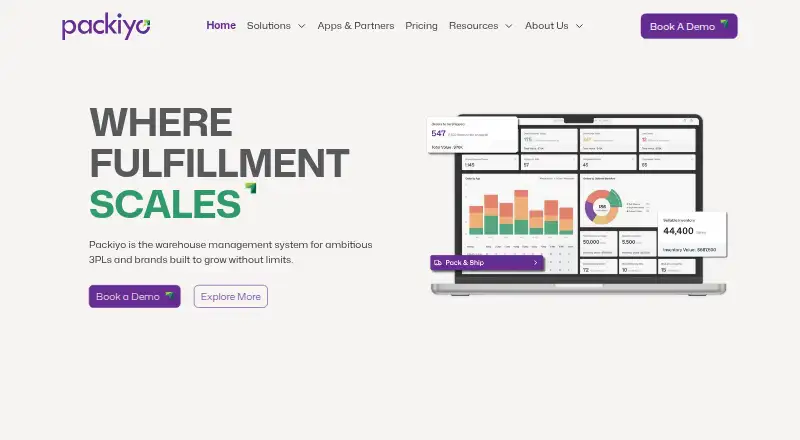
Packiyo WMS is a warehouse management system for third-party logistics providers and ecommerce brands. It tracks inventory across locations, bins, and clients, with real-time visibility, lot and batch tracking, expiration management, and low-stock alerts. Order workflows cover syncing, prioritization, split shipments, partial fulfillment, backorders, batch picking, and barcode validation. Shipping tools include carrier integrations, rate shopping, label generation, tracking updates, and separate carrier accounts for 3PL clients. Multi-client inventory, role-based client portals, automated billing, and client-specific workflows address 3PL operations. Dashboards and reports cover fulfillment performance, shipping spend, inventory velocity, and productivity, while configurable rules and workflows support automation. The iOS and Android app supports inventory, picking, packing, and shipping tasks. Packiyo lists integrations including Adobe Commerce, AfterShip, Amazon, Amazon Shipping, BigCommerce, Bring, Canada Post, and Celigo, as well as an open API. Its 3PL plan costs $949 a month, billed monthly, for five users and up to 5,000 monthly shipments. The product is also available on macOS, Windows, and the web.
Good
- Inventory tracking includes lots, batches, and expiration management
- Supports batch picking and barcode validation
- Multi-client tools include portals and billing automation
- Mobile app supports inventory, picking, packing, and shipping
- Open API and named integrations
Watch out
- 3PL plan costs $949 a month
- No free plan
Who it suits
Packiyo WMS suits 3PL providers and ecommerce brands managing inventory and fulfillment workflows. Its multi-client tools are relevant to 3PLs that need client portals, billing, and configurable workflows.
Verdict
Packiyo WMS combines inventory, order, shipping, and client-management tools for warehouse operations. Its listed 3PL plan has a monthly charge and specified user and shipment limits.
Plans and prices
From Packiyo WMS's own pricing page, checked 14 Oct 2026.
| Plan | Price | What it gives you |
|---|---|---|
| Brand Plan | $599 a month | starting per month |
| 3PL | $949 a month | 5 users · up to 5,000 shipments/month · multi-client inventory and orders · 3PL billing · configurable workflows · multi-warehouse routing · open API · branded client dashboards · per month |
| Enterprise | Priced on request | Advanced multi-client and multi-warehouse operations · dedicated account management · priority support · direct support channel · performance reviews |
| Starter | Priced on request | Core inventory and order management · picking, bulk ship and single-order workflows · Packiyo Wallet live rate shopping · real-time visibility · hands-on onboarding |
The facts
Each one read from Packiyo WMS's own pages, with the date it was checked.
What it does
- 3PL operations
- The platform supports multi-client inventory segmentation, per-client carrier accounts, 3PL billing automation and role-based client portals.checked 14 Oct 2026
- 3PL tools
- 3PL capabilities include multi-client inventory, client portals with role-based permissions, native billing automation, and configurable workflows by client.checked 30 Sep 2026
- API
- Packiyo advertises an open API and links to public developer documentation at developers.packiyo.com.checked 14 Oct 2026
- Automation
- Users can configure role permissions, custom workflow logic, service-level settings, billing rules and API-connected automations.checked 14 Oct 2026
- Capterra pricing snapshot
- Capterra lists For Brands at $1,200 per month, 3PL Startup at $850 per month and 3PL Scale at $1,300 per month, with unlimited orders, SKUs or automations on the displayed plans.checked 14 Oct 2026
- Carrier optimization
- Shipping supports multi-carrier connections, service-level rules, per-client carrier accounts, label generation and automated tracking updates.checked 14 Oct 2026
- Data handling
- Packiyo says it does not sell personal information and acts as a processor for client-uploaded platform data.checked 14 Oct 2026
- Documentation
- Packiyo provides a public help center with articles covering product use and integrations, while a Trustpilot reviewer said the knowledge base lacked articles for some basic questions.checked 14 Oct 2026
- Integration controls
- Help documentation says connection activity is logged, access tokens are not shown in logs, and scheduled syncs are limited to once per minute per app and action.checked 14 Oct 2026
- Integrations
- The integration directory lists Adobe Commerce, Aftership, Amazon, Amazon Shipping, BigCommerce, Bring, Canada Post, Celigo and other carrier, marketplace, ERP and warehouse tools.checked 14 Oct 2026
- Inventory
- Inventory functions include real-time multi-location and bin tracking, returns, lot and batch tracking, expiration controls, low-stock alerts and movement history.checked 14 Oct 2026
- Legal entity
- Packiyo’s privacy policy names Packiyo Holdings Inc. as the company operating the service.checked 14 Oct 2026
- Limit: documentation and integrations
- Another Trustpilot reviewer said some integrations were missing and the knowledge base needed substantial updating, although support responded quickly.checked 14 Oct 2026
- Limit: limited G2 evidence
- G2 says Packiyo has too few reviews on its profile to provide buying insight.checked 14 Oct 2026
- Limit: Trustpilot workflow gaps
- One Trustpilot reviewer reported many manual steps, bugs, limited flexibility and an interface that did not solve several 3PL problems.checked 14 Oct 2026
- Notable news
- Packiyo published a June 23, 2026 article describing a refreshed cloud WMS aimed at 3PLs and eCommerce brands.checked 14 Oct 2026
- Onboarding
- Packiyo describes its implementation as hands-on, covering workflow configuration, integration setup, billing rules for 3PLs, automation configuration, and operator training.checked 30 Sep 2026
Where it runs
- Android app listing
- Google Play shows Packiyo rated for Everyone, with 100+ downloads and an update dated March 25, 2026.checked 14 Oct 2026
- iOS app capabilities
- The iOS listing describes browser-based warehouse management, device picking, store integrations, tracking notifications, automation rules and barcode workflows.checked 14 Oct 2026
- iOS app listing
- Apple lists Packiyo as free, rated 5.0 out of 5 from 5 ratings, requiring iOS/iPadOS 15 or later.checked 14 Oct 2026
- Mobile app
- The Google Play listing describes a warehouse-worker app for picking orders, inventory management and shipping, with Socket Mobile scanner integration on Android and iOS.checked 14 Oct 2026
The company
- Company background
- Packiyo says it began as an internal solution after its founder encountered software limitations while running a 3PL.checked 30 Sep 2026
- Company facts
- LinkedIn identifies Packiyo as privately held, founded in 2021, headquartered in San Francisco and employing 11–50 people.checked 14 Oct 2026
- Headquarters
- San Francisco Bay Area, United Stateschecked 28 Sep 2026
The full review of Packiyo WMS
Packiyo WMS is built for third-party logistics providers and ecommerce businesses that need warehouse, fulfillment, shipping, and client operations in one system. It is the strongest fit for growing 3PLs with multiple clients and warehouses; smaller operators may find the starting commitment difficult to justify. The decisive question is whether native 3PL billing and client workflows are worth the monthly cost and shipment ceiling.
Overview
Packiyo brings inventory, orders, shipping, reporting, and 3PL administration into a shared workspace. Inventory can be viewed by location, bin, and client, with lot and batch records, expiration controls, and low-stock alerts. That combination is useful when one warehouse serves several accounts and each client needs separate visibility.
Its background as an internal system created by a 3PL operator is reflected in the client-oriented design. Ecommerce brands can use the fulfillment functions, but the platform makes most sense when warehouse work, client service, and billing must be coordinated rather than handled in separate tools.
Key features
Inventory and order control
Order syncing, priority handling, split shipments, partial fulfillment, and backorder management cover the exceptions that can disrupt routine picking. Batch picking and barcode validation give teams a defined way to organize and check work. Inventory safeguards include expiration management, lot and batch tracking, and low-stock alerts. Batch is the stated picking method, so operations built around other picking approaches should verify suitability before committing.
Shipping and fulfillment
Multi-carrier connections, live rate shopping, label creation, and automated tracking updates keep shipping activity in the same workflow as order processing. 3PLs can assign carrier accounts per client, which is important when customers have their own negotiated services or billing arrangements. Multi-warehouse routing extends the system beyond a single facility.
3PL management, reporting, and automation
Client portals with role-based permissions provide account-specific access, while configurable workflows let a 3PL vary processing by customer. Native billing automation can reduce manual charge preparation. Dashboards and reports cover fulfillment performance, shipping spend, inventory velocity, and productivity, and configurable rules support repeatable automation. An open API and integrations including Adobe Commerce, AfterShip, Amazon, Amazon Shipping, BigCommerce, Bring, Canada Post, and Celigo make it more practical for businesses with an existing commerce stack.
Mobile and implementation
The iOS and Android app supports inventory, picking, packing, and shipping on phones and tablets. That guided implementation should help complex operations, although it also signals that deployment is a project rather than a quick self-serve setup.
Pricing
3PL
The 3PL plan costs $949 a month, billed monthly, for five users and up to 5,000 shipments per month. It includes multi-client inventory and order visibility, native 3PL billing and client management, configurable client workflows, multi-warehouse routing, rate shopping, an open API, and branded client dashboards. This is the clearest fit for a 3PL that can stay within the user and shipment allowances and needs those capabilities together. The five-user limit may require careful role allocation, while the 5,000-shipment ceiling matters to higher-volume operators.
Starter
Starter uses custom pricing. It is the more natural entry point for a smaller operation that does not need the full multi-client billing and routing package, but the absence of a published price makes budgeting harder.
Enterprise
Enterprise also uses custom pricing and adds advanced multi-client and multi-warehouse operations, dedicated account management, priority support, a direct support channel, faster response times, and ongoing performance reviews and optimization. It targets organizations whose scale or support requirements exceed the 3PL package.
Platforms
Packiyo supports Android, iOS, macOS, Windows, web access, and an API. The mobile app covers warehouse tasks, while the API and broad platform coverage support connected operations across office and facility devices.
Who it's for
Choose Packiyo when you run a 3PL or a complex ecommerce fulfillment operation that needs client-level inventory, billing, permissions, carrier handling, and warehouse routing in one platform. It is less compelling for a small warehouse with modest volume, few users, or no need for 3PL administration, particularly if the 3PL plan's shipment allowance and monthly fee do not align with demand.
Pros and cons
- Pro: Multi-client inventory, portals, role permissions, billing automation, and client-specific workflows address core 3PL administration without separate systems.
- Pro: Lot, batch, and expiration controls plus low-stock alerts support tighter inventory accountability.
- Pro: Rate shopping, labels, tracking updates, and per-client carrier accounts consolidate shipping work.
- Con: The 3PL entry plan is 949.00 USD monthly and limited to five users and 5,000 shipments.
- Con: Starter and Enterprise pricing is custom, which limits upfront cost comparison.
- Con: Batch is the only stated picking method, potentially limiting teams that require alternative methods.
- Con: The privacy policy acknowledges that electronic transmission and storage can never be completely secure.
Alternatives
For a usage-based starting point, Tremo has a free plan covering 100 completed pick lists per month, then charges €0.26 per additional pick list; choose it when that model better matches small or variable volume. CoreIMS is the better comparison if a 15-day free trial and a secure sample-data environment are priorities.
EasyEcom 3PL suits teams evaluating user, SKU, and warehouse allowances across Starter and Growth plans. Infoplus 3PL WMS is another paid WMS option with Android, iOS, web, and API access. Storely is worth considering when warehouse and client capacity are added through separate monthly add-ons. Binsy offers a quoted subscription based on warehouse count and monthly order volume. Brilliant WMS provides SaaS and on-premise choices, including a free trial. Camelot 3PLink BMS is a paid web and Windows alternative with pricing supplied by the vendor.
For broader category comparisons, browse Third-Party Logistics Software and Warehouse Management Software.
Verdict
Packiyo WMS is a strong recommendation for 3PLs that need multi-client inventory, native billing, configurable workflows, and integrated shipping across warehouses. Its main reason to choose it is the depth of client-aware operations in one system. Look elsewhere if your team is small, shipment volume is low, you need a lower-cost or usage-based plan, or your picking process requires methods beyond batch picking.
Alternatives to Packiyo WMS
- 1

Extensiv 3PL Warehouse Manager
AndroidiOSWebAPI7.6From $500 a month - 2

CoreIMS
AndroidiOSWebAPI7.5From $80 a month - 3
Tremo
Free planiOSWebAPImacOS7.3From €329 a month - 4

Logiware
AndroidiOSWebAPI7.0 - 5
Storely
AndroidiOSWebAPI6.8From $49 a month - 6
PrepShipHub
AndroidiOSWebAPI6.7From $39 a month