ShipBob
ShipBob combines fulfillment services with software for ecommerce businesses.
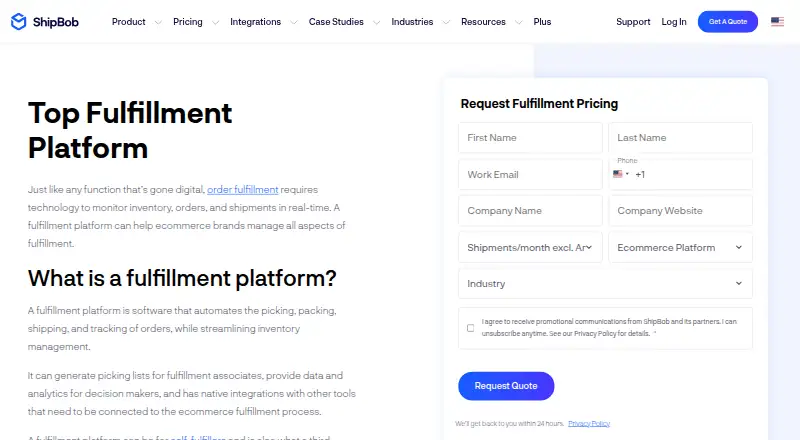
What ShipBob is
ShipBob combines fulfillment services with software for ecommerce businesses. Its workflows cover order picking, packing, shipping, tracking and inventory management, with support for order routing, multiple warehouses, shipment handoff and returns. Inventory tools include bundling items, merging duplicates, real-time stock levels, distribution data and reorder notifications. Analytics provide order and inventory visibility, fulfillment performance and SLA data, transit-time breakdowns and demand forecasts. The platform names Shopify, WooCommerce, BigCommerce, Squarespace, Amazon and Walmart among its native ecommerce integrations; its partner directory also includes Loop Returns, AfterShip, Gorgias and NetSuite. Fulfillment centers operate across the United States, Canada, the EU, the UK and Australia, and named carrier partners include UPS, USPS, FedEx and DHL. ShipBob’s software is free for ShipBob customers. Fulfillment services require a customized quote, and kitting or other unique requirements may add costs. ShipBob was founded in 2014 and is headquartered in Chicago, Illinois.
Good
- Inventory tools include real-time stock levels and reorder notifications.
- Analytics include transit-time breakdowns and demand forecasts.
- Supports multiple warehouses and order routing.
- Offers returns management and wholesale fulfillment.
Watch out
- Fulfillment services require a customized quote.
- Kitting or unique requirements may cost extra.
- Fulfillment orders are processed by a location-specific outbound SLA.
Who it suits
ShipBob is intended for small and mid-size businesses, including direct-to-consumer ecommerce brands. Its channel and warehouse support may suit businesses managing orders across multiple sales routes or locations.
Verdict
ShipBob brings inventory, order and fulfillment workflows together for ecommerce operations. The software is free for ShipBob customers, while fulfillment services are quoted individually and some requirements may cost extra.
Plans and prices
From ShipBob's own pricing page, checked 9 Oct 2026.
| Plan | Price | What it gives you |
|---|---|---|
| ShipBob software | Free | Available to ShipBob customers; connects ecommerce stores and manages inventory, orders, and shipments · Completely free for all customers. |
| Outsourced order fulfillment | Priced on request | Implementation · receiving · warehousing · picking, packing and shipping · returns charged per returned shipment · kitting available at extra cost · Custom quote from a fulfillment expert |
| ShipBob fulfillment services | Priced on request | Implementation · inventory receiving · warehousing · picking, packing, and shipping · additional services may cost extra · Custom quote; all quotes are customized for each customer. |
The facts
Each one read from ShipBob's own pages, with the date it was checked.
What it does
- Accuracy controls
- Merchants can upload product photos, define packaging preferences and use digital pick-and-pack verification steps to reduce fulfillment errors.checked 15 Oct 2026
- Analytics
- The platform exposes fulfillment performance, SLA visibility, order status, inventory counts, transit times and demand-forecasting tools.checked 15 Oct 2026
- API access and sandbox
- API use requires an account; accounts remain free until physical inventory arrives, the trial does not expire, and a free sandbox is available for simulated data flows.checked 15 Oct 2026
- API documentation
- The developer portal provides quickstart guidance, an API reference, versioned documentation, downloadable OpenAPI specifications and developer-support email with a one-business-day first-response target.checked 15 Oct 2026
- API extensibility
- ShipBob publishes release notes covering new endpoints, webhooks, sandbox simulations and an MCP server with tools for orders, products, inventory and channels.checked 15 Oct 2026
- Carrier relationships
- The company says it works with UPS, USPS, FedEx and DHL and passes volume-based shipping savings to customers.checked 15 Oct 2026
- Custom pricing
- Fulfillment quotes are customized, and kitting or other unique requirements may carry additional costs.checked 9 Oct 2026
- Founders
- Crunchbase identifies Dhruv Saxena, Divey Gulati, George Wojciechowski and Jivko Bojinov as founders.checked 15 Oct 2026
- Fulfillment network
- ShipBob says its fulfillment centers operate across the United States, Canada, the EU, the UK, and Australia.checked 9 Oct 2026
- Funding status
- Crunchbase lists ShipBob as a private Series E company with seven funding rounds and Bain Capital Ventures shown as a Series E lead investor.checked 15 Oct 2026
- Global network
- ShipBob lists fulfillment centers in the United States, Canada, the European Union, the United Kingdom and Australia.checked 15 Oct 2026
- Integrations
- Native connections include Shopify, WooCommerce, BigCommerce, Squarespace, Amazon and Walmart, with additional marketplace, ERP, EDI, returns, CRM, subscription and support integrations.checked 15 Oct 2026
- Intended customers
- ShipBob says its fulfillment services are intended to help small and mid-size businesses, including direct-to-consumer ecommerce brands.checked 9 Oct 2026
- Inventory management
- Built-in inventory tools support bundling, duplicate merging, real-time stock visibility and inventory splitting across warehouses.checked 15 Oct 2026
- Inventory tools
- Inventory features include bundling items, merging duplicates, real-time stock levels, inventory distribution data, and reorder point notifications.checked 9 Oct 2026
- Limit: carrier and claims issues
- Shopify App Store reviewers report carrier delays, lost packages, damaged goods and claims processes that can require long waits or repeated follow-up.checked 15 Oct 2026
- Limit: operational errors
- Independent reviews describe delayed receiving, misplaced or lost inventory, incorrect shipments, tracking delays and warehouse-transfer problems.checked 15 Oct 2026
- Limit: pricing complaints
- Reviewers report surprise fees, overbilling and unexpectedly high return, label and fulfillment costs despite some users finding the service budget-friendly.checked 15 Oct 2026
Where it runs
- App Store
- ShipBob says its dashboard App Store contains dozens of direct integrations and adds more based on customer feedback.checked 15 Oct 2026
The company
- Company founding and headquarters
- ShipBob was founded in 2014 and is headquartered in Chicago, Illinois.checked 15 Oct 2026
- Company legal name
- Crunchbase lists the legal name as Shipbob Inc.checked 15 Oct 2026
- Company size
- LinkedIn lists ShipBob as privately held with 501–1,000 employees.checked 15 Oct 2026
- Founded
- 2014checked 28 Sep 2026
- Headquarters
- Chicago, Illinois, United Stateschecked 28 Sep 2026
The full review of ShipBob
Overview
ShipBob pairs ecommerce fulfillment services with software for managing orders, inventory and shipments. It is best suited to small and midsize brands that want a fulfillment partner across multiple markets, rather than software to run a warehouse entirely on their own.
Its strongest case is the connection between order handling, inventory visibility and a broad fulfillment network; the trade-off is that service costs are individually quoted, and some specialized work costs extra.
Key features
ShipBob’s warehouse software processes B2C orders imported by a fulfillment center’s outbound SLA. The cutoff varies by location, from noon to 6 p.m. local time, so fulfillment timing depends on the center handling an order. Product photos, digital checks during picking and packing, and merchant packaging preferences provide practical safeguards against errors.
Inventory tools cover bundling, duplicate merging, live stock levels, distribution data and reorder-point notifications. These are useful for brands coordinating stock across locations, while order and inventory visibility, fulfillment performance and SLA data, transit-time breakdowns and demand forecasts help teams assess how inventory and shipments are moving.
ShipBob supports order routing, multiple warehouses, pick-and-pack workflows, shipment handoff, returns workflows and automation rules. Native ecommerce integrations include Shopify, WooCommerce, BigCommerce, Squarespace, Amazon and Walmart. Its partner directory includes Loop Returns, AfterShip, Gorgias, NetSuite, Shopify and BigCommerce.
The fulfillment network spans the United States, Canada, the EU, the UK and Australia. Carrier partnerships include UPS, USPS, FedEx and DHL, with bulk discounts passed to customers. Returns management is available, and the service can handle EDI-compliant and larger wholesale or B2B orders for an additional cost. ShipBob also lists SOC 2 and ISO 27001:2022 compliance in its Trust Center.
Pricing
ShipBob software: free, billed completely free for all customers. It is available to ShipBob customers and connects ecommerce stores to manage inventory, orders and shipments. This makes the software a no-cost part of using ShipBob, not a standalone free warehouse system for businesses that use another fulfillment provider.
ShipBob fulfillment services: custom quote. The quote covers implementation, inventory receiving, warehousing, picking, packing and shipping. Kitting and other unique requirements may add cost; returns and larger B2B or wholesale orders also carry additional cost. Because quotes are customized, businesses should evaluate the full service scope against their own operating needs.
Platforms
ShipBob offers web and API access. Its workflow spans ecommerce sales channels including DTC stores, B2B, EDI, retail distribution and dropshipping, online marketplaces, wholesale and Amazon FBA.
Who it's for
ShipBob is a good fit for direct-to-consumer and other small or midsize ecommerce businesses that want outsourced storage and fulfillment alongside inventory and order software. Its multi-warehouse support and international network are particularly relevant to businesses distributing stock across regions.
It is a weaker fit for merchants seeking a standalone warehouse management system, a predictable public fulfillment price, or specialized services without additional charges. Its order-processing cutoff also varies with the assigned fulfillment center.
Pros and cons
- Pro: Inventory, order and shipment workflows sit alongside fulfillment, helping merchants manage operations through one provider.
- Pro: Multiple warehouses, a network across five major regions and carrier partnerships support businesses shipping across markets.
- Pro: Picking and packing checks, packaging preferences, live stock levels and reorder alerts address concrete accuracy and inventory needs.
- Con: The software is free only for ShipBob customers, so it is not a free option for businesses that want to keep fulfillment elsewhere.
- Con: Customized quotes and extra charges for kitting or larger B2B work make total service cost less predictable.
- Con: The outbound cutoff varies by location, which can affect when orders enter fulfillment.
Alternatives
Order Fulfillment Software is a useful category comparison for businesses weighing fulfillment platforms more broadly. For warehouse-focused options, compare the Warehouse Management Software category.
OpenBoxes is worth considering when self-managed hosting and unlimited users matter more than ShipBob’s fulfillment service: its Community Self-Hosted plan is free, with storage on your server and no minimum term.
Sentry WMS is a free, open-source self-hosted alternative for businesses that prefer to run the system themselves. The separate Sentry WMS listing likewise describes a free, self-hosted option, without first-party ERP or commerce connectors yet.
Vinculum Vin OMS is another paid web and API option, with pricing available by demo request rather than a public price.
Cin7 Omni may suit teams comparing paid inventory software with defined plans: its Omni plan includes eight users, five ecommerce and app integrations, and unlimited inventory locations. The listing also gives Standard pricing of $349 a month.
Descartes Sellercloud is a paid alternative with an annual subscription based on order volume and add-ons; its listed subscription is $1,349 a year.
fulfillmenttools is another paid platform to consider if a free trial is important; it offers a trial and positions its platform for enterprise use.
Orders Now is a free web-based alternative.
Verdict
Choose ShipBob if your ecommerce business wants fulfillment services and inventory, order and shipment workflows from the same provider, especially across multiple warehouses and regions. Look elsewhere if you need standalone software or a predictable public price: ShipBob’s free software is tied to being a customer, while fulfillment is custom-quoted and some requirements cost extra.
Getting started
- Visit ShipBob’s fulfillment platform website.
- Connect an ecommerce store using the ShipBob software.
- Use the software if you are a ShipBob customer; it is free for customers.
- Request a customized quote for fulfillment services.
- Discuss any kitting or other unique requirements as part of the quote.
Limits worth knowing
ShipBob software is free only for ShipBob customers. Fulfillment services require a customized quote, and additional services may cost extra.
Questions
How much does ShipBob cost?
ShipBob software is free for ShipBob customers. Fulfillment services require a custom quote, and additional services may cost extra.
Is there a free plan?
ShipBob software is completely free for customers. It connects ecommerce stores and manages inventory, orders, and shipments.
What platforms does ShipBob support?
The listed platforms are web and API.
Which ecommerce platforms integrate natively?
Named native integrations include Shopify, WooCommerce, BigCommerce, Squarespace, Amazon, and Walmart.
Where does ShipBob operate fulfillment centers?
ShipBob says its centers operate across the United States, Canada, the EU, the UK, and Australia.
When was ShipBob founded, and where is it headquartered?
ShipBob was founded in 2014 and is headquartered in Chicago, Illinois, United States.
Alternatives to ShipBob
- 1

OpenBoxes
Free planOpen sourceAndroidiOSWebAPI8.6From $24 a month - 2

Clougistic
AndroidiOSWebAPI7.6From $199 a month - 3

Extensiv 3PL Warehouse Manager
AndroidiOSWebAPI7.6From $500 a month - 4

Sentry WMS
Free planOpen sourceAndroidWebAPILinux7.6Free plan - 5

Sentry WMS
Free planOpen sourceAndroidWebAPISelf-hosted7.5Free plan - 6

Packiyo WMS
AndroidiOSWebAPI7.4From $599 a month